Garden Hose and Nozzle Hanger
Created 1 months ago
Description
What it's for
A wall-mounted storage bracket designed to hold a standard 15-meter garden hose outdoors. It features a wide saddle for the main coil and an integrated upper bracket with a U-slot to suspend a spray nozzle securely, keeping it off the ground and out of the dirt.
Dimensions
- Main Hanger: 200mm wide, extending 120mm from the wall to support bulky hose coils.
- Overall Height: 260mm tall backplate.
- Mounting: Three vertically aligned countersunk holes (12mm head clearance, 6.5mm shaft).
- Nozzle Slot: 28mm wide U-shaped cutout positioned 70mm above the main hanger.
Remix ideas
- Modify the nozzle slot diameter to fit specific quick-connect fittings or larger spray guns.
- Adjust the mounting hole spacing to align with specific mortar joints or siding panels.
- Extend the main shelf depth and retaining lip height to accommodate a 30-meter hose.
Images
More like this
Explore more in Storage & Organization →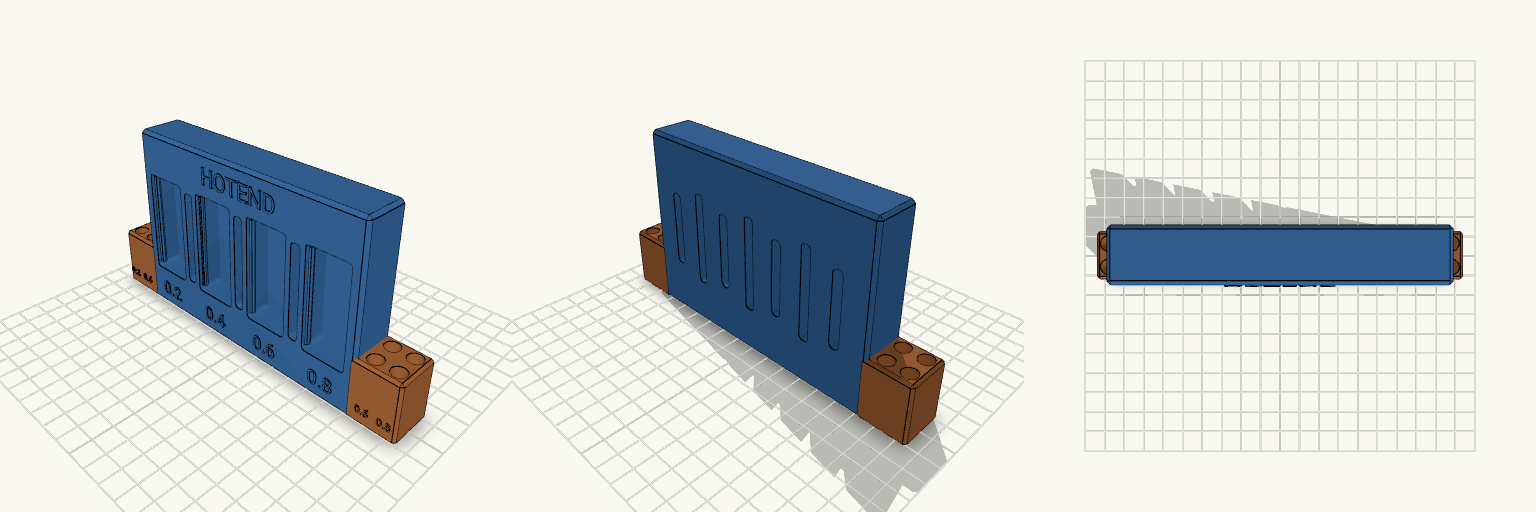
4-Hotend 8-Nozzle Holder for Elegoo Centauri 2
A storage holder for Elegoo Centauri 2 hotends and nozzles. The main block has four front-opening hotend pockets on a 32 mm pitch, each with snap-in retention ridges at the opening so a hotend snaps past and stays put. Four rounded-end magnet slots in the back face take press-fit magnets. Nozzles sit in two holders fused to the ends of the block, four 7.2 mm wells each in a 2 x 2 grid, labelled 0.2/0.4 on one side and 0.6/0.8 on the other. Each holder overlaps its block end by 3 mm, so the whole holder is one solid piece rather than separate clip-on parts, and the wells are shifted outward to sit clear of the block face. The front face is marked HOTEND above the pockets. Lightening slots through the dividers cut material use and print time. Specifications Overall footprint: approximately 170 x 22.8 x 90 mm including the fused side nozzle holders; the hotend block alone is 128 x 22.8 x 90 mm Hotends: 4 front-opening pockets, each 22 x 13 mm and 50 mm tall; check the pocket size against your actual hotend dimensions Retention: two rounded ridges at each pocket opening narrow it to roughly 18.6 mm, so a hotend around 20 mm wide snaps past and stays put Nozzles: 8 wells total, four per side holder in a 2 x 2 grid, 7.2 mm diameter x 14 mm deep Side nozzle holders: each about 24 x 22.8 x 30 mm, protruding roughly 21 mm past each end of the block with a 3 mm overlap; wells sit about 1.5 mm clear of the block face Labelling: 0.2 and 0.4 on one holder, 0.6 and 0.8 on the other, each label covering the two wells behind it; holder lettering is 3.5 mm tall Magnet slots: 4 stadium-shaped slots in the back face, 5.2 x 37 mm and 4 mm deep, for 5 x 37 x 4 mm rounded-end magnets, one centred in each column Text: HOTEND embossed 8 mm tall above the pockets, 0.8 mm proud; size numbers on the main block are 7 mm tall Lightening: 5 mm wide x 46 mm tall slots through the three dividers between columns, front to back Column pitch: 32 mm
Bass Tackle Box With Hinged Lid
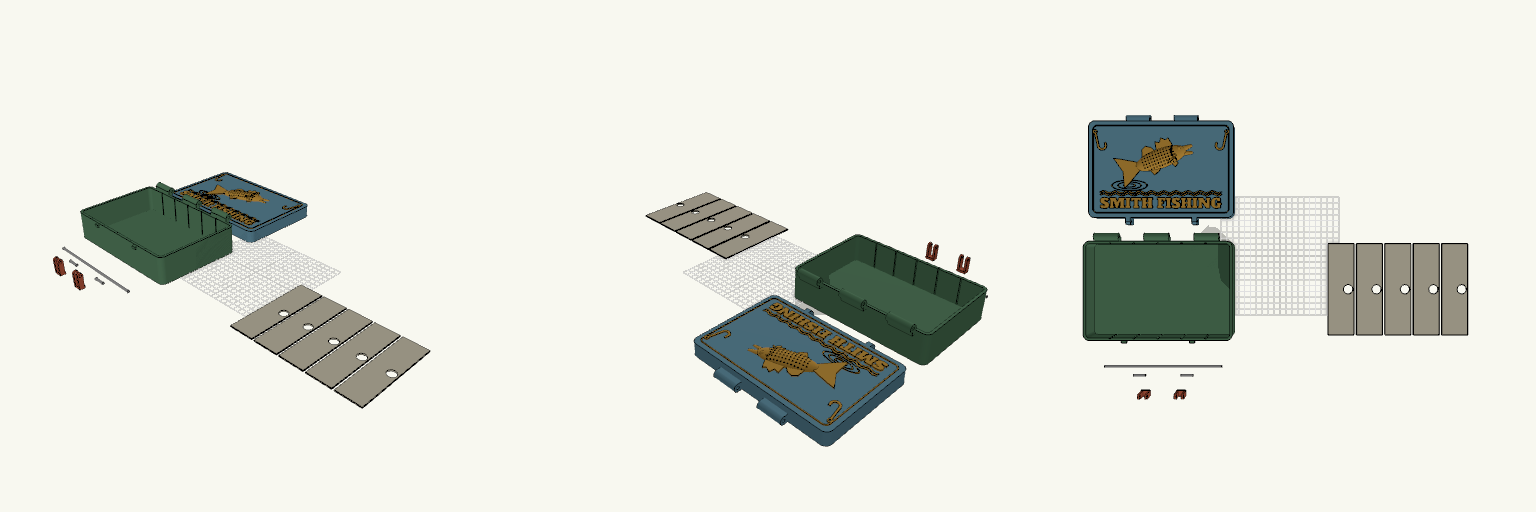
Tackle boxes that pop open in the boat, rattle hooks into the soft plastics, or lose a lid hinge get replaced. This one is a hinged bass tackle box with a locking front latch, adjustable dividers and a leaping largemouth bass on the lid, with SMITH FISHING raised underneath. Load-bearing numbers Base: 240 × 160 × 50 mm, 4 mm walls, 3 mm floor, rounded vertical corners. Lid: 240 × 160 × 22 mm, with a raised bass, ripples, waves, hooks and a border on top. Dividers: 5 removable cross dividers, 1.8 mm thick, sliding in 2.4 mm grooves at 38.5 mm spacing. Hinge: 5 interleaved knuckles across the back, joined by a 4.2 mm pin (197 mm long, printed separately). Latches: 2 front latches with 4.2 mm pivot pins. Each hooks under a ledge on the base. Printing Print every piece in the layout shown: base, lid, dividers, latches and pins are all separate. Lid: print upright. The underside of the top plate bridges across the cavity, so use supports or good bridging settings. Layer height 0.2 mm, PETG or ASA, 3+ perimeters. Hinge and latch pins can be glued or capped at the ends to keep them in.
Exploding Kittens Drawer Card Case
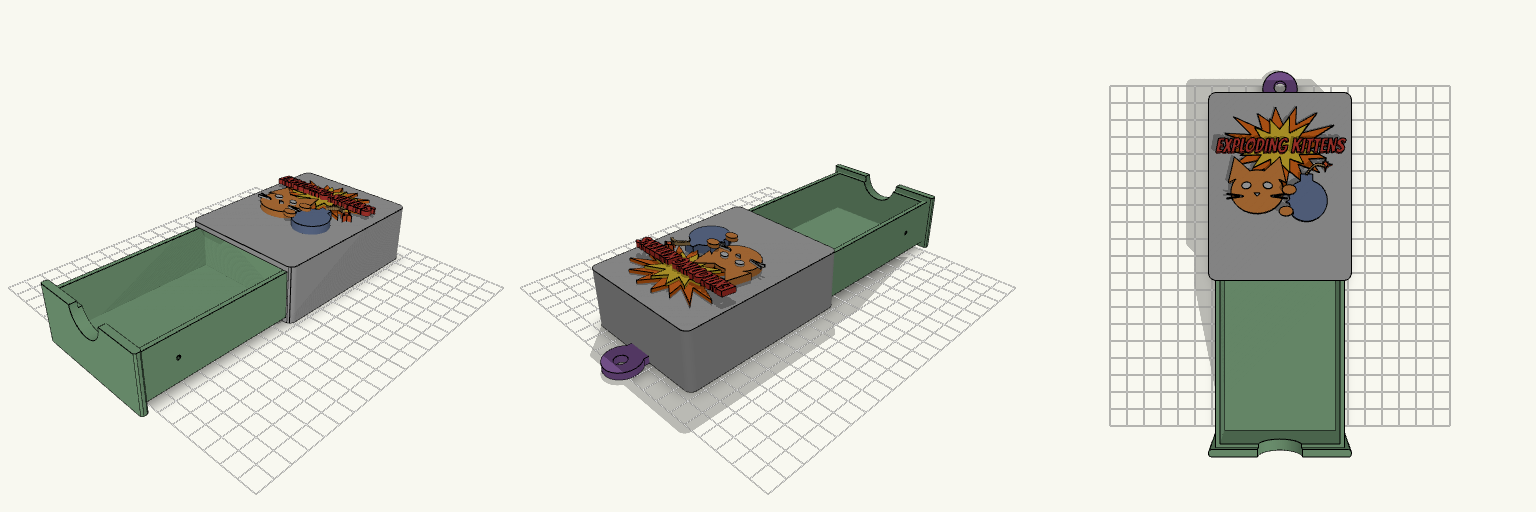
What it's for A two-part slide-out card case sized for a single poker-size deck, with the Exploding Kittens artwork carried on the top of the sleeve. The relief shows an angry cat beside a round bomb, bite marks cut into the bomb's edge, a dotted fuse and a spark. A large jagged orange explosion with an uneven outline and a smaller yellow core sits flat on the lid, centred on the title. Because the blast is fused to the surface rather than floating above it, the cat and bomb rise through it, so the explosion reads as a backdrop behind them and both stay clearly visible. The red "EXPLODING KITTENS" lettering stands on the core, kept low so it rises only about 3 mm above the blast. The drawer has a front pull panel with a thumb notch and slides out of the sleeve; a small snap detent on each side wall clicks it shut and lets go with a firm pull. A fused keychain loop on the back of the sleeve lets the case clip to a bag with a carabiner or split ring. Dimensions Sleeve: 76 × 100 × 34 mm, open at the front Drawer: 76 × 99 × 34 mm, with a front pull panel and thumb notch Card well: one compartment, about 64.6 × 91.5 mm, sized for a 63.5 × 89 mm deck Explosion: 57.8 × 44.8 mm blast, 2 mm thick, fused to the lid; core 42.2 × 29.2 × 1.5 mm on top of it Title lettering: 68 × 8 mm, standing on the core about 3 mm above the blast Bomb relief: 5 mm tall, with the paws and fuse lowered to sit level on top of it Keychain loop: 20 mm round lug, 4 mm thick, with a 7 mm hole, fused to the back of the sleeve and reaching about 70 mm out on Y Detents: one small bump per sleeve wall, with matching dimples on the drawer sides Print notes Print the sleeve upside down or with supports under the top, since the ceiling spans the full width. Print the drawer flat on its floor. The keychain lug sits flat on the build plate and needs no supports, but at 4 mm thick it is the lightest part of the case — thicken it if the case will hang from a heavy bag. The enlarged loop pushes the footprint out to roughly 70 mm on Y beyond the sleeve; check it against your plate before starting a full-bed print. Drawer clearance is 0.3 mm per side; adjust if the drawer binds. Sleeved cards need roughly 2 mm more in both the width and length of the well. The lowered red lettering sits directly on the orange and yellow blast, so contrast is low at small scales; check a render before printing the lid art very small. Detent tension has not been test-printed; sand or adjust the bumps if the drawer is too stiff or too loose. Remix ideas Widen the card well for a sleeved or double-sleeved deck. Burst the explosion over the top of the cat and bomb instead of behind them, accepting that it would hide most of the cat. Swap the round bomb for a C4 brick. Add a divider for tokens or a rules card. Thicken the keychain lug to 6 mm and widen the hole further for heavier bags. Trade the detents for a magnetic catch if you prefer a quieter close.
Retró vadászdoboz 16-os sörétes töltényekhez
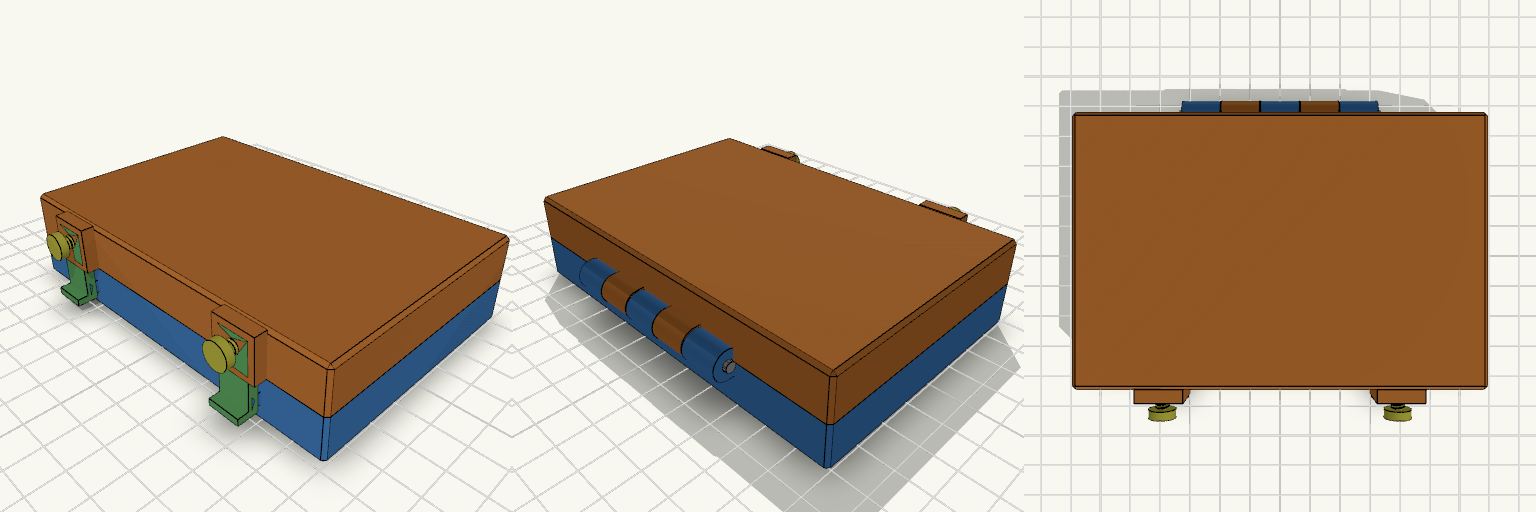
Csuklós fedelű, ötrekeszes doboz, amely úgy néz ki, mint egy régi vadászfelszerelés darabja: lapos, szögletes test, hátul csuklópánttal nyíló fedél, elöl két zárral, amelyeket kis fogóorr fog meg. Belül öt párhuzamos fészek várja a töltényeket — 21,8 mm széles vájat, 22,6 mm-es osztás, 74 mm hosszú hüvelyekhez. Csukva a doboz 120 × 90 mm-es alapterületű, kényelmesen elfér egy lőszertáskában vagy a szekrény polcán. Ami a nyomtatáshoz tartozik: Öt darab kerül a tálcára: a doboz alsó része, a fedél, a két zár, a négy zárhoz való csavar és a csuklótüske. A csukló egy külön 3 mm-es pálcából áll össze, a zárakat 4 mm-es menetes csavarok rögzítik a fedélhez — a doboz tehát összeszerelést igényel, nem egy darabban készül el. Nyomtatásnál a dobozt és a fedelet a lapos oldalukra érdemes fektetni, a zárakat, csavarokat és a tüskét külön. Illesztés: a fészek mérete becslésen alapul, ezért érdemes egy tölténnyel próbát tenni: peremes hüvelyeknél vagy a 74 mm-nél hosszabb daraboknál a vájatok szűkebbek vagy rövidebbek lehetnek a kelleténél. Egy kis reszelés a fészek falán sokat segít, és a zár csavarját se húzd túl szorosra, hogy a fedél ne feszüljön.
Low-Profile Extractor Set Tray
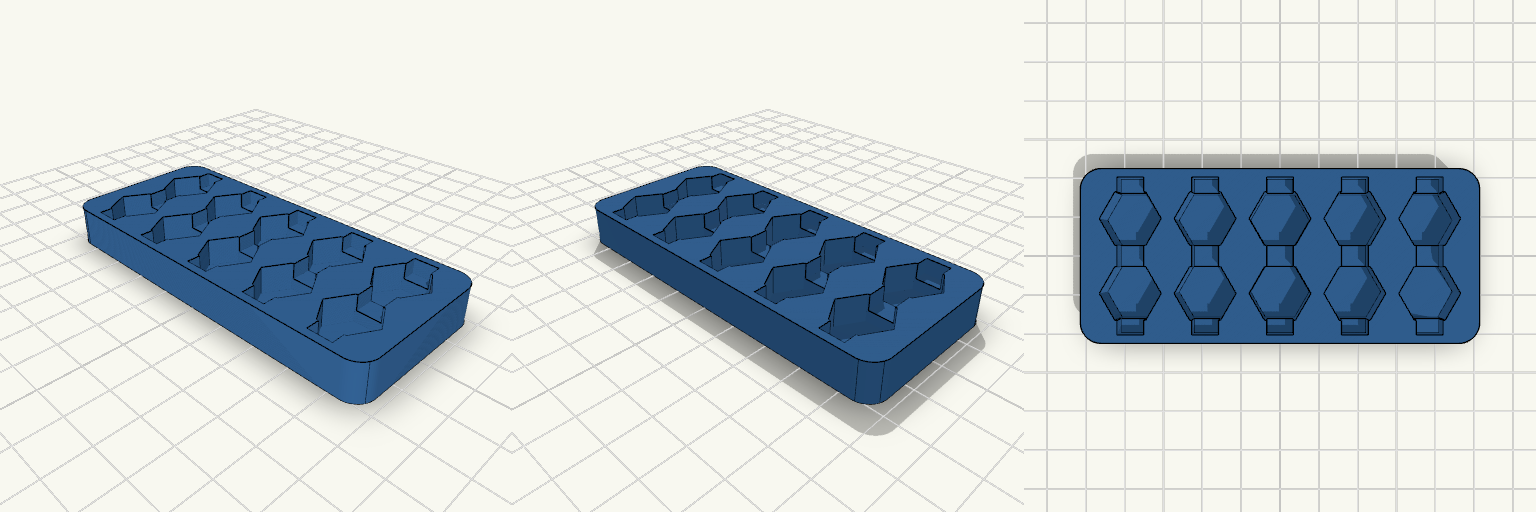
A slim, flat drop-in tray in the spirit of a toolbox foam insert, with ten hex pockets in two rows of five. Each pocket fits a thread extractor with a 12.8 mm hex base, and a finger slot across each one makes lifting them out easy. Overall size: 96 × 42 × 10 mm Pockets: 13.7 mm across flats, 7 mm deep, 3 mm solid floor Extractors stand upright, so the tall ends project above the tray Rounded vertical corners for easy fit into a case
Modulare Lochplatte mit Dorn für Filamentrollen
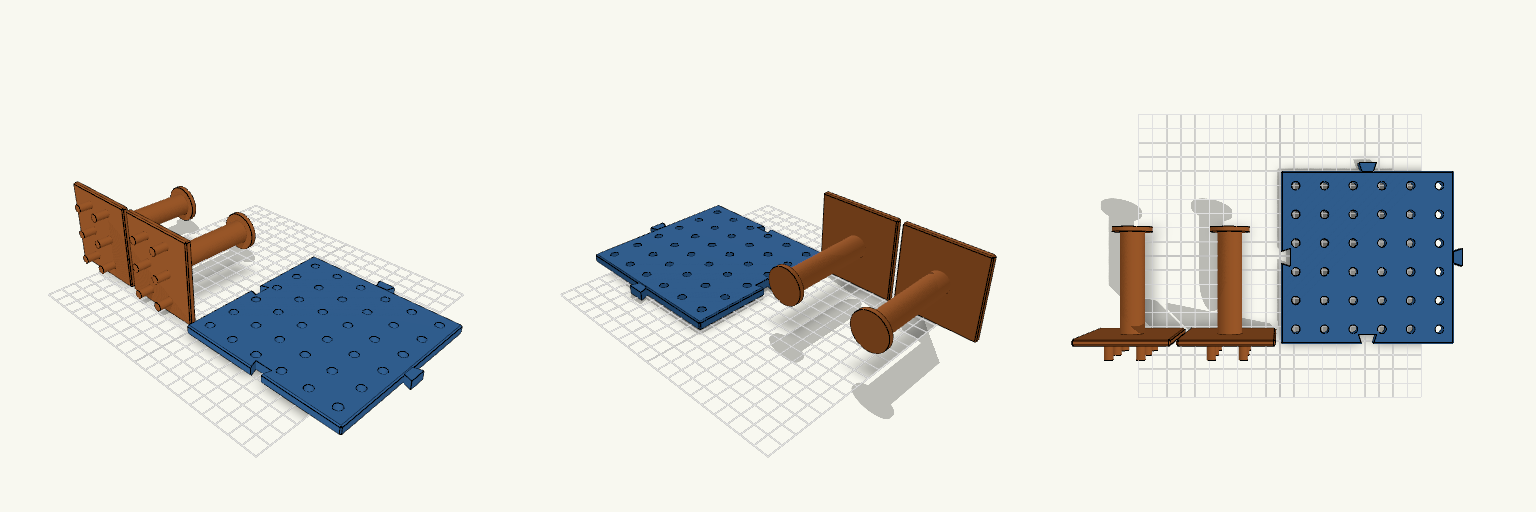
Eine modulare Lochwand aus 120 × 120 mm großen Kacheln, die sich in X- und Y-Richtung beliebig aneinanderstecken lässt: Rechts und hinten sitzen Schwalbenschwanz-Zapfen, links und vorne die passenden Nuten. Jede Kachel ist 6 mm dick und hat 6 × 6 Löcher mit 6 mm Durchmesser im 20-mm-Raster. Mit den Zapfen misst eine Kachel etwa 126 mm und passt damit auf nahezu jedes Druckbett. Dazu gehört ein Steckhalter mit Dorn, der eine Filamentrolle trägt. Auf dem Druckbett steht der Halter seitlich, links neben der Lochplatte; der Dorn zeigt nach hinten, die Stifte nach vorne. Zwischen Halter und Kachel bleiben rund 4 mm Luft, damit beim Drucken nichts verschmilzt. Der Halter hat eine 60 × 60 mm große Rückplatte mit sechs Stiften in 2 × 3 Anordnung im 20-mm-Raster; die Stifte sind 5,7 mm stark und 10 mm lang. Der Dorn sitzt mittig auf der Platte und ragt waagerecht nach hinten: 16 mm Durchmesser, 70 mm Länge, am Ende eine 26-mm-Scheibe, die die Rolle zurückhält. Übliche Rollen mit rund 50 mm Innenloch passen locker darüber. Die Rückplatte verteilt das Gewicht einer vollen Rolle auf mehrere Stifte. Kacheln und Halter werden gesteckt — die Wand wächst mit dem Bedarf, der Halter lässt sich jederzeit umsetzen. Wo ein Remix ansetzen kann Kachelmaß: Die 120 × 120 mm sind bewusst ein Vielfaches des 20-mm-Rasters — 100 mm wäre die nächste kleinere sinnvolle Stufe, 140 mm die nächste größere. Das 20-mm-Raster mit 6-mm-Löchern ist eine Wahl, keine Vorgabe; ein engeres Raster erlaubt feinere Haken. Passung der Verbinder: Das Spiel der Schwalbenschwänze liegt bei 0,25 mm. Das ist der erste Wert, den man an den eigenen Drucker anpasst — strammer für formschlüssigen Sitz, lockerer, wenn sich die Kacheln schwer fügen. Stiftfeld: Die Rückplatte ist 60 × 60 mm groß und nutzt sechs Stifte im 20-mm-Raster. Für leichtere Halter lässt sich das Feld verkleinern; für breitere Lasten kann es weiter wachsen, solange Stiftabstand und Lochraster zusammenpassen. Dorn: 16 mm Durchmesser und 70 mm Länge reichen für schmale Rollen; bei breiten Rollen mit etwa 70 mm oder mehr wird es knapp. Ein längerer Stab deckt breitere Rollen ab, schwerere brauchen eine dickere Rückplatte oder eine Stütze darunter; der Scheibendurchmesser von 26 mm lässt sich an das Innenloch der eigenen Rollen anpassen. Halterform: Derselbe Dorn lässt sich kürzen oder mit einem zweiten Dorn nebeneinander kombinieren, damit zwei Rollen auf einer Kachel Platz finden. Ausrichtung: Der Halter steht derzeit seitlich neben der Kachel, der Dorn zeigt nach hinten. Das ist eine Wahl, keine Vorgabe — die Drehung lässt sich ändern und der Halter weiter von der Kachel abrücken, ohne die Steckverbindung anzutasten. Als System gedacht: Weitere Kacheln vergrößern die Fläche, weitere Halter mit gleicher Rückplatte teilen sich die Wand — und jede Variante bleibt mit allen anderen kombinierbar, solange Raster und Stiftabstand gleich bleiben.