Liftlatch — Modular Stacking Desk Drawer
Made by HumbleMongoose
Created today
Description
Liftlatch is a modular desk storage module built from a rounded outer housing, a sliding drawer, and two bowtie joiner clips. The design language is quiet and symmetrical: thin 1.6 mm walls, soft 6 mm fillets down all four vertical corners, a flush front with a recessed finger pull, and completely flat outer side walls that stay within 82.0 mm. A single unit reads as a smooth box; a row reads as a bank of drawers, joined by clips that sit flush in dovetail slots rather than protruding rails. Units stack vertically on a 2 mm lip and matching underside pocket, and lock side-by-side with the separate clips, so the system grows from one 82 × 165 × 55 mm module without changing hardware. The housing, drawer and clips are laid out separately on the plate; the housing prints standing on its back wall with the open front facing up, which removes the wide ceiling bridge and keeps the side slots vertical for a support-free print.
Dimensions
- Module footprint: 82 × 165 × 55 mm nominal
- Housing as laid out: 82 × 57 × 165 mm, standing on its back wall with the open front facing up
- Drawer as laid out: 76 × 162.6 × 49.1 mm, flat on its base with the open top facing up
- Joiner clips: two bowtie clips, each about 35 mm long and 5.8 mm wide, lying flat in the 15 mm gap between housing and drawer
- Walls: 1.6 mm base wall, thickened locally to 2.6 mm around the side slots
- Corner radius: 6 mm on all four vertical corners of the housing, matched on the drawer front so it sits flush in the rounded opening
- Drawer clearance: 0.4 mm at the thickened slot sections; the drawer is narrowed to 76 mm, leaving about 1.4 mm of play per side elsewhere
- Stacking lip: 2 mm stepped lip on top with a matching recessed pocket underneath, both following the same 6 mm corner path
- Side joinery: flush 1.2 mm deep dovetail slots in both outer side walls, with matching bowtie clips and 0.2 mm clearance; joined units sit flush with no gap
- Catch: 2.8 mm tab on the drawer's rear top edge meets a 2.5 mm stop lip under the front ceiling, with a 4 mm gap above the drawer walls
Features
- Lift-to-remove catch: the rear tab catches the front stop so the drawer cannot fall out accidentally. Lift the front slightly to drop the tab clear of the stop and pull the drawer free; the overlap is about 1 mm, so the motion is short.
- Flush front: a 2 mm deep recessed finger slot with a 1 mm flare at its mouth, and a 1 mm chamfer around the front face perimeter, keep the face smooth to the touch and flat enough to stack.
- Symmetrical side slots: both outer walls are flat and clean, with nothing protruding. The bowtie clips slide in from the bottom of the housing to join neighbouring units flush; leave them out when a unit stands alone.
- Open back frame: a large chamfered cutout in the rear wall trims filament without weakening the structure.
- Stackable and joinable: the top lip and underside pocket align stacked units, while the flush slots and bowtie clips hold a row together side-by-side, gap-free.
Print notes
Every internal overhang is chamfered or tapered at 45° where needed — including the ledge under the front stop and the stacking lip tip — so the housing, drawer and clips print without supports, in a single colour with no multi-material setup. The housing stands on its back wall, the drawer lies flat beside it, and the two clips lie flat in the 15 mm gap, so the side slots print vertically and the wide ceiling bridge is gone. All printed elements fit a 180 × 180 mm Bambu Lab A1 mini bed with only a small margin, and the housing's 165 mm height sits close to the printer's height limit, so keep the spacing as laid out. The drawer walls are straight from front to back; the drawer is narrowed to clear the locally thickened slot walls, so check that it slides freely once inserted into the housing after printing.
Images
More like this
Explore more in Storage & Organization →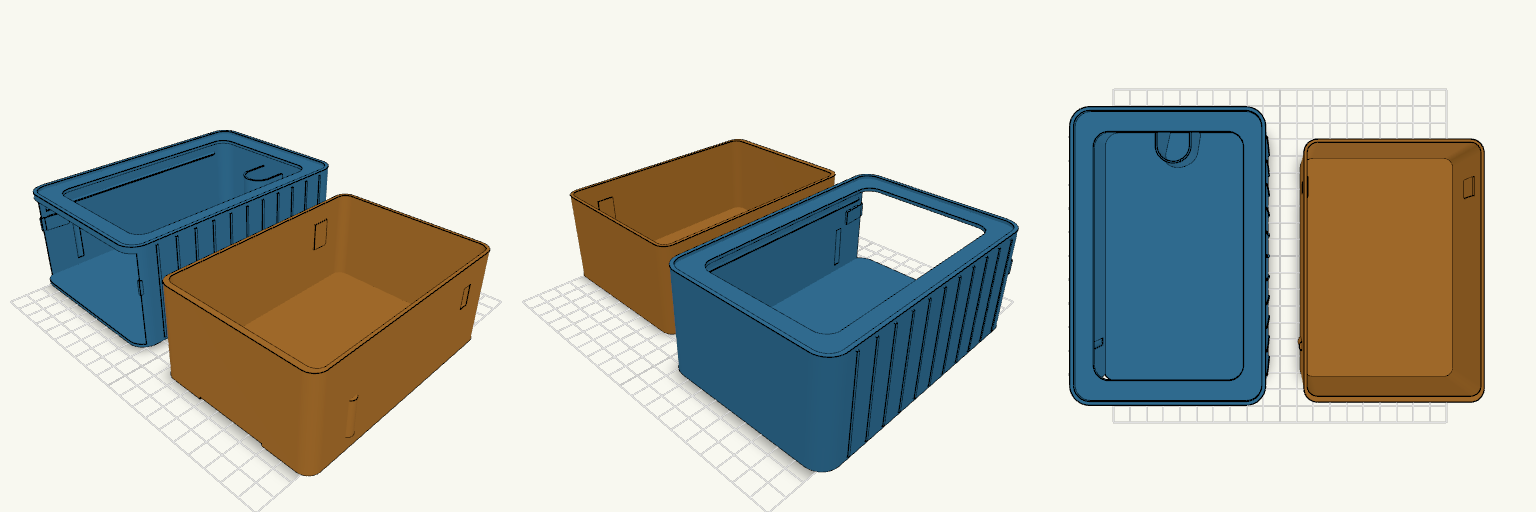
Two-Piece Sliding Storage Drawer with Spring Release
A minimalist two-piece sliding storage drawer: a ribbed outer housing with an open front and a separate inner drawer with a flush, handle-free face. The housing measures 100 × 150 × 60 mm with 10 mm rounded outer corners and 1.6 mm walls. Vertical ribbing stiffens the side walls, and thin 45° guide rails keep the drawer aligned. The guide rails and side stop tabs stay inside the outer walls, with only the ribs standing proud by design; the front ends of the rails stop inside the rounded front corners. The top is an open frame with a 12 mm solid rim, thickened to 3.4 mm so the stacking recess does not cut through. The drawer slides on the rails and locks closed with rounded snap bumps that seat into grooves in the housing. Push the drawer inward to release the bumps; the rear U-shaped leaf spring then pushes it forward. The spring is 0.95 mm thick and 40 mm wide, anchored to the inner back wall and touching the floor only where it meets that wall. A 45° chamfer under its bottom edge lifts the loop clear of the floor as it runs forward, so it flexes freely and still prints without supports — the trade-off is a shorter front loop, so the spring is on the soft side. A 45° finger bevel under the bottom front edge gives a hidden pull once the drawer has popped out. Flexible side stop tabs catch pockets near the back of the drawer, limiting travel to about 95 mm; press the tabs aside to remove the drawer fully. The stop pockets are 1.2 mm deep with 1.4 mm of solid wall behind them. The housing also stacks: a 1.5 mm bottom foot, inset 2.2 mm with a 45° chamfer, sits in a matching 1.8 mm recessed step on the top rim with 0.3 mm clearance. Housing: 100 × 150 × 60 mm, ribbed sides, open top with 12 mm rim, 10 mm rounded corners, 1.6 mm walls Drawer: 95.7 × 135 × 53.2 mm, flush front, no handle, side snap bumps Release: push-push detent with rear U-spring Pull: hidden 45° finger bevel under the front bottom edge Stop: flexible side tabs limit travel to about 95 mm; press aside for full removal Stacking: 1.5 mm bottom foot and matching 1.8 mm top recess Printing: two separate pieces, no supports, overhangs 45° or shallower Tuning: spring force and detent interference may need adjustment after a test print
Open-Top Square Box 75 × 75 × 25 mm
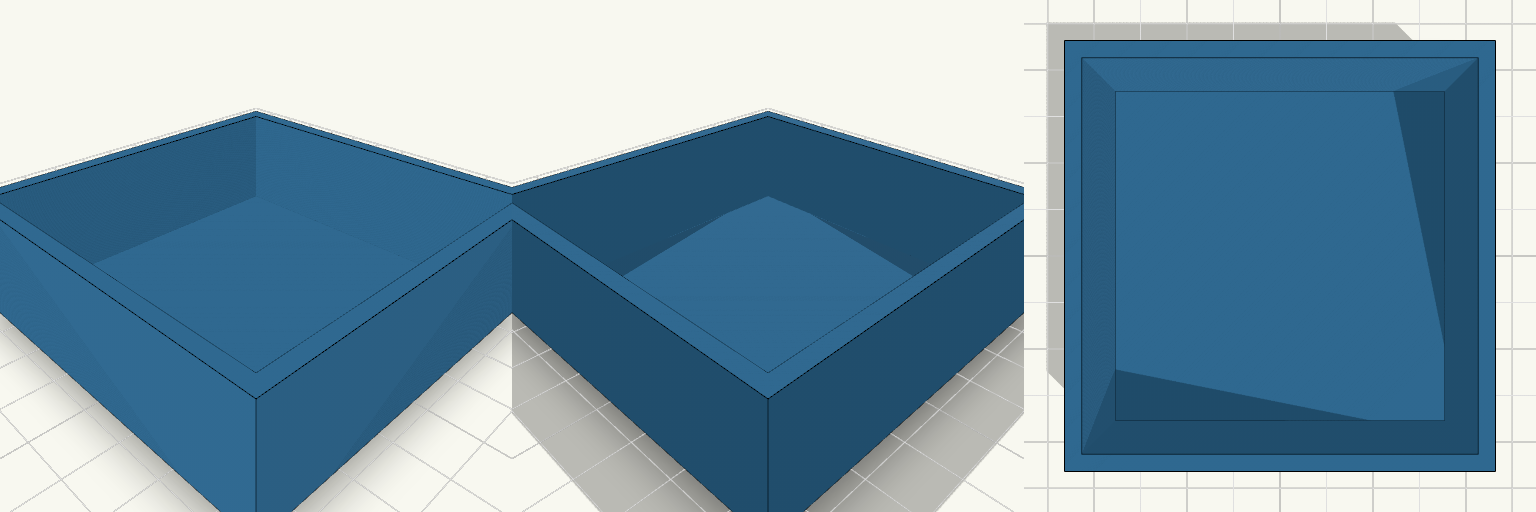
What it's for A plain open-topped square box with a closed floor, sized to hold small parts, tools, or loose odds and ends on a desk or workbench. The straight sides and flat base keep it stable on the print plate and easy to drop things into from above. Dimensions Outer footprint: 75 × 75 mm Height: 25 mm Wall thickness: 3 mm Floor thickness: 3 mm Top: fully open, no lid Print notes Prints upright as it sits, with no supports needed for the vertical walls. A 3 mm wall and floor hold up well in PLA or PETG at a standard layer height; thicker walls take a slightly wider nozzle or more perimeters comfortably. Remix ideas Add a lid or a stacking lip so several boxes can sit on top of one another. Round the outer corners for a softer look and less sharp handling. Divide the interior with a grid to sort small hardware.
Nook — Round Pencil Cup
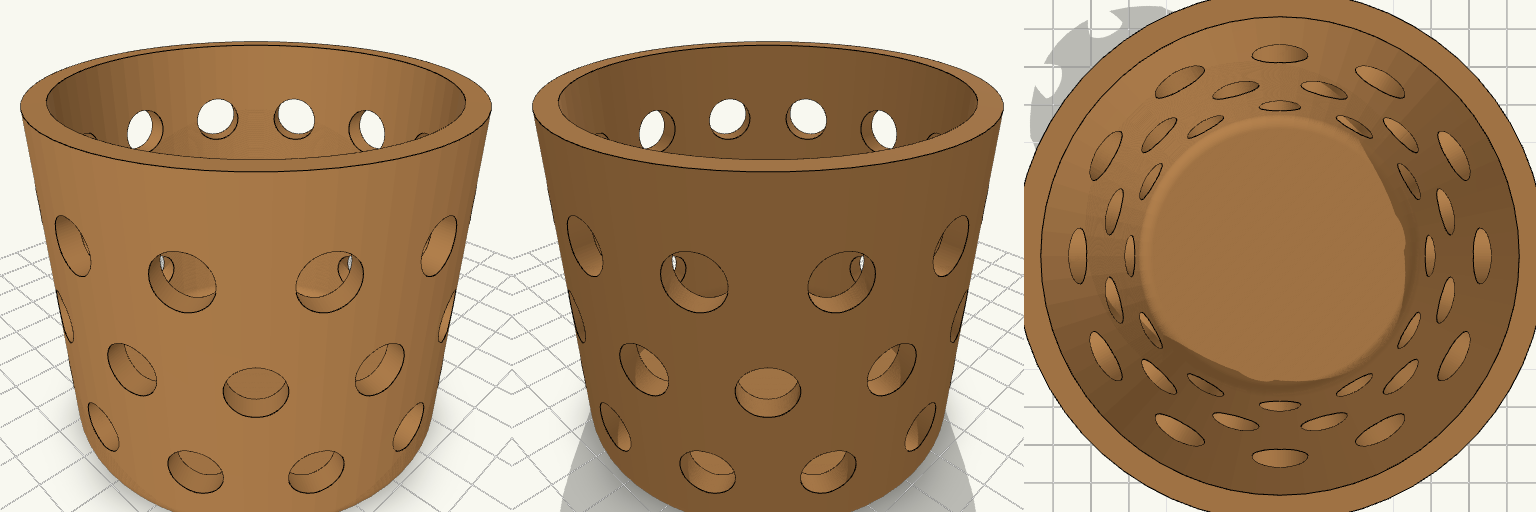
Nook is a round pencil cup sized to hold pens, pencils, markers and short rulers upright on a desk. The design keeps a clean, fully circular profile — no flat back, no corners — so it reads as a plain cylinder from every side. What sets this version apart is a wall of openings cut all the way around and up the side: three staggered rows of small round holes that let you see at a glance what's inside, let the cup breathe, and keep the barrel light. At 80 mm across and 70 mm tall it takes a full handful of writing tools while staying low enough to reach into from a seated position. Dimensions Diameter: 80 mm, fully round Height: 70 mm Walls: 4 mm Footprint: 80 × 80 mm Side openings: 36 round holes, 10 mm across, in three staggered rows of 12, spread around and up the cup wall Features Full circle profile with no flat back — the same silhouette from any angle A staggered grid of 10 mm holes around the side wall, small enough to leave solid wall between them Base and top rim stay solid, so the cup holds its shape and stands straight Wide 80 mm mouth for pencils, pens, markers and short rulers 4 mm walls give it enough weight at the base to stay put while you pull a pen out Freestanding: it sits directly on a desk, shelf or tray with nothing to fix or hang Print notes Prints as a single piece with no supports. Print it upright as it sits on the plate so the walls and the round holes stay clean, or lay it on its side if you prefer a smoother inner surface and can accept a light support under the outer curve. A slightly wider brim helps on taller, narrow prints.
Clicker Keycap__Panda
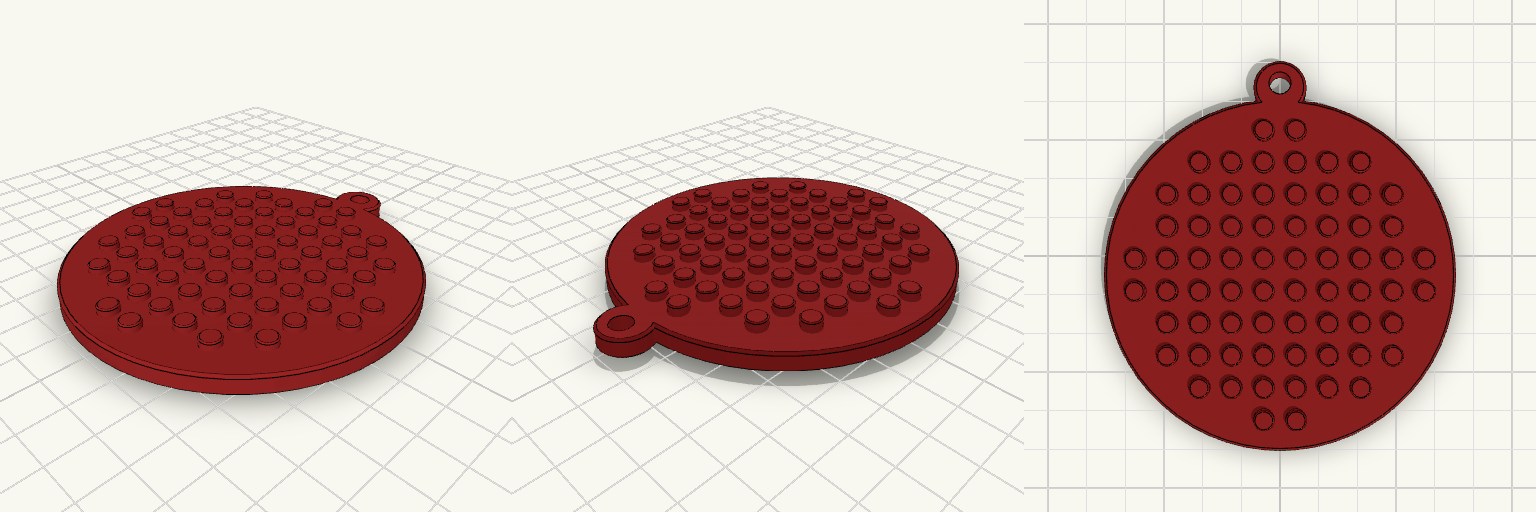
A round 88 mm ornament disc, 4.8 mm thick, with a grid of LEGO-compatible studs on the face and a hanging loop at the top. Printed in red, flat, with no supports. Remix hooks Stud diameter: 5.0 mm now (standard is 4.8 mm). Raise it to 5.05 for a firmer grip, or drop it to 4.9 if bricks sit too tight on your printer. Stud height: 1.8 mm. Taller studs give a deeper grip but need more bridging care. Disc thickness: 4.8 mm, or 1.5 LEGO plates. Use 3.2 mm for one plate or 9.6 mm for a full brick height. Disc diameter: 88 mm on an 8 mm stud pitch. The stud grid is cut to a 37 mm radius, which leaves a plain rim. Loop: 13 mm outer, 5.5 mm hole. Widen it for ribbon. Pairs with: 1x1 and 2x2 bricks, tiles, and small minifigure scenes.
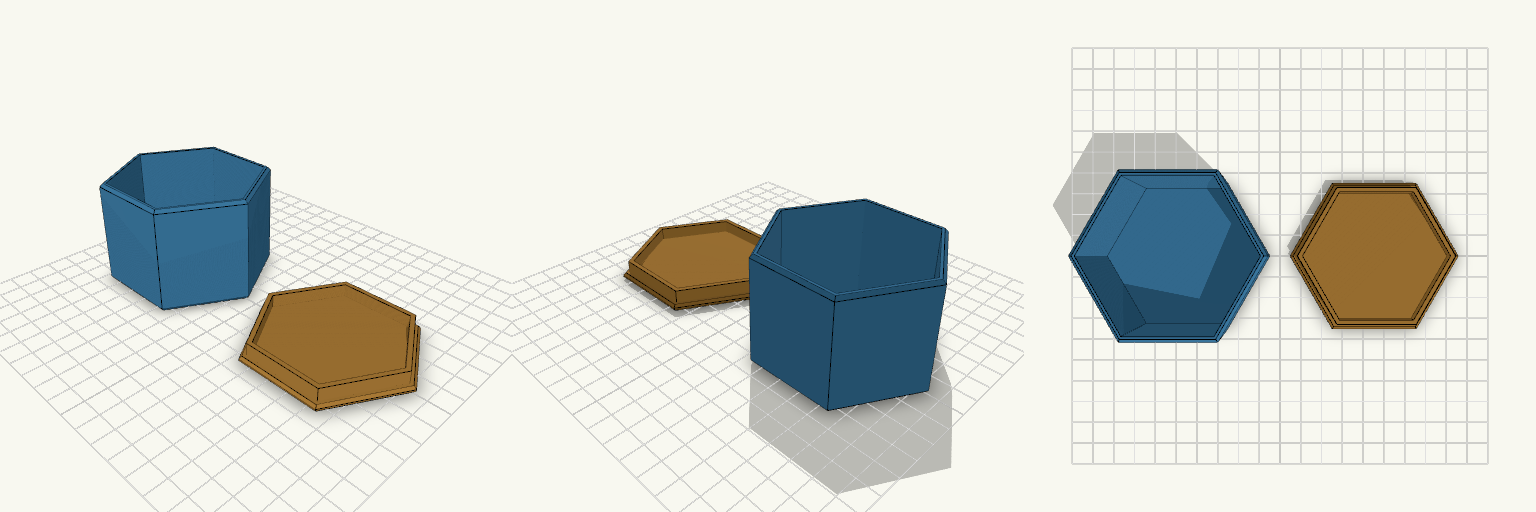
Hexagonal Box with Lid
A hexagonal box with a matching lid, printed as two separate pieces. The box is 50 mm tall and 80 mm across the corners, with 2.4 mm walls and a 3 mm floor. The lid is a 3 mm hexagonal plate with a 6 mm hollow lip underneath. The lip sits inside the box opening with about 0.4 mm of clearance per side, so the lid stays put without a tight press fit. Box: 80 mm across corners, 50 mm tall, chamfered base edge Lid: 80 mm across corners, 3 mm plate, 6 mm inner lip Print the lid flat with the lip facing up No supports needed for either piece
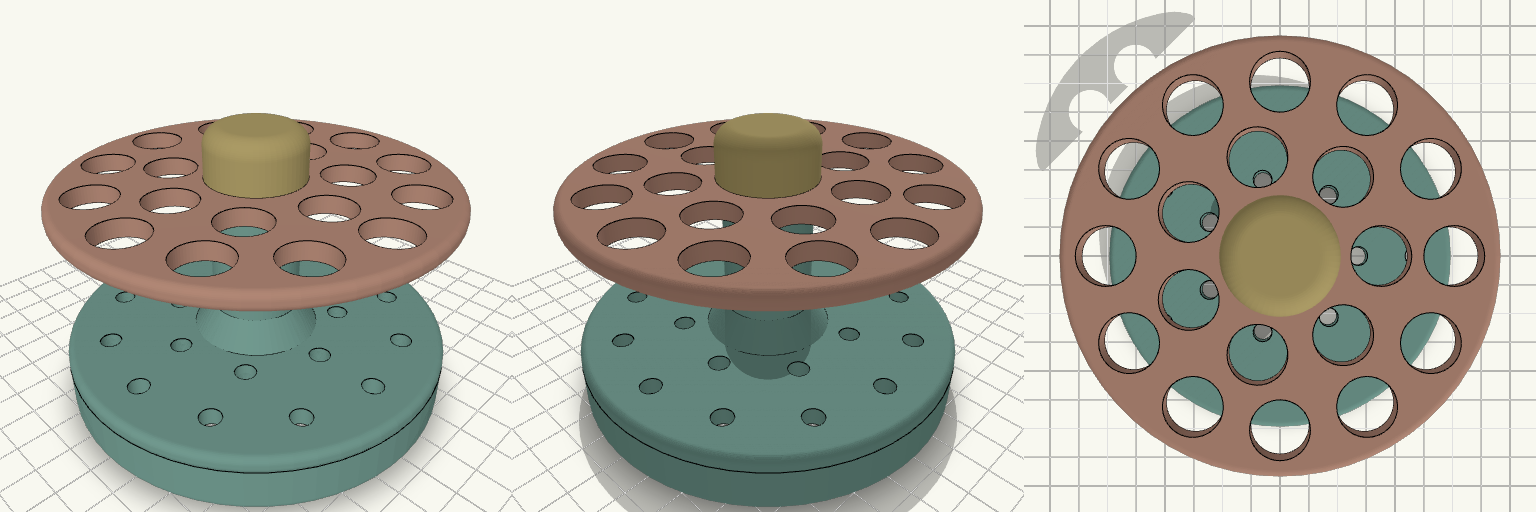
Mini 19-Cone Henna Carousel Stand
A compact two-tier henna cone stand: 110 mm trays, 60 mm apart, holding 19 cones tip-down, joined by a 25 mm central column and a screw cap. The top tray's 15 mm holes sit directly over 6 mm tip holes in the lower tray. A foot ring under the lower tray keeps cone tips off the table. Remix hooks Tray spacing: 60 mm now. Raise it for longer cones. Ring layout: 12 holes at 43 mm radius plus 7 at 25 mm radius. Wall between rings is about 3 mm, so adding holes means growing the tray. Tray diameter: 110 mm. Scale it up and add a third ring for more capacity. Hole size: 15 mm top, 6 mm bottom. Adjust to your cone brand. Pairs with: a turntable disc or non-slip mat under the foot ring.