100mm Square Utensil Drawer Bin
Created 1 months ago
Description
A 100mm square modular bin for flat-bottomed utensil drawers. Engineered with zero-draft vertical outer walls to tile continuously across a drawer floor with zero clearance gaps. The interior utilizes a 12mm continuous scoop radius, eliminating dead corners where small items bind.
Fitment Requirements
- Base Grid: Each unit requires exactly 100x100mm of flat drawer floor. Measure the interior base at the narrowest point to calculate maximum capacity.
- Height Clearance: Stands 50mm tall. Verify clearance against casework cross-members and internal runners when the drawer is in motion.
- Incompatibilities: Does not seat correctly in stamped metal or molded plastic drawers with heavily radiused interior corners. Designed exclusively for square-box cabinetry.
Images
More like this
Explore more in Storage & Organization →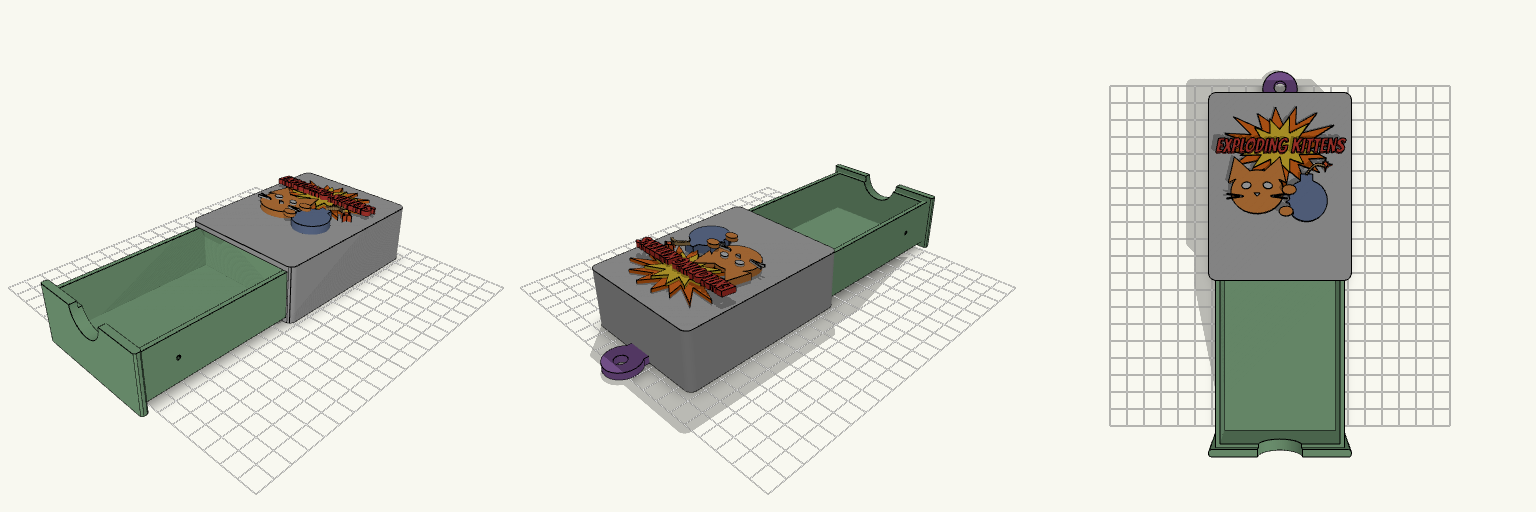
Exploding Kittens Drawer Card Case
What it's for A two-part slide-out card case sized for a single poker-size deck, with the Exploding Kittens artwork carried on the top of the sleeve. The relief shows an angry cat beside a round bomb, bite marks cut into the bomb's edge, a dotted fuse and a spark. A large jagged orange explosion with an uneven outline and a smaller yellow core sits flat on the lid, centred on the title. Because the blast is fused to the surface rather than floating above it, the cat and bomb rise through it, so the explosion reads as a backdrop behind them and both stay clearly visible. The red "EXPLODING KITTENS" lettering stands on the core, kept low so it rises only about 3 mm above the blast. The drawer has a front pull panel with a thumb notch and slides out of the sleeve; a small snap detent on each side wall clicks it shut and lets go with a firm pull. A fused keychain loop on the back of the sleeve lets the case clip to a bag with a carabiner or split ring. Dimensions Sleeve: 76 × 100 × 34 mm, open at the front Drawer: 76 × 99 × 34 mm, with a front pull panel and thumb notch Card well: one compartment, about 64.6 × 91.5 mm, sized for a 63.5 × 89 mm deck Explosion: 57.8 × 44.8 mm blast, 2 mm thick, fused to the lid; core 42.2 × 29.2 × 1.5 mm on top of it Title lettering: 68 × 8 mm, standing on the core about 3 mm above the blast Bomb relief: 5 mm tall, with the paws and fuse lowered to sit level on top of it Keychain loop: 20 mm round lug, 4 mm thick, with a 7 mm hole, fused to the back of the sleeve and reaching about 70 mm out on Y Detents: one small bump per sleeve wall, with matching dimples on the drawer sides Print notes Print the sleeve upside down or with supports under the top, since the ceiling spans the full width. Print the drawer flat on its floor. The keychain lug sits flat on the build plate and needs no supports, but at 4 mm thick it is the lightest part of the case — thicken it if the case will hang from a heavy bag. The enlarged loop pushes the footprint out to roughly 70 mm on Y beyond the sleeve; check it against your plate before starting a full-bed print. Drawer clearance is 0.3 mm per side; adjust if the drawer binds. Sleeved cards need roughly 2 mm more in both the width and length of the well. The lowered red lettering sits directly on the orange and yellow blast, so contrast is low at small scales; check a render before printing the lid art very small. Detent tension has not been test-printed; sand or adjust the bumps if the drawer is too stiff or too loose. Remix ideas Widen the card well for a sleeved or double-sleeved deck. Burst the explosion over the top of the cat and bomb instead of behind them, accepting that it would hide most of the cat. Swap the round bomb for a C4 brick. Add a divider for tokens or a rules card. Thicken the keychain lug to 6 mm and widen the hole further for heavier bags. Trade the detents for a magnetic catch if you prefer a quieter close.
Modulare Lochplatte mit Dorn für Filamentrollen
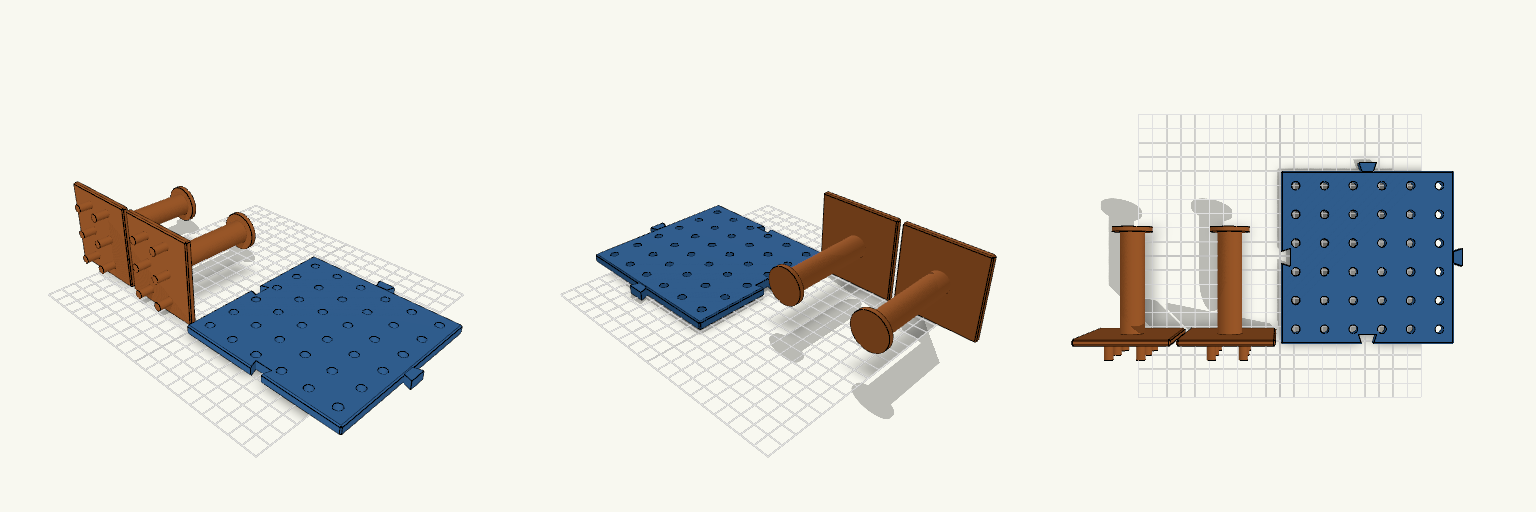
Eine modulare Lochwand aus 120 × 120 mm großen Kacheln, die sich in X- und Y-Richtung beliebig aneinanderstecken lässt: Rechts und hinten sitzen Schwalbenschwanz-Zapfen, links und vorne die passenden Nuten. Jede Kachel ist 6 mm dick und hat 6 × 6 Löcher mit 6 mm Durchmesser im 20-mm-Raster. Mit den Zapfen misst eine Kachel etwa 126 mm und passt damit auf nahezu jedes Druckbett. Dazu gehört ein Steckhalter mit Dorn, der eine Filamentrolle trägt. Auf dem Druckbett steht der Halter seitlich, links neben der Lochplatte; der Dorn zeigt nach hinten, die Stifte nach vorne. Zwischen Halter und Kachel bleiben rund 4 mm Luft, damit beim Drucken nichts verschmilzt. Der Halter hat eine 60 × 60 mm große Rückplatte mit sechs Stiften in 2 × 3 Anordnung im 20-mm-Raster; die Stifte sind 5,7 mm stark und 10 mm lang. Der Dorn sitzt mittig auf der Platte und ragt waagerecht nach hinten: 16 mm Durchmesser, 70 mm Länge, am Ende eine 26-mm-Scheibe, die die Rolle zurückhält. Übliche Rollen mit rund 50 mm Innenloch passen locker darüber. Die Rückplatte verteilt das Gewicht einer vollen Rolle auf mehrere Stifte. Kacheln und Halter werden gesteckt — die Wand wächst mit dem Bedarf, der Halter lässt sich jederzeit umsetzen. Wo ein Remix ansetzen kann Kachelmaß: Die 120 × 120 mm sind bewusst ein Vielfaches des 20-mm-Rasters — 100 mm wäre die nächste kleinere sinnvolle Stufe, 140 mm die nächste größere. Das 20-mm-Raster mit 6-mm-Löchern ist eine Wahl, keine Vorgabe; ein engeres Raster erlaubt feinere Haken. Passung der Verbinder: Das Spiel der Schwalbenschwänze liegt bei 0,25 mm. Das ist der erste Wert, den man an den eigenen Drucker anpasst — strammer für formschlüssigen Sitz, lockerer, wenn sich die Kacheln schwer fügen. Stiftfeld: Die Rückplatte ist 60 × 60 mm groß und nutzt sechs Stifte im 20-mm-Raster. Für leichtere Halter lässt sich das Feld verkleinern; für breitere Lasten kann es weiter wachsen, solange Stiftabstand und Lochraster zusammenpassen. Dorn: 16 mm Durchmesser und 70 mm Länge reichen für schmale Rollen; bei breiten Rollen mit etwa 70 mm oder mehr wird es knapp. Ein längerer Stab deckt breitere Rollen ab, schwerere brauchen eine dickere Rückplatte oder eine Stütze darunter; der Scheibendurchmesser von 26 mm lässt sich an das Innenloch der eigenen Rollen anpassen. Halterform: Derselbe Dorn lässt sich kürzen oder mit einem zweiten Dorn nebeneinander kombinieren, damit zwei Rollen auf einer Kachel Platz finden. Ausrichtung: Der Halter steht derzeit seitlich neben der Kachel, der Dorn zeigt nach hinten. Das ist eine Wahl, keine Vorgabe — die Drehung lässt sich ändern und der Halter weiter von der Kachel abrücken, ohne die Steckverbindung anzutasten. Als System gedacht: Weitere Kacheln vergrößern die Fläche, weitere Halter mit gleicher Rückplatte teilen sich die Wand — und jede Variante bleibt mit allen anderen kombinierbar, solange Raster und Stiftabstand gleich bleiben.
4x4 Gridfinity Baseplate with Bowtie Clips
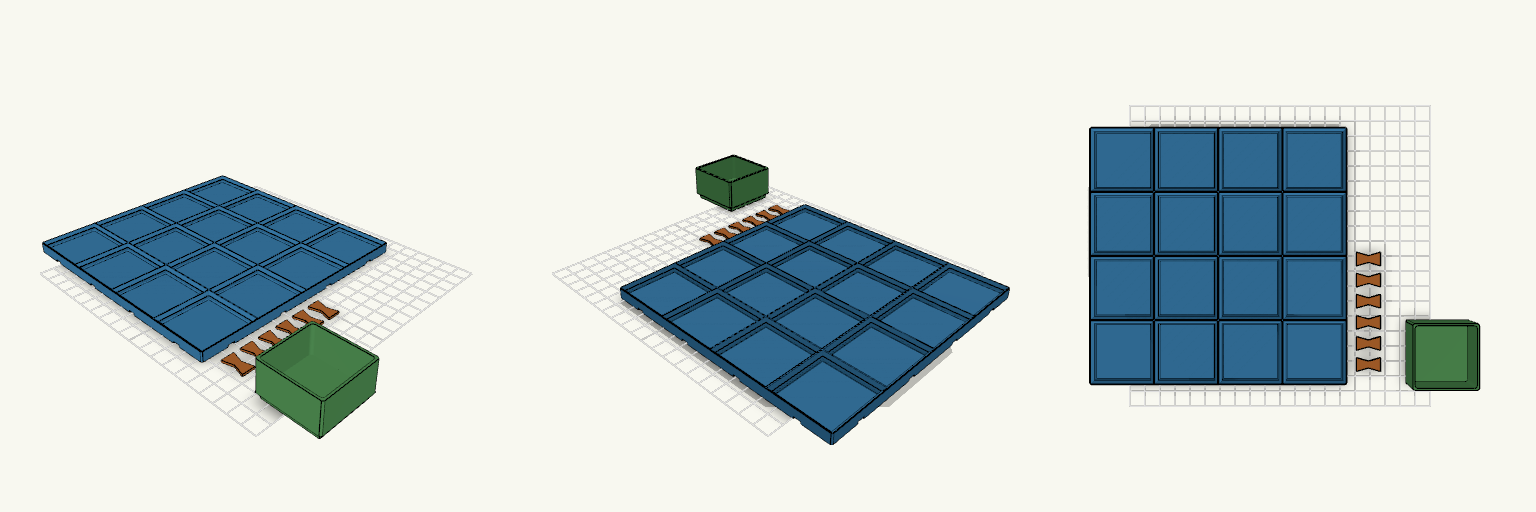
What it's for A 4x4 Gridfinity baseplate that joins to neighbouring plates without interrupting the grid. Each outer edge carries four bowtie-shaped recesses on the underside, one centred on every cell edge. Butt two plates together and press a clip into the matching recesses from below; the clip sits flush so the top surface stays seamless and the 42 mm pitch carries across the join. The set prints as separate parts: the baseplate, the bowtie clips and a 1x1 bin. The bin has a foot profile that matches the baseplate pockets but no stacking lip. Dimensions Baseplate: 168 × 168 × 6.8 mm (4 × 4 cells on the 42 mm grid) 1x1 bin: 41.5 × 41.5 × 25.7 mm Bowtie clips: 16 × 79 × 1.2 mm, sitting in 1.4 mm deep recesses with 0.2 mm clearance Print notes Six clips are included, which is enough for one seam only — print four per cell edge you want to join. Print the clips flat in PETG or a tougher filament rather than PLA; at 1.2 mm thick they are the weak point of the set. Remix ideas Scale the plate to other grid sizes, or mix a 4x4 with smaller plates along the same seams. Add more 1x1 bins, or extend the bin family with deeper sizes. Add a stacking lip to the bin for stacked storage.
Pokémon Deck Box With Drawer2
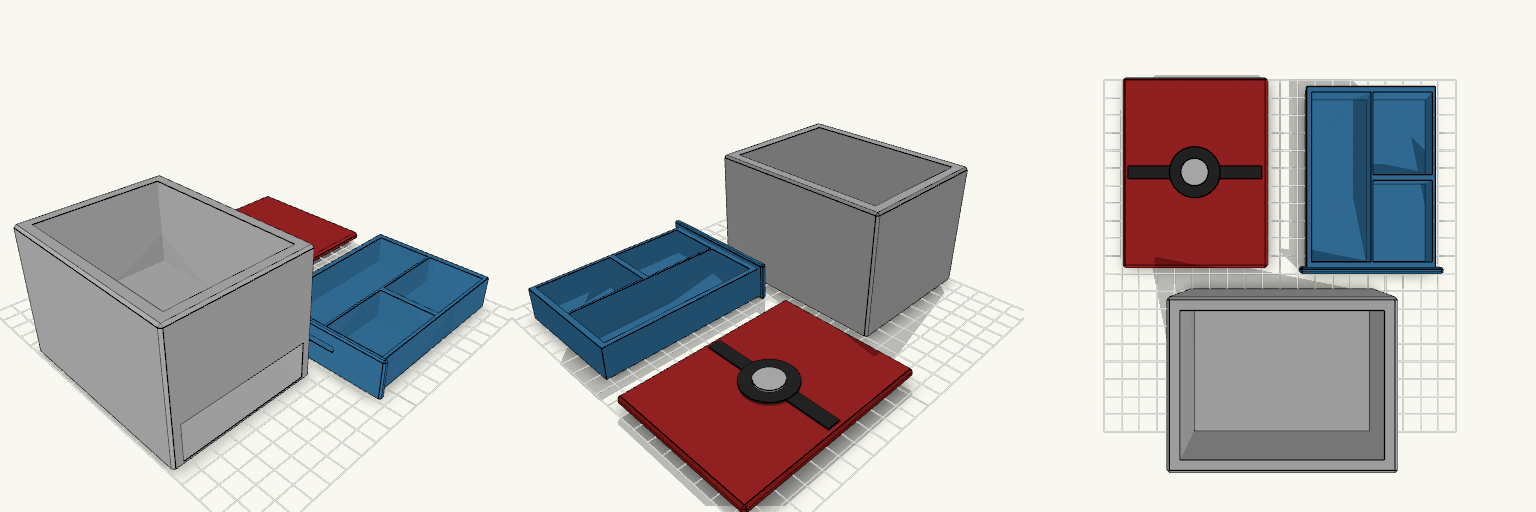
A Pokémon-themed deck box with a lift-off Poké Ball lid, a card well and a separate pull-out drawer for dice and counters. Parts are laid out on two plates: the box body alone on plate 1, and the lid and drawer side by side on plate 2. Remix hooks Overall size: the body is 80 x 105 x 70 mm. Change W, D or H to fit larger sleeved decks. Card well: 68 x 93 mm. Widen it for double-sleeved cards. Drawer bays: one long bay for dice and two smaller ones, 32 mm wide. Re-split them for tokens or damage counters. Plate layout: the body is turned 90° so it sits along X on plate 1. Plate 2 is offset 160 mm along Y. Pairs with: a card divider set or a coin-flip token tray.
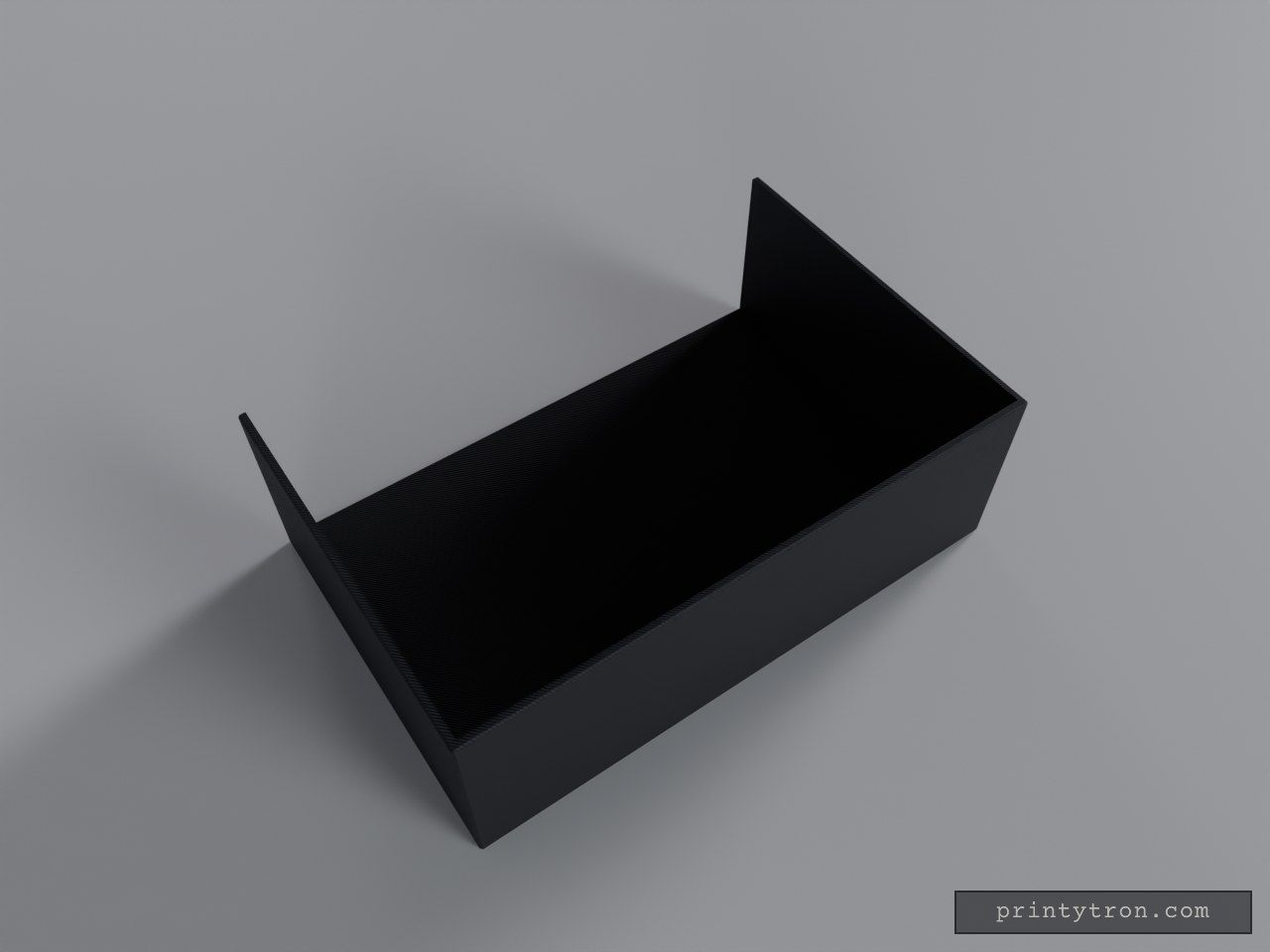
150×100mm U型三面围挡抽纸挡架
这是一个U型抽纸挡架,用于放入约150×100 mm的抽纸包。左、右、后三面围挡,前面完全敞开,便于抽取纸巾并减少纸巾滑落;底板、背板和侧板均为完整实心结构,无开孔、镂空或凹槽。整体为单件结构,无需组装。 规格 内部放纸区域:150 × 100 mm 外形尺寸:约154 × 102 × 52 mm 挡板高度:50 mm(底板以上) 总高:52 mm(含2 mm底板) 壁厚:2 mm 底板:整块2 mm实心平板,无孔洞 围挡方式:左、右、后三面围挡,前面敞开 背板与侧板:完整实心,无开孔 结构:一体打印,无需组装
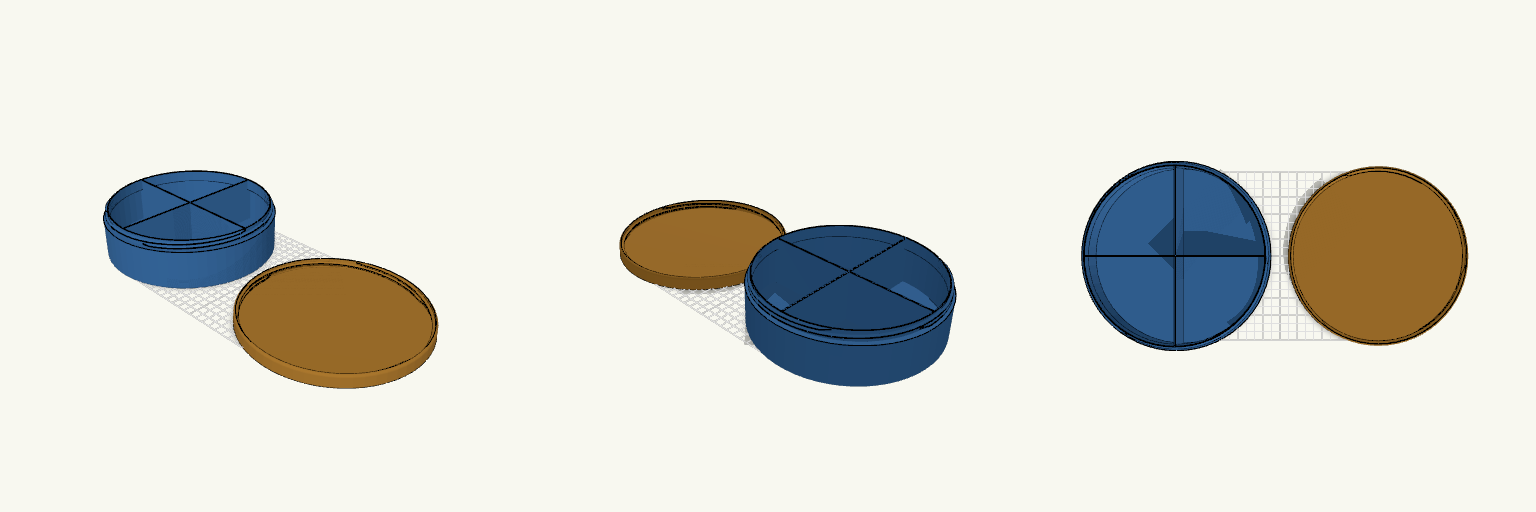
4 Bölmeli Vidalı Kapaklı Saklama Kabı
210 mm çapında ve 60 mm yüksekliğinde yuvarlak bir saklama kabı. İçi çapraz iki bölmeyle dört eşit gözeye ayrılmış; kapak kapalıyken gözeler birbirine karışmaz. Kapak, gövdenin üstündeki dış dişe vidalanarak kapanır, böylece taşırken kendiliğinden açılmaz. Gövde duvarları, taban, bölmeler ve kapak üstü ince tutulmuş, böylece baskı kısa sürer ve malzeme az gider. Gövde: 210 mm çap, 60 mm yükseklik, dört eşit bölme Kapak: 210 mm çap, 14,3 mm yükseklik, gövdeye vidalanır Diş: 12 mm boy, 5 mm adım, 3 ağızlı (hatve 15 mm), 0,5 mm boşluk; kapatmak için yaklaşık 0,8 tur (yaklaşık 290°) çevirmek yeterlidir Et kalınlıkları: yan duvar ve taban 1,6 mm, iç bölmeler 1,2 mm, kapak üstü 2,4 mm Baskı: gövde ve kapak ayrı ayrı basılır; kapak ters çevrilmeden, düz yüzü tablaya gelecek şekilde basılır Diş çapı 204 mm'ye çıkarıldığı için gövdenin üst kısmındaki basamak her yanda yaklaşık 3 mm'ye iner; boyun iç çapı 197 mm'dir. Dişin dibindeki duvar ince kaldığından o bölgeyi basarken katman ayarlarına dikkat etmek gerekir. Bölmeler dişli boyun bölgesinde de gövdenin içinde kaldığı için kapak takılıyken de ayrım korunur. Geniş çapı sayesinde dökme parçaları, vida ve küçük donanımı ya da atölye malzemesini tek kapta ayrı gözelerde tutmak için uygundur.