Exploding Kittens Drawer Card Case
Created 2 days ago
Description
What it's for
A two-part slide-out card case sized for a single poker-size deck, with the Exploding Kittens artwork carried on the top of the sleeve. The relief shows an angry cat beside a round bomb, bite marks cut into the bomb's edge, a dotted fuse and a spark.
A large jagged orange explosion with an uneven outline and a smaller yellow core sits flat on the lid, centred on the title. Because the blast is fused to the surface rather than floating above it, the cat and bomb rise through it, so the explosion reads as a backdrop behind them and both stay clearly visible. The red "EXPLODING KITTENS" lettering stands on the core, kept low so it rises only about 3 mm above the blast.
The drawer has a front pull panel with a thumb notch and slides out of the sleeve; a small snap detent on each side wall clicks it shut and lets go with a firm pull. A fused keychain loop on the back of the sleeve lets the case clip to a bag with a carabiner or split ring.
Dimensions
- Sleeve: 76 × 100 × 34 mm, open at the front
- Drawer: 76 × 99 × 34 mm, with a front pull panel and thumb notch
- Card well: one compartment, about 64.6 × 91.5 mm, sized for a 63.5 × 89 mm deck
- Explosion: 57.8 × 44.8 mm blast, 2 mm thick, fused to the lid; core 42.2 × 29.2 × 1.5 mm on top of it
- Title lettering: 68 × 8 mm, standing on the core about 3 mm above the blast
- Bomb relief: 5 mm tall, with the paws and fuse lowered to sit level on top of it
- Keychain loop: 20 mm round lug, 4 mm thick, with a 7 mm hole, fused to the back of the sleeve and reaching about 70 mm out on Y
- Detents: one small bump per sleeve wall, with matching dimples on the drawer sides
Print notes
- Print the sleeve upside down or with supports under the top, since the ceiling spans the full width.
- Print the drawer flat on its floor.
- The keychain lug sits flat on the build plate and needs no supports, but at 4 mm thick it is the lightest part of the case — thicken it if the case will hang from a heavy bag.
- The enlarged loop pushes the footprint out to roughly 70 mm on Y beyond the sleeve; check it against your plate before starting a full-bed print.
- Drawer clearance is 0.3 mm per side; adjust if the drawer binds.
- Sleeved cards need roughly 2 mm more in both the width and length of the well.
- The lowered red lettering sits directly on the orange and yellow blast, so contrast is low at small scales; check a render before printing the lid art very small.
- Detent tension has not been test-printed; sand or adjust the bumps if the drawer is too stiff or too loose.
Remix ideas
- Widen the card well for a sleeved or double-sleeved deck.
- Burst the explosion over the top of the cat and bomb instead of behind them, accepting that it would hide most of the cat.
- Swap the round bomb for a C4 brick.
- Add a divider for tokens or a rules card.
- Thicken the keychain lug to 6 mm and widen the hole further for heavier bags.
- Trade the detents for a magnetic catch if you prefer a quieter close.
Images
More like this
Explore more in Storage & Organization →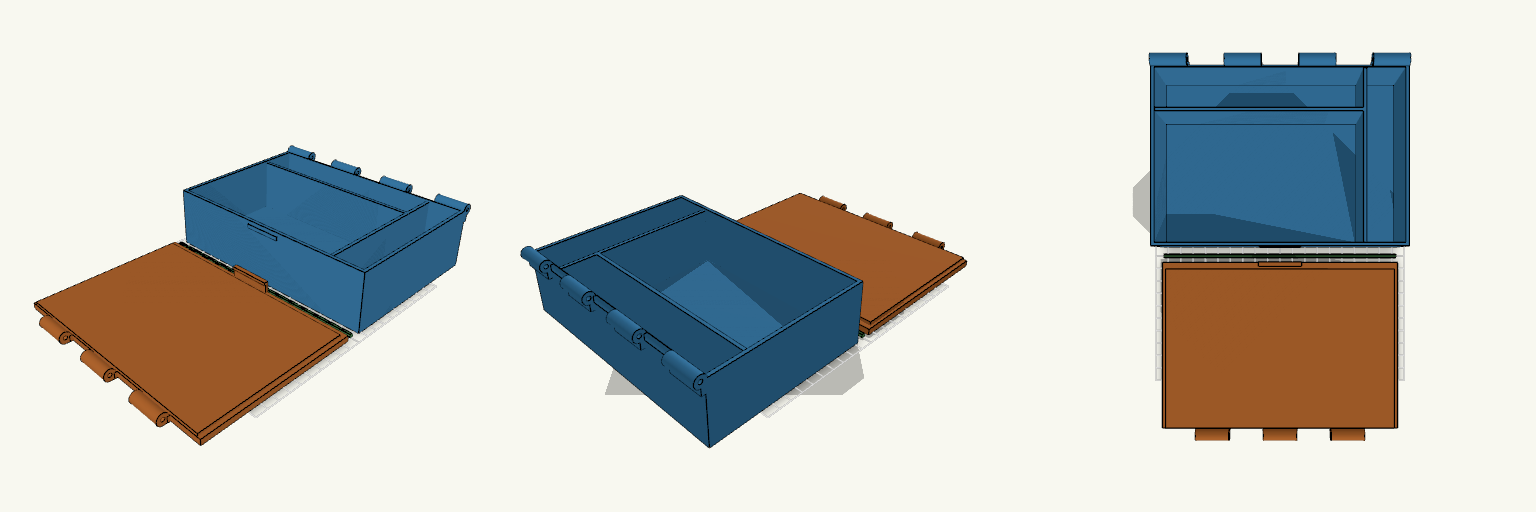
Hinged Latching Box With Front Divider
Small parts slide into one pile the moment the lid comes off; this hinged latching box splits the main space with a divider and adds a full-depth side bay so screws, clips and the like stop mixing. The main compartment clears 152 × 127 × 45 mm, with a 2.5 mm divider set 97 mm back from the front. A 2.5 mm wall separates a 28 mm wide, full-depth compartment on the right, and that bay has no cross divider. The walls stand 2 mm taller than the divider, and the divider top sits level with the underside of the lid lip, so the full 45 mm of height is usable. Fit and compartments Main compartment: 152 × 127 × 45 mm clear (width × depth × height). Right side compartment: 28 mm wide × 127 mm deep × 45 mm high, separated by a 2.5 mm wall and open for its full depth; overall inside width about 182.5 mm. Divider: 2.5 mm thick, 97 mm back from the front of the main compartment; front bay 97 mm deep, rear bay about 27.5 mm clear in the main area. The divider stops at the side-compartment wall so the right bay stays open. Walls and floor: 2.5 mm; the divider is 2 mm shorter than the walls so the lid lip clears it. Lid: 2 mm inner lip locates it on the base. Hinge clearance The lid's back edge has notches where the base's hinge knuckles pass through it. The base's back wall is cut away where the lid's knuckles swing down into it. Both cuts carry roughly 0.3 mm of play, so the lid closes without catching. Latch The hooked tab on the lid is set so the hook sits close over the catch bump without binding. Closed, the gap between the top of the hook and the underside of the catch bump is about 1.3 mm. If it prints too tight to snap over, lengthen the tab by a fraction of a millimetre at a time; if it is too loose, shorten it the same way. Printing and assembly Prints as three separate pieces: base, lid, and hinge pin. Base footprint is about 187.5 × 140.6 mm; the lid is about 187.5 × 142.3 mm; the pin is about 185.5 mm long and 3 mm in diameter. The pieces sit apart on the plate with gaps: the lid is flipped so its flat top face is on the bed, and the 3 mm pin lies flat in the gap. None of the three touch. If a slicer imports the file as one body, use Split to objects or Separate parts. Hinge: seven interleaved knuckles with a 3 mm pin. Use a 3 mm rod or filament, or print the pin. Slide the pin through the knuckles after printing; the lid hinges on it and the front latch holds it shut.
Pokémon Deck Box With Drawer2
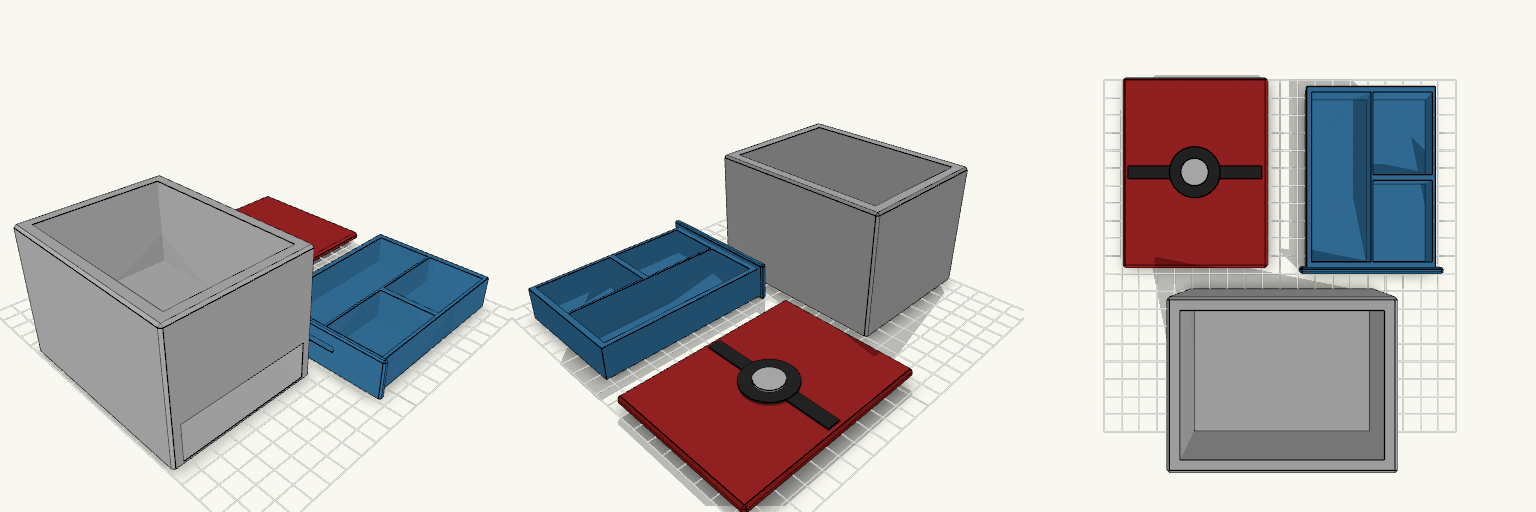
A Pokémon-themed deck box with a lift-off Poké Ball lid, a card well and a separate pull-out drawer for dice and counters. Parts are laid out on two plates: the box body alone on plate 1, and the lid and drawer side by side on plate 2. Remix hooks Overall size: the body is 80 x 105 x 70 mm. Change W, D or H to fit larger sleeved decks. Card well: 68 x 93 mm. Widen it for double-sleeved cards. Drawer bays: one long bay for dice and two smaller ones, 32 mm wide. Re-split them for tokens or damage counters. Plate layout: the body is turned 90° so it sits along X on plate 1. Plate 2 is offset 160 mm along Y. Pairs with: a card divider set or a coin-flip token tray.
Drawer Organizer Grid for Mini Toolbox Top Drawer
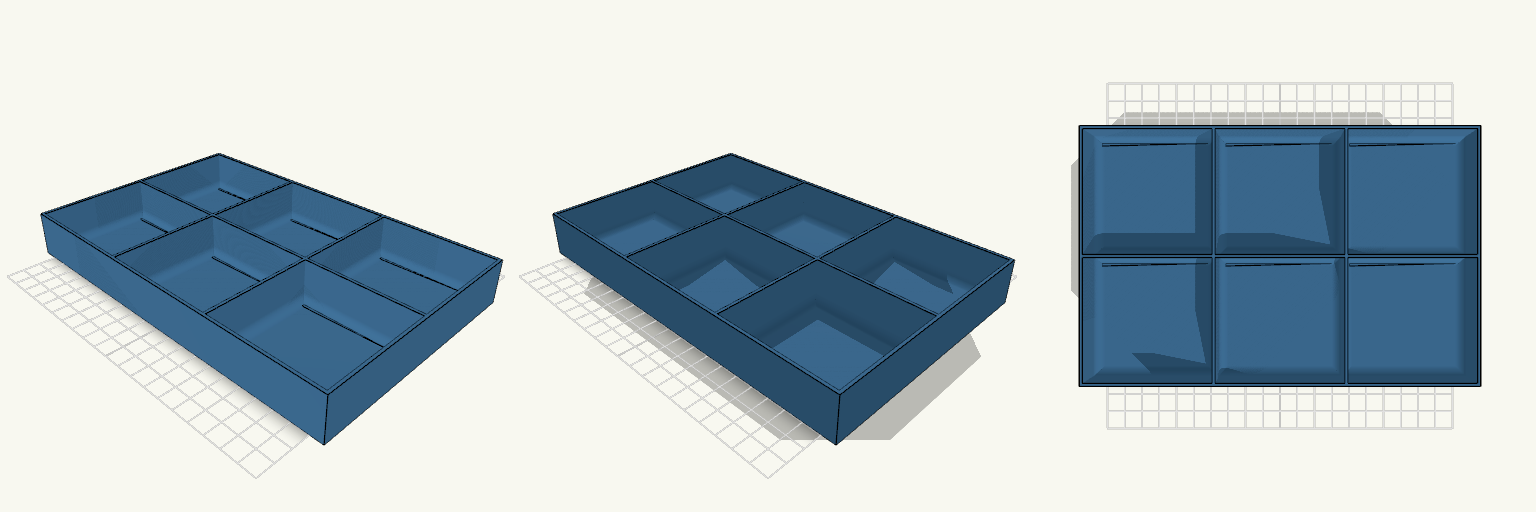
Small screws, bits, and sockets slide into one pile in the shallow top drawer of a U.S. General Mini Toolbox. This 3×2 organizer grid drops into that drawer and gives each group its own bin, so you can grab one without dragging the rest along. Footprint: 215.5 × 140 × 26 mm, sized for the top drawer with clearance. Compartments: six bins, each about 69.7 × 67.6 mm. Walls and floor: 1.6 mm walls, 1.2 mm floor. Bin floors: 5 mm rounded bottom edges so small parts can be scooped out instead of trapped in square corners. Printing: one piece, no separate inserts or assembly. The grid works as a single tray: print it, drop it in, and lift the whole thing out when you need the drawer back. The rounded floors are part of the print, not loose scoops.
4 Bölmeli Vidalı Kapaklı Saklama Kabı
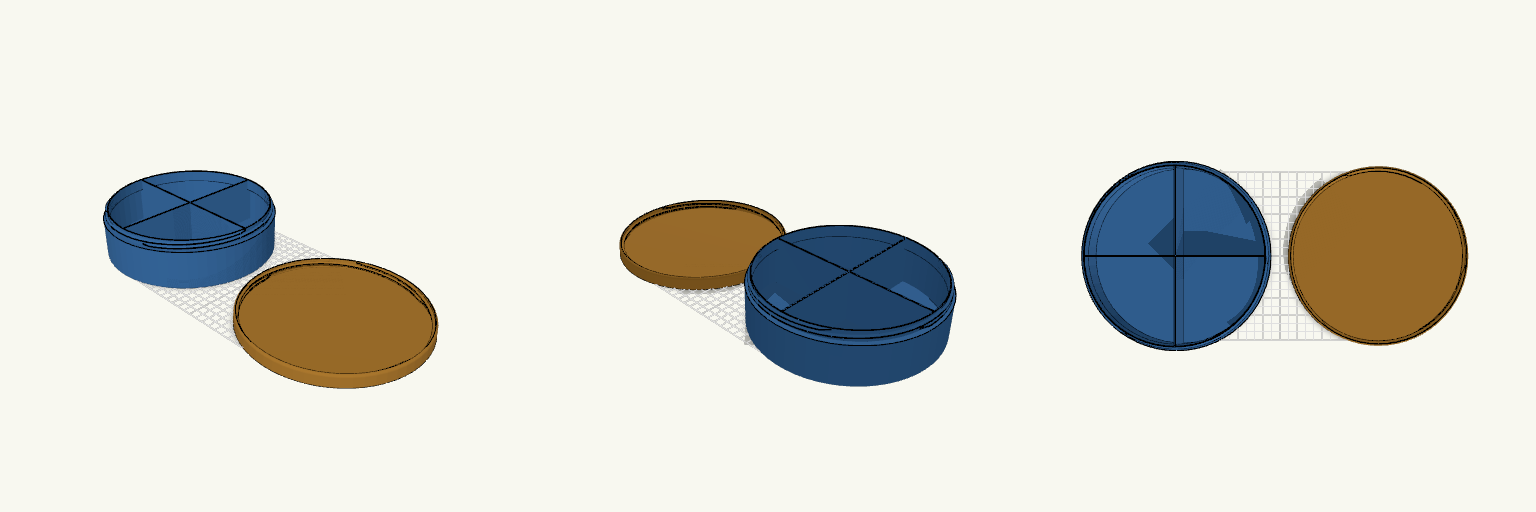
210 mm çapında ve 60 mm yüksekliğinde yuvarlak bir saklama kabı. İçi çapraz iki bölmeyle dört eşit gözeye ayrılmış; kapak kapalıyken gözeler birbirine karışmaz. Kapak, gövdenin üstündeki dış dişe vidalanarak kapanır, böylece taşırken kendiliğinden açılmaz. Gövde duvarları, taban, bölmeler ve kapak üstü ince tutulmuş, böylece baskı kısa sürer ve malzeme az gider. Gövde: 210 mm çap, 60 mm yükseklik, dört eşit bölme Kapak: 210 mm çap, 14,3 mm yükseklik, gövdeye vidalanır Diş: 12 mm boy, 5 mm adım, 3 ağızlı (hatve 15 mm), 0,5 mm boşluk; kapatmak için yaklaşık 0,8 tur (yaklaşık 290°) çevirmek yeterlidir Et kalınlıkları: yan duvar ve taban 1,6 mm, iç bölmeler 1,2 mm, kapak üstü 2,4 mm Baskı: gövde ve kapak ayrı ayrı basılır; kapak ters çevrilmeden, düz yüzü tablaya gelecek şekilde basılır Diş çapı 204 mm'ye çıkarıldığı için gövdenin üst kısmındaki basamak her yanda yaklaşık 3 mm'ye iner; boyun iç çapı 197 mm'dir. Dişin dibindeki duvar ince kaldığından o bölgeyi basarken katman ayarlarına dikkat etmek gerekir. Bölmeler dişli boyun bölgesinde de gövdenin içinde kaldığı için kapak takılıyken de ayrım korunur. Geniş çapı sayesinde dökme parçaları, vida ve küçük donanımı ya da atölye malzemesini tek kapta ayrı gözelerde tutmak için uygundur.
Bass Tackle Box With Hinged Lid
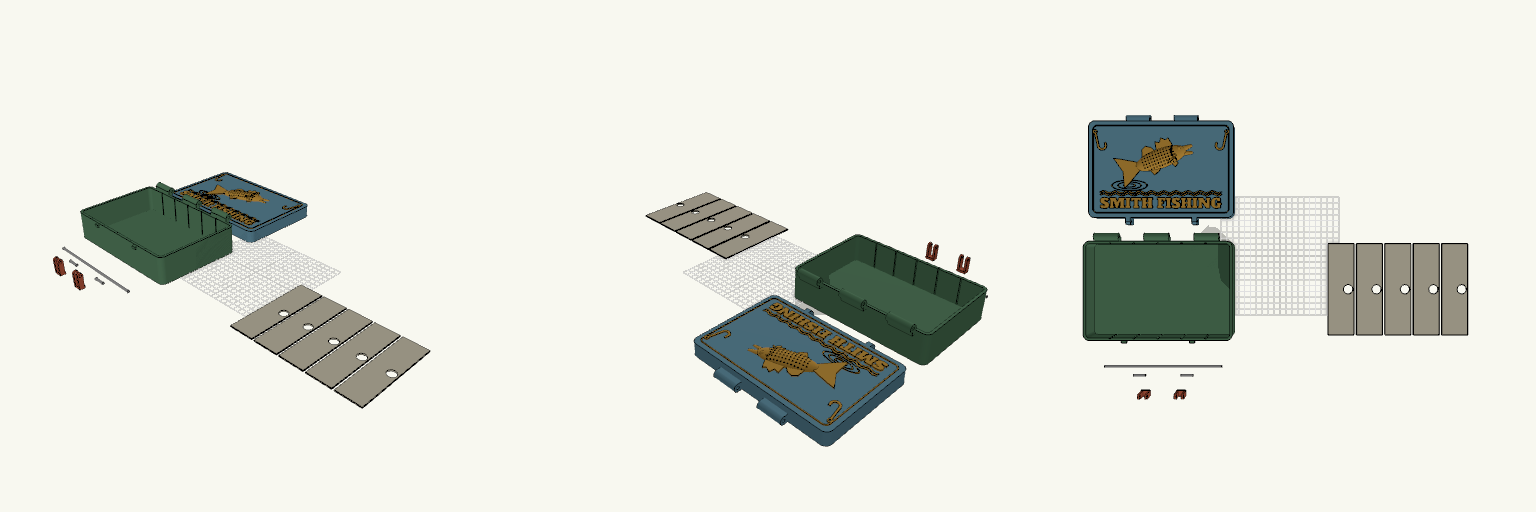
Tackle boxes that pop open in the boat, rattle hooks into the soft plastics, or lose a lid hinge get replaced. This one is a hinged bass tackle box with a locking front latch, adjustable dividers and a leaping largemouth bass on the lid, with SMITH FISHING raised underneath. Load-bearing numbers Base: 240 × 160 × 50 mm, 4 mm walls, 3 mm floor, rounded vertical corners. Lid: 240 × 160 × 22 mm, with a raised bass, ripples, waves, hooks and a border on top. Dividers: 5 removable cross dividers, 1.8 mm thick, sliding in 2.4 mm grooves at 38.5 mm spacing. Hinge: 5 interleaved knuckles across the back, joined by a 4.2 mm pin (197 mm long, printed separately). Latches: 2 front latches with 4.2 mm pivot pins. Each hooks under a ledge on the base. Printing Print every piece in the layout shown: base, lid, dividers, latches and pins are all separate. Lid: print upright. The underside of the top plate bridges across the cavity, so use supports or good bridging settings. Layer height 0.2 mm, PETG or ASA, 3+ perimeters. Hinge and latch pins can be glued or capped at the ends to keep them in.
Mini 19-Cone Henna Carousel Stand
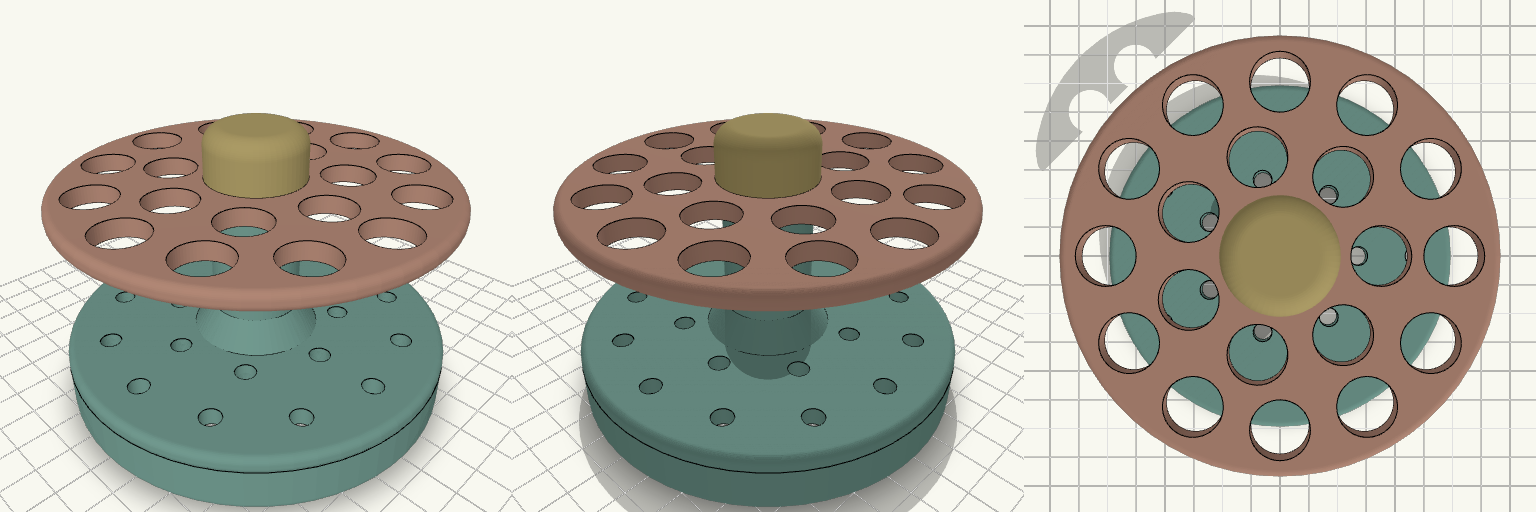
A compact two-tier henna cone stand: 110 mm trays, 60 mm apart, holding 19 cones tip-down, joined by a 25 mm central column and a screw cap. The top tray's 15 mm holes sit directly over 6 mm tip holes in the lower tray. A foot ring under the lower tray keeps cone tips off the table. Remix hooks Tray spacing: 60 mm now. Raise it for longer cones. Ring layout: 12 holes at 43 mm radius plus 7 at 25 mm radius. Wall between rings is about 3 mm, so adding holes means growing the tray. Tray diameter: 110 mm. Scale it up and add a third ring for more capacity. Hole size: 15 mm top, 6 mm bottom. Adjust to your cone brand. Pairs with: a turntable disc or non-slip mat under the foot ring.