65mm Wood Hook Phone Bracket
Created 25 days ago
Description
A heavy-duty hook bracket to suspend a phone over a 60mm wooden beam or headboard. The main channel is sized at 65mm for clearance, dropping a device tray down 65mm from the top edge.
- Fitment: 65mm interior gap clears standard 60mm stock.
- Tray Specs: 16mm deep with a 3mm inward tilt to keep the device seated against the backrest.
- Width: 50mm overall extrusion.
- Printability: Designed to be printed flat on its side. Requires no supports.
Images
More like this
Explore more in Storage & Organization →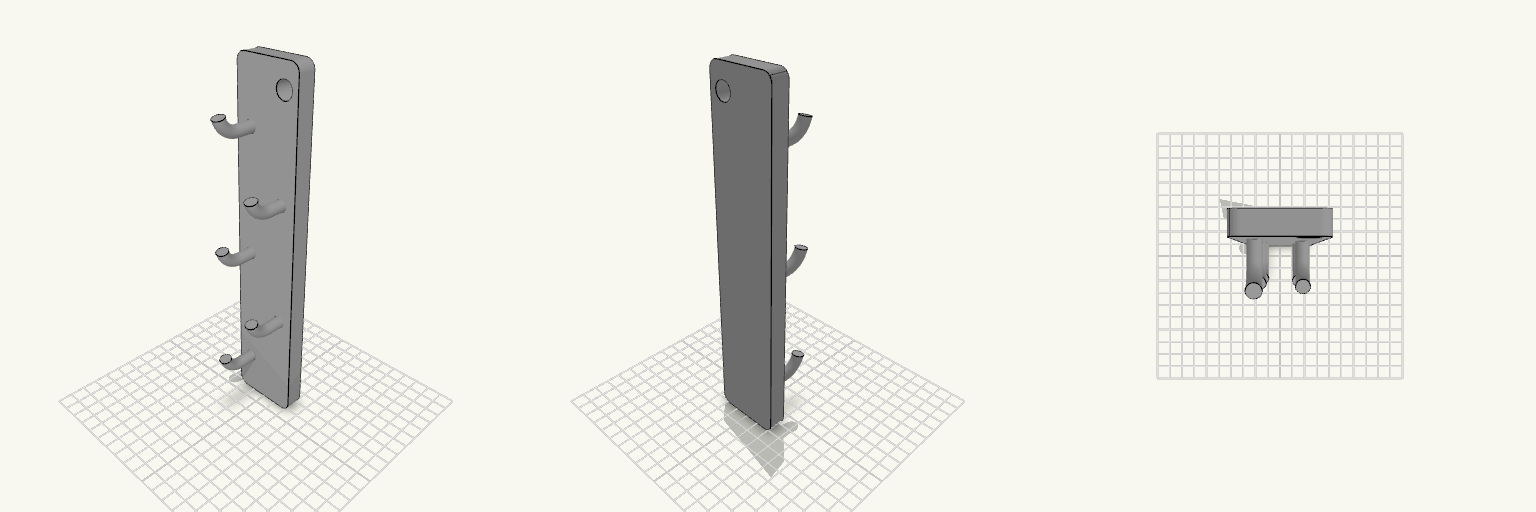
Staggered 5-Key Hook Extender
A tall back plate that hangs from a key rack and holds five keys on alternating left and right pegs, so fobs dangle without touching each other. The plate is 46.2 mm wide, 240 mm tall and 12 mm thick, with a 12 mm hang hole at the top right. Each peg is 8 mm in diameter, runs straight for 12 mm, then curves upward through 75° to keep rings seated. Remix hooks Plate thickness (12 mm): the easiest stiffness lever. Pegs are set into the plate face, so going thicker needs no other changes. Peg spacing (42 mm pitch): raise it for longer fobs, lower it to fit more pegs on a shorter plate. Bend angle (75°) and straight run (12 mm): lengthen the run for larger rings, ease the angle for a flatter peg. Hang hole (12 mm): resize to match your rack hook. Pairs with: any horizontal key rack with a post or screw head that fits the hole.
TANKER 3 Water
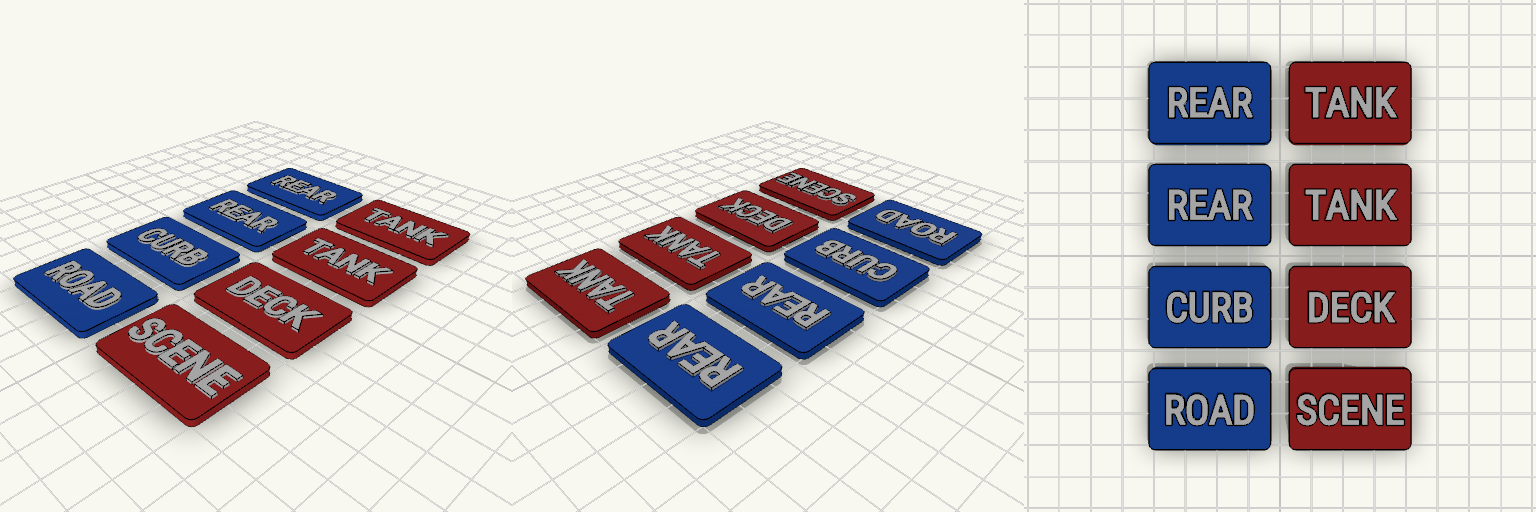
A matched set of eight small label plates with bold raised white lettering, styled like the enamel signage screwed to a garage wall, a shelf edge or the front of a storage bin. Each plate carries a single word — the four blue plates read ROAD, CURB, REAR and REAR, and the four red plates read SCENE, DECK, TANK and TANK — so a wall of bins, hooks, shelves or parking spots can be told apart at a glance. Colour does the sorting: blue for one group, red for the other, both with the same white lettering, so the two families stay distinguishable from across the room while reading as one set. The letters are thickened rather than enlarged, so the strokes carry weight without changing the plate size. The plates are plain rectangles with rounded corners and no fixing hole, leaving the full face free for the text — stick them on with double-sided tape or adhesive, or drill and screw them wherever they are needed. Dimensions Each plate: 1.5 in wide × 1 in tall (38.1 × 25.4 mm), 2 mm thick Rounded corners, no hanging hole Raised lettering: 0.8 mm proud of the face, strokes thickened for a heavier face Lettering centred horizontally and vertically on every plate Plates laid out 32 mm apart in two columns, blue set on the left, red set on the right Set contents Blue: ROAD, CURB, REAR, REAR Red: SCENE, DECK, TANK, TANK Print notes All eight plates sit flat on the bed and print without supports A single filament swap at letter height produces the two-tone face; painting the raised text works just as well The whole set prints in one go and comes off as eight separate tags The same layout takes any short word you want to swap in, as long as the plate size and the two-tone face stay the same.
Apothecary Grid Hinged Pill Box
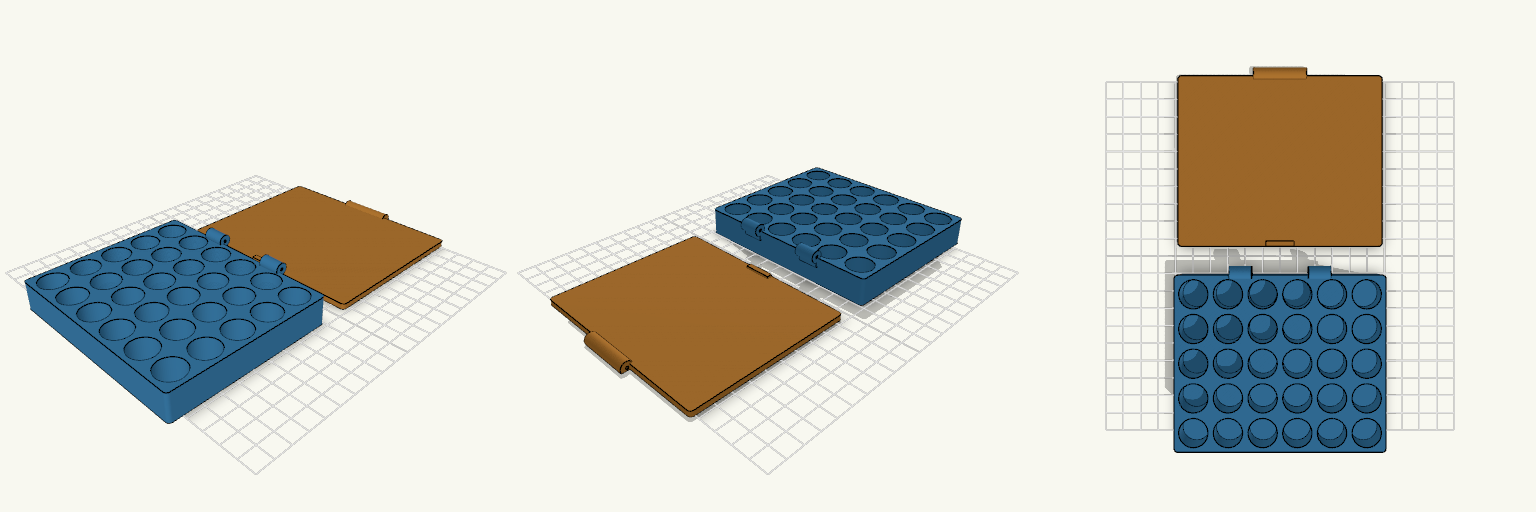
A pharmacy-drawer grid in miniature: thirty round wells in a 6×5 layout, topped by a lid that swings open on a real pin hinge at the back edge. The lid prints flat beside the tray and clicks into the hinge ears once a short pin is slid through. 30 slots, 16 mm wide and 14 mm deep Hinge pin hole sized for a 1.75 mm filament offcut, about 56 mm long Front finger tab on the lid for easy opening Lid and tray print without supports in separate pieces

Seagate 1TB Hinged Drive Case
A hinged case for a 117 x 80 x 14.8 mm external drive, printed flat as one piece with a base, a cover and a flexible hinge between them. A snap latch on the opposite end holds the cover closed. Remix hooks Drive size: the inner cavity is the drive plus 1.5 mm in length and width and 1 mm in height. Change those numbers to fit another drive. Hinge strip: 0.6 mm thick and about 7 mm wide. Thicker is stiffer and longer-lived, thinner folds more easily. PETG is recommended. Latch: the cover tab is 30 mm wide and the base catch is 20 mm wide. Adjust either to change the closing force. Cable storage: the cable tray has been removed. A separate tray or a cable pocket could be added back on the cover's outer face. Both halves print without supports, with the cover opening facing up.
Bass Tackle Box With Hinged Lid
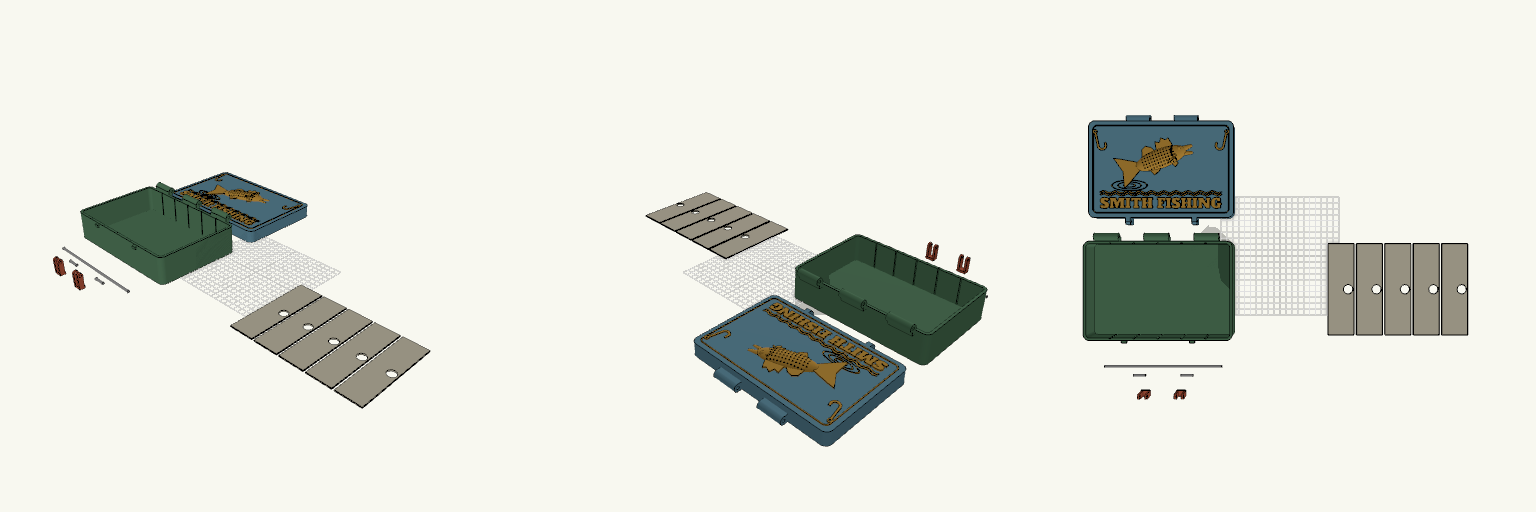
Tackle boxes that pop open in the boat, rattle hooks into the soft plastics, or lose a lid hinge get replaced. This one is a hinged bass tackle box with a locking front latch, adjustable dividers and a leaping largemouth bass on the lid, with SMITH FISHING raised underneath. Load-bearing numbers Base: 240 × 160 × 50 mm, 4 mm walls, 3 mm floor, rounded vertical corners. Lid: 240 × 160 × 22 mm, with a raised bass, ripples, waves, hooks and a border on top. Dividers: 5 removable cross dividers, 1.8 mm thick, sliding in 2.4 mm grooves at 38.5 mm spacing. Hinge: 5 interleaved knuckles across the back, joined by a 4.2 mm pin (197 mm long, printed separately). Latches: 2 front latches with 4.2 mm pivot pins. Each hooks under a ledge on the base. Printing Print every piece in the layout shown: base, lid, dividers, latches and pins are all separate. Lid: print upright. The underside of the top plate bridges across the cavity, so use supports or good bridging settings. Layer height 0.2 mm, PETG or ASA, 3+ perimeters. Hinge and latch pins can be glued or capped at the ends to keep them in.
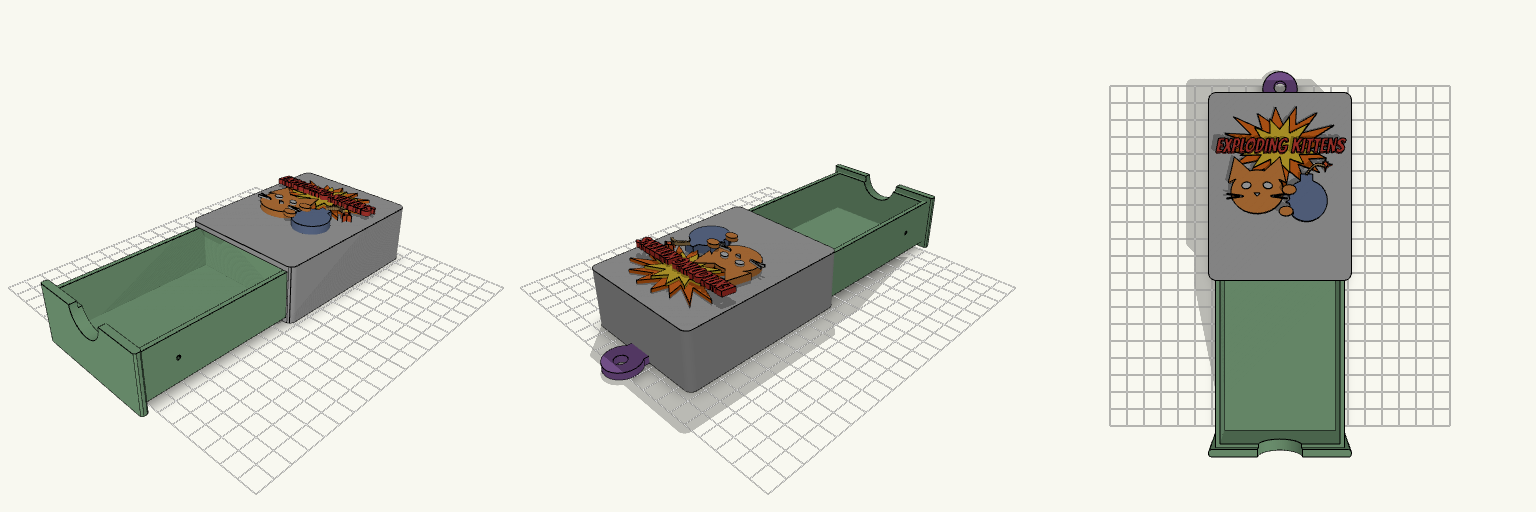
Exploding Kittens Drawer Card Case
What it's for A two-part slide-out card case sized for a single poker-size deck, with the Exploding Kittens artwork carried on the top of the sleeve. The relief shows an angry cat beside a round bomb, bite marks cut into the bomb's edge, a dotted fuse and a spark. A large jagged orange explosion with an uneven outline and a smaller yellow core sits flat on the lid, centred on the title. Because the blast is fused to the surface rather than floating above it, the cat and bomb rise through it, so the explosion reads as a backdrop behind them and both stay clearly visible. The red "EXPLODING KITTENS" lettering stands on the core, kept low so it rises only about 3 mm above the blast. The drawer has a front pull panel with a thumb notch and slides out of the sleeve; a small snap detent on each side wall clicks it shut and lets go with a firm pull. A fused keychain loop on the back of the sleeve lets the case clip to a bag with a carabiner or split ring. Dimensions Sleeve: 76 × 100 × 34 mm, open at the front Drawer: 76 × 99 × 34 mm, with a front pull panel and thumb notch Card well: one compartment, about 64.6 × 91.5 mm, sized for a 63.5 × 89 mm deck Explosion: 57.8 × 44.8 mm blast, 2 mm thick, fused to the lid; core 42.2 × 29.2 × 1.5 mm on top of it Title lettering: 68 × 8 mm, standing on the core about 3 mm above the blast Bomb relief: 5 mm tall, with the paws and fuse lowered to sit level on top of it Keychain loop: 20 mm round lug, 4 mm thick, with a 7 mm hole, fused to the back of the sleeve and reaching about 70 mm out on Y Detents: one small bump per sleeve wall, with matching dimples on the drawer sides Print notes Print the sleeve upside down or with supports under the top, since the ceiling spans the full width. Print the drawer flat on its floor. The keychain lug sits flat on the build plate and needs no supports, but at 4 mm thick it is the lightest part of the case — thicken it if the case will hang from a heavy bag. The enlarged loop pushes the footprint out to roughly 70 mm on Y beyond the sleeve; check it against your plate before starting a full-bed print. Drawer clearance is 0.3 mm per side; adjust if the drawer binds. Sleeved cards need roughly 2 mm more in both the width and length of the well. The lowered red lettering sits directly on the orange and yellow blast, so contrast is low at small scales; check a render before printing the lid art very small. Detent tension has not been test-printed; sand or adjust the bumps if the drawer is too stiff or too loose. Remix ideas Widen the card well for a sleeved or double-sleeved deck. Burst the explosion over the top of the cat and bomb instead of behind them, accepting that it would hide most of the cat. Swap the round bomb for a C4 brick. Add a divider for tokens or a rules card. Thicken the keychain lug to 6 mm and widen the hole further for heavier bags. Trade the detents for a magnetic catch if you prefer a quieter close.