Two-Piece Bowl Tray, Wall-Fused Posts
Made by CompassAlpaca
Created today
Description
A split-bowl tray in the spirit of a workshop parts bin: two halves that lock together with a tongue-and-groove lap joint, then take a lid on six full-height screw posts.
Design notes
- 290 × 190 × 80 mm overall, R10 corners, 4 mm walls, 5 mm floor
- Component A (80 mm) carries the tongue and two corner posts
- Component B (210 mm) carries the groove, four posts, two Ø24 front openings and a 160 × 24 mm rear slot
- Every post is fused into the adjacent walls and runs to the rim
- 3.4 mm pilot holes for ST4.2 self-tapping plastic screws
- Smooth interior, no ribs
Images
More like this
Explore more in Storage & Organization →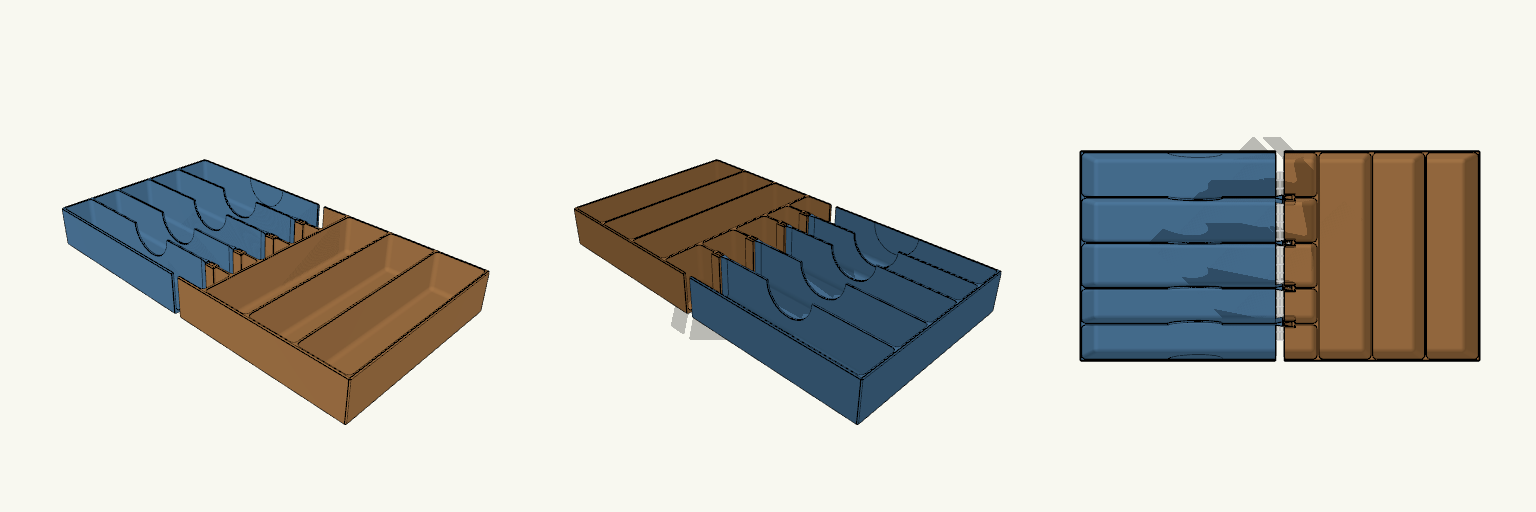
Two-Piece Dovetailed 432x232x50 mm Cutlery Tray
Cutlery drawer tray split into two halves that fit a 256 mm print bed. The halves join with vertical dovetails at the seam and lock together when slid down. Overall size when assembled: 432 x 232 x 50 mm Each half: 216 x 232 x 50 mm Five 250 mm long slots (knives x2, forks, spoons x2) with 30 mm deep finger scoops Three cross slots for small spoons, dessert forks and small knives Four full-height dovetails along the dividers, 0.3 mm clearance per side Local thickened pads on the receiving half hold the sockets Glue is optional for a permanent bond
Two-Piece Sliding Storage Drawer with Spring Release
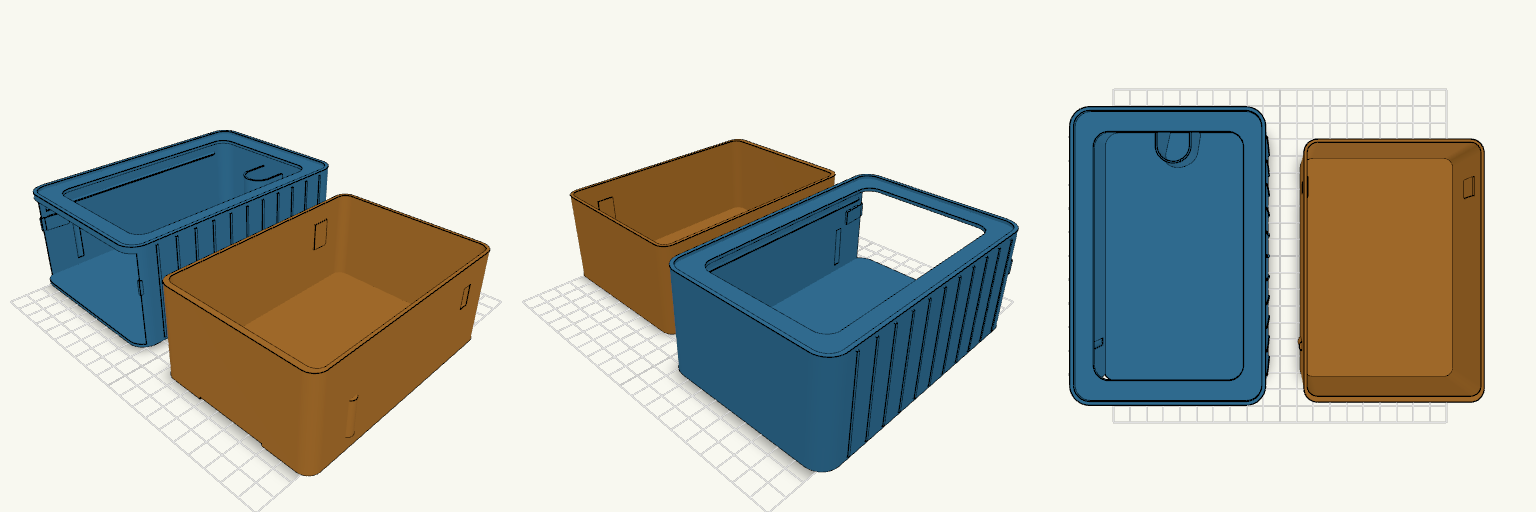
A minimalist two-piece sliding storage drawer: a ribbed outer housing with an open front and a separate inner drawer with a flush, handle-free face. The housing measures 100 × 150 × 60 mm with 10 mm rounded outer corners and 1.6 mm walls. Vertical ribbing stiffens the side walls, and thin 45° guide rails keep the drawer aligned. The guide rails and side stop tabs stay inside the outer walls, with only the ribs standing proud by design; the front ends of the rails stop inside the rounded front corners. The top is an open frame with a 12 mm solid rim, thickened to 3.4 mm so the stacking recess does not cut through. The drawer slides on the rails and locks closed with rounded snap bumps that seat into grooves in the housing. Push the drawer inward to release the bumps; the rear U-shaped leaf spring then pushes it forward. The spring is 0.95 mm thick and 40 mm wide, anchored to the inner back wall and touching the floor only where it meets that wall. A 45° chamfer under its bottom edge lifts the loop clear of the floor as it runs forward, so it flexes freely and still prints without supports — the trade-off is a shorter front loop, so the spring is on the soft side. A 45° finger bevel under the bottom front edge gives a hidden pull once the drawer has popped out. Flexible side stop tabs catch pockets near the back of the drawer, limiting travel to about 95 mm; press the tabs aside to remove the drawer fully. The stop pockets are 1.2 mm deep with 1.4 mm of solid wall behind them. The housing also stacks: a 1.5 mm bottom foot, inset 2.2 mm with a 45° chamfer, sits in a matching 1.8 mm recessed step on the top rim with 0.3 mm clearance. Housing: 100 × 150 × 60 mm, ribbed sides, open top with 12 mm rim, 10 mm rounded corners, 1.6 mm walls Drawer: 95.7 × 135 × 53.2 mm, flush front, no handle, side snap bumps Release: push-push detent with rear U-spring Pull: hidden 45° finger bevel under the front bottom edge Stop: flexible side tabs limit travel to about 95 mm; press aside for full removal Stacking: 1.5 mm bottom foot and matching 1.8 mm top recess Printing: two separate pieces, no supports, overhangs 45° or shallower Tuning: spring force and detent interference may need adjustment after a test print
Matchbox with Snap-Lock Tray
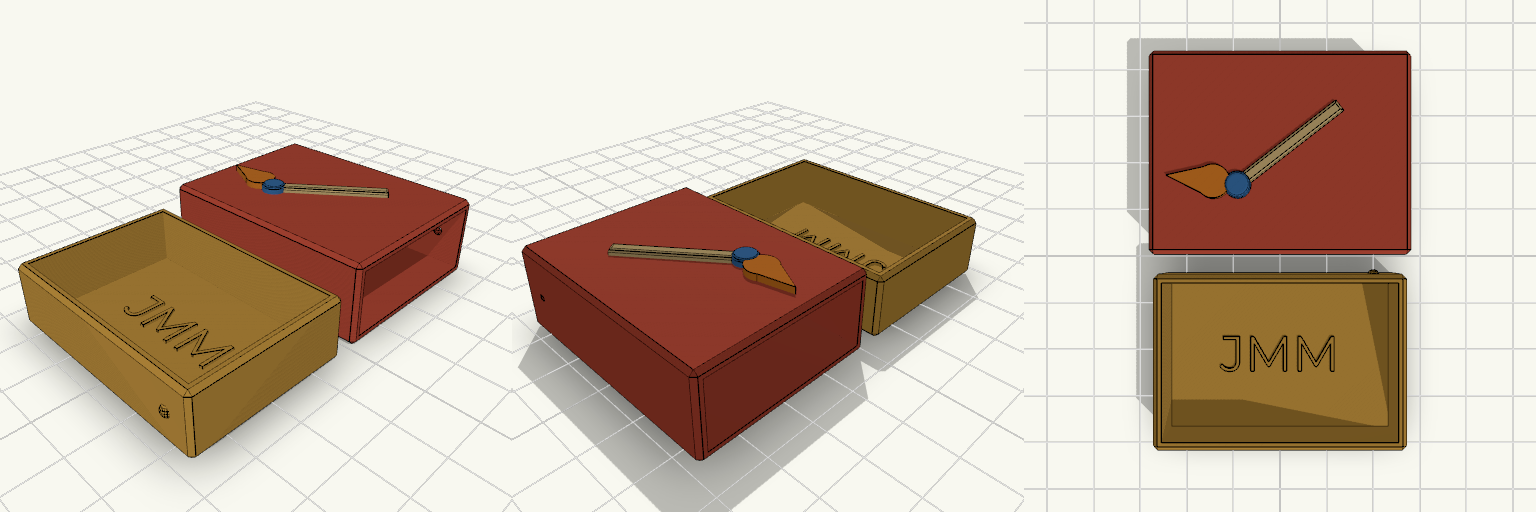
A matchbox made of a sliding tray and an open-ended sleeve, printed as two separate pieces. The tray has solid walls and the raised text "JMM" on its inner floor. The sleeve carries a raised match motif with a blue head and an orange flame, lying along the lid diagonal. Tray: 49 × 34 × 13 mm Sleeve: 0.4 mm clearance around the tray Snap-lock: a small bump on each tray side clicks into a matching recess in the sleeve Text: raised 0.7 mm, centred in the tray Print the tray and sleeve flat on the bed. No supports are needed for the main bodies.
Four-Compartment Cutlery Separator Tray
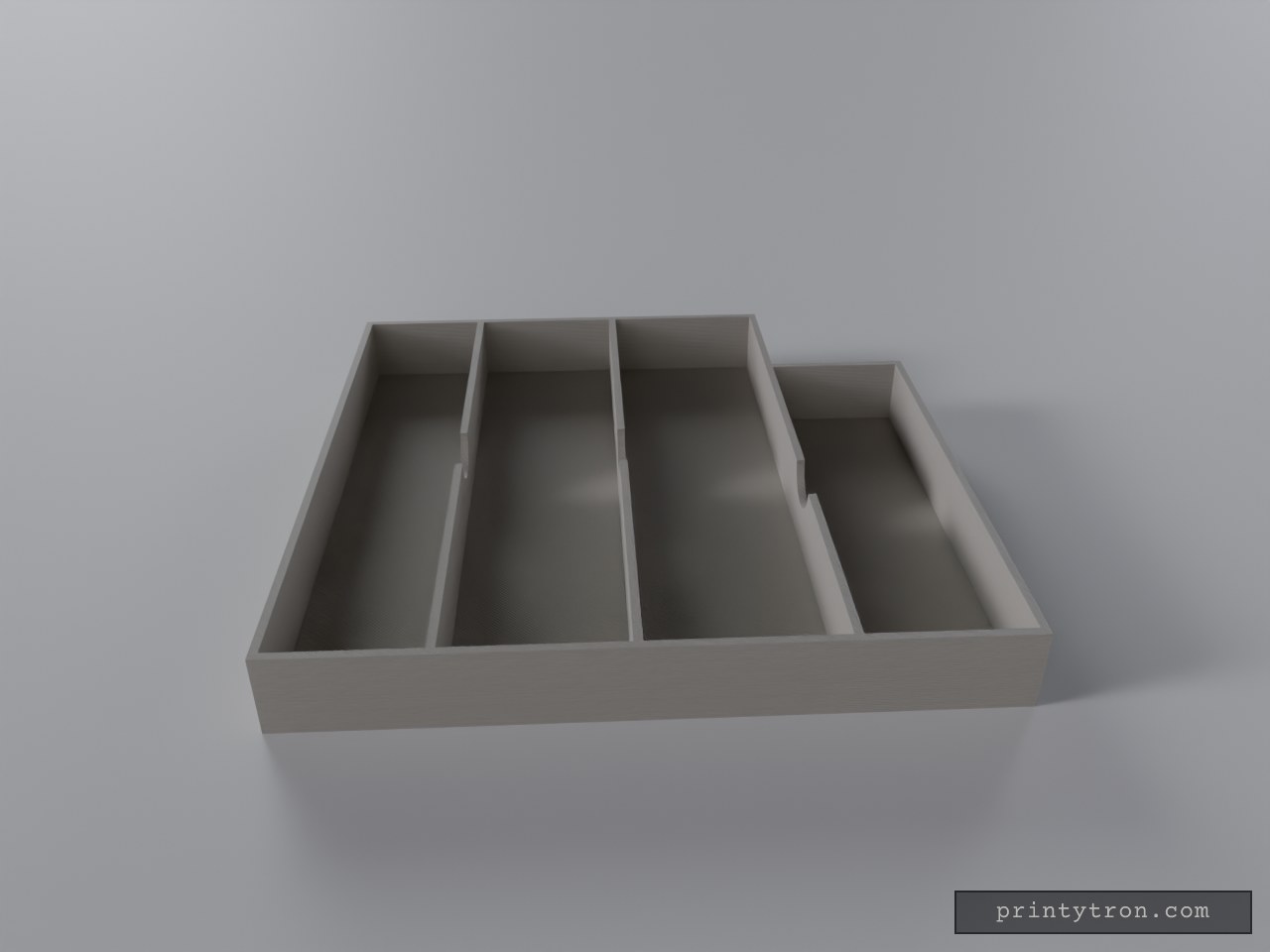
What it's for A four-compartment cutlery separator tray for a drawer, with semi-round finger cutouts in each divider so utensils lift out easily. Dimensions Overall height: 30 mm, with a 3 mm base and 3 mm walls Three compartments 240 mm long: 50, 60 and 65 mm wide One 55 mm wide, 185 mm long compartment beside the 65 mm one Finger cutouts: 24 mm diameter semicircles centred on each divider Remix ideas Change the cutout radius for deeper or shallower scoops Split the tray into pieces for smaller print beds Add a lip or feet for drawer grip
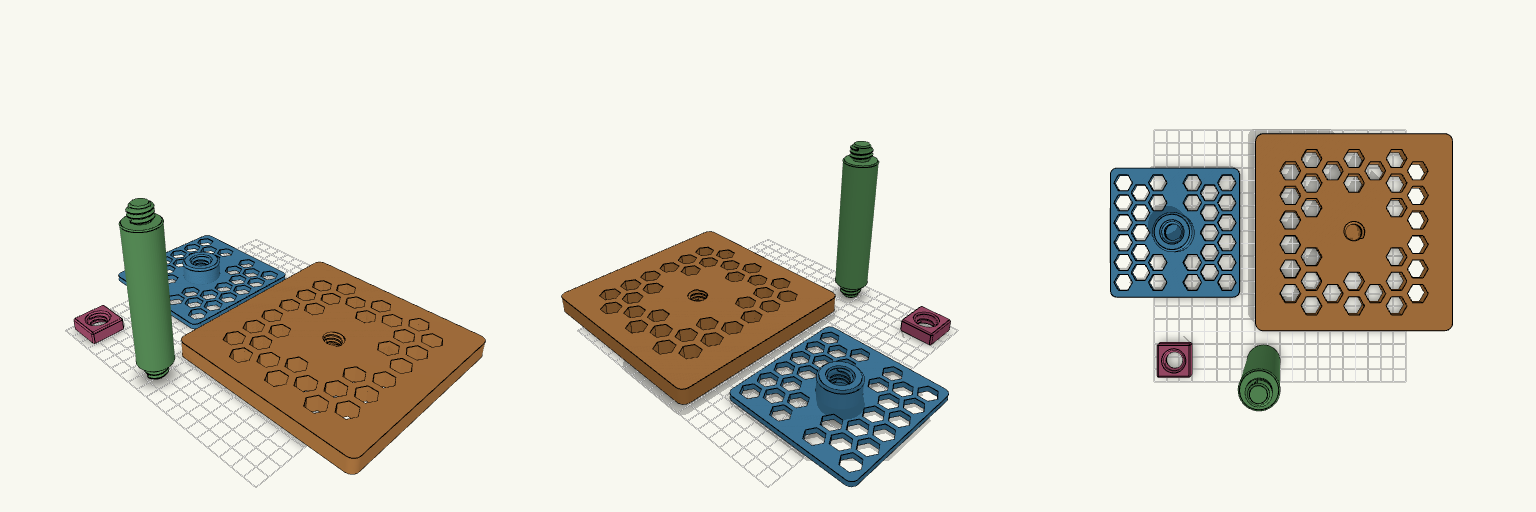
M16×3 Rod Henna Cone Stand, 4 and 6 Inch
Three-piece henna cone stand: a 4 × 4 inch (101.6 mm) upper plate, a 6 × 6 inch (152.4 mm) base and a 127 mm center rod, joined by M16 × 3 mm threads. Fitment Rod: 25.4 mm diameter, 127 mm long, 12 mm of M16 × 3 mm male thread on each end. Upper plate: 4 mm thick, 30 hex openings at 12.7 mm flat-to-flat, 30 mm threaded boss underneath. Base: 152.4 × 152.4 × 12.5 mm, solid outer frame and solid center, hex windows through the rest. Sockets: 0.3 mm radial clearance with chamfered entrances. The base socket leaves about 1 mm of floor and engages roughly 11.5 mm of thread. Check before printing Print the small thread test nut first and confirm it turns on the rod's M16 × 3 mm thread. Does not fit Not tested against any other thread standard. The base is no longer 25 mm tall, so it does not match the 25 mm spec.
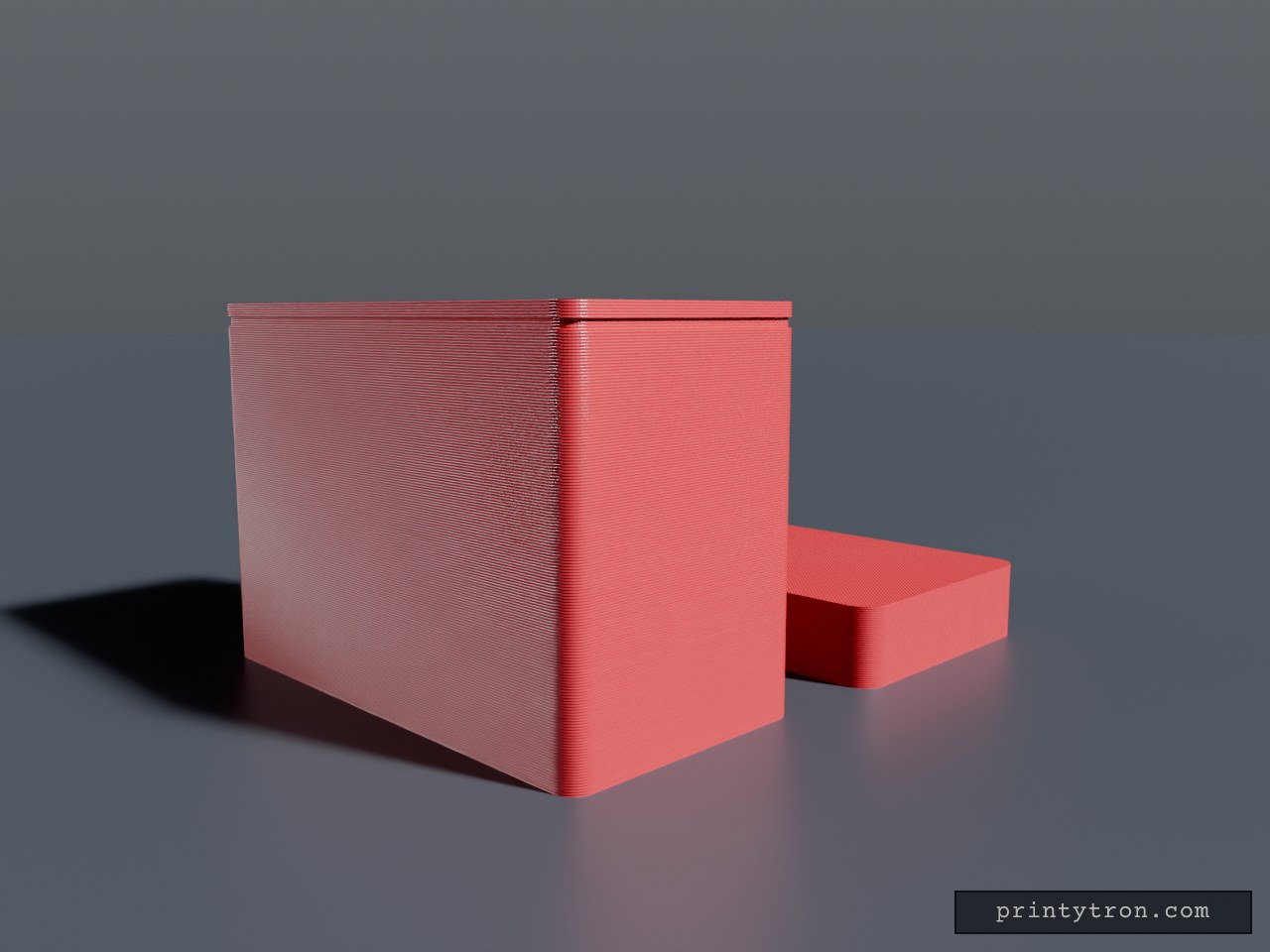
Two-Vial Storage Case with Snap Lid
A storage case for two 31 mm round, 71 mm tall vials, with a separate snap-on lid. Body and lid are two separate pieces, laid out side by side so each can be exported as its own STL. Each vial sits in its own round pocket, with a 4 mm solid wall between the pockets so the vials never touch at the base. The pockets have 0.6 mm of clearance and a 3 mm floor. A finger slot on the front of each pocket makes lifting a vial out easier. The lid fits over the top of the body and clicks onto a shallow groove around the rim. It leaves room for the vial tops that stick out above the body. Vial size: 31 mm diameter, 71 mm tall Body height: 60 mm, 2.5 mm walls Lid: 5 mm overlap onto the body, with an inward snap bead Made with resin printers such as the Elegoo Mars in mind