Distributeur de Gommettes Sport Tir
Created 1 months ago
Description
Boîte de distribution verticale dimensionnée sur mesure pour accueillir librement un rouleau de gommettes de 98 mm. Le rouleau repose par gravité, distribuant les autocollants via une fente frontale affleurante.
Détails de conception
- Fente ajustée : 18 mm de large pour guider précisément un rouleau de 16 mm.
- Typographie en relief : Inscription latérale robuste dépassant de 0,7 mm.
- Mécanisme sans axe : Le rouleau tourne naturellement contre les parois internes.
- Couvercle à glissière : Insertion par l'arrière avec un ergot de verrouillage tactile et une prise en relief.
Images
More like this
Explore more in Storage & Organization →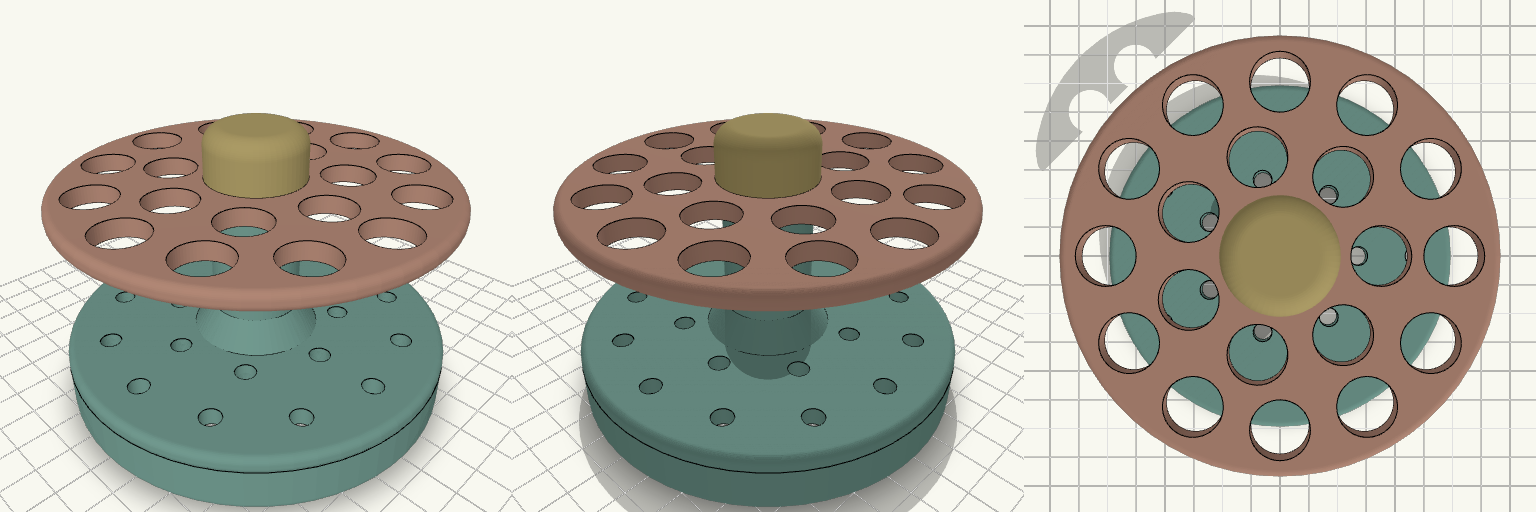
Mini 19-Cone Henna Carousel Stand
A compact two-tier henna cone stand: 110 mm trays, 60 mm apart, holding 19 cones tip-down, joined by a 25 mm central column and a screw cap. The top tray's 15 mm holes sit directly over 6 mm tip holes in the lower tray. A foot ring under the lower tray keeps cone tips off the table. Remix hooks Tray spacing: 60 mm now. Raise it for longer cones. Ring layout: 12 holes at 43 mm radius plus 7 at 25 mm radius. Wall between rings is about 3 mm, so adding holes means growing the tray. Tray diameter: 110 mm. Scale it up and add a third ring for more capacity. Hole size: 15 mm top, 6 mm bottom. Adjust to your cone brand. Pairs with: a turntable disc or non-slip mat under the foot ring.
Two-Piece Pro Controller Wall Holder
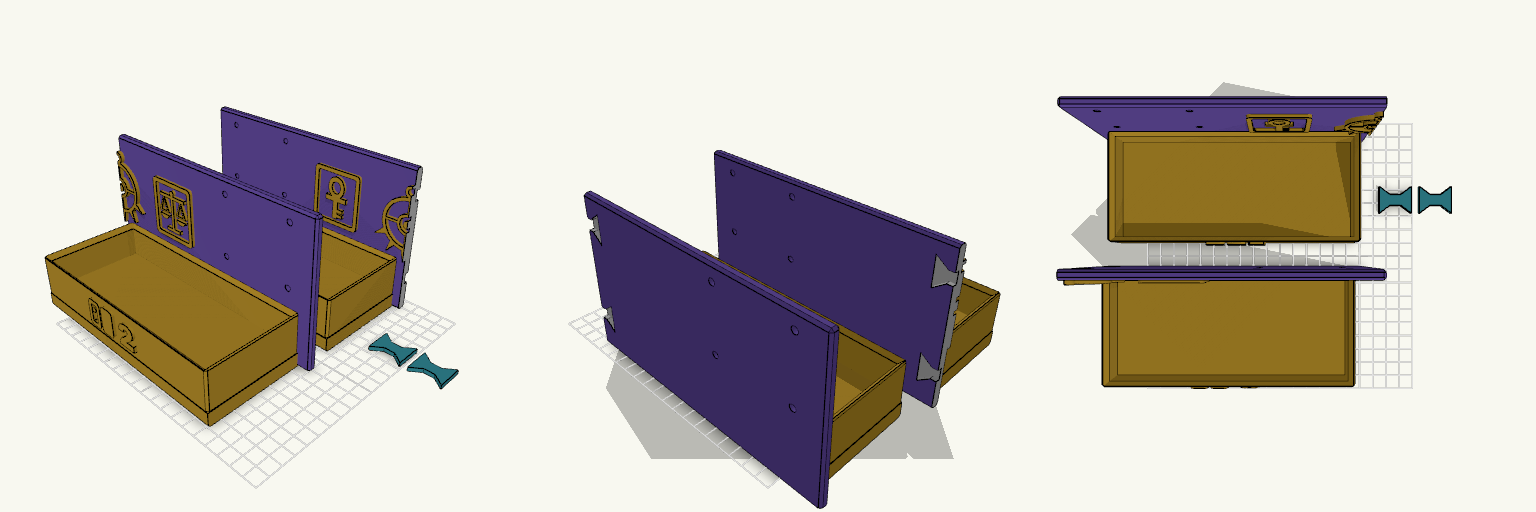
A 380 mm wall holder for a PS5 and a Switch Pro controller is too wide for most print beds, and a single plate can crack along its length. This version prints as two 190 mm halves that lock together with two butterfly keys. Fit and print Split line: centre of the plate, through the Yu-Gi-Oh! ring emblem Keys: two butterfly-shaped keys, 24 mm wide and 20 mm tall, 2.9 mm thick, printed flat Key pockets: cut 3.3 mm deep into the back face, 0.3 mm clearance all round Assembly: press the keys into the back pockets across the seam, then screw the halves to the wall. The wall holds the keys in Mounting: eight countersunk screw holes in total, four per half Printing: halves lie on their backs or stand on the shelf base. No supports are needed for the hollow blocks Pocket sizes are 166 mm wide and 70 mm deep, from typical controller sizes and not from measurements of a specific controller.
Staggered 5-Key Hook Extender
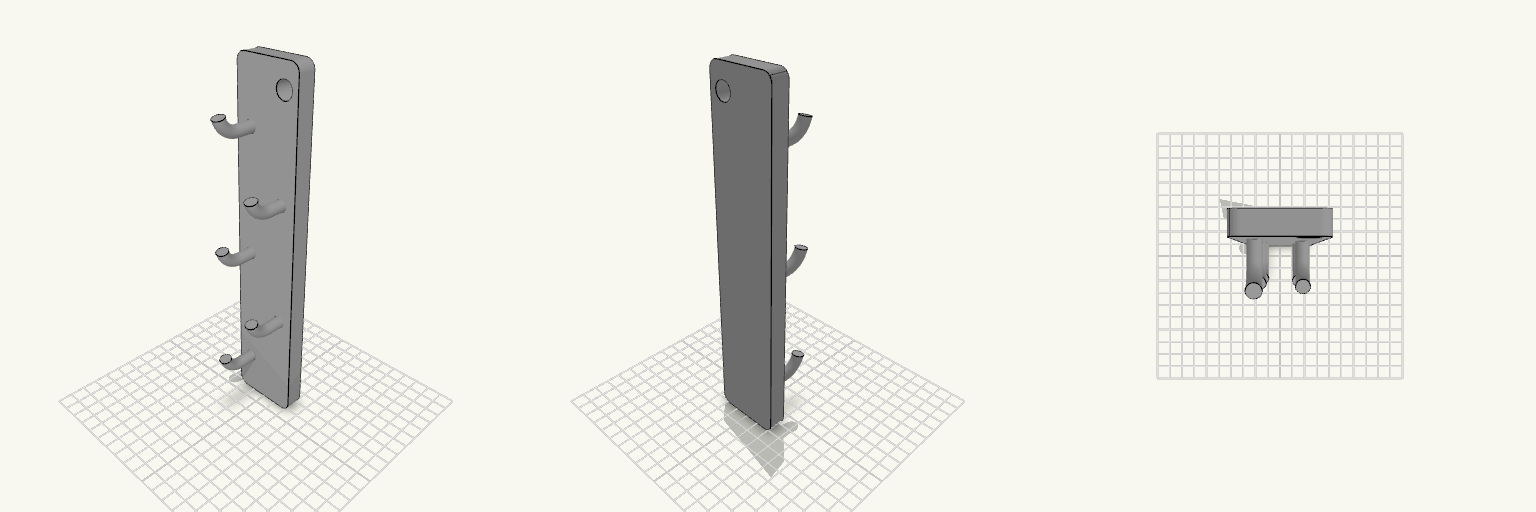
A tall back plate that hangs from a key rack and holds five keys on alternating left and right pegs, so fobs dangle without touching each other. The plate is 46.2 mm wide, 240 mm tall and 12 mm thick, with a 12 mm hang hole at the top right. Each peg is 8 mm in diameter, runs straight for 12 mm, then curves upward through 75° to keep rings seated. Remix hooks Plate thickness (12 mm): the easiest stiffness lever. Pegs are set into the plate face, so going thicker needs no other changes. Peg spacing (42 mm pitch): raise it for longer fobs, lower it to fit more pegs on a shorter plate. Bend angle (75°) and straight run (12 mm): lengthen the run for larger rings, ease the angle for a flatter peg. Hang hole (12 mm): resize to match your rack hook. Pairs with: any horizontal key rack with a post or screw head that fits the hole.
TANKER 3 Water
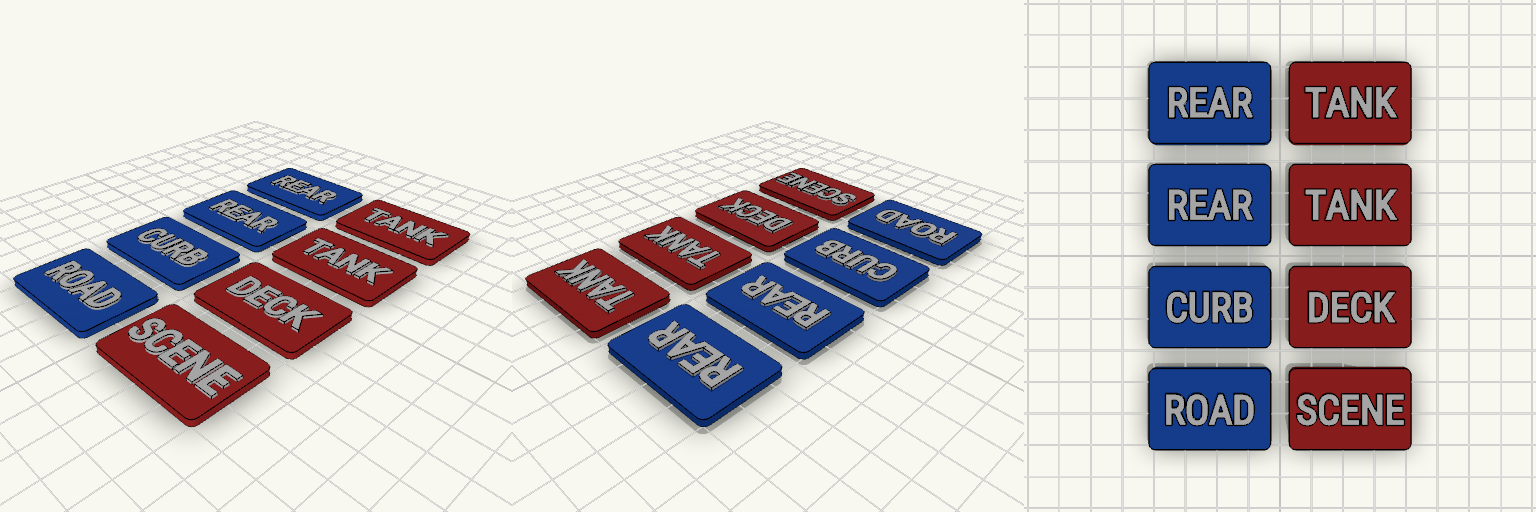
A matched set of eight small label plates with bold raised white lettering, styled like the enamel signage screwed to a garage wall, a shelf edge or the front of a storage bin. Each plate carries a single word — the four blue plates read ROAD, CURB, REAR and REAR, and the four red plates read SCENE, DECK, TANK and TANK — so a wall of bins, hooks, shelves or parking spots can be told apart at a glance. Colour does the sorting: blue for one group, red for the other, both with the same white lettering, so the two families stay distinguishable from across the room while reading as one set. The letters are thickened rather than enlarged, so the strokes carry weight without changing the plate size. The plates are plain rectangles with rounded corners and no fixing hole, leaving the full face free for the text — stick them on with double-sided tape or adhesive, or drill and screw them wherever they are needed. Dimensions Each plate: 1.5 in wide × 1 in tall (38.1 × 25.4 mm), 2 mm thick Rounded corners, no hanging hole Raised lettering: 0.8 mm proud of the face, strokes thickened for a heavier face Lettering centred horizontally and vertically on every plate Plates laid out 32 mm apart in two columns, blue set on the left, red set on the right Set contents Blue: ROAD, CURB, REAR, REAR Red: SCENE, DECK, TANK, TANK Print notes All eight plates sit flat on the bed and print without supports A single filament swap at letter height produces the two-tone face; painting the raised text works just as well The whole set prints in one go and comes off as eight separate tags The same layout takes any short word you want to swap in, as long as the plate size and the two-tone face stay the same.
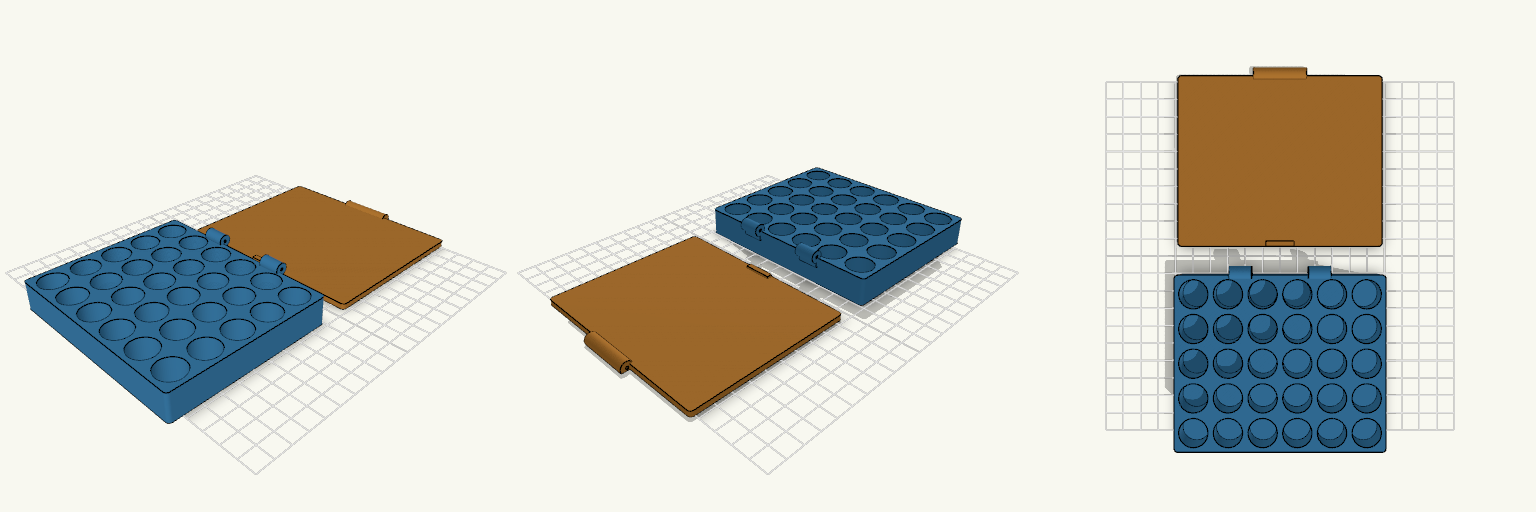
Apothecary Grid Hinged Pill Box
A pharmacy-drawer grid in miniature: thirty round wells in a 6×5 layout, topped by a lid that swings open on a real pin hinge at the back edge. The lid prints flat beside the tray and clicks into the hinge ears once a short pin is slid through. 30 slots, 16 mm wide and 14 mm deep Hinge pin hole sized for a 1.75 mm filament offcut, about 56 mm long Front finger tab on the lid for easy opening Lid and tray print without supports in separate pieces
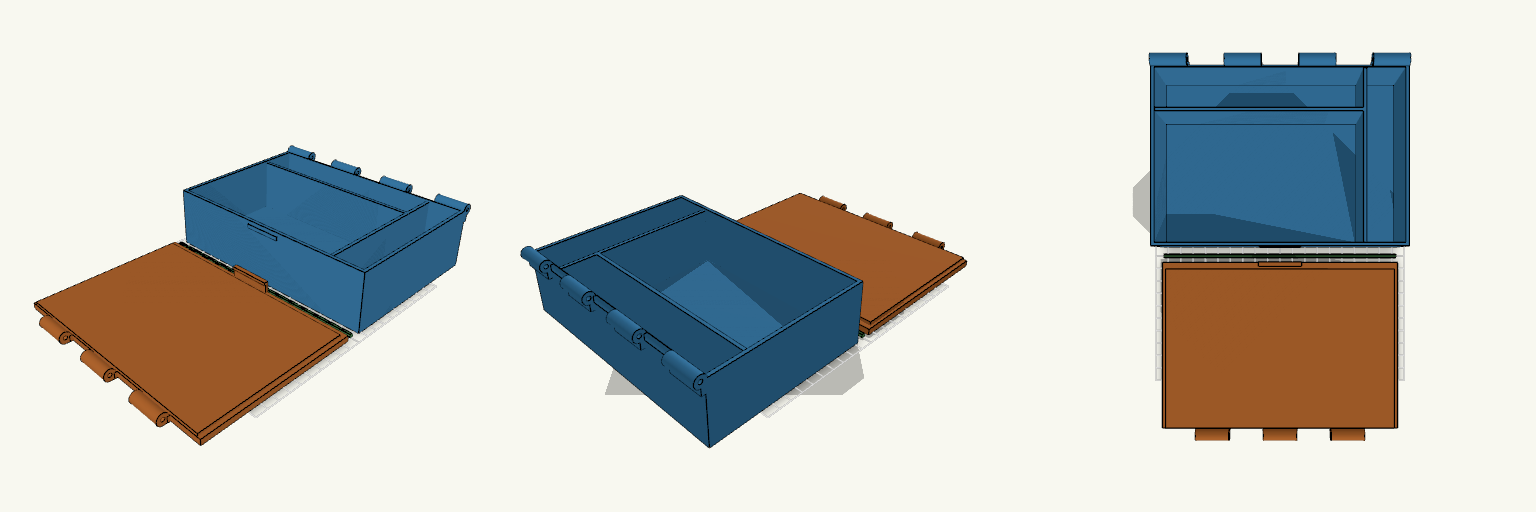
Hinged Latching Box With Front Divider
Small parts slide into one pile the moment the lid comes off; this hinged latching box splits the main space with a divider and adds a full-depth side bay so screws, clips and the like stop mixing. The main compartment clears 152 × 127 × 45 mm, with a 2.5 mm divider set 97 mm back from the front. A 2.5 mm wall separates a 28 mm wide, full-depth compartment on the right, and that bay has no cross divider. The walls stand 2 mm taller than the divider, and the divider top sits level with the underside of the lid lip, so the full 45 mm of height is usable. Fit and compartments Main compartment: 152 × 127 × 45 mm clear (width × depth × height). Right side compartment: 28 mm wide × 127 mm deep × 45 mm high, separated by a 2.5 mm wall and open for its full depth; overall inside width about 182.5 mm. Divider: 2.5 mm thick, 97 mm back from the front of the main compartment; front bay 97 mm deep, rear bay about 27.5 mm clear in the main area. The divider stops at the side-compartment wall so the right bay stays open. Walls and floor: 2.5 mm; the divider is 2 mm shorter than the walls so the lid lip clears it. Lid: 2 mm inner lip locates it on the base. Hinge clearance The lid's back edge has notches where the base's hinge knuckles pass through it. The base's back wall is cut away where the lid's knuckles swing down into it. Both cuts carry roughly 0.3 mm of play, so the lid closes without catching. Latch The hooked tab on the lid is set so the hook sits close over the catch bump without binding. Closed, the gap between the top of the hook and the underside of the catch bump is about 1.3 mm. If it prints too tight to snap over, lengthen the tab by a fraction of a millimetre at a time; if it is too loose, shorten it the same way. Printing and assembly Prints as three separate pieces: base, lid, and hinge pin. Base footprint is about 187.5 × 140.6 mm; the lid is about 187.5 × 142.3 mm; the pin is about 185.5 mm long and 3 mm in diameter. The pieces sit apart on the plate with gaps: the lid is flipped so its flat top face is on the bed, and the 3 mm pin lies flat in the gap. None of the three touch. If a slicer imports the file as one body, use Split to objects or Separate parts. Hinge: seven interleaved knuckles with a 3 mm pin. Use a 3 mm rod or filament, or print the pin. Slide the pin through the knuckles after printing; the lid hinges on it and the front latch holds it shut.