Honeycomb Pen Organizer Box
Made by a Guest
Created 3 months ago
Description
What it's for
A desktop container designed to hold pens, markers, and tools upright. The interior is divided into a continuous honeycomb matrix, keeping individual pens separated and stopping them from leaning or sliding to the bottom of the box.
Dimensions
- Overall footprint: 106 mm wide × 72 mm deep
- Overall height: 96 mm
- Hexagon size: 17.5 mm flat-to-flat (comfortably accommodates standard pens and thicker markers)
- Wall thickness: 1.5 mm perimeters and interior walls
Print notes
- Print it upright as oriented.
- No supports required.
- The dense honeycomb acts as a structural infill for the walls, making the final piece remarkably rigid.
Images
More like this
Explore more in Desk & Tech →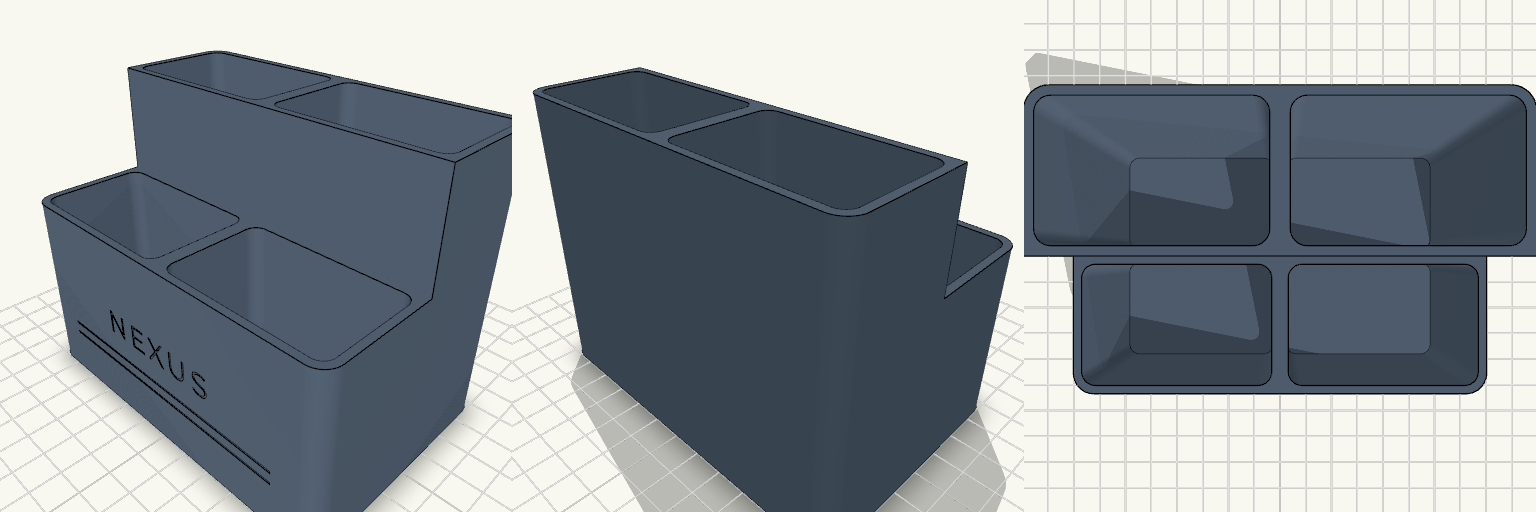
NEXUS Desk Pen Holder
What it's for A minimalist desk organizer with four open-top compartments for pens, pencils, markers and small stationery. A stepped front lowers the front pair for easy reach to small items, and a small NEXUS logo is engraved on the front face. Dimensions Footprint: 120 × 80 mm Height: 95 mm rear, 60 mm front Wall thickness: about 2.4 mm Flat base, rounded vertical corners, chamfered base edge Remix ideas Change the logo text to a name or initials. Make the front compartments deeper for scissors or rulers. Add a non-slip pad under the base.
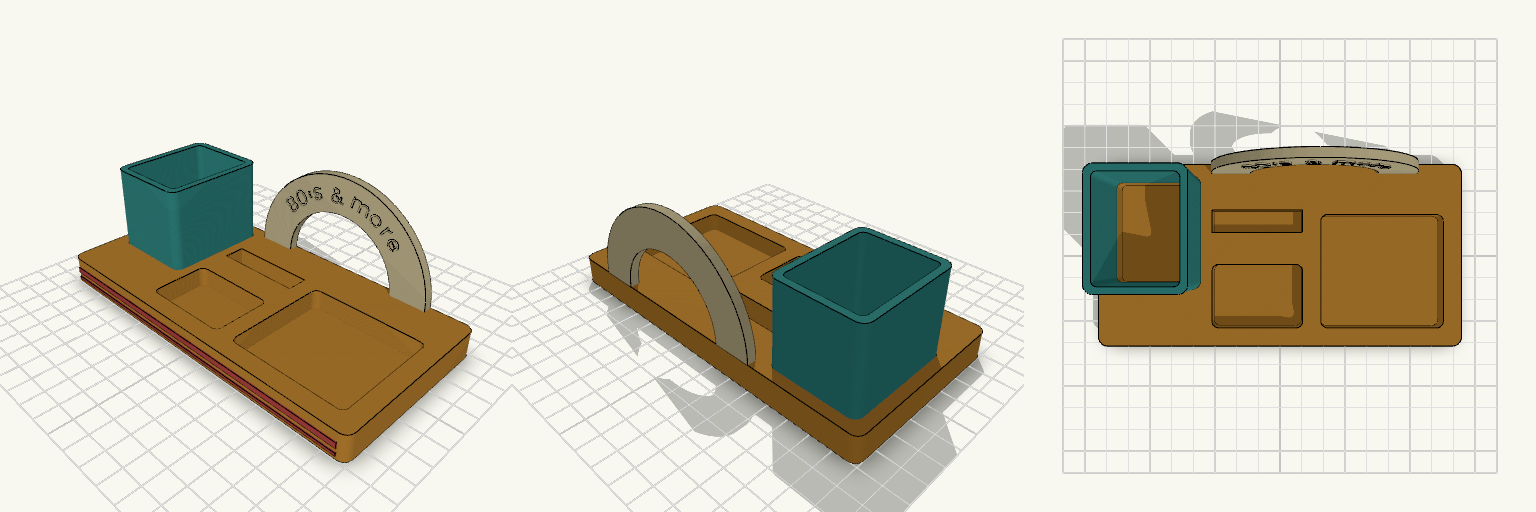
Retro Desk Organizer with Pen Tower
What it's for A retro-styled desk organizer that keeps pens, cards and small items in one place. A teal pen tower, a card or phone slot and two open trays sit on an amber base. A red racing stripe runs along the front. A cream arched backrest has a round window and embossed "80's & more" lettering following the curve. Dimensions Base tray: 160 × 80 × 12 mm Pen tower: 40 × 50 mm footprint, rising to 50 mm overall height Card / phone slot: 40 × 10 mm opening Front tray: 40 × 28 mm Large right tray: 54 × 50 mm Arched backrest: about 90 mm wide, top at 57 mm Lettering: embossed 1 mm, 7 mm tall Remix ideas Change the lettering to a name or a different slogan. Resize the trays for coins, clips or sticky notes. Recolour the stripe and backrest to match a different retro palette. Widen the card slot for a tablet.
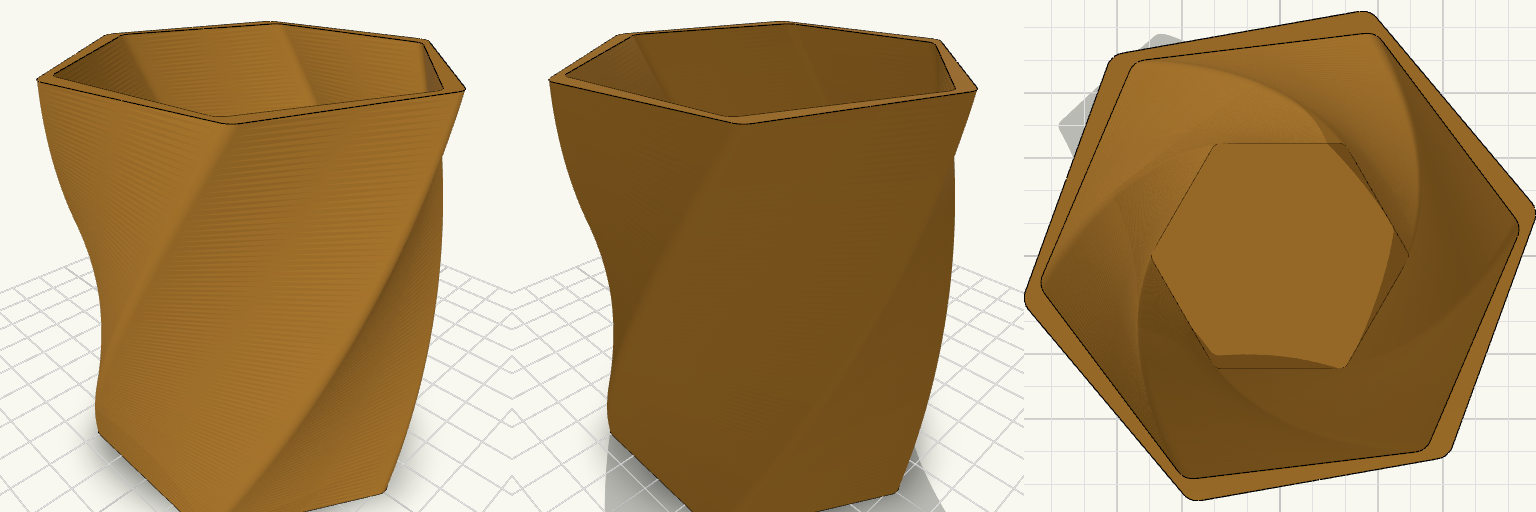
Helix — Twisted Hexagonal Pen Cup
A hexagonal desk cup with the twist built into its silhouette: the six-sided body rotates 70° from bottom to top, so the facets read as a slow spiral rather than a straight column. It stands 90 mm tall and measures about 83 mm across the corners — enough for pens and pencils, with room to spare for scissors or a ruler. The hexagon sits flat on the desk, giving it the weight of a solid block rather than a floating one. Walls are 3 mm and the floor is 4 mm, so it holds its shape under a full load without feeling heavy. Dimensions Overall height: 90 mm — takes pens, pencils, scissors and a ruler Width across corners: about 83 mm Wall thickness: 3 mm Floor thickness: 4 mm Features Six-sided body with a 70° twist from base to rim Flat hex base sits directly on the desk for a stable, blocky stance One named area, Twisted Cup Body, printed as a single piece Flat facets catch the light along the spiral Print notes Print upright as oriented on the plate. The twist is gentle enough that the walls lean without needing supports, and the flat hex base gives a broad, secure contact patch. A matte dark filament shows the spiral facets best; 0.2 mm layers with two or three perimeters make a sturdy cup, and a finer layer height sharpens the edges of the twist.
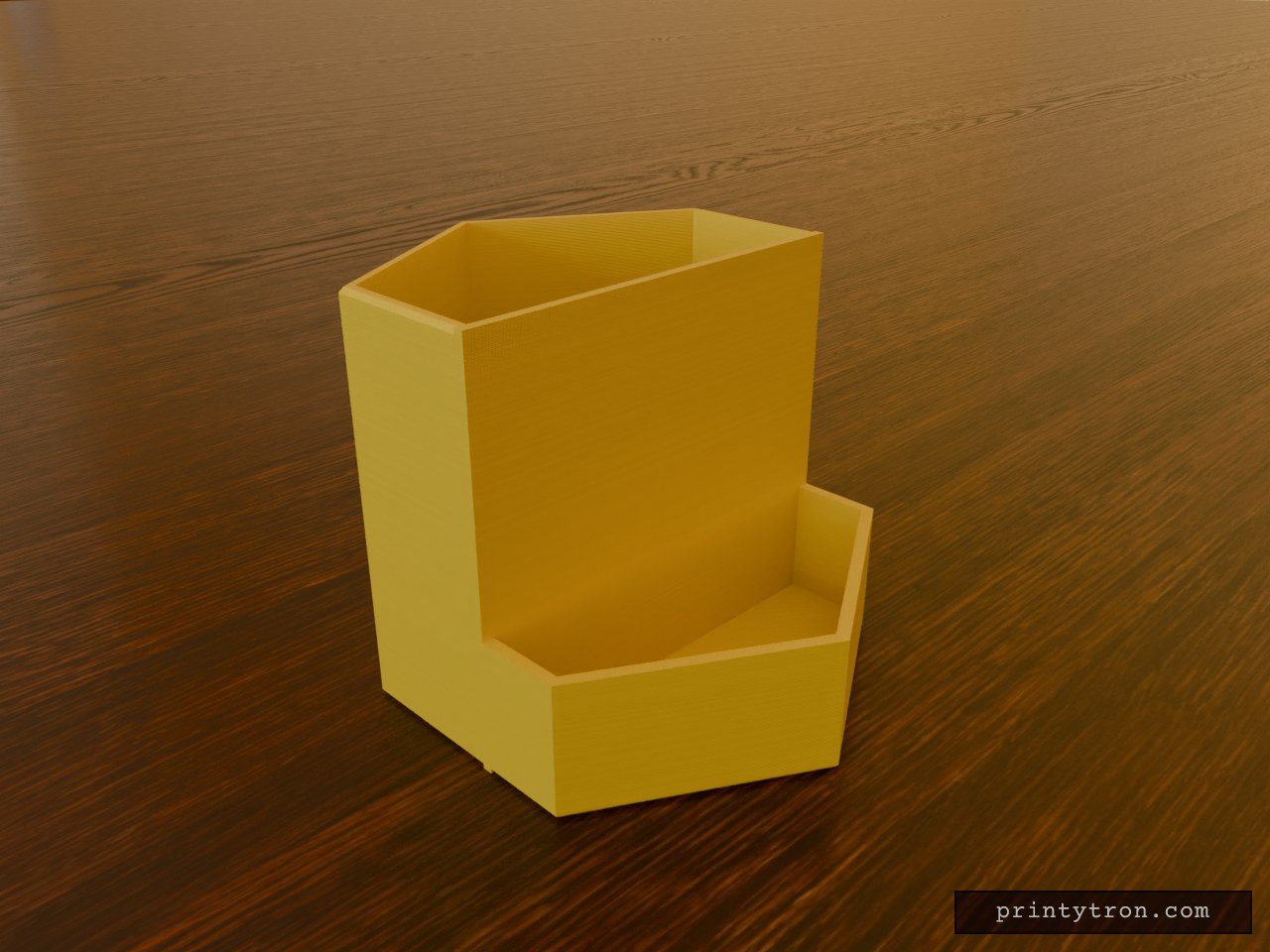
Hexagonal Pen Cup with Divider
A hexagonal desk cup, 80 mm tall and 100 mm point to point, split into two sections by an internal divider wall. The larger section runs full height and holds pens and pencils. The smaller section is cut down to one third of that height, about 27 mm, and works as a tray for paper clips, erasers and other small items. The divider sits slightly off-centre so the short tray takes up roughly 40% of the floor area. The walls are 2.4 mm thick and the base is 3 mm thick. The top and bottom outer edges have a small chamfer. Overall size: 100 mm across corners, 80 mm tall Tall pen section: full height, about 60% of the floor Short tray section: one third height, about 40% of the floor Wall thickness: 2.4 mm, floor thickness: 3 mm Prints upright as one piece with no supports needed
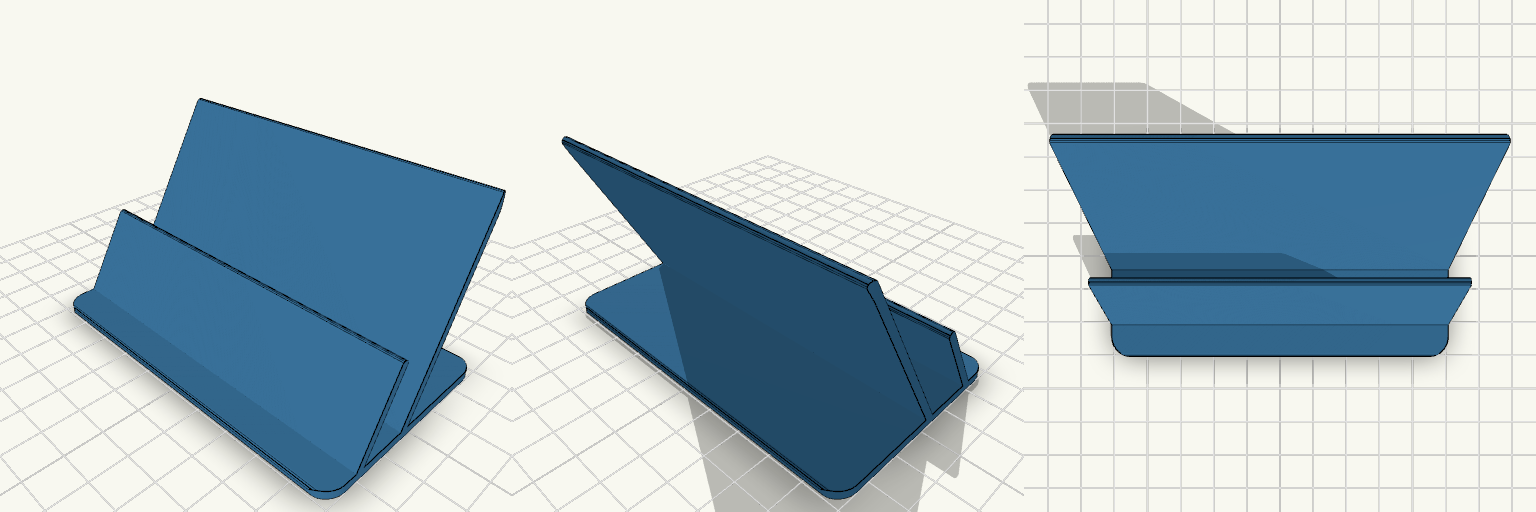
手机支架
A phone stand for a phone that keeps sliding flat or tipping over: a 60° backrest holds it upright, and a front lip stops it sliding out. Key numbers Base: 100 × 60 mm, 2.2 mm thick Backrest tilt: 60° from the table Slot: 12 mm wide, measured between backrest and front lip Walls: 2.2 mm throughout Corners: rounded in plan and along the profile edges Printing Print with the base flat on the bed. No supports needed: the backrest leans back at 60°, which stays within a typical overhang limit. Phones with thick cases may need a wider slot.
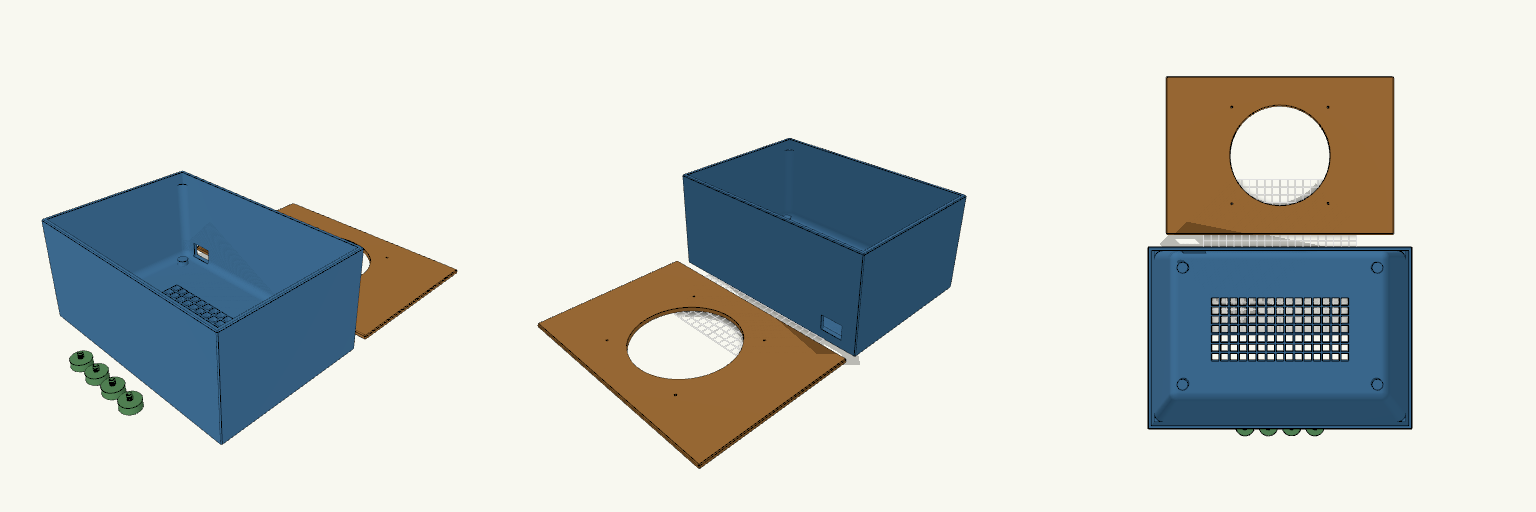
Mini-Server-Box with Feet, Lid and Fan
What it's for A solid-walled enclosure for hiding and cooling equipment. Every side wall is closed, and the only airflow path is a sturdy grid cut into the floor, so the box stays dark and quiet from the sides. A 30 × 20 mm cable hole in the lower rear corner lets wiring in and out, and the flat lid lifts off for access. The model prints as separate pieces: the box, the lid and four feet. The lid is a flat plate with a locating lip underneath, slightly larger than the box on every side so it overhangs and can never drop inside. Each foot carries its own coarse threaded stud, so the feet screw directly into matching threaded holes in the floor bosses with no separate fasteners. Dimensions Box: 290 × 200 × 130 mm, with 4 mm walls, solid on all four sides, an 8 mm floor, and a 50 mm solid border around the floor grid. The floor grid is centred on the narrower floor. The thicker floor makes the mesh bars deeper, so airflow per opening drops slightly. Inside fillets: 10 mm radius on the vertical corners and the floor-to-wall edges, stopping 15 mm below the rim. The top 15 mm stays square so the lid and its lip fit without changes. Lid: 294 × 204 mm, 9 mm overall with a 5 mm plate and underside lip; overhangs the box by 2 mm on all sides; 140 mm fan opening and four 3 mm fan screw holes at 124.5 mm center-to-center. Cable hole: 30 × 20 mm in the rear wall, set 20 mm from the left edge and 12 mm above the bottom, inside the solid section so it doesn't weaken the corners. Feet: four solid 24 mm discs, 10 mm tall, each with a 6 mm thick, 8 mm long threaded stud on top; 18 mm overall. The studs use a 1.5 mm pitch. Foot sockets: four corner bosses widened to 14 mm, with threaded holes 6.6 mm across and 11 mm deep at the same 1.5 mm pitch, giving about 0.6 mm clearance on diameter. Print notes Print the box, lid and feet separately. Print the lid lip-side up so its flat face sits on the bed and the lip rises clear of the plate. The floor grid benefits from enough perimeters to keep the bars sturdy. The threads have not been test-fitted; if the feet bind, raise the socket diameter slightly, and if they wobble, lower it. Test-fit the fan and check its screw-hole spacing before committing to a full print. Remix ideas Add a removable filter frame behind the fan opening. Add internal standoffs or a shallow tray for mounting equipment inside. Resize or duplicate the rear cable port for thicker cable bundles. Swap the floor grid for a denser or more open pattern to change the airflow.