Industrial Wearable Electronics Enclosure
Created today
Description
A heavy-duty three-part electronics enclosure designed for wearable prototype suits. Features a slide-and-lock fabric mounting plate that allows the main box to be removed without unthreading straps.
- Main Box: 140 × 90 × 40 mm with 3 mm walls and 10 mm side ports for external sensors.
- Mounting Plate: Slotted for fabric straps, featuring a male dovetail rail that slides into the main box and locks with a single pilot screw.
- Lid: Secures with four M3 screws into tapped corner bosses, featuring a 90 × 50 mm blank recess for a separate logo plate.
Images
More like this
Explore more in Workshop & Tools →
Console — Custom Electronics Enclosure
This is a comprehensive, dimensionally accurate parametric enclosure designed for DIY electronics. Laid out to securely house a 16×2 character LCD and four tactile push buttons, it uses standard M3 machine screws with captive nut traps for secure and repeatable assembly. The design separates the tactile switch bodies from the actual visible button caps, ensuring a clean and professional appearance. Features Locating Lip: Recessed rabbet ensures the top cover nests tightly and squarely onto the bottom shell. Component-Specific Pockets: 12×12 mm push-button switches are secured from the underside, operated by independent retained caps. Hidden Mounting: The 16×2 LCD is held flush against the top window from the inside via a custom bezel, keeping the surrounding PCB hidden. Directed Ventilation: Cooling slots are restricted to the lower front face, allowing flush wall mounting at the rear. Hardware Needed 4 × M3 × 12 mm machine screws 4 × M3 hex nuts (5.5 mm across flats) 4 × 12×12×7.3 mm tactile switches 1 × 16×2 Character LCD (JHD162A style)
Biofloc Monitor Station Enclosure
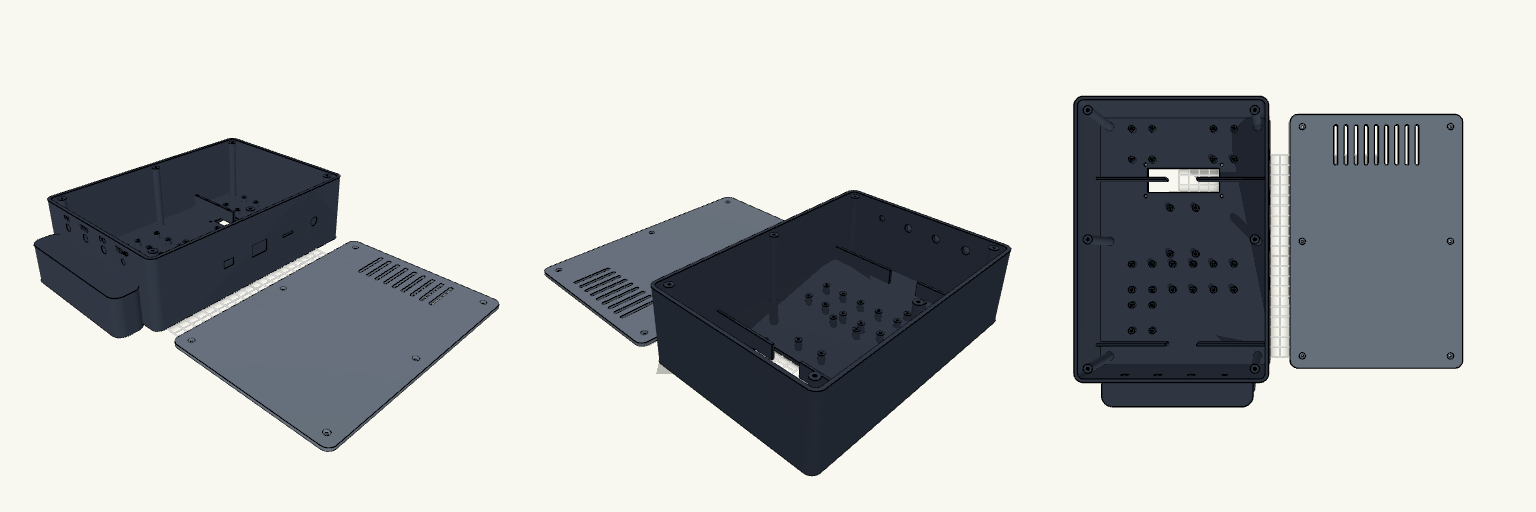
An enclosure is only as good as the snarl of wires it prevents. This is a heavy-duty two-part monitor housing built specifically for FDM printing, designed to group, separate, and anchor a complete suite of biofloc water-quality electronics without turning into a bird's nest inside. The layout isolates the battery compartment at the bottom and keeps the DC buck converters and relay in a ventilated top section, leaving the central deck clear for the ESP32 and an array of sensor interfaces. Internal divider walls double as cable routing channels, forcing the wiring to stay orderly. Core Features Printability: Both halves print completely flat on the build plate (Z=0). The integrated bottom handle is flush with the front face to avoid overhangs. Dimensions: 170 mm width × 250 mm height × 75 mm depth. Hardware Required: 6× M3 screws for the rear cover; additional M3 hardware for the internal standoffs and the 16x2 LCD faceplate mount. Ports: Bottom panel holds 4× sensor ports (3× 8mm, 1× 6mm) with engraved labels. Right panel holds cutouts for 12V DC, an SD card slot, a rocker switch, and USB programming access.
Experimental Filter Housing V1
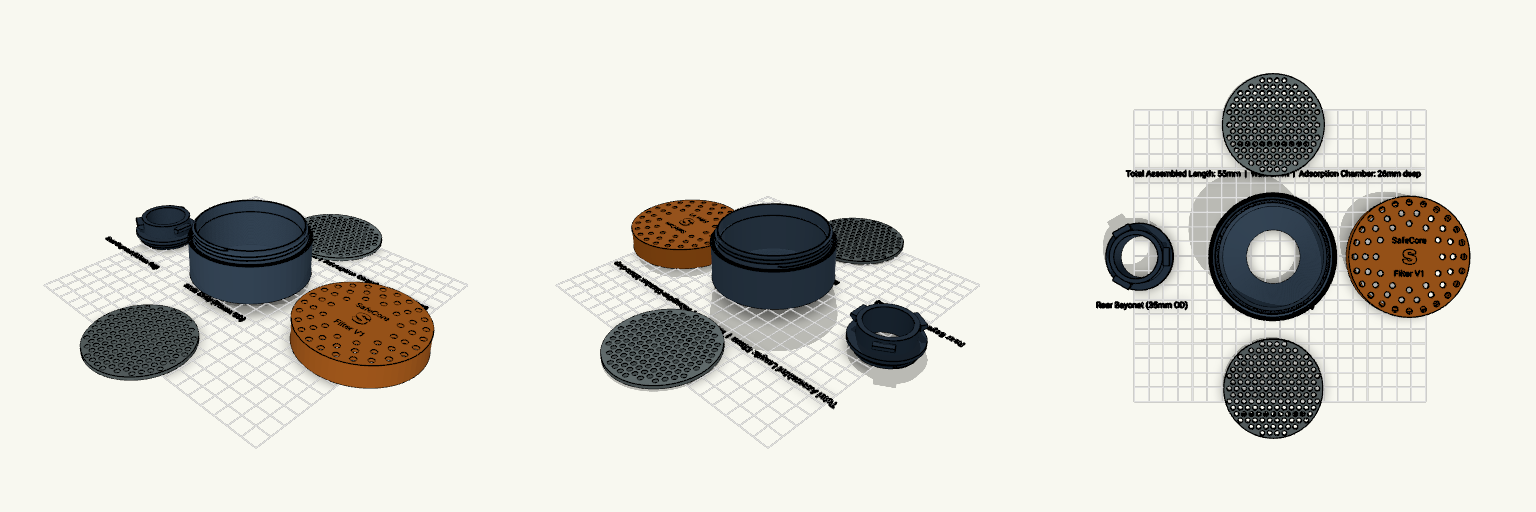
A multi-part FDM-optimized housing for testing granular and particulate filter media. Designed with discrete chambers, retaining grids, and standard O-ring sealing surfaces. Disclaimer: This is a strictly non-certified prototype for experimental projects. Do not use for certified respiratory protection. What it's for Testing layered filtration concepts. The housing accommodates a 26mm deep granular adsorption bed and an 8–10mm particulate filter section, separated by an air-distribution spacer. Media is retained by drop-in mesh grids, allowing rapid replacement during testing. Dimensions Overall Assembled Size: 80 mm diameter × 55 mm length Wall Thickness: 3 mm main shell Adsorption Chamber: 68 mm ID × 26 mm depth Connections: Rear standard 3-tab quarter-turn bayonet (35 mm OD tube) Print notes Orientation: Parts are laid out flat on the bed. The front cap should be flipped 180° in your slicer so its top face rests on the build plate. Supports: None required. The bayonet tabs are modeled with a 45° chamfer profile to print cleanly without support material. Tolerances: Threaded interfaces are built with 0.5–1mm diametrical clearances to accommodate standard PETG shrinkage.
Acoustic Harmonica Silencer Enclosure
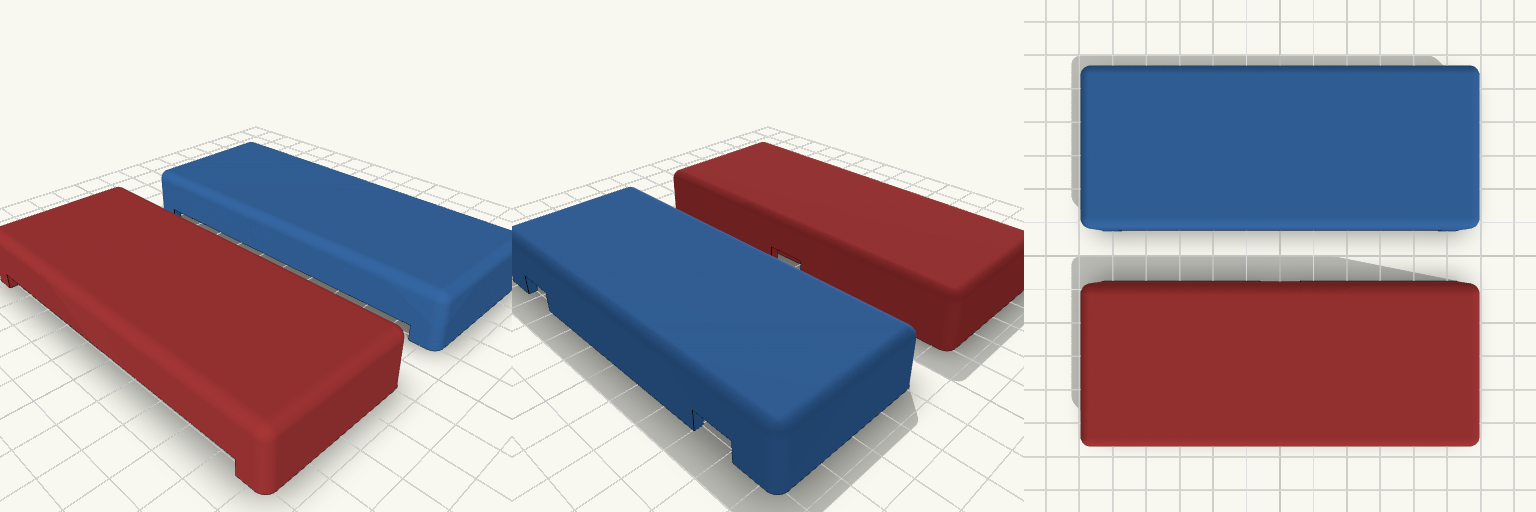
A custom-designed acoustic enclosure built to fit a standard 10-hole diatonic harmonica (specifically dimensioned for the Fender Blues Deluxe). This silencer is built to drop external volume during practice while preserving a totally natural playing feel. The enclosure features a wide front opening that allows direct lip contact with the harmonica body, avoiding any forced embouchure changes. The rear of the enclosure acts as a miniature acoustic labyrinth, forcing outgoing air through staggered baffles and multi-chamber pathways to break up sound waves before they exit the exhaust ports. Remixing and Assembly Clearances: The default harmonica cavity includes a 0.4mm clearance, with 4mm of allocated depth at the rear for installing your own acoustic foam. Two-Piece Shell: The model splits into a top and bottom shell, joined by integrated friction-fit alignment pins. Print Settings: Prints completely support-free when the large flat mating surfaces are placed face-down on the build plate. PLA or PETG recommended for rigidity and snap-fit durability.
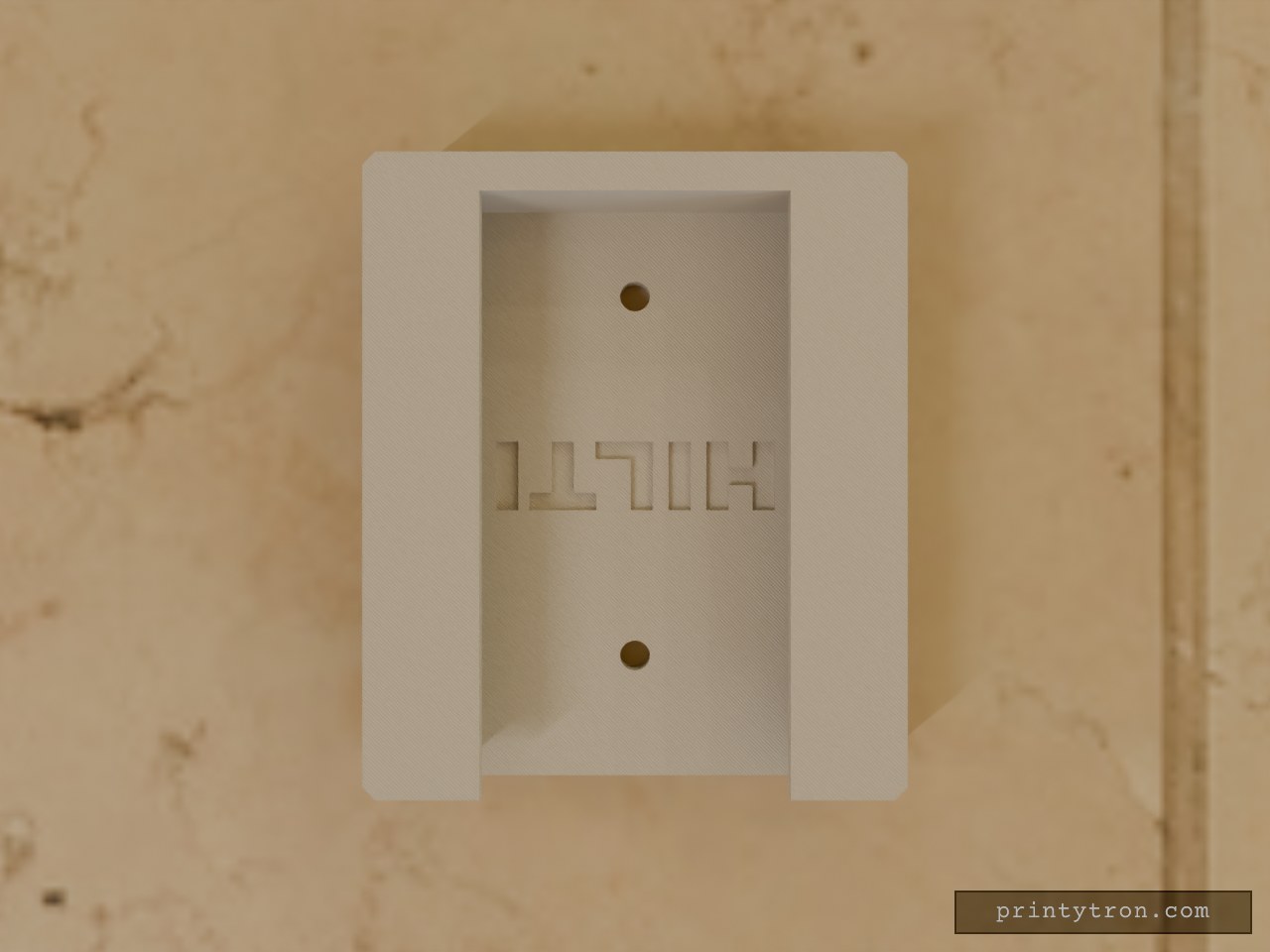
Hilti Nuron Battery Mount
A wall-mounted receiver bracket for Hilti Nuron batteries. Heavy battery packs love to lever short brackets right out of the drywall. This bracket gives them a solid vertical footprint to spread that load, catching the battery's sliding interface on an internal U-channel with a dead stop at the base. Internal Channel: 63mm wide (48mm opening) Clearance: Counter-sunk screw holes keep the hardware below the sliding surface Detail: Features a debossed HILTI logo on the backplate that stays clear of the sliding path
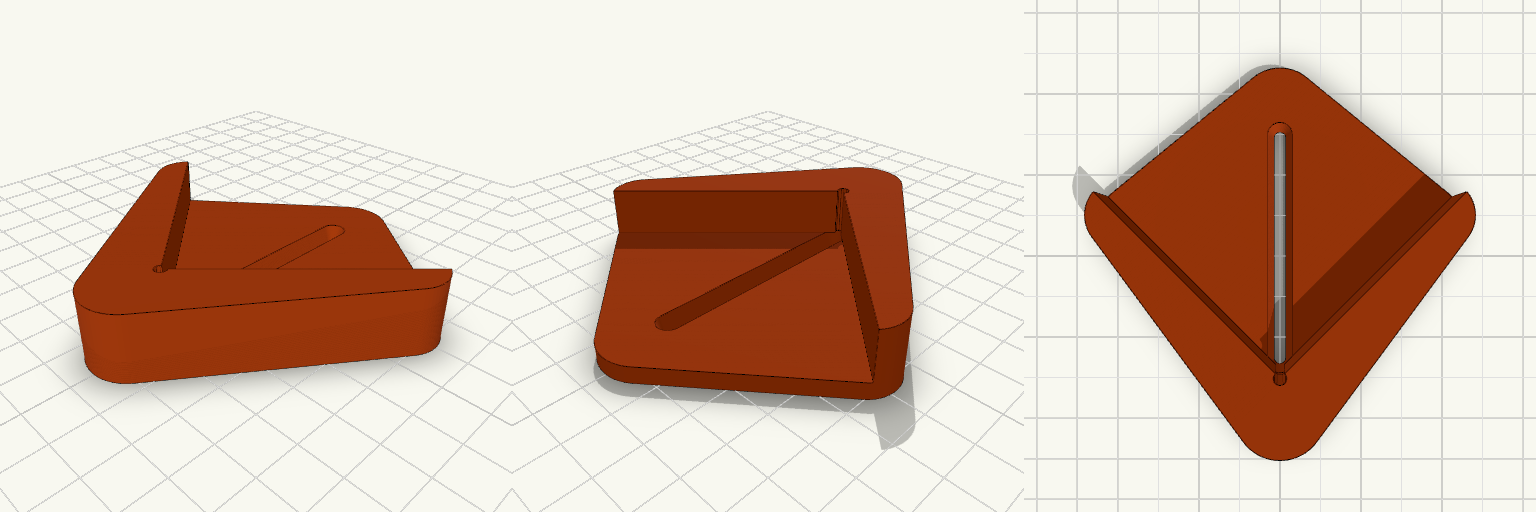
Self-Centering V-Block Finder
A precision marking tool designed to locate the exact center of round and square stock. Eliminates the need to eyeball center lines when preparing material for drilling, turning, or joining. What it's for Self-Centering Base: A 90-degree V-groove securely seats the tool on both round dowels and square cuts. Tapered Pencil Slot: The marking slot tapers from 6mm down to a 1.5mm slit, physically forcing the pencil lead onto the true center line. Corner Relief: The apex of the V-groove includes a circular relief, preventing the sharp corners of square stock from binding. Dimensions Stock Compatibility: Accommodates material widths from 10mm up to 60mm. Overall Size: Measures roughly 86mm wide and 90mm long. Base Plate Thickness: The main plate is 4mm thick, providing a rigid straight edge. Remix ideas Extend the length of the plate and slot for marking deeper along the stock. Widen the V-arms to accommodate larger stock sizes like fence posts. Modify the slot taper to perfectly capture a specific mechanical pencil or marking knife.