Lamp Bases, Shades and Diffuser Set
Created 25 days ago
Remixed once
Description
A set of mid-century lamp parts that all share one coarse 6 mm-pitch thread, so any shade fits any base. The set has two fluted shades (round and square ribs), a white adjustable diffuser and several bases: tall, short, grooved, two tripods, a flat-leg grooved tripod and a dowel-leg hub.
Remix hooks
- Flat-leg tripod: legs are 16 mm wide slabs (before scaling) with two grooves, 3.2 mm wide, down each outer face. Change the groove count, offset (±4 mm) or width.
- Leg height and spread: hub height 70 mm and foot radius 70 mm set the splay. Raise both for a taller version.
- Thread spigot: 52 mm across, 38 mm long. Keep it to stay compatible with the shades.
- Pairs with: either fluted shade and the diffuser. The 42 mm bore runs straight through for the bulb and cord.
Images
More like this
Explore more in Decor & Display →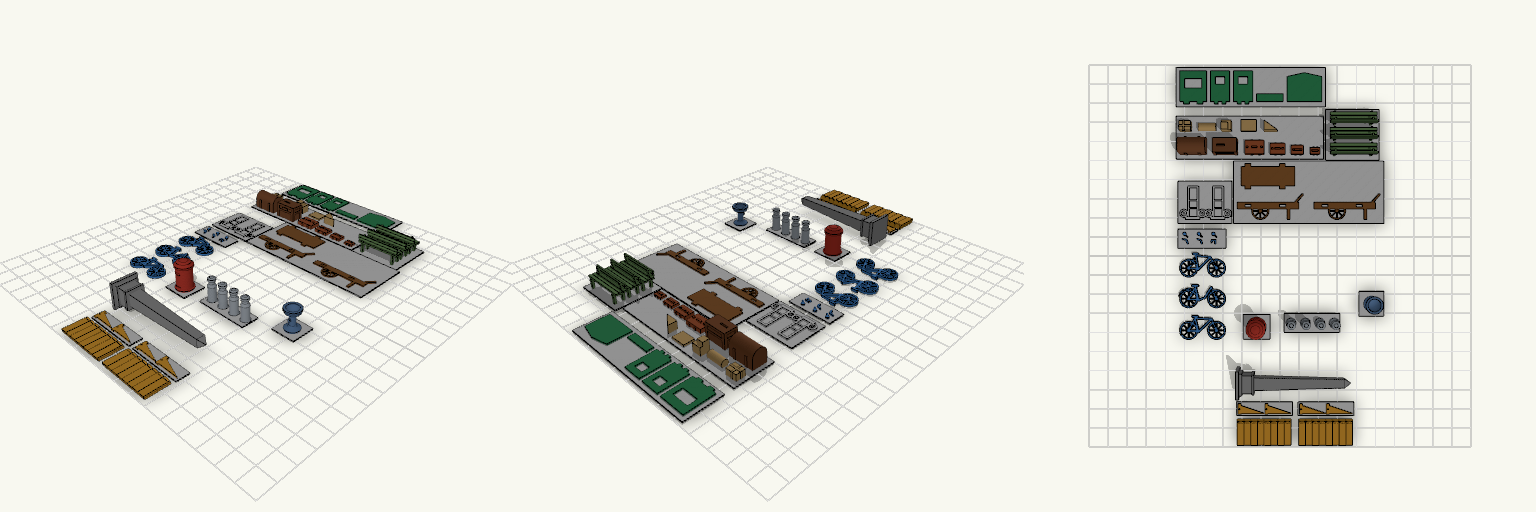
OO Scale Station Set with Sack Trucks
An OO-scale railway station accessory set printed on one plate, with webs joining the grouped items. The set includes bicycles, a postbox, an obelisk, shop canopies with brackets, a flat-pack barrow, milk churns, luggage, a newspaper kiosk, benches, a drinking fountain and two sack trucks. Sack trucks: two flat 1.2 mm silhouettes, each about 10 mm wide and 17 mm tall, with a toe plate, crossbars and two wheels. Web: 0.4 mm sheet shared by both trucks, left of the barrow. Printing: thin parts need a fine FDM or resin printer.
Pebbl — Aquarium Plant Weight
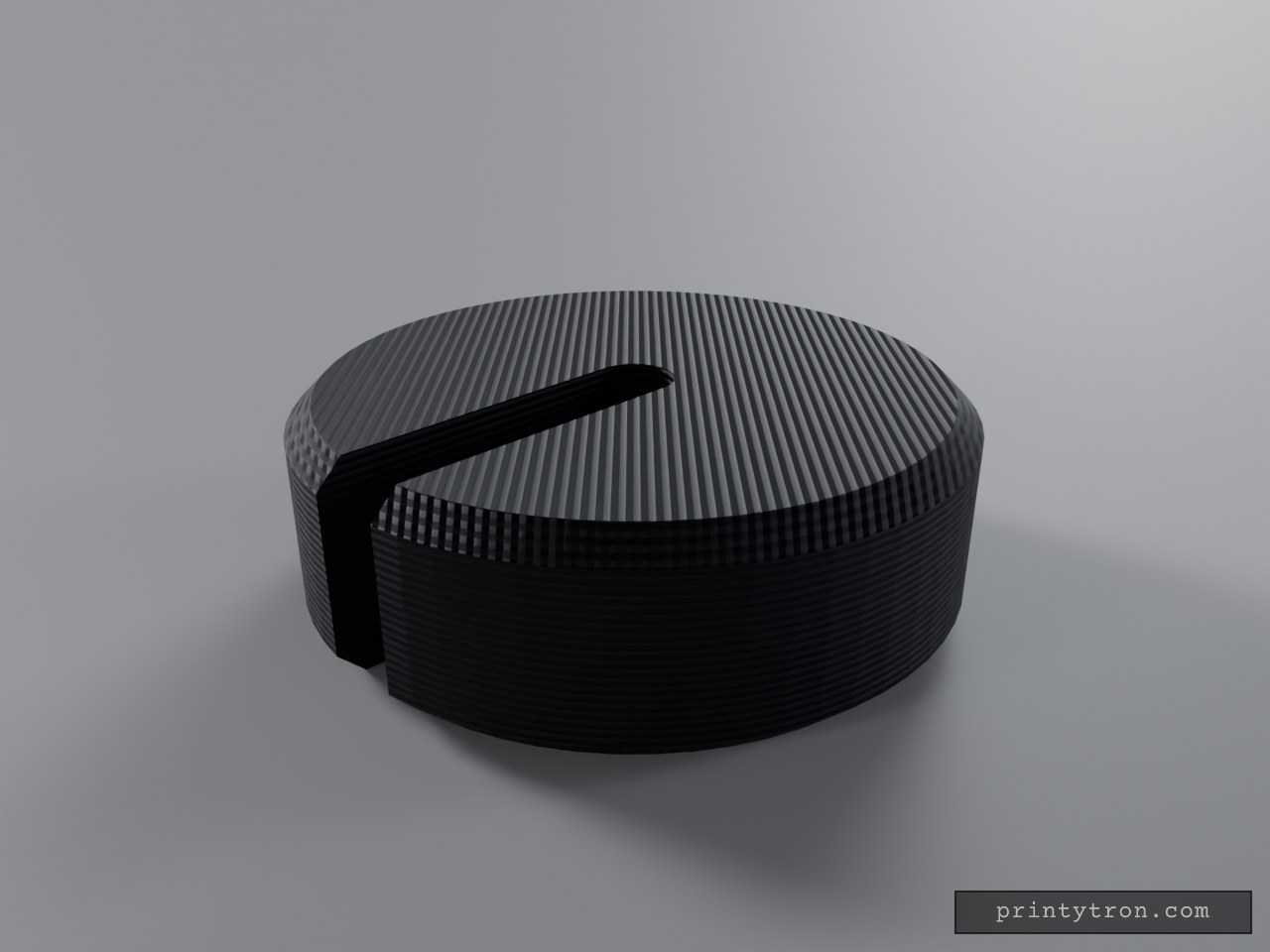
Pebbl is a small slotted disc that holds aquarium plant stems down in the substrate. The stem slides in through the open slot and seats in a rounded pocket at the centre, so the plant stays put without wire, glue or clips. The flat, compact profile sits low and is easy to bury under gravel or sand. Dimensions Diameter: 25 mm Thickness: 8 mm Slot width: 3 mm, running from one edge to the centre Edges: 1 mm chamfer on the top and bottom rims Slot end: rounded at the centre so a stem seats cleanly Print notes Prints flat on the build plate with no supports. PETG at high infill is a good choice for sinking weight. Plastic is light, so larger plants may need a thicker or wider disc. Use an aquarium-safe filament.
Wall-Mounted Running Medal Holder
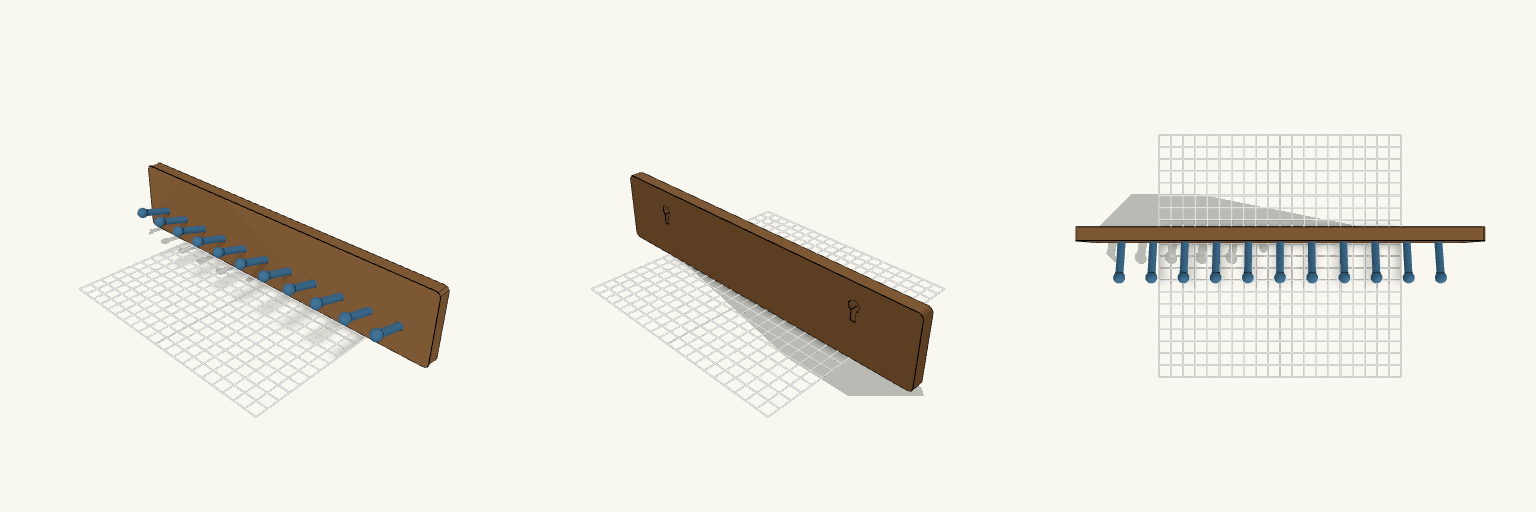
What it's for A wall-mounted rack for displaying running medals. Each ribbon slides onto one of eleven angled prongs that project from a flat backboard, so medals hang in a neat row and stay visible instead of ending up in a drawer. The prongs tilt up and finish in a ball tip, which holds the strap in place once it is looped on. The backboard is left plain above the prongs, giving the row of medals a clean edge to hang against and keeping the silhouette simple to print. The front face is completely smooth — the hanging slots are cut only into the back, so no holes or screw heads show through the display side. Dimensions Backboard: 300 mm wide × 60 mm tall × 10 mm deep Medal prongs: 11 prongs at 25 mm spacing, each reaching 30 mm out from the backboard at a 15° upward tilt, with ball tips Hanging slots: two keyhole pockets cut 6 mm into the back, 200 mm apart, leaving 4 mm of solid material at the front Prong spacing is the number worth checking against your own medals — wide straps need more room between prongs, and the spacing can be opened up if yours run thick. Roughly 10 to 15 medals fit across the 300 mm board. Print notes Prints as one piece; no assembly required. Lay the backboard flat on the plate so the prongs build up in front of it. The tilt keeps them self-supporting, so no supports are needed. Because the slots are stopped short of the front, the screw heads sit recessed in the back rather than passing through the board. Two wall screws 200 mm apart carry the holder. Remix ideas Widen the backboard to 400 or 500 mm and add prongs for a larger collection. Add a second row of prongs below the first to stagger medals in two tiers. Add a raised name plate or a finish-line banner along the plain top edge using the same prong layout. Materials Rigid filament is the better choice here; the prongs carry real weight and a soft or flexible material will let them droop.
OO Mill Front and part-tapered Chimney Set
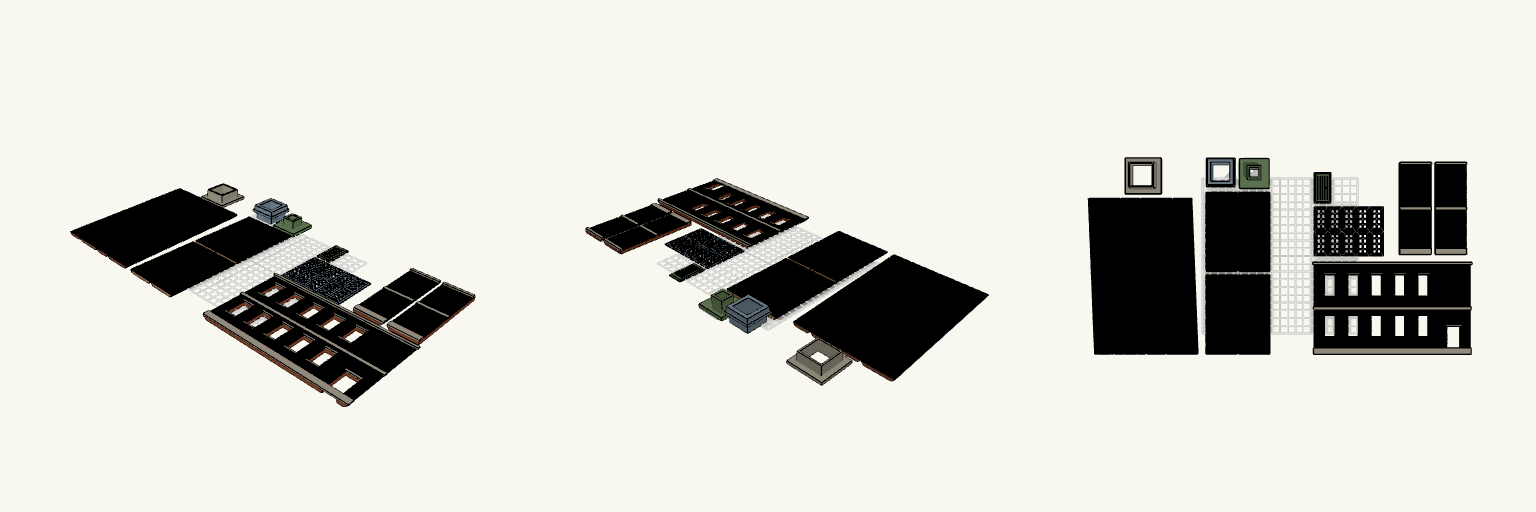
A four-panel tapered chimney with a straight brick base, paired with a half-relief two-storey mill front in OO scale. The wall, ten window frames and plank door all print flat. Each window frame and the door now carries a thin web around its outside edge to hold it down during printing. Remix hooks Web width (webw, 1.8 mm): wider grips better; keep it under half the 4 mm spacing so neighbouring webs stay separate. Web thickness (webt, 0.3 mm): roughly one or two layers. Thinner peels off easier, thicker holds harder. Window grid (14 x 28 mm frames, 4 mm spacing): change the spacing if the web is widened. Pairs with: the chimney set on the same plate layout, and a clear or painted glazing insert behind the frames. Print notes Trim the web with a hobby knife after printing, before fitting frames into the wall openings. Wall is 200 mm long and needs its own print separate from the chimney set.
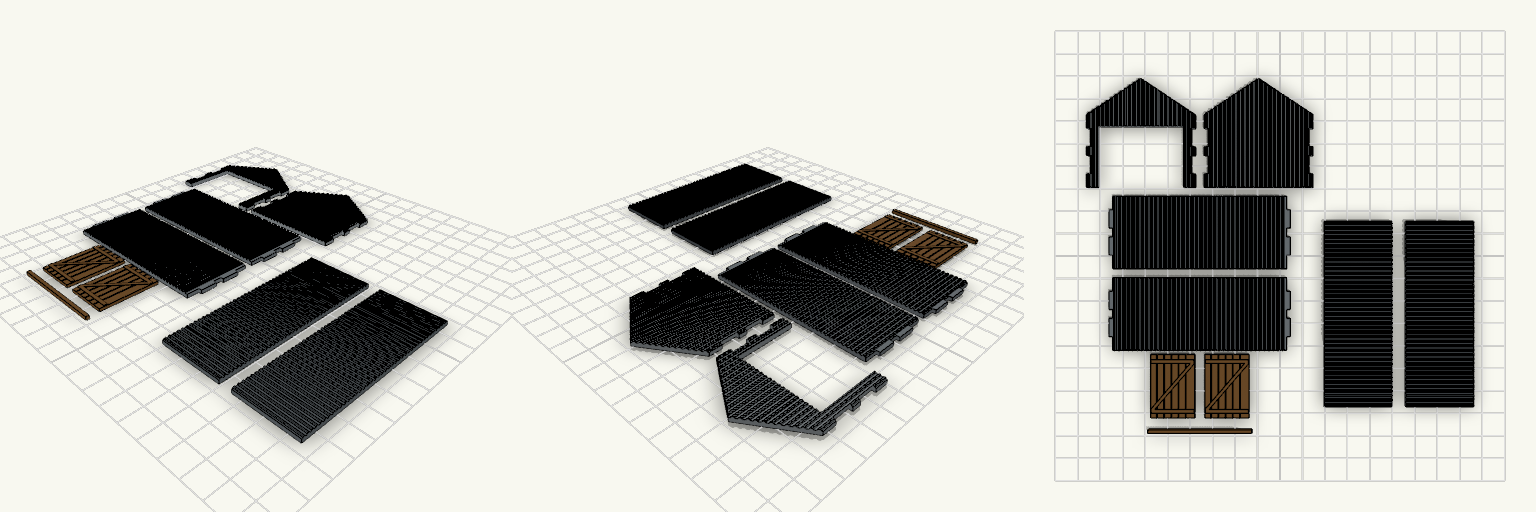
Flat-Pack OO Scale Corrugated Garage
A flat-pack OO scale garage with corrugated iron panels, a gable roof and sliding timber doors. Every piece prints flat on the bed with no supports, then assembles with glue. The side walls carry tabs that pass through slots in the front and back gable ends, with 0.3 mm clearance. The two roof panels sit on the gable slopes. Two plank-and-brace doors hang from a separate rail across the front opening. Footprint: about 48 × 80 mm, ridge height about 48 mm Pieces: 2 side walls, 2 gable ends (front one has the door opening), 2 roof panels, 2 doors, 1 rail Panel thickness 1.6 mm with raised corrugation ribs Print flat, glue the joints, fix the rail above the opening
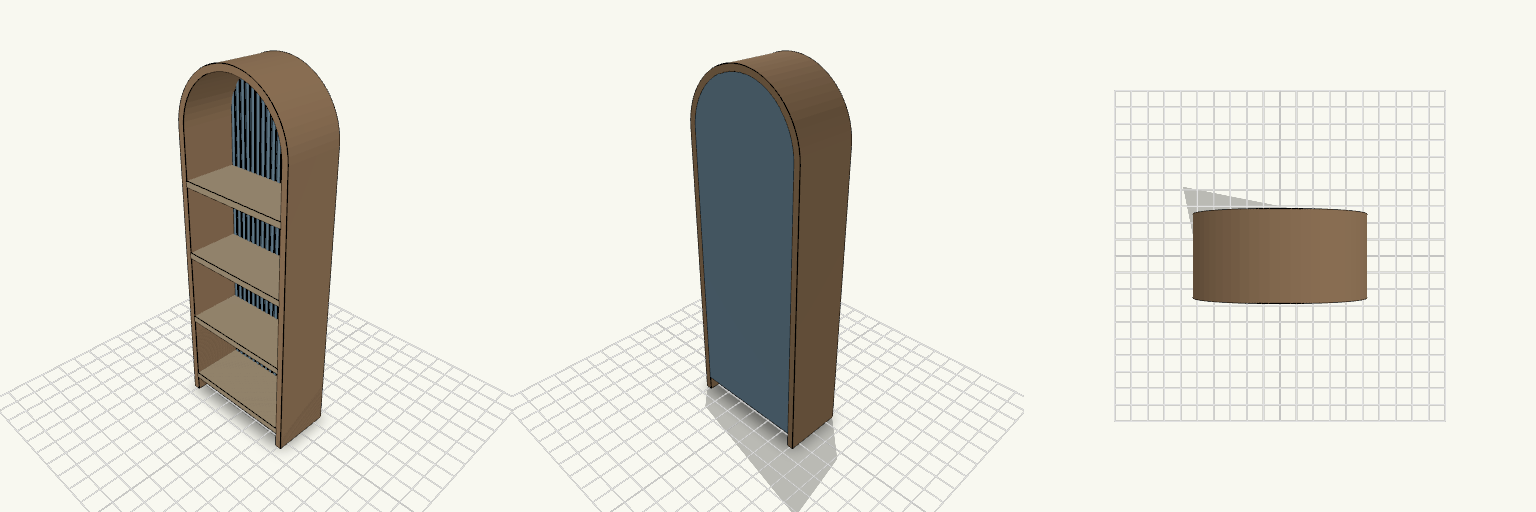
Arched Fluted Bookshelf, 63.5x177.8 mm
Miniature arched-top bookshelf, 7 in tall and 2.5 in wide, with four shelves and a vertically fluted back panel that mimics shiplap. The side walls extend below the bottom shelf to form feet, lifting it off the surface. Overall size: 63.5 mm wide x 30 mm deep x 177.8 mm tall Top: semicircular arch, 31.75 mm radius Back: 18 fine half-round vertical flutes Feet: 8 mm, formed by the side walls Wall and shelf thickness: 3 mm Prints upright as one piece; the arched top and shelf undersides may benefit from supports