Moonlit Ghost Chain Swing Display
Created 23 days ago
Remixed once
Description
A friendly sheet-wearing ghost sits on a chain swing hanging from the horn of a crescent moon, in the spirit of a Halloween nursery rhyme. His blue tennis shoes dangle below the sheet and his hands grip the chains above his head, the way a kid holds on mid-swing.
- Crescent moon with shallow craters
- Chain swing with a rounded seat
- Cut-out eyes and a recessed smile
- Flat rounded base keeps the whole scene standing upright
Sand the edges before handing it to a child.
Images
More like this
Explore more in Decor & Display →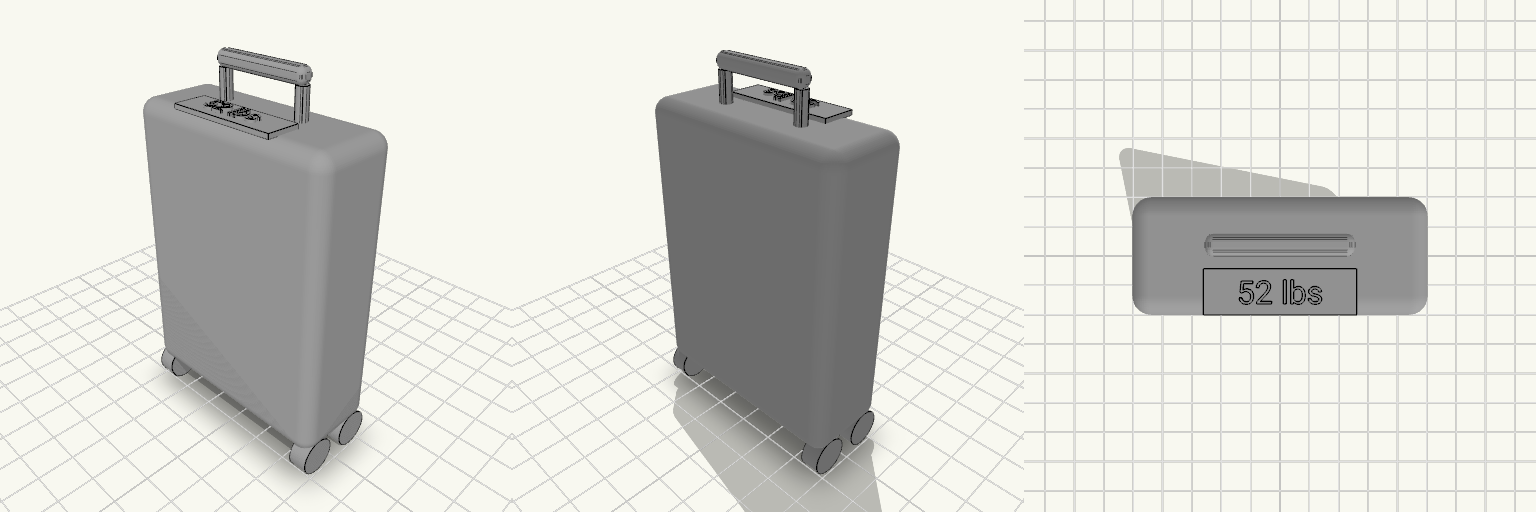
Miniature Suitcase with Handle, Wheels and Weight Display
What it's for A miniature suitcase standing upright on four sideways-mounted wheels, with a pull handle on top and a small thin scale plate set into the top face just in front of the handle. The plate carries a raised readout of 52 lbs, so the piece reads as a luggage scale at a glance. It works as a small desk ornament, a travel-themed display piece, or a scale prop for a dollhouse or diorama. The whole thing is one plain neutral finish, with no colour coding or recessed front screen. Dimensions Overall footprint: 60 × 24 × 100 mm (width × depth × height, as it sits on the print plate) Wheels: mounted sideways, axles running across the width of the case, so the body rests on them Weight plate: a small thin panel on the top face, in front of the handle Readout: raised 52 lbs lettering, picked as a believable airline-limit weight — say if you want a different figure Print notes The model prints as a single piece lying on its wheels, so no supports are needed under the body. The raised readout is small — a 0.4 mm nozzle with fine layer heights keeps the digits and the "lbs" legible, and a 0.25 mm nozzle gives crisper text. The thin top plate is shallow, so check that your bridging over that area is clean. Remix ideas Change the readout to a different weight, or leave the plate blank for a custom label. Swap the handle for a telescoping version, or add corner guards to the body. Scale the case up to hold small items, or down to keyring size. Finish A single neutral colour suits the plain, serious look — the design relies on shape and the raised text rather than colour contrast, so any filament works.
70 mm Cratered Moon Sphere2
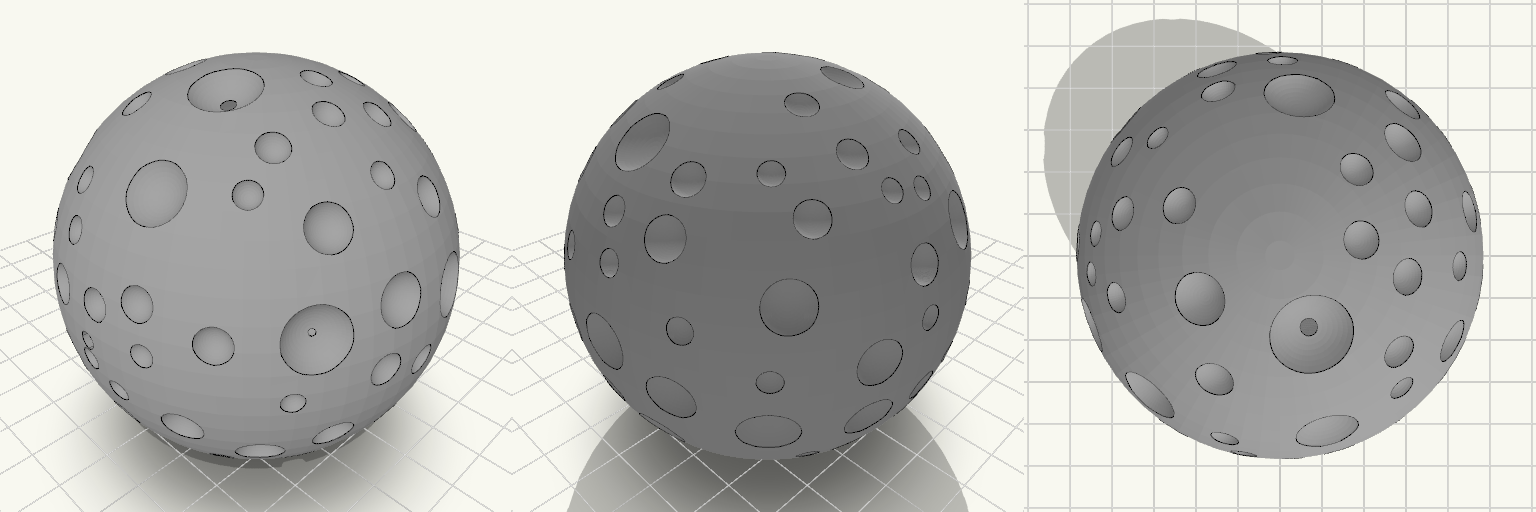
A roughly 70 mm ball pitted with 60 craters of uneven size and placement, so it reads as a moon rather than a clean sphere. The craters run from about 4 mm to 14 mm across and 0.5 mm to 1.5 mm deep, scattered across the whole surface — a few sit on the underside, so the face changes as you turn the part. A 3 mm blind hole enters from the front and stops at the centre, leaving the back solid; it runs 35 mm deep and takes a thin wire or cord pushed in from one side. The ball is a hollow shell with a 3 mm wall, so there is no interior to fill — the hole opens into a sealed cavity that is otherwise closed. That keeps the weight and material down, but the top of the cavity is an overhang: it may need supports or it may sag slightly inside, where only you will see it. The outside still touches the build plate at a single point, so print it with supports or a wide brim, or split it at the equator into two hemispheres that each print flat-side down and join afterwards. The crater field is surface detail, so almost nothing here is locked in. Remix hooks Diameter — about 70 mm on all three axes. The crater field and wall thickness scale with it; much past 200 mm and you are into split-and-glue territory on most beds. Wall thickness — 3 mm as it stands. Thinner walls save material but print shakier; thicker walls swallow the crater depth, so deepen the craters if you go up. Crater count and size range — 60 craters from 4 mm to 14 mm across. Raise the count and tighten the range for a finely pocked surface, or drop to a couple of dozen large ones for a few big basins. Crater depth — 0.5 mm to 1.5 mm. Shallower craters print cleaner overhead and read best under a wash; deeper ones catch more shadow but want slower overhangs — and they must stay well under the wall thickness. Minimum gap — a pair or two still meet, which the gap check misses because the cut widens slightly on the curved surface. Widen the spacing and count each crater's true surface width if you want every bowl cleanly separate; expect slightly fewer craters as a result. Wire hole — 3 mm wide, 35 mm deep, blind, entering from the front and ending at the centre. Scale it with the wire you have. Running it all the way through gives a threaded bauble; moving it off-axis gives one that hangs tilted. Cavity openings — the shell is sealed apart from the wire hole. A drain hole or a screw cap turns the hollow into a container. Distribution and split point — bias the scatter toward one hemisphere for a near-side/far-side look; cut at the equator for two support-free halves, or off-centre for a shallow cap and deep bowl, with a locating lip to register the halves. Obvious variants A flat-bottomed version that stands on a shelf or glues to a base without supports. A solid version when weight matters more than material, with the full-depth craters of the earlier build. A scaled-down single-piece print when you want the cratered shape without the support hassle. Pairs with A thin wire or cord pushed into the 3 mm blind hole for a hanging decoration, with a dab of glue to hold it. A socketed ring or base if you add a flat, for a stand-up display.
Arched Fluted Bookshelf, 63.5x177.8 mm
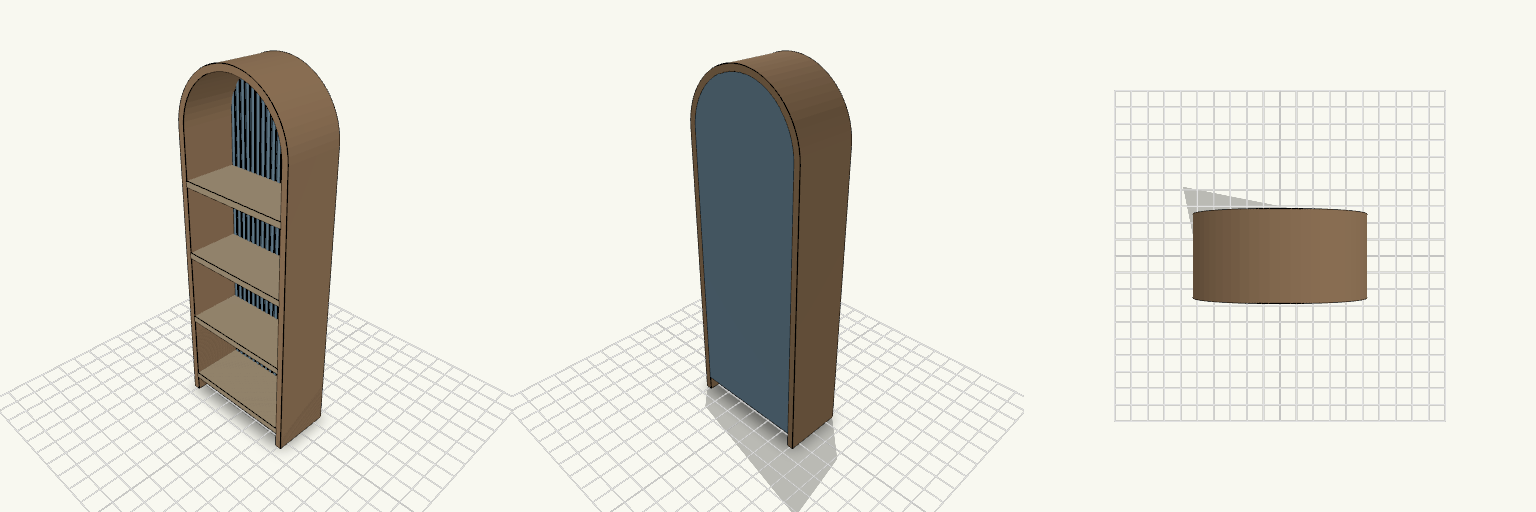
Miniature arched-top bookshelf, 7 in tall and 2.5 in wide, with four shelves and a vertically fluted back panel that mimics shiplap. The side walls extend below the bottom shelf to form feet, lifting it off the surface. Overall size: 63.5 mm wide x 30 mm deep x 177.8 mm tall Top: semicircular arch, 31.75 mm radius Back: 18 fine half-round vertical flutes Feet: 8 mm, formed by the side walls Wall and shelf thickness: 3 mm Prints upright as one piece; the arched top and shelf undersides may benefit from supports
55كعبة مجزءة
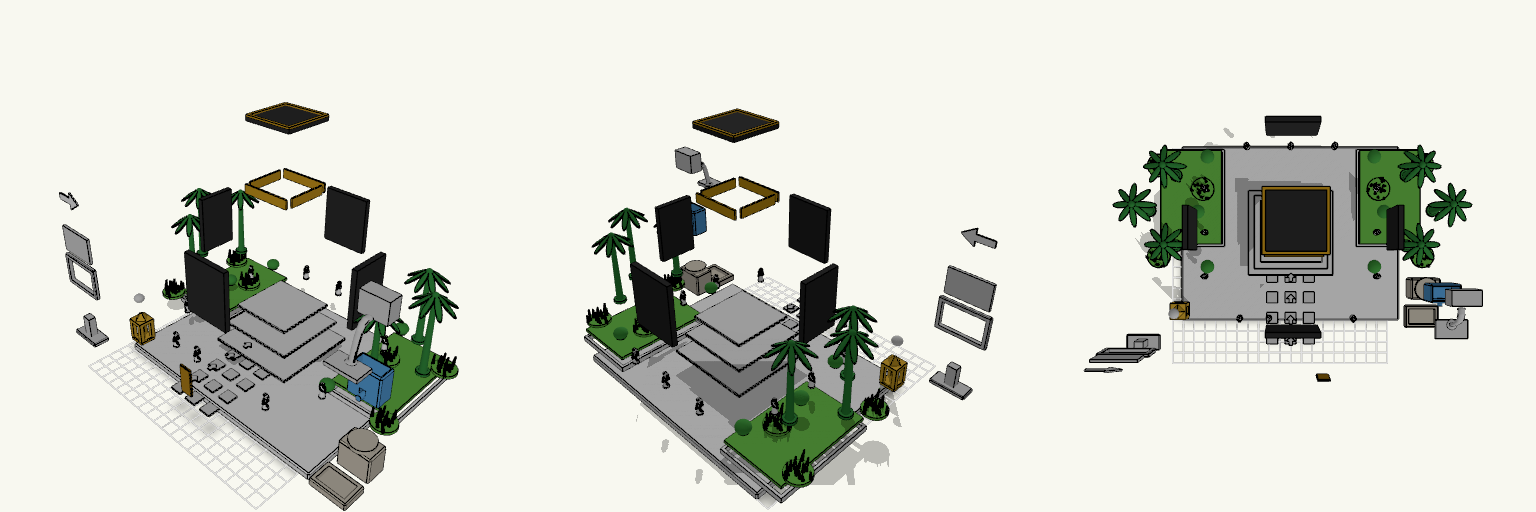
Exploded miniature of a masjid scene with every component spread apart with visible gaps. Parts: white base, platform tiers, four black Kaaba walls, roof, door, gold bands, walkway tiles, arrows, palms, bushes, grass, pilgrims, Zamzam station, Maqam Ibrahim and blue sign parts. Layout: exploded only, no assembled copy. Export: the download is one file; separating individual parts happens outside this model.
Fara — Uproszczony Model Kościoła
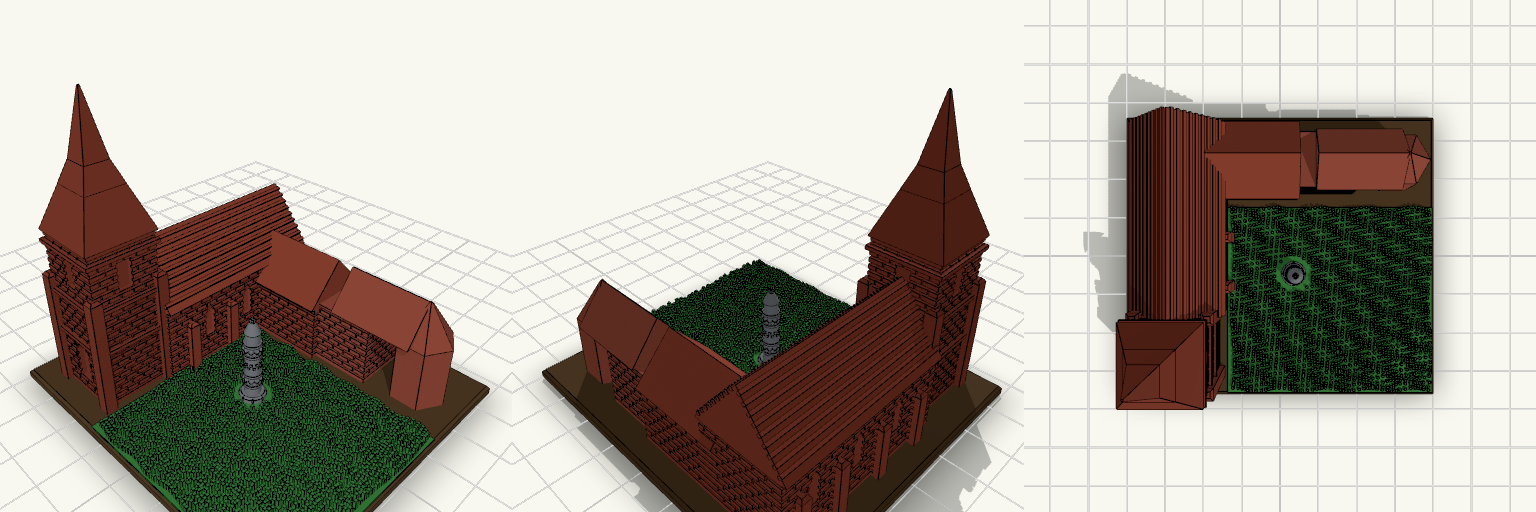
Fara to miniaturowa świątynia w duchu gotyku ceglanego, rozplanowana na literę L. Nawa biegnie wzdłuż jednej osi, a od jej tylnego końca odchodzi w bok skrzydło z dachem dwuspadowym; na jego końcu zamyka całość wieloboczne prezbiterium. Przy froncie wznosi się smukła wieża z ostrym hełmem. W środku wewnętrznego narożnika litery L, odsunięty od ściany nawy i od frontu skrzydła, stoi Słup Koniński — walcowaty trzon na szerszej podstawie ze stożkowym zwieńczeniem i kulką na szczycie. Ściany nawy, wieży i prezbiterium mają ceglaną czerwień oraz relief prawdziwego muru: poziome fugi i przesunięte w co drugiej warstwie pionowe spoiny. Słup zachowuje własny, kamienny charakter i odrębny zestaw ornamentów. Całość stoi na wspólnej, brązowej płycie o lekko ściętej krawędzi. Plac wokół słupa ma zieloną nawierzchnię i porasta go gęsta trawa — źdźbła o różnej wysokości, rozsiane w rozstawie około 1 mm, z wolnym miejscem tuż przy podstawie słupa. Model dobrze czyta się jako dekoracyjna miniatura na półkę, element makiety miasteczka albo pamiątka związana z Koninem. Proporcje są przybliżone — oparte na ogólnym układzie świątyni, a nie na planach budynku — więc detale wieży czy liczba okien mogą odbiegać od oryginału. Słup jest wyraźnie wyższy względem kościoła, niż byłby w skali: prawdziwy jest dużo niższy i przy tej skali wyszedłby zbyt cienki do druku. Wymiary Szerokość × głębokość × wysokość poszczególnych części: Płyta: 79 × 71 × 2 mm, z lekko ściętą krawędzią Trawa (zielony plac ze słupem): 52,6 × 47,8 × 2,3 mm Nawa (ze skrzydłem): 39,8 × 45,2 × 32 mm Wieża: 18,6 × 18,6 × 67 mm Prezbiterium: 30,9 × 14 × 24 mm Słup koniński: 6,1 × 6,1 × 21 mm Wieża jest najwyższym elementem całości — o tym warto pamiętać przy planowaniu wysokości druku. Cechy Plan litery L: nawa i odchodzące od jej tylnego końca skrzydło z dachem dwuspadowym, a na jego końcu wieloboczne prezbiterium Stromy dach nawy, przypory i ostrołukowe okna — czytelny gotycki charakter bryły Mur z cegieł na nawie, wieży i prezbiterium: poziome fugi co około 1,6 mm oraz pionowe spoiny co około 3 mm, przesunięte o pół cegły w co drugiej warstwie Żebra imitujące dachówki na obu połaciach dachu nawy Trzy poziome gzymsy i rząd drobnych rombów pod hełmem wieży Słup ustawiony w środku placu przy wewnętrznym narożniku litery L, odsunięty od kościoła, z podstawą i stożkowym zwieńczeniem z kulką, ozdobiony pierścieniami, dwoma rzędami rombów, zygzakiem i bruzdami na cokole Wspólna płyta pod całością, z zieloną nawierzchnią i trawą na placu wokół słupa — model stoi stabilnie i zaczyna się od płaskiego spodu Uwagi o druku Model nie ma delikatnych, ażurowych detali — okna i przypory są płaskorzeźbione w bryle — więc dobrze znosi typowe ustawienia druku. Fugi mają około 0,4 mm głębokości, a pionowe spoiny rozstawione co 3 mm mogą przy standardowej dyszy 0,4 mm wyjść ledwo widoczne; jeśli drukarka je zaleje, warto zmniejszyć warstwę lub nieco pogłębić rowki w slicerze. Źdźbła trawy mają 0,6 mm szerokości i rozstaw około 1 mm — gęściej nie ma sensu przy dyszy 0,4 mm, bo źdźbła zleją się w jedną plamę. Największą uwagę warto poświęcić wieży z hełmem, która sięga 67 mm, oraz cienkiemu trzonowi słupa o średnicy 6,1 mm. Cały model jest jednym elementem na wspólnej płycie — nie wymaga sklejania.
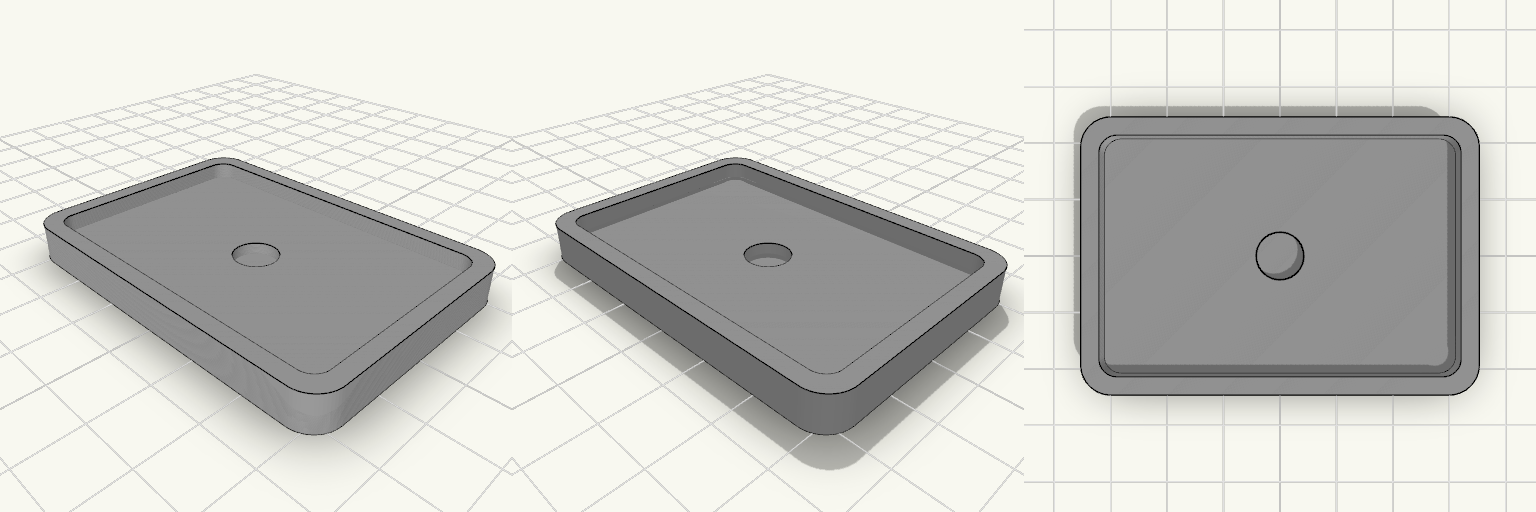
Moldura retangular para botão com ímã
Moldura retangular para um botão de 60 × 40 mm, com encaixe de 3 mm de profundidade e cantos arredondados. A parede ao redor do encaixe tem 3 mm, resultando em 66,1 × 46,1 mm por fora e 6,5 mm de altura. Um furo para ímã de 8×2 mm fica centralizado no fundo do encaixe; na face inferior há quatro furos para ímãs de 5×2 mm, próximos aos cantos. A peça imprime em uma única parte, apoiada na face inferior, com o encaixe voltado para cima. Encaixe: 60,1 × 40,1 mm (botão de 60 × 40 mm com folga de 0,1 mm), cantos arredondados, 3 mm de profundidade Dimensão externa: 66,1 × 46,1 mm; altura: 6,5 mm Parede ao redor do encaixe: 3 mm Ímã central: furo de 8,2 mm de diâmetro × 2,1 mm de profundidade no fundo do encaixe (ímã de 8×2 mm) Quatro furos na face inferior para ímãs de 5×2 mm: 5,2 mm de diâmetro × 2,1 mm de profundidade, em X ±25 mm e Y ±15 mm Folga dos furos: 0,2 mm no diâmetro e 0,1 mm na profundidade Impressão: uma peça única, deitada sobre a face inferior, sem suportes nos furos