OsteoHinge — Resettable Femur Simulator
Created 3 months ago
Description
This anatomical simulation bone is designed for realistic mechanical training and demonstrations. Modelled at a compact 200mm footprint to suit standard print beds, it features a functional, re-settable fracture mechanism built straight into the main shaft.
The midshaft utilises an interlocking V-notch joint tailored for sudden directional failures. By threading elastic shock cord through the central internal channel and tying it off in the polar counterbores, the bone is tensioned. It rests firmly aligned and rigid until lateral force (a "push") hits the threshold, causing the V-notch to ramp open and cleanly hinge to simulate a fracture. Stopping the lateral pressure causes the elastic cord to snap the halves immediately back into the unmarred state.
Assembly notes
- Hardware: Requires one length of 3-4mm elastic shock cord.
- Tie-down: Feed cord completely through the continuous central bore, stretch for the desired breaking tension, and secure via simple knots. Both ends feature counterbores specifically to hide the tie-offs.
- Scaling: Feel free to scale the assembly up uniformly to simulate a full adult male femur (~225%), but note you will require a correspondingly wider elastic band.
Images
More like this
Explore more in Workshop & Tools →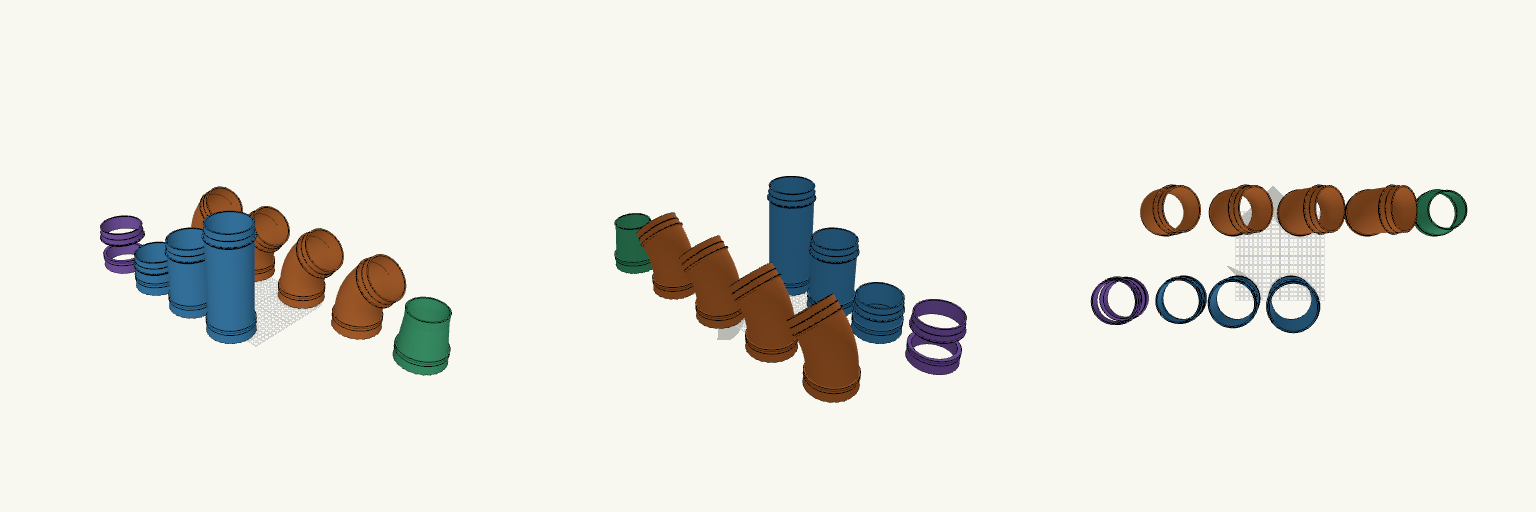
EGO GutterJet — Elliptical Leaf Blower Extension
GutterJet is a modular gutter-clearing extension for an EGO leaf blower, built around a single elliptical adapter that slips over the blower tube and transitions into a round, swiveling system. Only the piece that meets the blower stays elliptical; from there everything is circular, so the bends can be rotated to aim the outlet and the whole run can turn without fighting an oval joint. Every round joint indexes every 15°, letting you lock the U-turn or sweep the outlet to a set angle. The set prints as separate pieces that push together and pull apart with a firm tug, and a tapered reducer nozzle narrows the end of the U-turn for a focused blast. What's included Elliptical adapter: a 30 mm elliptical socket, a 40 mm transition from ellipse to circle, and a 30 mm round spigot with an indexing collar. Three straight tubes: 80, 160 and 240 mm, each with a socket on one end and a beaded spigot on the other. Four identical 45° bends that connect into a 180° U-turn with a 120 mm centreline radius. Reducer nozzle: a 30 mm socket that fits the U-tube spigot, a 60 mm taper, and a 20 mm-long straight nozzle with a 76 mm bore (about 4,536 mm² of flow area). Fit and joints The adapter's socket measures 94.4 × 89.4 mm inside, leaving 0.3 mm clearance over a blower tube of 88.5 × 83.5 mm inside diameter and 2.8 mm wall. Round joints pair a 94 mm spigot (89.2 mm bore) with a 94.6 mm socket. Each spigot carries a 0.9 mm bead ring 15 mm back from its tip; each socket has a matching groove 15 mm in from its mouth. The bead has 45° flanks and the groove has matching 45° faces, so the joint eases in and pulls apart cleanly. A 3 mm collar on each spigot carries 24 shallow teeth on its top face, with matching notches in the socket mouth. The joints click every 15°, including at the adapter, straights and bends. The teeth are 1.2 mm tall with a gentle slope for a soft click. The spigot tip stops just short of the inside shoulder, so the collar and socket mouth are the faces that seat against each other. Walls are 2.4 mm throughout, and the bore is slightly larger than the blower's, so airflow is not restricted. The bead ring is the wear point after many snaps. Print notes Print each piece standing on its socket end. The 240 mm tube fits a 260 mm Z build height; the bend pieces are about 170 mm tall. The layout is for preview, not arranged for one plate — print as many straight tubes as needed. For repeated snapping, print the bead rings at 100% infill or slow the outer wall in those areas. The collar on each bend's tilted outlet is a 45° overhang; watch that face when printing. The set has not been fit-tested; check the adapter socket on the blower tube before printing a full set.
Tapa cuadrada con agujeros mixtos
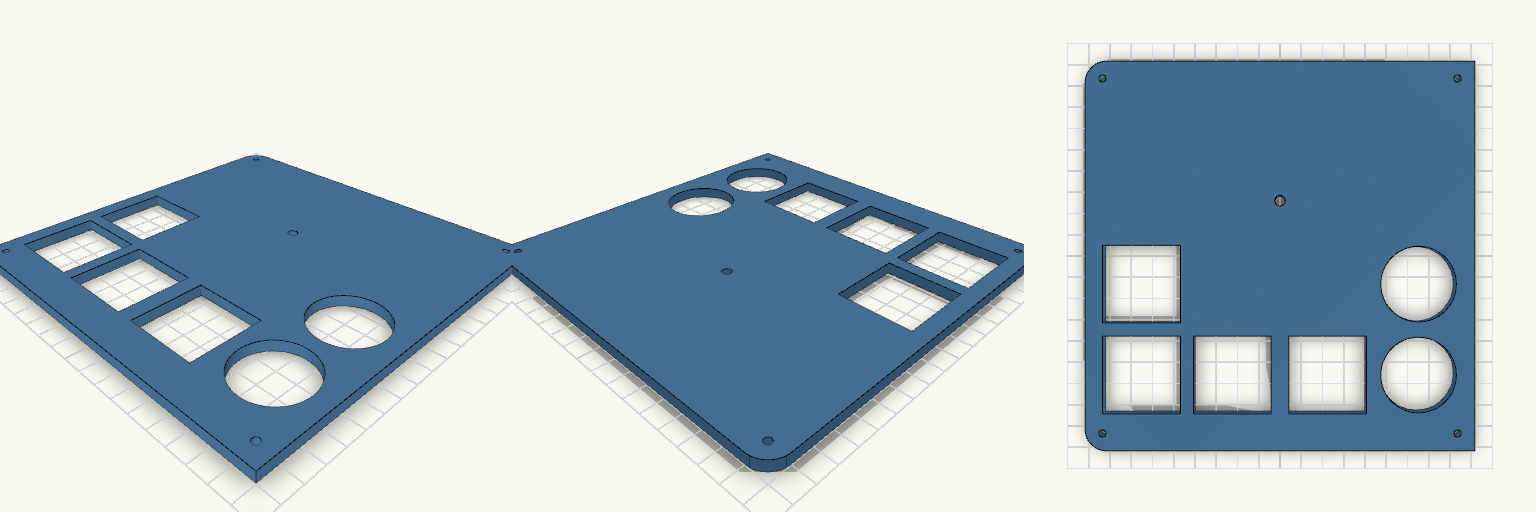
Tapa de 180×180×5 mm con dos lados redondeados a la izquierda (radio 10 mm), cuatro agujeros M3 en las esquinas y un agujero de 5 mm. Dos agujeros redondos de 35 mm a la derecha y cuatro cuadrados de 36 mm a la izquierda, en la zona inferior. Ideas para remezclar Diámetro de los redondos (35 mm): súbelo o bájalo según la pieza que deba pasar; la pared entre ellos es de 7 mm. Lado cuadrado (36 mm): ajústalo por separado; los centros están a 42 mm. Radio de las esquinas (10 mm): 5 mm para una curva más suave. Agujero de 5 mm: está a 25,5 mm sobre el centro; muévelo para un pasacables o un pulsador. Combina con: una base o caja de 180 mm usando los M3 de las esquinas (3,4 mm, a 8 mm del borde).
SpoolScope — Filament Remaining Gauge
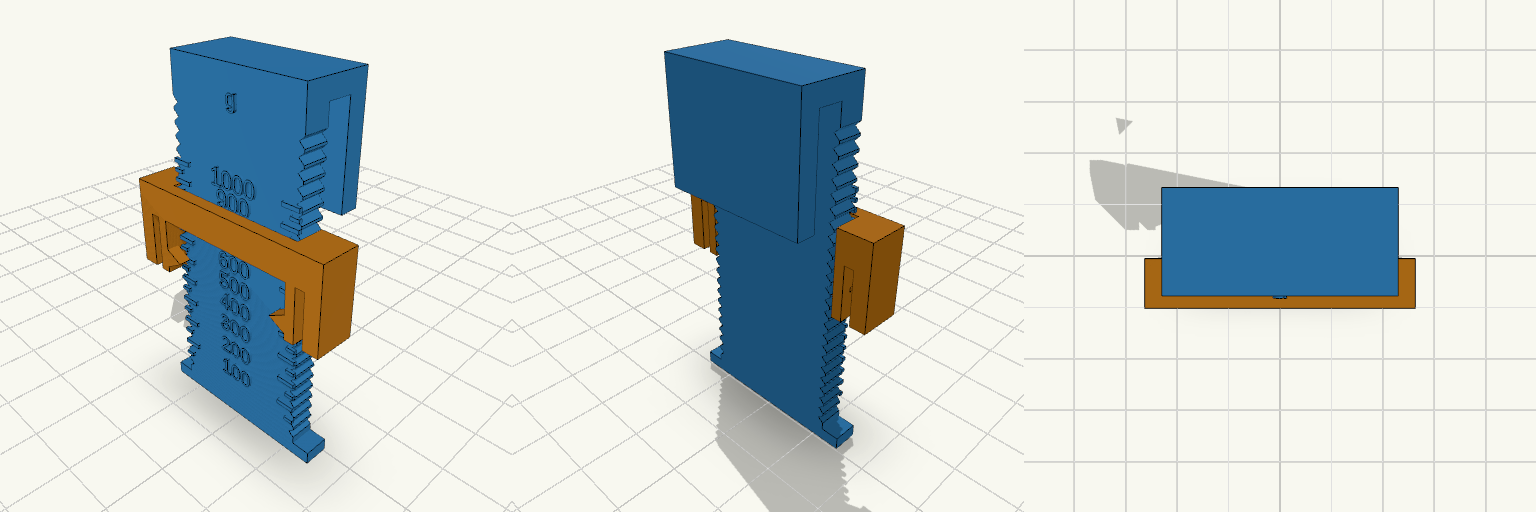
SpoolScope is a two-part gauge for estimating how much filament remains on a standard spool, made for spools that sit out of easy view in an AMS or on a shelf. The rail hooks over the flange rim; the sliding block rides on it with light detents, so you can push it down until it touches the filament, lift the gauge away and read the result. Raised ticks and numbers plus an unambiguous arrow on the block make the measurement clear without needing line-of-sight while the gauge is in place. Features Two printed parts: a rail with a rim hook, and a detented sliding block. Gram scale from 0 to 1000 g, with ticks every 50 g and numbers every 100 g. Ticks follow filament geometry rather than an even spacing: closer together near full, wider apart near empty. Arrows on the block tip directly toward the scale, and the detents hold the reading after the gauge is lifted off. Hook gap of 4 mm, sized to clear flanges from 2.8 mm to 3.6 mm thick. Dimensions Flange diameter: 200 mm. Hub outer diameter: 95 mm (from a measured Polymaker spool). Full-roll diameter: 170 mm (estimated from a 1 kg PLA roll on a 95 mm hub and a 65.6 mm spool width). Hook gap: 4 mm. Fitting and calibration Sized around Polymaker and Inland 1 kg spools; other brands are worth checking against the hub and flange figures above. The scale can be shifted by a single fixed offset if a first print reads consistently high or low, so a weight check against a known spool is worth doing before trusting the numbers. If the error differs between a full and an empty spool, the hub and full-roll values are the ones to correct. Print notes Both parts are laid out flat on the print plate. The block contacts the filament at its outer edges rather than at the centre, so a reading can sit slightly high; a weight check against a known spool is the best way to confirm the scale.
Support mural tournevis 255 × 40 × 40 mm
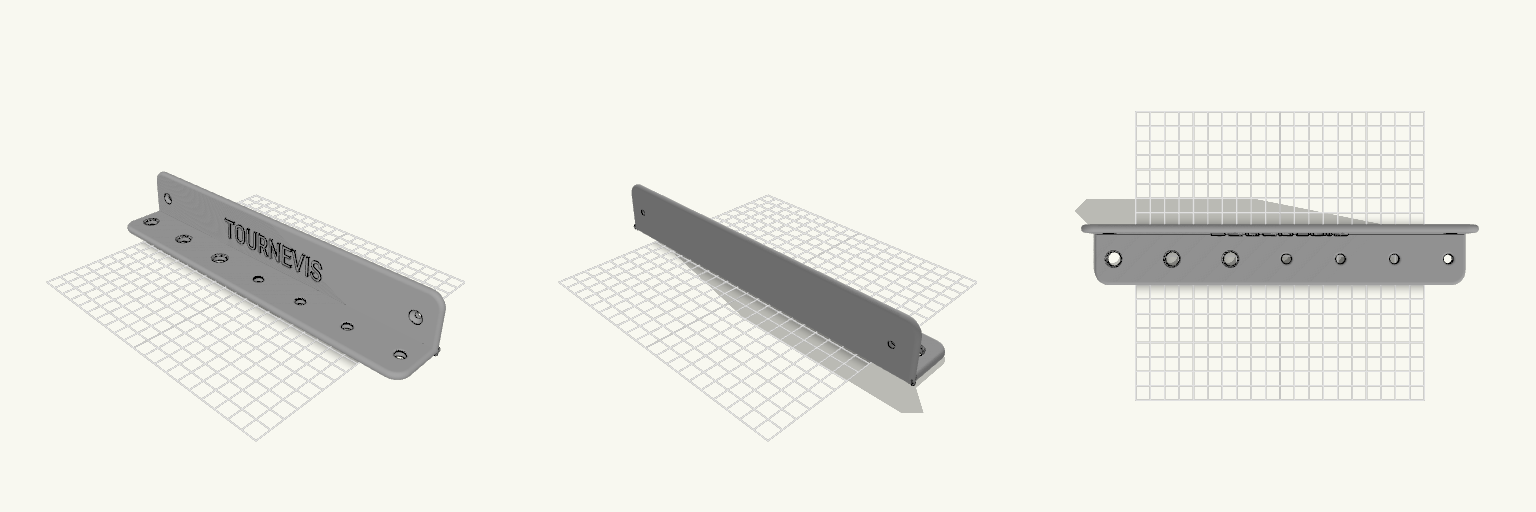
Support mural pour tournevis : plaque verticale de 255 × 40 mm et tablette horizontale de 255 × 40 mm, épaisseur 5 mm. Trous de la tablette, de gauche à droite : 10, 10, 10, 7, 7, 7, 7 mm, bords arrondis. Deux trous de vis fraisés dans la plaque. Texte « TOURNEVIS » en relief de 1,5 mm. Coins extérieurs arrondis à 10 mm ; les deux coins à la jonction plaque/tablette sont droits. À vérifier avant impression : la longueur de 255 mm doit tenir sur votre plateau. Ne convient pas aux tournevis dont la tige dépasse 10 mm.
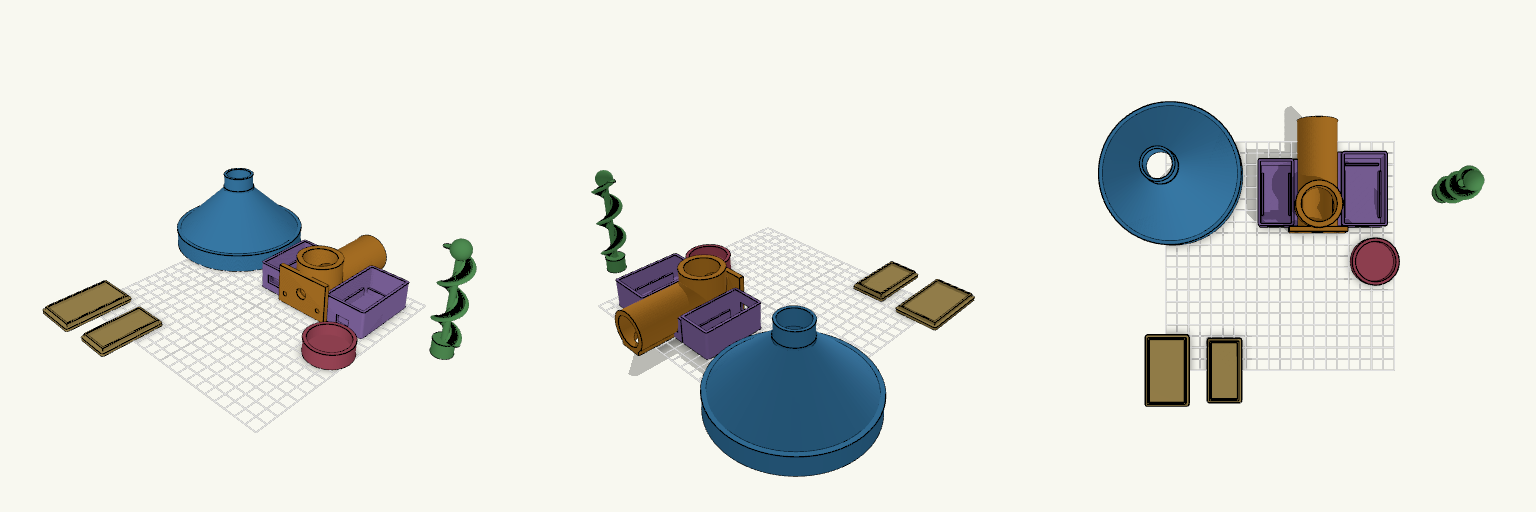
28BYJ-48 Solid One-Piece Kibble Auger
Solid one-piece helical auger for a 28BYJ-48 geared stepper, running in a 26 mm housing bore, with the funnel and electronics cases printed alongside. Fit Motor: 28BYJ-48 only (5 mm shaft with 3 mm flats). Bore: 26 mm; flight tip 24.4 mm. Kibble: sized for about 11.5 mm pieces. Check before printing Thread pitch on the 109 mm funnel is assumed at 6 mm. Measure the host opening. The auger prints in one piece, so the flight overhangs may need supports. Does not fit Motors with a different shaft profile or hole spacing. Housing bores other than 26 mm.
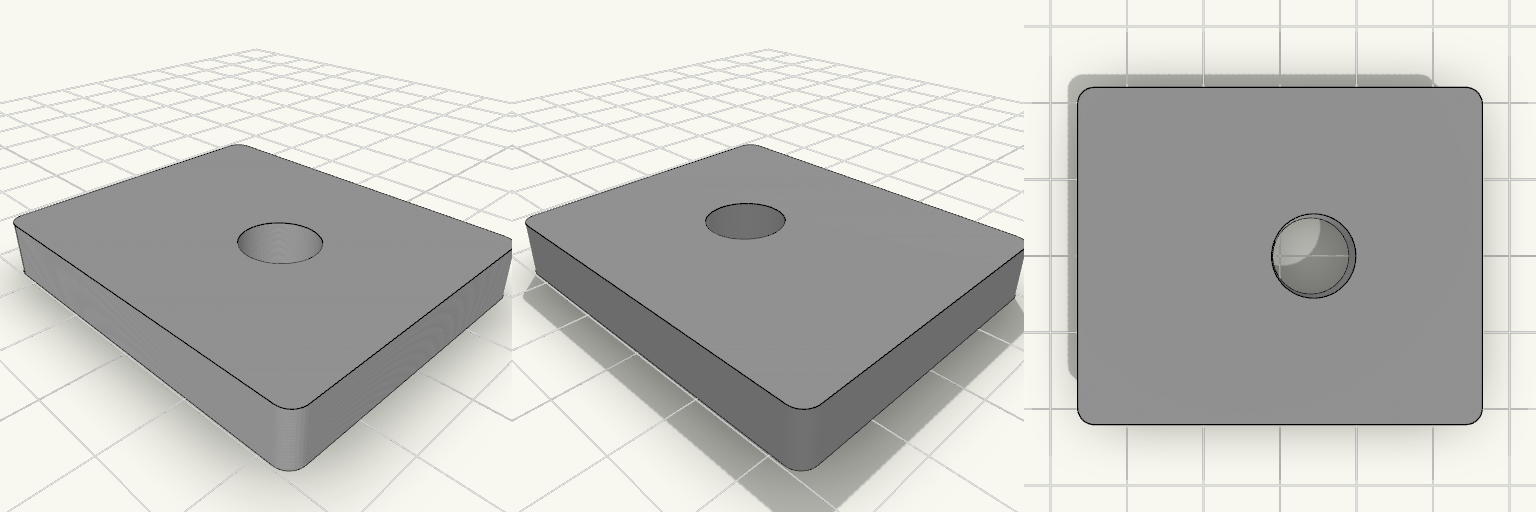
Elliptical Pedal Insert 48x40 Offset Hole
What it's for Central reinforcement insert for an elliptical trainer pedal, bonded into the damaged opening. Flat top, ribbed underside. Dimensions Base: 48 × 40 × 7 mm, rounded corners Through-hole: 10 mm, centered at 24 mm along the length and 4 mm toward the top edge from the width center 18 mm boss around the hole, 5 ribs to a 3 mm frame Remix ideas Change the hole offset for a different pedal Add or remove ribs Thicken the frame for heavier loads