PivotTee — Portabrugole con Fermo Girevole
Made by UmberSqueegee
Created today
Description
PivotTee è un portabrugole piatto per chiavi a T da 10 a 3 mm, con perni laterali che lo fanno ruotare da orizzontale a verticale su una base da fissare al cassetto. Un fermo girevole dietro il blocco lo tiene in verticale durante l'uso, e il perno centrale accoglie un inserto filettato M3 per avvitare il fermo.
Caratteristiche
- Otto sedi da 10 a 3 mm con fessura superiore e numeri incisi
- Base con due fori svasati da 5 mm
- Perno del fermo da 8 mm con foro da 4,2 mm per inserto M3 (profondità circa 8 mm)
- Fermo girevole 44 × 14 × 6 mm
Print notes
- Tre pezzi stampati sdraiati, senza supporti
- Inserto filettato da scaldare a caldo nel foro del perno
Images
More like this
Explore more in Storage & Organization →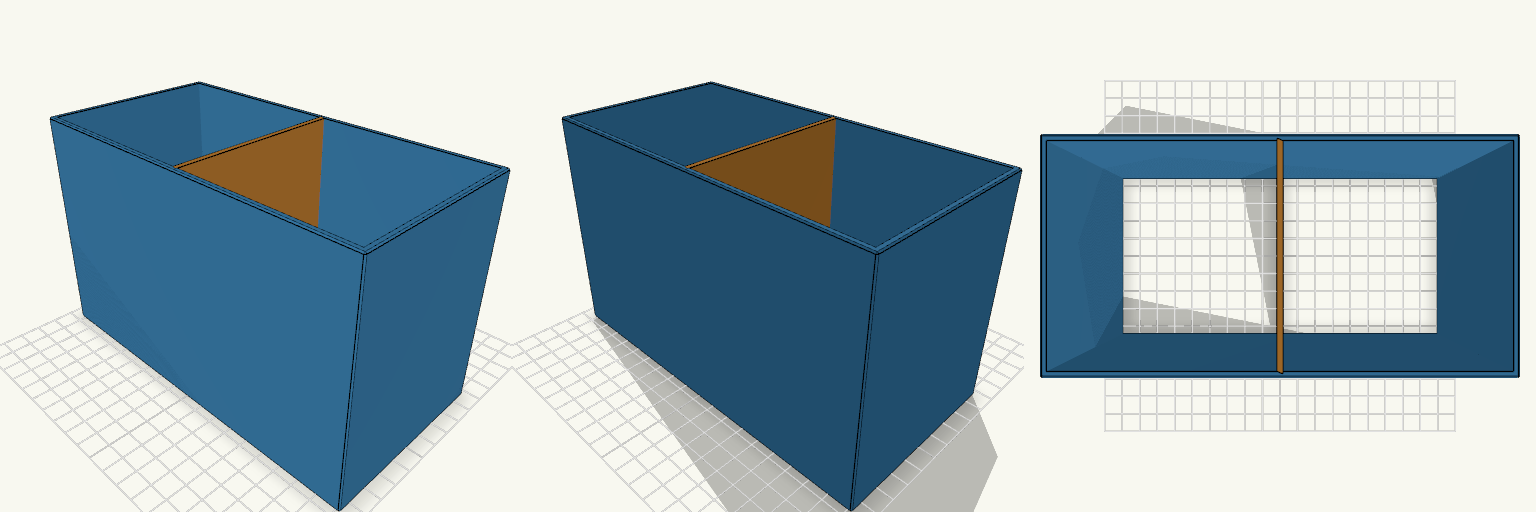
Open Drawer Box With Middle Divider
Loose items slide around in a drawer, and a floorless box with a divider keeps them in place. This one is a rectangular frame with no floor and a full-height wall across the middle. Key numbers Outer size: 184 x 93.33 x 115 mm (height) Wall thickness: 2.4 mm Divider: 2.4 mm, full height, at the middle of the 184 mm length Three boxes side by side fill a 280 mm drawer depth Print: open end up, no supports needed, fits beds of 210 mm or larger
210x112x85 Three-Compartment Box, CHARO
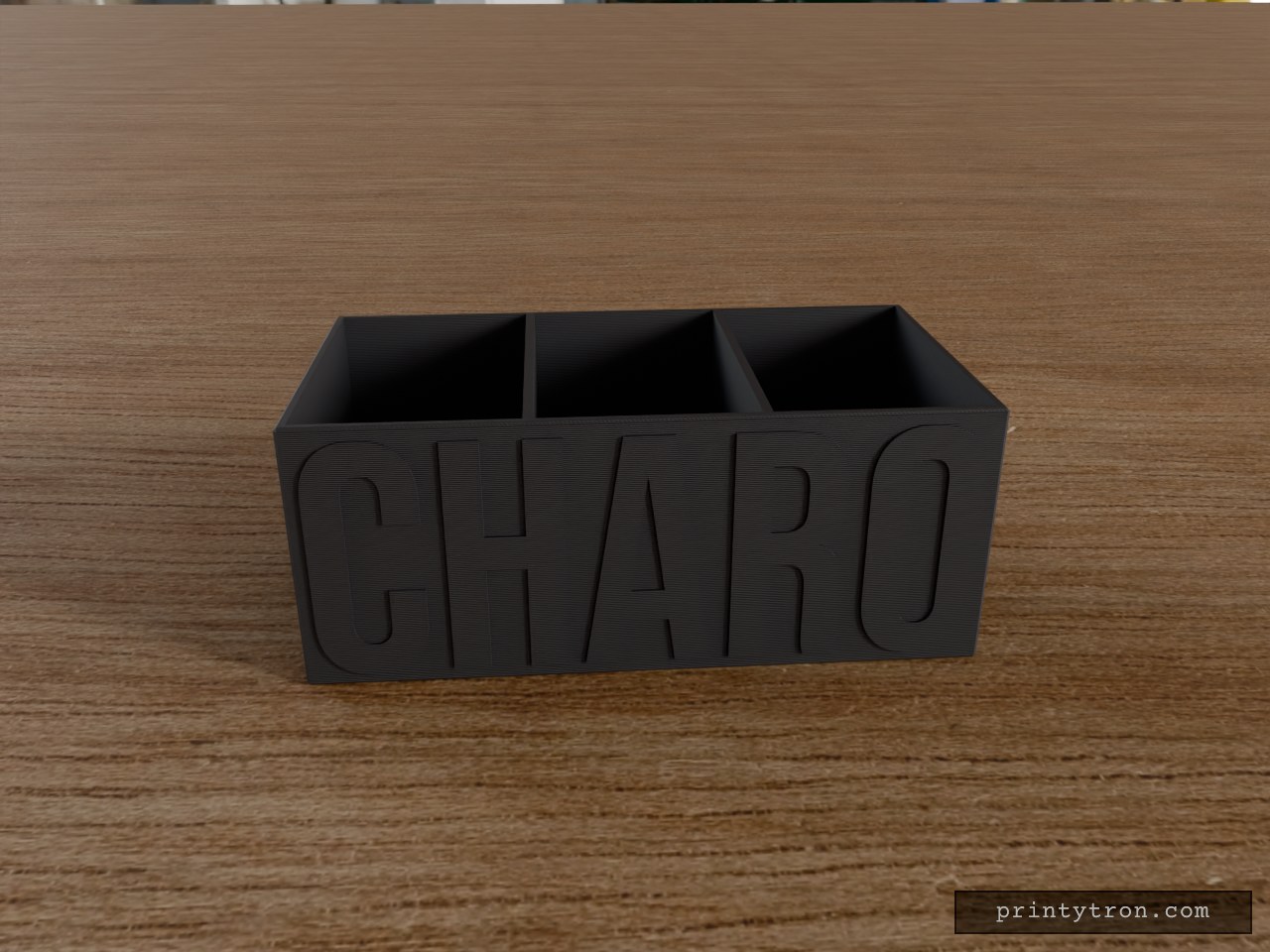
Open-top storage box with three equal compartments side by side, and the name CHARO raised across the full front face. Outer size: 210 x 112 x 85 mm Walls and dividers: 3 mm Floor: 4 mm Compartments: 3, each about 66 x 106 mm inside Lettering: Bebas Neue, about 200 x 77 mm, raised 1 mm on the front Prints upright with no supports
Liftlatch — Modular Stacking Desk Drawer
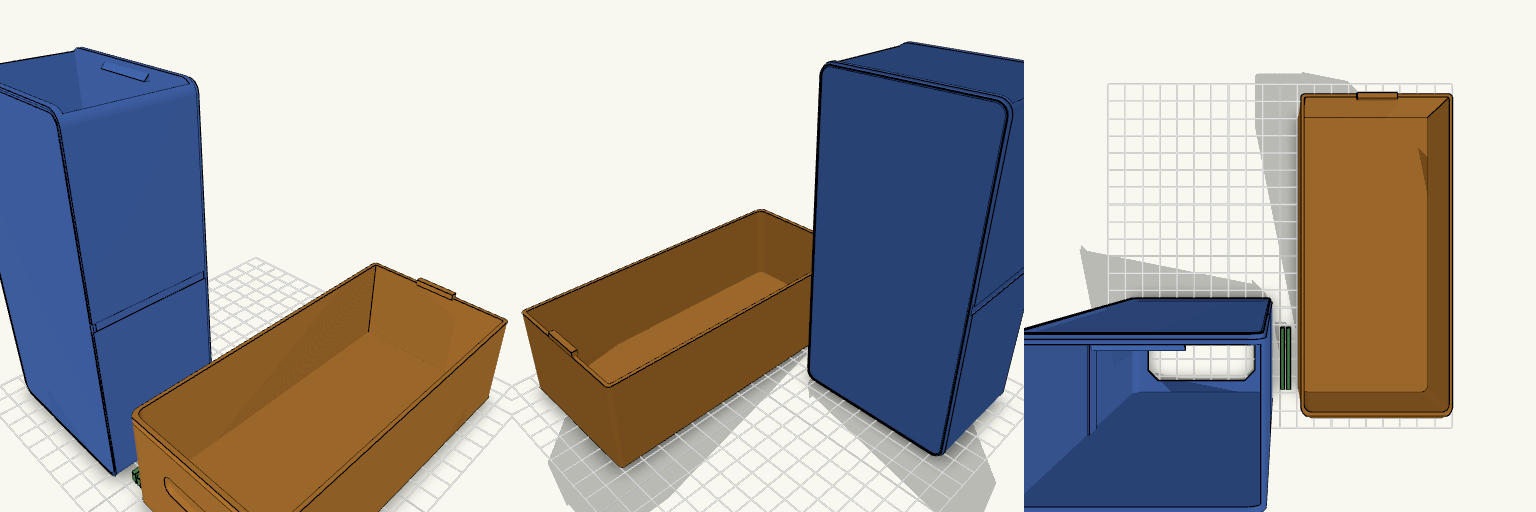
Liftlatch is a modular desk storage module built from a rounded outer housing, a sliding drawer, and two bowtie joiner clips. The design language is quiet and symmetrical: thin 1.6 mm walls, soft 6 mm fillets down all four vertical corners, a flush front with a recessed finger pull, and completely flat outer side walls that stay within 82.0 mm. A single unit reads as a smooth box; a row reads as a bank of drawers, joined by clips that sit flush in dovetail slots rather than protruding rails. Units stack vertically on a 2 mm lip and matching underside pocket, and lock side-by-side with the separate clips, so the system grows from one 82 × 165 × 55 mm module without changing hardware. The housing, drawer and clips are laid out separately on the plate; the housing prints standing on its back wall with the open front facing up, which removes the wide ceiling bridge and keeps the side slots vertical for a support-free print. Dimensions Module footprint: 82 × 165 × 55 mm nominal Housing as laid out: 82 × 57 × 165 mm, standing on its back wall with the open front facing up Drawer as laid out: 76 × 162.6 × 49.1 mm, flat on its base with the open top facing up Joiner clips: two bowtie clips, each about 35 mm long and 5.8 mm wide, lying flat in the 15 mm gap between housing and drawer Walls: 1.6 mm base wall, thickened locally to 2.6 mm around the side slots Corner radius: 6 mm on all four vertical corners of the housing, matched on the drawer front so it sits flush in the rounded opening Drawer clearance: 0.4 mm at the thickened slot sections; the drawer is narrowed to 76 mm, leaving about 1.4 mm of play per side elsewhere Stacking lip: 2 mm stepped lip on top with a matching recessed pocket underneath, both following the same 6 mm corner path Side joinery: flush 1.2 mm deep dovetail slots in both outer side walls, with matching bowtie clips and 0.2 mm clearance; joined units sit flush with no gap Catch: 2.8 mm tab on the drawer's rear top edge meets a 2.5 mm stop lip under the front ceiling, with a 4 mm gap above the drawer walls Features Lift-to-remove catch: the rear tab catches the front stop so the drawer cannot fall out accidentally. Lift the front slightly to drop the tab clear of the stop and pull the drawer free; the overlap is about 1 mm, so the motion is short. Flush front: a 2 mm deep recessed finger slot with a 1 mm flare at its mouth, and a 1 mm chamfer around the front face perimeter, keep the face smooth to the touch and flat enough to stack. Symmetrical side slots: both outer walls are flat and clean, with nothing protruding. The bowtie clips slide in from the bottom of the housing to join neighbouring units flush; leave them out when a unit stands alone. Open back frame: a large chamfered cutout in the rear wall trims filament without weakening the structure. Stackable and joinable: the top lip and underside pocket align stacked units, while the flush slots and bowtie clips hold a row together side-by-side, gap-free. Print notes Every internal overhang is chamfered or tapered at 45° where needed — including the ledge under the front stop and the stacking lip tip — so the housing, drawer and clips print without supports, in a single colour with no multi-material setup. The housing stands on its back wall, the drawer lies flat beside it, and the two clips lie flat in the 15 mm gap, so the side slots print vertically and the wide ceiling bridge is gone. All printed elements fit a 180 × 180 mm Bambu Lab A1 mini bed with only a small margin, and the housing's 165 mm height sits close to the printer's height limit, so keep the spacing as laid out. The drawer walls are straight from front to back; the drawer is narrowed to clear the locally thickened slot walls, so check that it slides freely once inserted into the housing after printing.
Two-Piece Sliding Storage Drawer with Spring Release
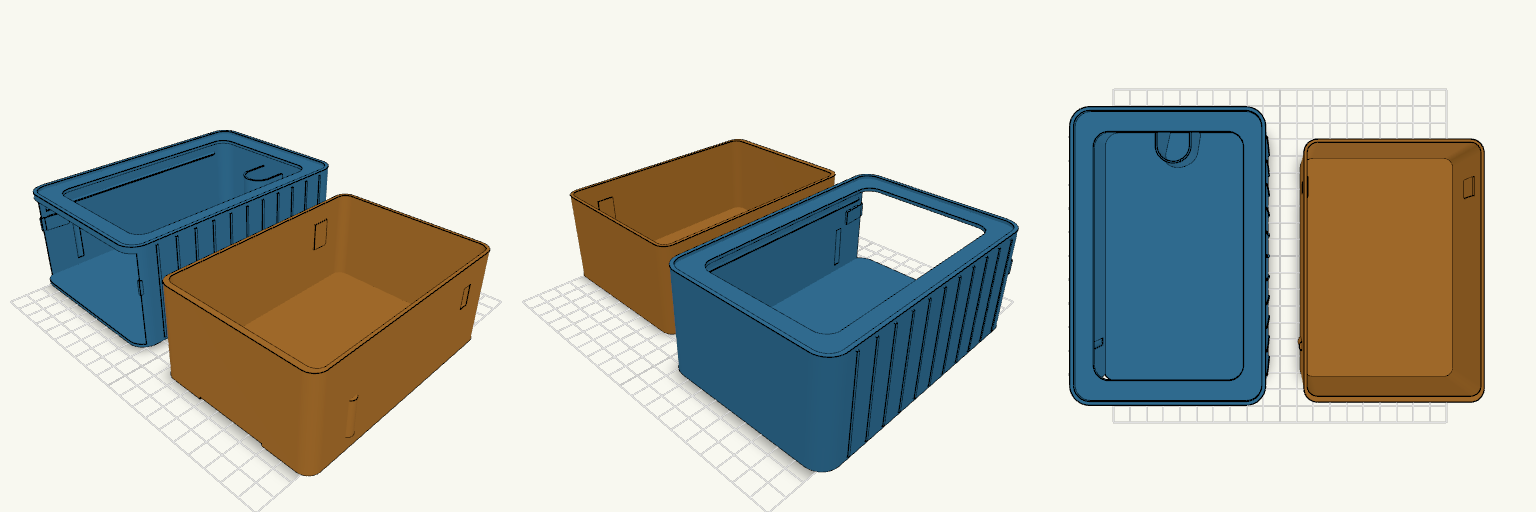
A minimalist two-piece sliding storage drawer: a ribbed outer housing with an open front and a separate inner drawer with a flush, handle-free face. The housing measures 100 × 150 × 60 mm with 10 mm rounded outer corners and 1.6 mm walls. Vertical ribbing stiffens the side walls, and thin 45° guide rails keep the drawer aligned. The guide rails and side stop tabs stay inside the outer walls, with only the ribs standing proud by design; the front ends of the rails stop inside the rounded front corners. The top is an open frame with a 12 mm solid rim, thickened to 3.4 mm so the stacking recess does not cut through. The drawer slides on the rails and locks closed with rounded snap bumps that seat into grooves in the housing. Push the drawer inward to release the bumps; the rear U-shaped leaf spring then pushes it forward. The spring is 0.95 mm thick and 40 mm wide, anchored to the inner back wall and touching the floor only where it meets that wall. A 45° chamfer under its bottom edge lifts the loop clear of the floor as it runs forward, so it flexes freely and still prints without supports — the trade-off is a shorter front loop, so the spring is on the soft side. A 45° finger bevel under the bottom front edge gives a hidden pull once the drawer has popped out. Flexible side stop tabs catch pockets near the back of the drawer, limiting travel to about 95 mm; press the tabs aside to remove the drawer fully. The stop pockets are 1.2 mm deep with 1.4 mm of solid wall behind them. The housing also stacks: a 1.5 mm bottom foot, inset 2.2 mm with a 45° chamfer, sits in a matching 1.8 mm recessed step on the top rim with 0.3 mm clearance. Housing: 100 × 150 × 60 mm, ribbed sides, open top with 12 mm rim, 10 mm rounded corners, 1.6 mm walls Drawer: 95.7 × 135 × 53.2 mm, flush front, no handle, side snap bumps Release: push-push detent with rear U-spring Pull: hidden 45° finger bevel under the front bottom edge Stop: flexible side tabs limit travel to about 95 mm; press aside for full removal Stacking: 1.5 mm bottom foot and matching 1.8 mm top recess Printing: two separate pieces, no supports, overhangs 45° or shallower Tuning: spring force and detent interference may need adjustment after a test print
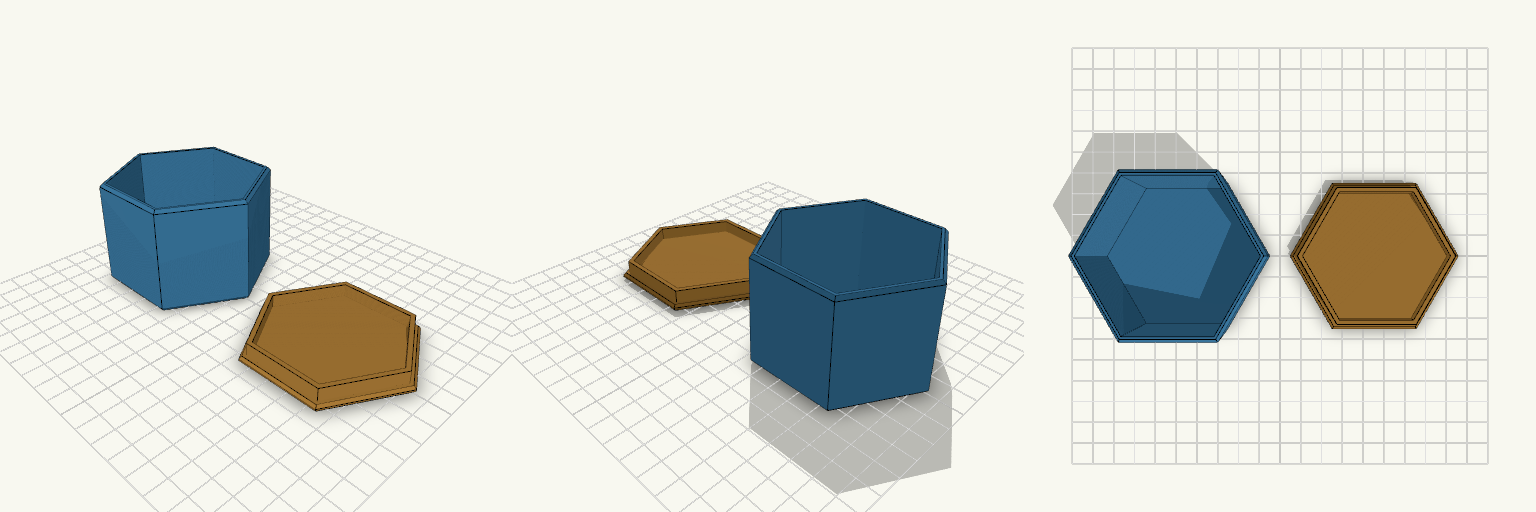
Hexagonal Box with Lid
A hexagonal box with a matching lid, printed as two separate pieces. The box is 50 mm tall and 80 mm across the corners, with 2.4 mm walls and a 3 mm floor. The lid is a 3 mm hexagonal plate with a 6 mm hollow lip underneath. The lip sits inside the box opening with about 0.4 mm of clearance per side, so the lid stays put without a tight press fit. Box: 80 mm across corners, 50 mm tall, chamfered base edge Lid: 80 mm across corners, 3 mm plate, 6 mm inner lip Print the lid flat with the lip facing up No supports needed for either piece
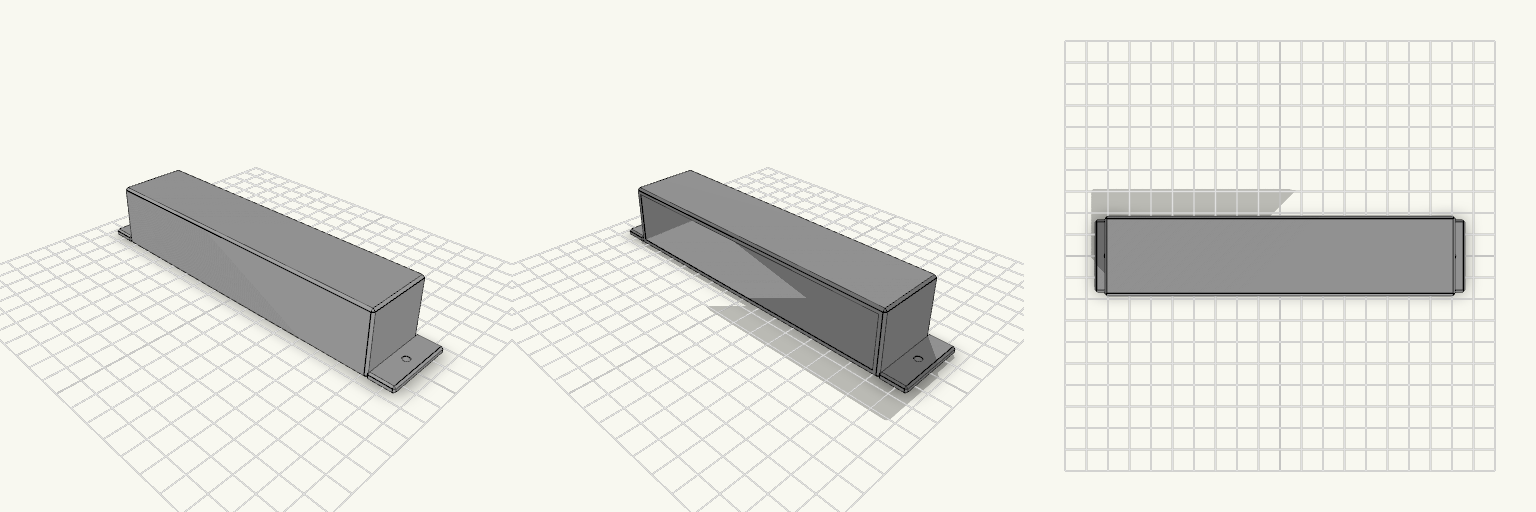
Cajetín Abierto con Pestañas
Cajetín de aire industrial, un canal rectangular hueco que deja una cara larga abierta para acceder al interior. Dos pestañas planas en los extremos permiten fijarlo con tornillos de 3 mm. Medidas: 170 × 33 × 30 mm Paredes de 2,5 mm Dos pestañas con agujero de 3,4 mm Se imprime apoyado sobre su base