Split 13-Inch Slip Box
Created 1 months ago
Remixed once
Description
A simple, cleanly split rectangular enclosure meeting a 3" × 1" × 13" outer footprint. Designed to print standing vertically on the build plate, the two halves meet in the middle with a sliding half-lap joint that handles alignment and friction.
Remix Hooks
The source relies on a few key parameters that dictate the fit and feel. If you pull this into a remix, check these first:
- Dimensions: Currently
W = 76.2,D = 25.4, andL = 172.6(for each half, achieving the 330.2mm total length). Tweak these to fit whatever board or gear you are housing. - Wall: Set to 3mm. This gives enough meat for the half-lap cut (leaving 1.5mm walls at the joint) without feeling overly bulky.
- Clearance: The joint runs a comfortable 0.4mm tolerance. Tighten it to 0.2mm if your printer is dialed in and you want a semi-permanent friction fit, or loosen it if it binds.
- Lip Length: The 15mm overlap keeps the assembled box rigid, but dropping it to 8-10mm would save a bit of plastic if the contents don't flex.
Images
More like this
Explore more in Storage & Organization →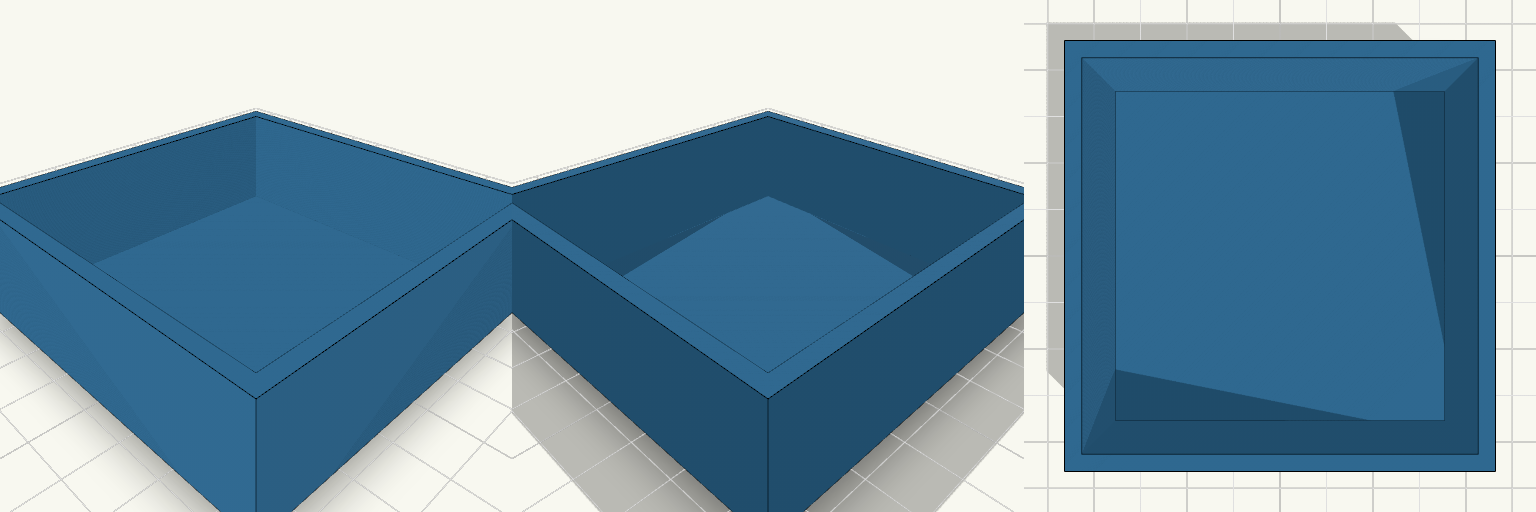
Open-Top Square Box 75 × 75 × 25 mm
What it's for A plain open-topped square box with a closed floor, sized to hold small parts, tools, or loose odds and ends on a desk or workbench. The straight sides and flat base keep it stable on the print plate and easy to drop things into from above. Dimensions Outer footprint: 75 × 75 mm Height: 25 mm Wall thickness: 3 mm Floor thickness: 3 mm Top: fully open, no lid Print notes Prints upright as it sits, with no supports needed for the vertical walls. A 3 mm wall and floor hold up well in PLA or PETG at a standard layer height; thicker walls take a slightly wider nozzle or more perimeters comfortably. Remix ideas Add a lid or a stacking lip so several boxes can sit on top of one another. Round the outer corners for a softer look and less sharp handling. Divide the interior with a grid to sort small hardware.
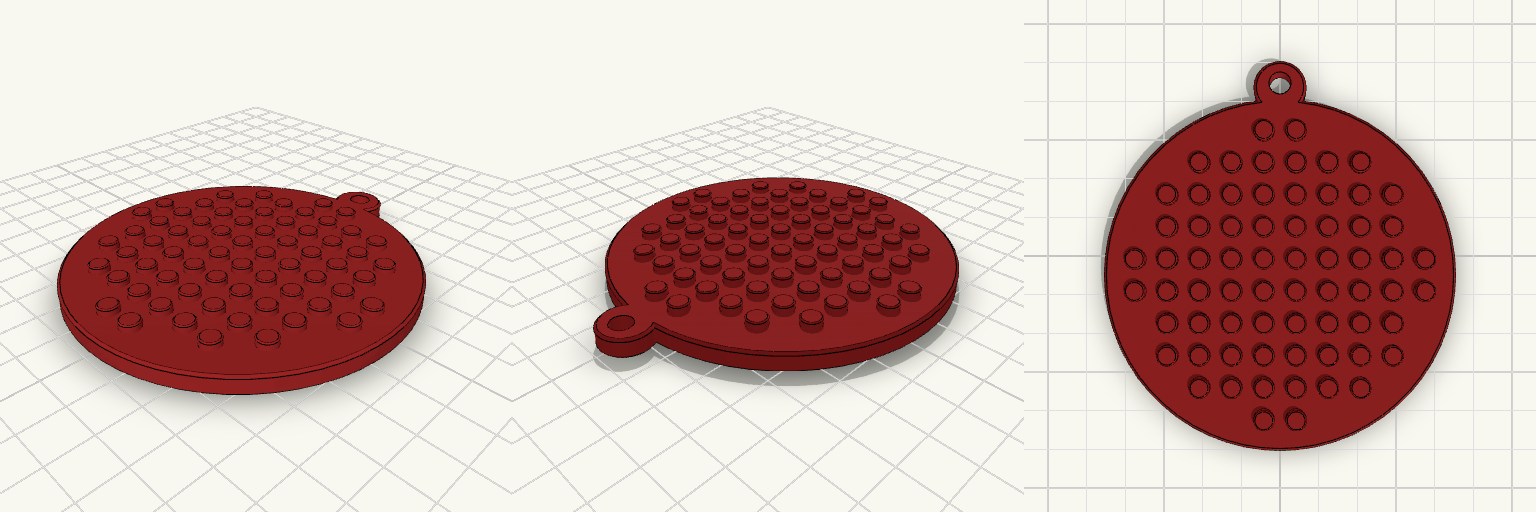
Clicker Keycap__Panda
A round 88 mm ornament disc, 4.8 mm thick, with a grid of LEGO-compatible studs on the face and a hanging loop at the top. Printed in red, flat, with no supports. Remix hooks Stud diameter: 5.0 mm now (standard is 4.8 mm). Raise it to 5.05 for a firmer grip, or drop it to 4.9 if bricks sit too tight on your printer. Stud height: 1.8 mm. Taller studs give a deeper grip but need more bridging care. Disc thickness: 4.8 mm, or 1.5 LEGO plates. Use 3.2 mm for one plate or 9.6 mm for a full brick height. Disc diameter: 88 mm on an 8 mm stud pitch. The stud grid is cut to a 37 mm radius, which leaves a plain rim. Loop: 13 mm outer, 5.5 mm hole. Widen it for ribbon. Pairs with: 1x1 and 2x2 bricks, tiles, and small minifigure scenes.
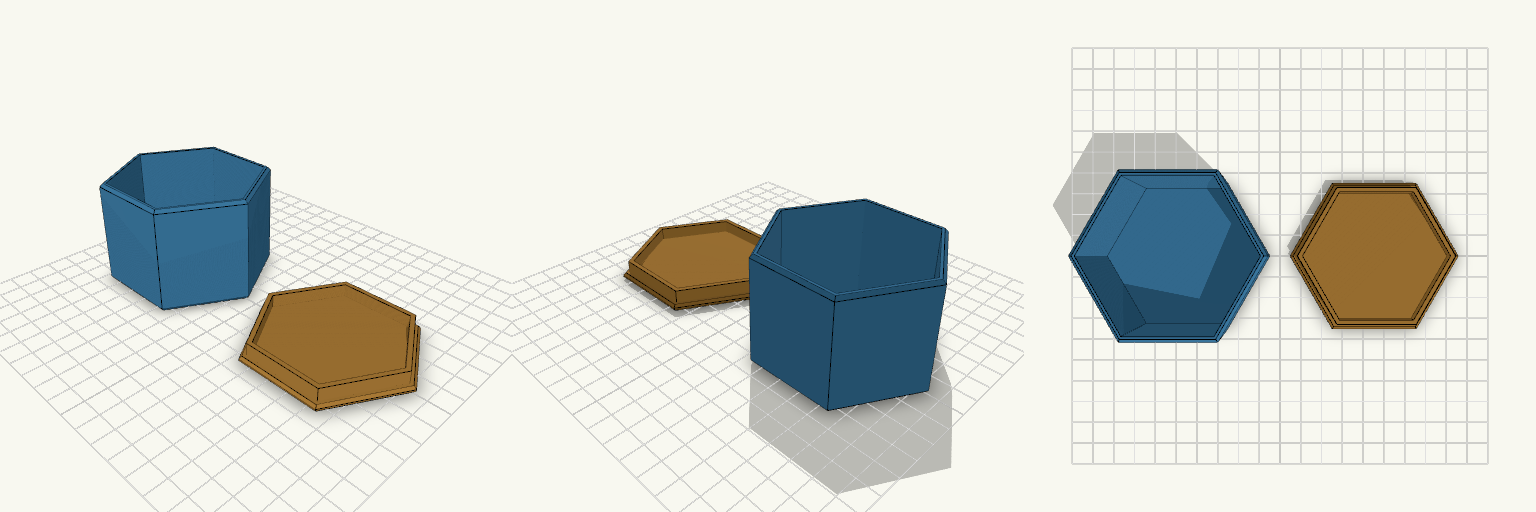
Hexagonal Box with Lid
A hexagonal box with a matching lid, printed as two separate pieces. The box is 50 mm tall and 80 mm across the corners, with 2.4 mm walls and a 3 mm floor. The lid is a 3 mm hexagonal plate with a 6 mm hollow lip underneath. The lip sits inside the box opening with about 0.4 mm of clearance per side, so the lid stays put without a tight press fit. Box: 80 mm across corners, 50 mm tall, chamfered base edge Lid: 80 mm across corners, 3 mm plate, 6 mm inner lip Print the lid flat with the lip facing up No supports needed for either piece
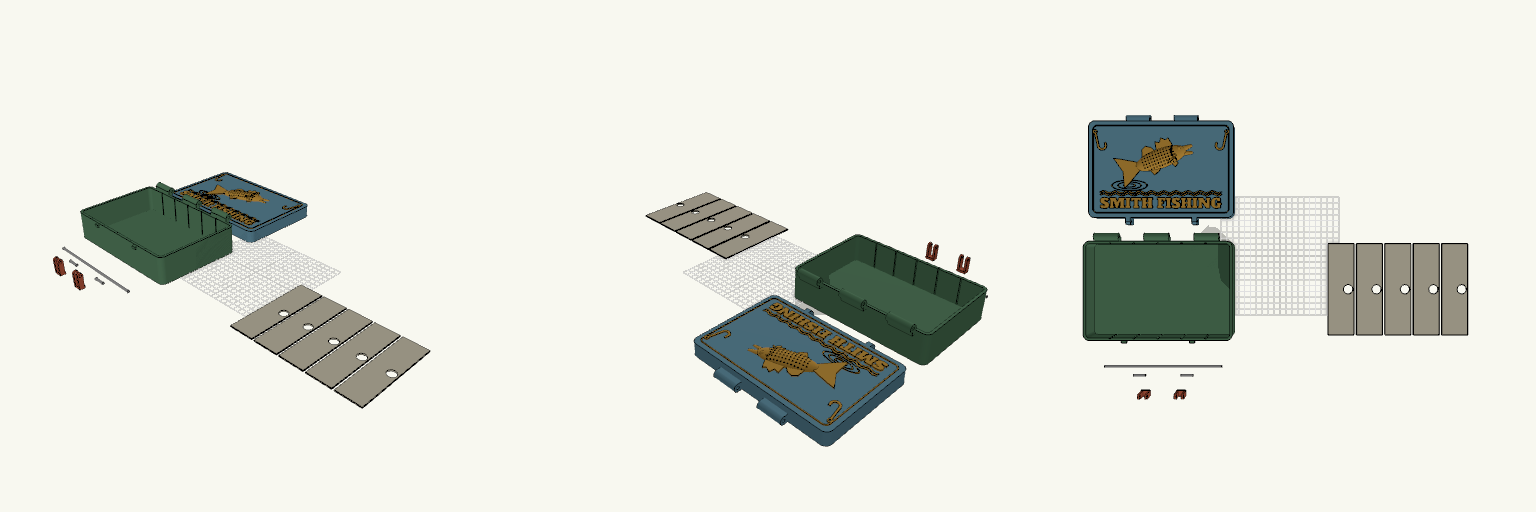
Bass Tackle Box With Hinged Lid
Tackle boxes that pop open in the boat, rattle hooks into the soft plastics, or lose a lid hinge get replaced. This one is a hinged bass tackle box with a locking front latch, adjustable dividers and a leaping largemouth bass on the lid, with SMITH FISHING raised underneath. Load-bearing numbers Base: 240 × 160 × 50 mm, 4 mm walls, 3 mm floor, rounded vertical corners. Lid: 240 × 160 × 22 mm, with a raised bass, ripples, waves, hooks and a border on top. Dividers: 5 removable cross dividers, 1.8 mm thick, sliding in 2.4 mm grooves at 38.5 mm spacing. Hinge: 5 interleaved knuckles across the back, joined by a 4.2 mm pin (197 mm long, printed separately). Latches: 2 front latches with 4.2 mm pivot pins. Each hooks under a ledge on the base. Printing Print every piece in the layout shown: base, lid, dividers, latches and pins are all separate. Lid: print upright. The underside of the top plate bridges across the cavity, so use supports or good bridging settings. Layer height 0.2 mm, PETG or ASA, 3+ perimeters. Hinge and latch pins can be glued or capped at the ends to keep them in.
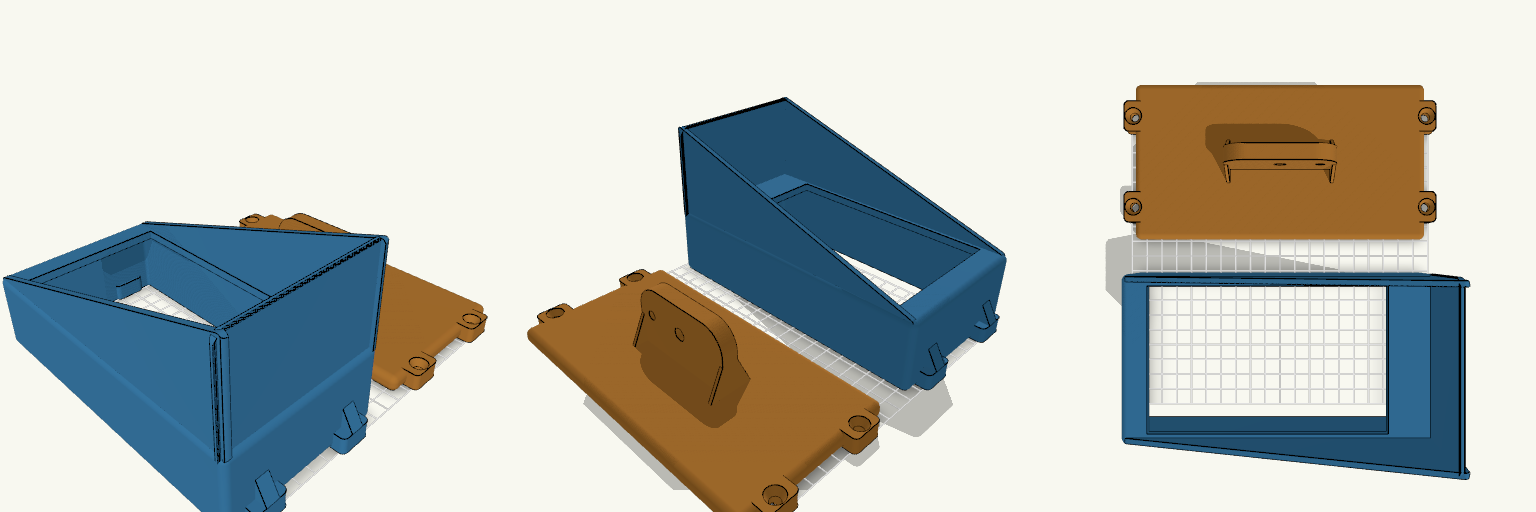
Caja con Tapa Ender 3 Pro
Caja con tapa y orejetas de cierre, dimensionada para imprimir cada pieza en la cama de 220 × 220 mm de una Ender 3 Pro. Interior de 182 × 93 × 42 mm; exterior de 192 × 103 mm y unos 208 mm de ancho total con las orejetas. Ideas para remezclar Medidas interiores: el largo, ancho y alto exterior se controlan con tres valores (192 × 103 × 47 mm). Las paredes y el suelo son de 5 mm; cambiarlos modifica el interior. Orejetas: 4 orejetas con agujero de 6,4 mm para insertos M6, a ±30 mm del centro. Se pueden mover o pasar a M4/M5. Ventana del suelo: el recorte de 145 × 89 mm se puede cerrar o reducir para más rigidez. Junta: la ranura de goma en la tapa y el borde de la caja sigue la medida exterior; ajusta su ancho según la junta que uses. Combina con: insertos roscados M6, tornillos de cabeza avellanada y cordón de goma de 2–3 mm. Cada pieza se imprime por separado; en el modelo aparecen juntas solo para la vista.
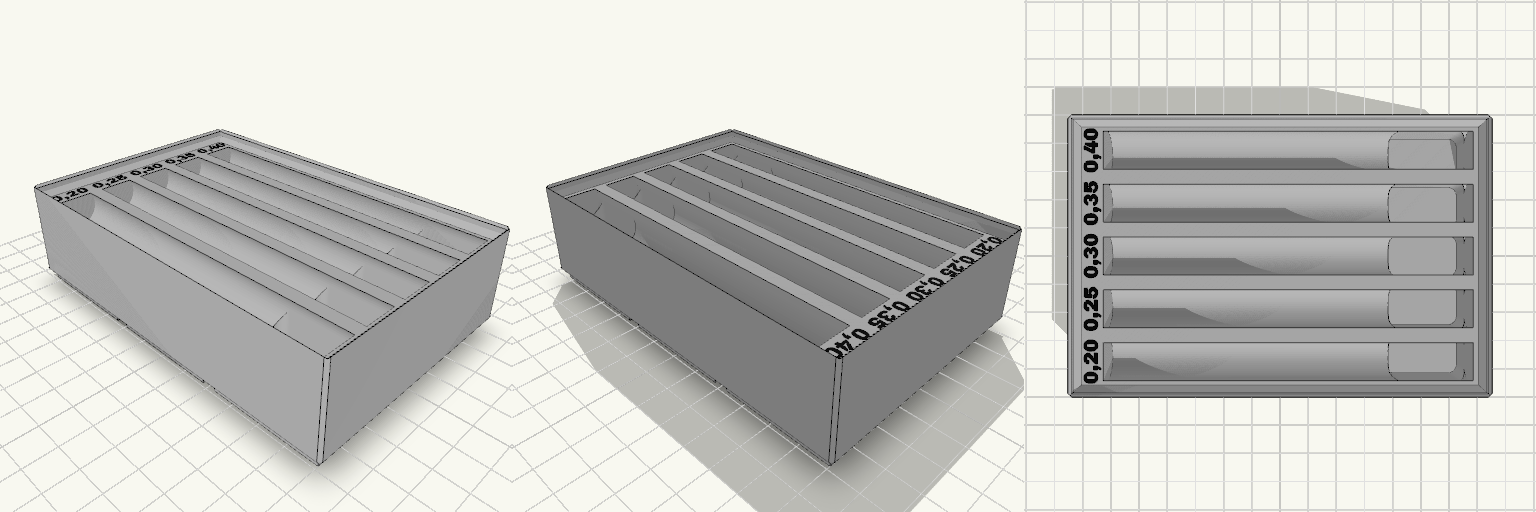
Gridfinity-Einsatz 3×2 für 5 Röhrchen Ø13 mm
Ein Gridfinity-Einsatz im 3×2-Raster mit 36 mm Gesamthöhe inklusive Fuß, der fünf längs liegende Mulden für Röhrchen von 13 mm Durchmesser und 110 mm Länge aufnimmt. Die Röhrchen werden von oben eingelegt; die Mulden sind oben offen. Vor den Mulden steht eine Beschriftung mit den Werten 0,20 / 0,25 / 0,30 / 0,35 / 0,40, von vorn nach hinten. Unter dem rechten Ende jeder Mulde sitzt eine zusätzliche Druckmulde in derselben Breite wie die Röhrchen-Mulde, die bis ans Muldenende geführt ist: Wird dort auf das eingelegte Röhrchen gedrückt, kippt es um die Kante und das gegenüberliegende Ende hebt sich zum Greifen an. Einsatz und Beschriftung sind getrennte Teile; die Beschriftung ist 0,8 mm tief in einer passenden Aussparung eingelassen, schließt oben bündig mit der Fläche des Einsatzes ab und liegt vollständig frei, sodass der Stapelrand sie nicht verdeckt. Die Mulden sind gegenüber der Beschriftung um 2,5 mm nach rechts versetzt, damit die Schrift nicht in die Mulden läuft. Der Einsatz ist weiß, die Schrift schwarz. Technische Daten Belegung: 3×2 Gridfinity-Felder, Rastermaß 42 mm Außenmaß: 125,5 × 83,5 × 36 mm (Fuß eingerechnet) Körperhöhe: 31,6 mm, darüber Stapelrand bis 36 mm Mulden: 5 Stück, je 13,6 mm breit und 112 mm lang, Abstand 16 mm, Muldenmitte auf 28 mm Höhe Druckmulden: je 24 mm lang, 13,6 mm breit und 14 mm tief, am +X-Ende jeder Mulde bis zum Muldenende geführt, nur an einer Seite, um die Auflage des Röhrchens nicht zu halbieren Wand zwischen benachbarten Mulden: 2,4 mm Spiel: rund 0,3 mm je Röhrchen bei Ø13 × 110 mm Schriftabstände: etwa 0,75 mm zum Überhang des Stapelrands und etwa 0,7 mm zur Mulde; rechter Steg etwa 4,25 mm Beschriftung: Werte 0,20 / 0,25 / 0,30 / 0,35 / 0,40; Schrift 4,2 mm hoch, 0,8 mm tief eingelassen, in kräftiger Schrift, um 90° gedreht, von unten nach oben lesbar, am linken Ende jeder Mulde auf einer ebenen Fläche; Einsatz weiß, Schrift schwarz Aufbau: zwei getrennte Teile – Einsatz und Beschriftung; die Schrift sitzt in einer 0,8 mm tiefen Aussparung und überlappt den Einsatz nicht Druck: 0,4-mm-Düse ausreichend; 0,16 mm Schichthöhe glättet die Schriftflanken, 0,2 mm funktioniert ebenfalls Geeignet für Schubladen mit Gridfinity-Auslegung, in denen Röhrchen, Stifte oder ähnliche zylindrische Teile griffbereit und lagestabil untergebracht werden sollen. Der Stapelrand ist für das Setzen eines zweiten Einsatzes ausgelegt; gestapelt kommt pro Einsatz etwa 31,6 mm Höhe dazu, weil der Fuß in den Rand eintaucht. Die Stapelgeometrie ist rechnerisch geprüft, nicht physisch gestapelt oder gedruckt; vor dem Druck mehrerer Einsätze empfiehlt sich ein Probestück. Die Oberkante des Stapelrands läuft spitz aus; bei Passproblemen sind 0,1 bis 0,2 mm mehr Spiel am Rand die übliche Korrektur.