Bass Tackle Box With Hinged Lid
Created 4 days ago
Remixed once
Description
Tackle boxes that pop open in the boat, rattle hooks into the soft plastics, or lose a lid hinge get replaced. This one is a hinged bass tackle box with a locking front latch, adjustable dividers and a leaping largemouth bass on the lid, with SMITH FISHING raised underneath.
Load-bearing numbers
- Base: 240 × 160 × 50 mm, 4 mm walls, 3 mm floor, rounded vertical corners.
- Lid: 240 × 160 × 22 mm, with a raised bass, ripples, waves, hooks and a border on top.
- Dividers: 5 removable cross dividers, 1.8 mm thick, sliding in 2.4 mm grooves at 38.5 mm spacing.
- Hinge: 5 interleaved knuckles across the back, joined by a 4.2 mm pin (197 mm long, printed separately).
- Latches: 2 front latches with 4.2 mm pivot pins. Each hooks under a ledge on the base.
Printing
- Print every piece in the layout shown: base, lid, dividers, latches and pins are all separate.
- Lid: print upright. The underside of the top plate bridges across the cavity, so use supports or good bridging settings.
- Layer height 0.2 mm, PETG or ASA, 3+ perimeters.
- Hinge and latch pins can be glued or capped at the ends to keep them in.
Images
More like this
Explore more in Storage & Organization →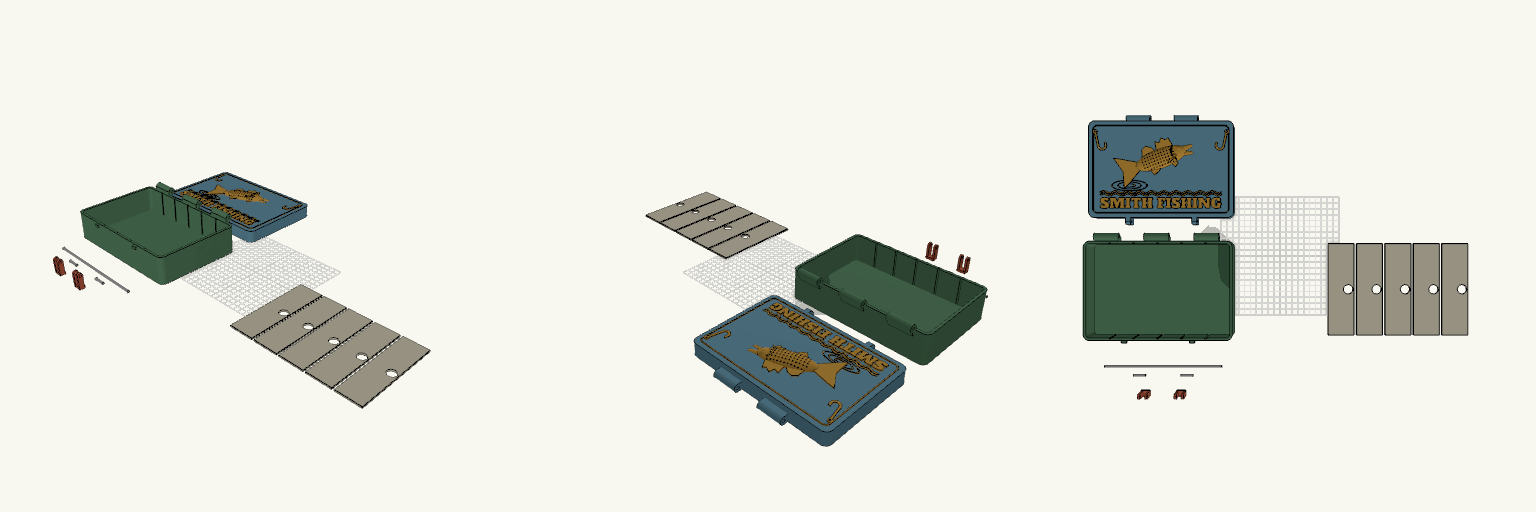
Hinged Bass Tackle Box with Dividers
What it's for A hinged tackle box for bass fishing gear, with a locking front latch, removable thick dividers and a leaping bass on the lid with SMITH FISHING lettering. Dimensions Base: 240 × 160 × 50 mm, 4 mm walls, 3 mm floor Lid: 240 × 160 × 22 mm with raised artwork Dividers: 5 pieces, 2.6 mm thick, sliding in 3.2 mm grooves Hinge: 5 knuckles with a separate 4.2 mm pin Latches: 2 front latches with pivot pins Remix ideas Change the lettering to a different name Add more divider grooves for smaller compartments Swap the lid artwork for another species
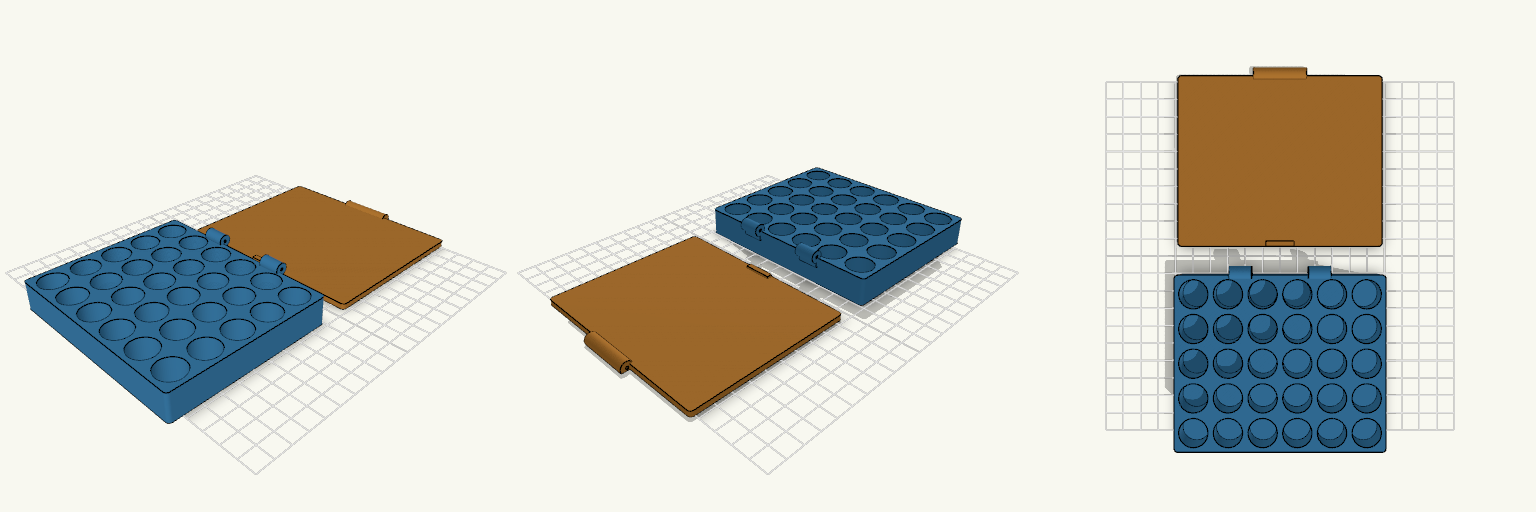
Apothecary Grid Hinged Pill Box
A pharmacy-drawer grid in miniature: thirty round wells in a 6×5 layout, topped by a lid that swings open on a real pin hinge at the back edge. The lid prints flat beside the tray and clicks into the hinge ears once a short pin is slid through. 30 slots, 16 mm wide and 14 mm deep Hinge pin hole sized for a 1.75 mm filament offcut, about 56 mm long Front finger tab on the lid for easy opening Lid and tray print without supports in separate pieces
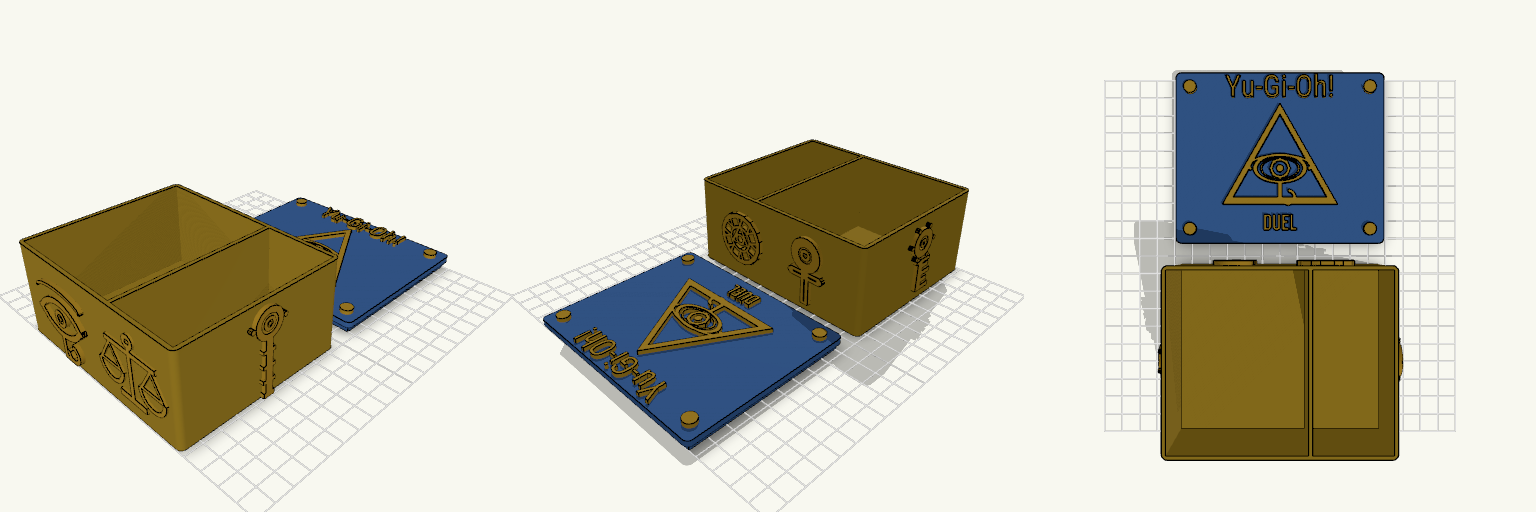
Yu-Gi-Oh Deck Box With Millennium Scale
Two-bay deck box for sleeved Yu-Gi-Oh! cards with a separate accessory bay for dice and other game items. A plug-in lid carries a Millennium Puzzle triangle with an eye and "Yu-Gi-Oh!" lettering in a regular-weight font. Millennium Items are raised on the outside walls. Card bay: 70 mm wide, for sleeved decks Accessory bay: 40 mm wide, with a cross divider separating dice from other items Front: Millennium Scale and Millennium Eye, 1.2 mm raised relief Back: Millennium Ankh and Millennium Ring Sides: Millennium Key (left) and Millennium Rod (right) Lid: flat plate with plugs for both bays, printed plate-side down
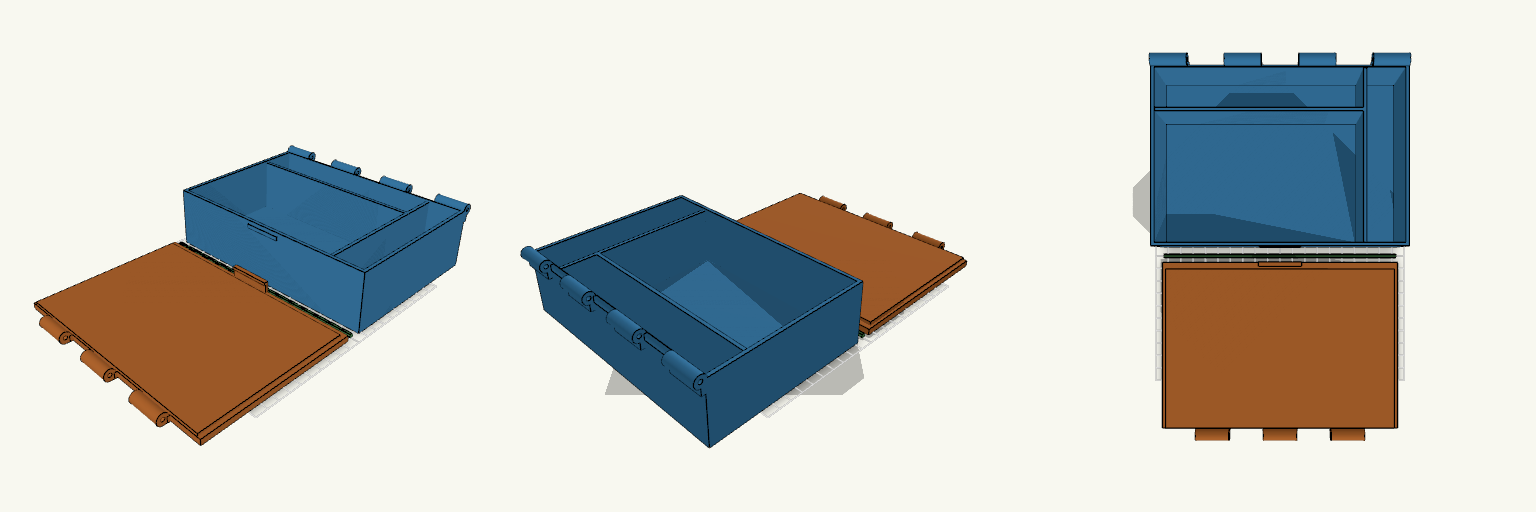
Hinged Latching Box With Front Divider
Small parts slide into one pile the moment the lid comes off; this hinged latching box splits the main space with a divider and adds a full-depth side bay so screws, clips and the like stop mixing. The main compartment clears 152 × 127 × 45 mm, with a 2.5 mm divider set 97 mm back from the front. A 2.5 mm wall separates a 28 mm wide, full-depth compartment on the right, and that bay has no cross divider. The walls stand 2 mm taller than the divider, and the divider top sits level with the underside of the lid lip, so the full 45 mm of height is usable. Fit and compartments Main compartment: 152 × 127 × 45 mm clear (width × depth × height). Right side compartment: 28 mm wide × 127 mm deep × 45 mm high, separated by a 2.5 mm wall and open for its full depth; overall inside width about 182.5 mm. Divider: 2.5 mm thick, 97 mm back from the front of the main compartment; front bay 97 mm deep, rear bay about 27.5 mm clear in the main area. The divider stops at the side-compartment wall so the right bay stays open. Walls and floor: 2.5 mm; the divider is 2 mm shorter than the walls so the lid lip clears it. Lid: 2 mm inner lip locates it on the base. Hinge clearance The lid's back edge has notches where the base's hinge knuckles pass through it. The base's back wall is cut away where the lid's knuckles swing down into it. Both cuts carry roughly 0.3 mm of play, so the lid closes without catching. Latch The hooked tab on the lid is set so the hook sits close over the catch bump without binding. Closed, the gap between the top of the hook and the underside of the catch bump is about 1.3 mm. If it prints too tight to snap over, lengthen the tab by a fraction of a millimetre at a time; if it is too loose, shorten it the same way. Printing and assembly Prints as three separate pieces: base, lid, and hinge pin. Base footprint is about 187.5 × 140.6 mm; the lid is about 187.5 × 142.3 mm; the pin is about 185.5 mm long and 3 mm in diameter. The pieces sit apart on the plate with gaps: the lid is flipped so its flat top face is on the bed, and the 3 mm pin lies flat in the gap. None of the three touch. If a slicer imports the file as one body, use Split to objects or Separate parts. Hinge: seven interleaved knuckles with a 3 mm pin. Use a 3 mm rod or filament, or print the pin. Slide the pin through the knuckles after printing; the lid hinges on it and the front latch holds it shut.
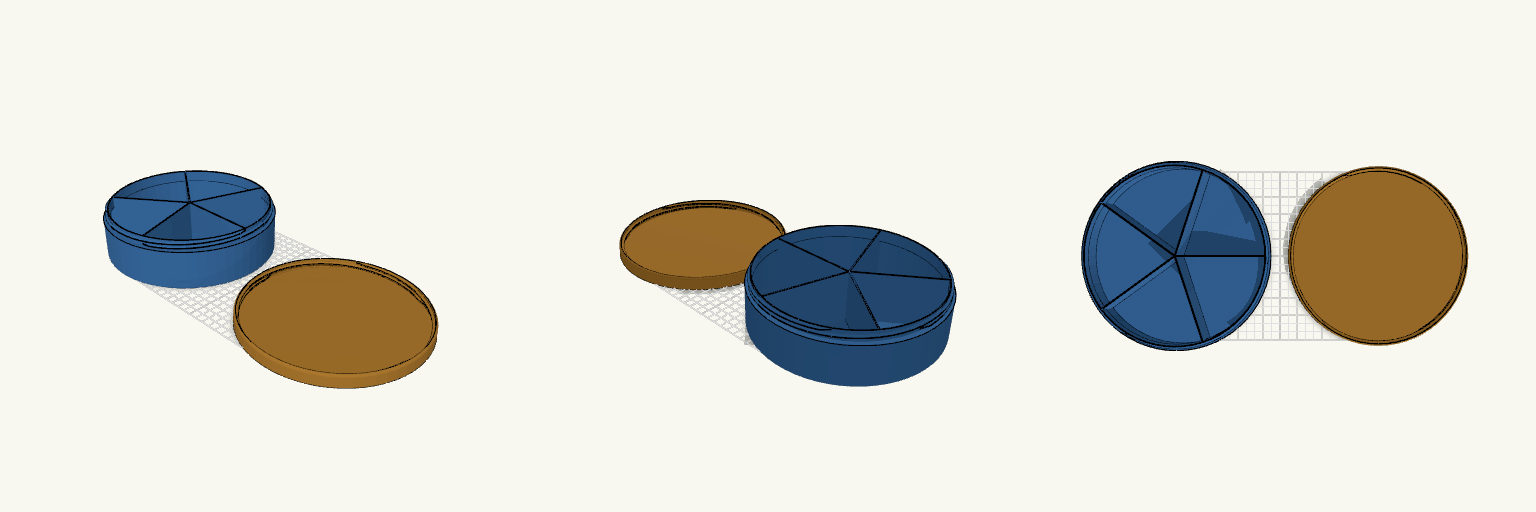
5 Bölmeli Vidalı Kapaklı Saklama Kabı
210 mm çapında, 60 mm yüksekliğinde yuvarlak bir saklama kabı. İçi, merkezden duvara 72° aralıkla çıkan beş bölmeyle eşit gözlere ayrılmış; bölmeler dişli boyun bölgesinde de devam ettiği için kapak takılıyken gözeler birbirine karışmaz. Kapak, gövdenin üstündeki dış dişe vidalanır; taşırken kendiliğinden açılmaz. Gövde ve kapak ayrı ayrı basılır. Remix için başlangıç değerleri Gövde: 210 mm çap, 60 mm yükseklik; yan duvar ve taban 1,6 mm, iç bölmeler 1,2 mm Kapak: 210 mm çap, 14,3 mm yükseklik, üst et 2,4 mm; düz yüzü tablaya gelecek şekilde basılır Diş: 12 mm boy, 5 mm adım, 3 ağızlı (hatve 15 mm), 0,5 mm boşluk; kapatmak için yaklaşık 0,8 tur (yaklaşık 290°) Diş çapı 204 mm, boyun iç çapı 197 mm; gövdenin üstündeki basamak her yanda yaklaşık 3 mm kalıyor Nereleri değiştirmek mantıklı Göz sayısı: bölmeler merkezden eşit açıyla çıktığı için sayıyı değiştirmek bölme açılarını da değiştirir; açıyı 72°'den farklı seçersen gözler eşit olmaktan çıkar, bunu bilerek yap. Bölme kalınlığı: 1,2 mm ince ve malzeme dostu; daha ağır parçalar koyacaksan kalınlaştır, ama göz hacmi daralır. Diş boşluğu: 0,5 mm baskıda rahat çalışıyor; makinen sıkı basıyorsa düşür, kapağı sık açıp kapatacaksan artır. Dış çap ve yükseklik: 210 × 60 mm raf ve çekmece için uygun bir başlangıç; aynı dişi koruyup gövdeyi derinleştirmek en kolay varyant. Alt kısımdaki diş dibi duvarı ince kaldığı için o bölgeyi basarken katman ayarlarına dikkat etmek gerekir. Beş gözü sayesinde dökme parçaları, vida ve küçük donanımı ya da atölye malzemesini tek kapta ayrı ayrı tutmak için uygundur; aynı diş ölçüsünü koruyan daha sığ bir gövde ya da daha çok gözlü bir üst katman iyi bir eşleşme olur.
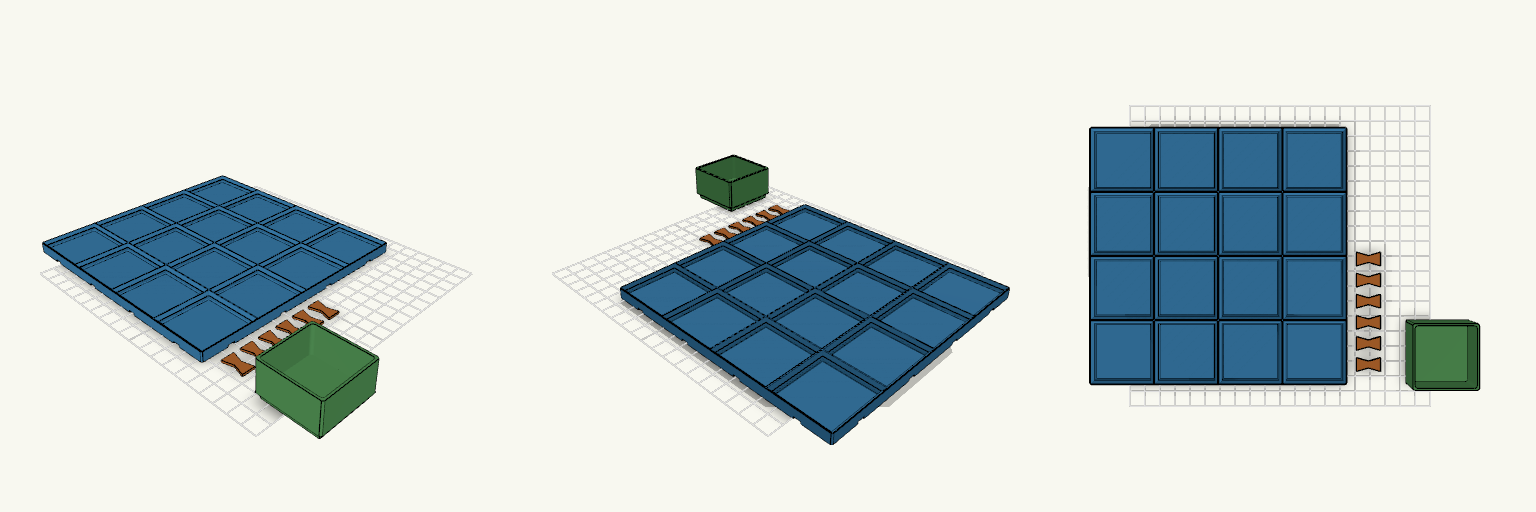
4x4 Gridfinity Baseplate with Bowtie Clips
What it's for A 4x4 Gridfinity baseplate that joins to neighbouring plates without interrupting the grid. Each outer edge carries four bowtie-shaped recesses on the underside, one centred on every cell edge. Butt two plates together and press a clip into the matching recesses from below; the clip sits flush so the top surface stays seamless and the 42 mm pitch carries across the join. The set prints as separate parts: the baseplate, the bowtie clips and a 1x1 bin. The bin has a foot profile that matches the baseplate pockets but no stacking lip. Dimensions Baseplate: 168 × 168 × 6.8 mm (4 × 4 cells on the 42 mm grid) 1x1 bin: 41.5 × 41.5 × 25.7 mm Bowtie clips: 16 × 79 × 1.2 mm, sitting in 1.4 mm deep recesses with 0.2 mm clearance Print notes Six clips are included, which is enough for one seam only — print four per cell edge you want to join. Print the clips flat in PETG or a tougher filament rather than PLA; at 1.2 mm thick they are the weak point of the set. Remix ideas Scale the plate to other grid sizes, or mix a 4x4 with smaller plates along the same seams. Add more 1x1 bins, or extend the bin family with deeper sizes. Add a stacking lip to the bin for stacked storage.