Stash Box With Rolling Groove2
Created 1 months ago
Description
A stash box dimensioned precisely to 6" x 4" x 2". The lid features an inner alignment flange for a secure slip-fit when closed. When removed and inverted, the lid acts as a functional tray, featuring a solid raised block with a 130mm long V-notch engineered into the center to cradle rolling papers.
Dimensions
- Overall Box Size: 152.4mm x 101.6mm x 50.8mm (6" x 4" x 2")
- V-Notch Length: 130mm (accommodates standard and king-size papers)
- Wall Thickness: 2mm throughout the base
Print Notes
- Both parts are oriented flat on the build plate in their optimal printing positions.
- The V-notch prints perfectly without supports due to its self-supporting 45-degree overhang geometry.
- A 0.6mm clearance tolerance is built into the lid lip to allow smooth opening and closing right off the printer.
Photos
Technical views
More like this
Explore more in Storage & Organization →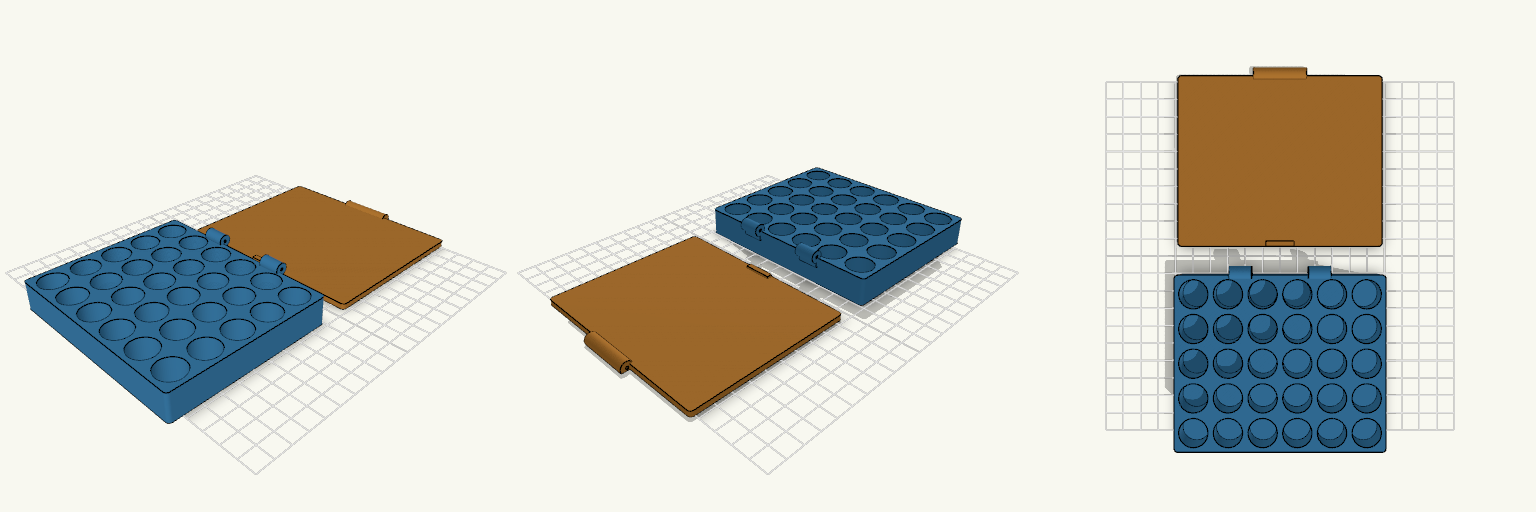
Apothecary Grid Hinged Pill Box
A pharmacy-drawer grid in miniature: thirty round wells in a 6×5 layout, topped by a lid that swings open on a real pin hinge at the back edge. The lid prints flat beside the tray and clicks into the hinge ears once a short pin is slid through. 30 slots, 16 mm wide and 14 mm deep Hinge pin hole sized for a 1.75 mm filament offcut, about 56 mm long Front finger tab on the lid for easy opening Lid and tray print without supports in separate pieces
Bass Tackle Box With Hinged Lid
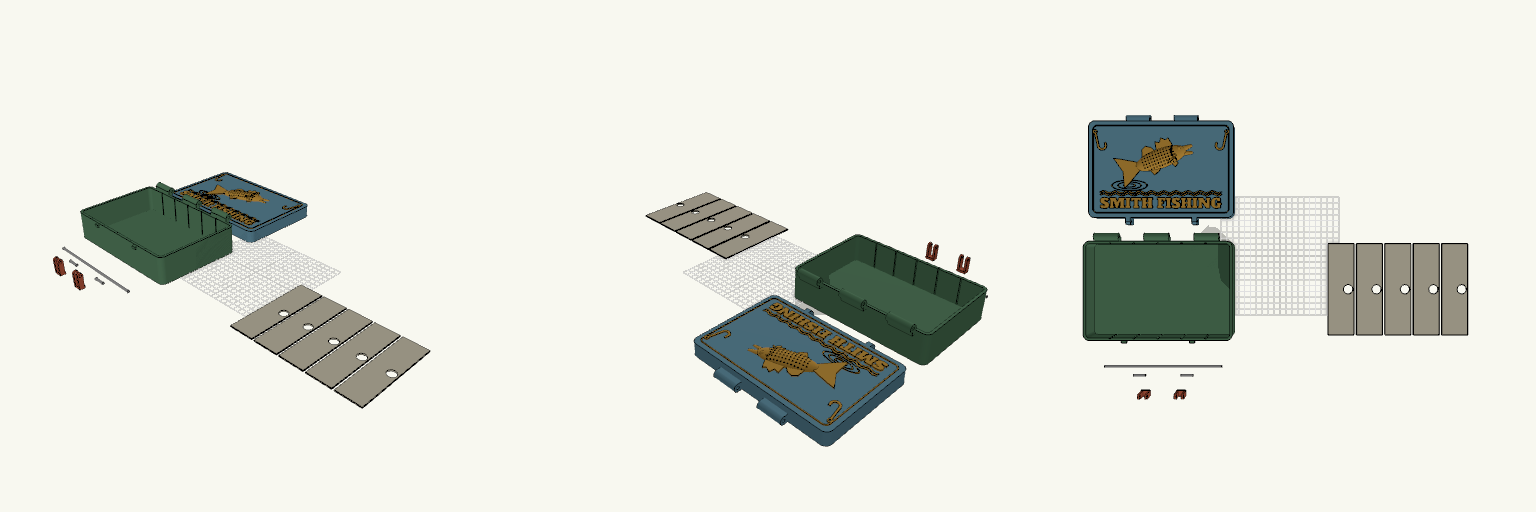
Tackle boxes that pop open in the boat, rattle hooks into the soft plastics, or lose a lid hinge get replaced. This one is a hinged bass tackle box with a locking front latch, adjustable dividers and a leaping largemouth bass on the lid, with SMITH FISHING raised underneath. Load-bearing numbers Base: 240 × 160 × 50 mm, 4 mm walls, 3 mm floor, rounded vertical corners. Lid: 240 × 160 × 22 mm, with a raised bass, ripples, waves, hooks and a border on top. Dividers: 5 removable cross dividers, 1.8 mm thick, sliding in 2.4 mm grooves at 38.5 mm spacing. Hinge: 5 interleaved knuckles across the back, joined by a 4.2 mm pin (197 mm long, printed separately). Latches: 2 front latches with 4.2 mm pivot pins. Each hooks under a ledge on the base. Printing Print every piece in the layout shown: base, lid, dividers, latches and pins are all separate. Lid: print upright. The underside of the top plate bridges across the cavity, so use supports or good bridging settings. Layer height 0.2 mm, PETG or ASA, 3+ perimeters. Hinge and latch pins can be glued or capped at the ends to keep them in.
Two-Piece Pro Controller Wall Holder
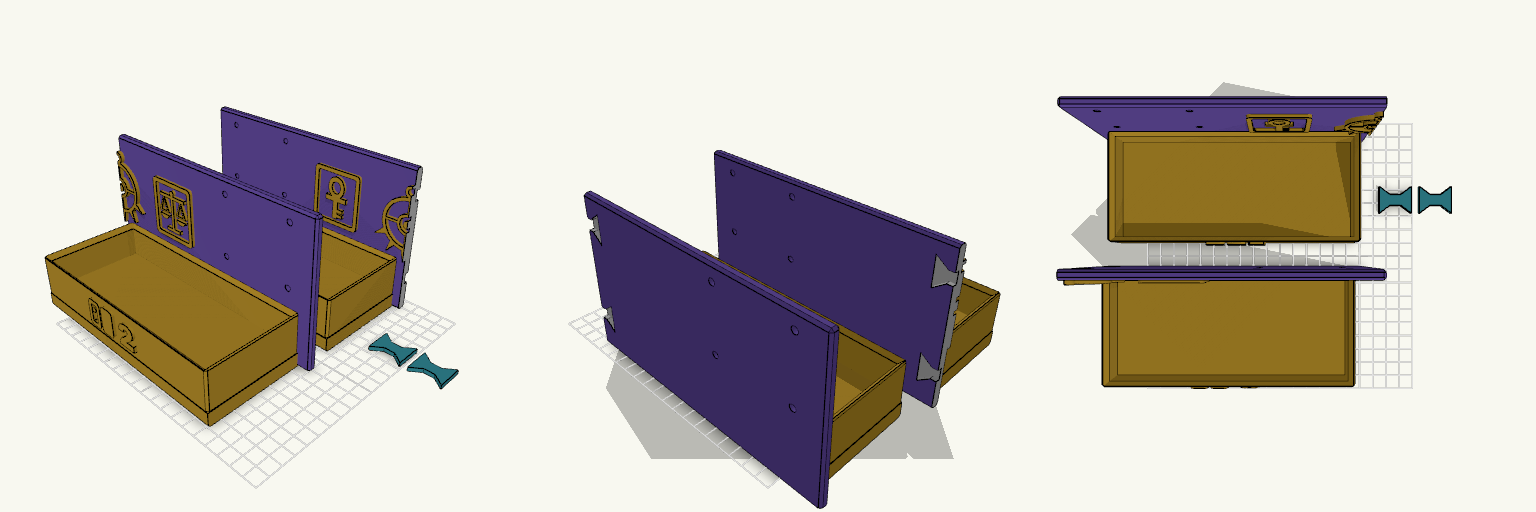
A 380 mm wall holder for a PS5 and a Switch Pro controller is too wide for most print beds, and a single plate can crack along its length. This version prints as two 190 mm halves that lock together with two butterfly keys. Fit and print Split line: centre of the plate, through the Yu-Gi-Oh! ring emblem Keys: two butterfly-shaped keys, 24 mm wide and 20 mm tall, 2.9 mm thick, printed flat Key pockets: cut 3.3 mm deep into the back face, 0.3 mm clearance all round Assembly: press the keys into the back pockets across the seam, then screw the halves to the wall. The wall holds the keys in Mounting: eight countersunk screw holes in total, four per half Printing: halves lie on their backs or stand on the shelf base. No supports are needed for the hollow blocks Pocket sizes are 166 mm wide and 70 mm deep, from typical controller sizes and not from measurements of a specific controller.
Yu-Gi-Oh Deck Box With Millennium Scale
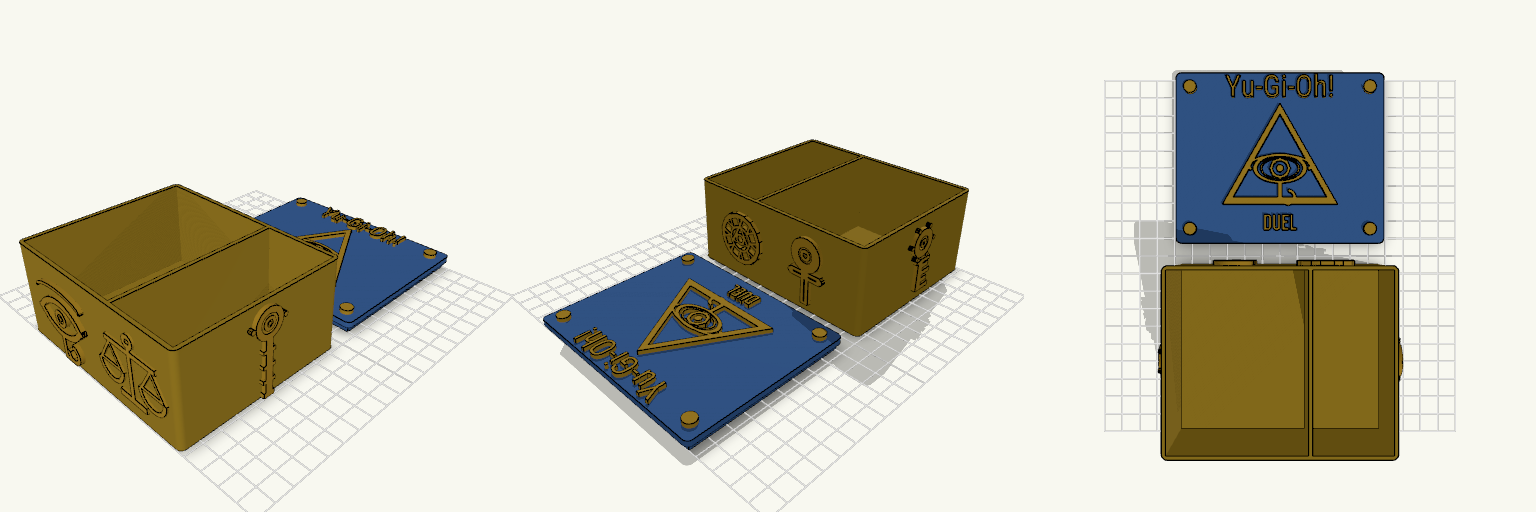
Two-bay deck box for sleeved Yu-Gi-Oh! cards with a separate accessory bay for dice and other game items. A plug-in lid carries a Millennium Puzzle triangle with an eye and "Yu-Gi-Oh!" lettering in a regular-weight font. Millennium Items are raised on the outside walls. Card bay: 70 mm wide, for sleeved decks Accessory bay: 40 mm wide, with a cross divider separating dice from other items Front: Millennium Scale and Millennium Eye, 1.2 mm raised relief Back: Millennium Ankh and Millennium Ring Sides: Millennium Key (left) and Millennium Rod (right) Lid: flat plate with plugs for both bays, printed plate-side down
Staggered 5-Key Hook Extender
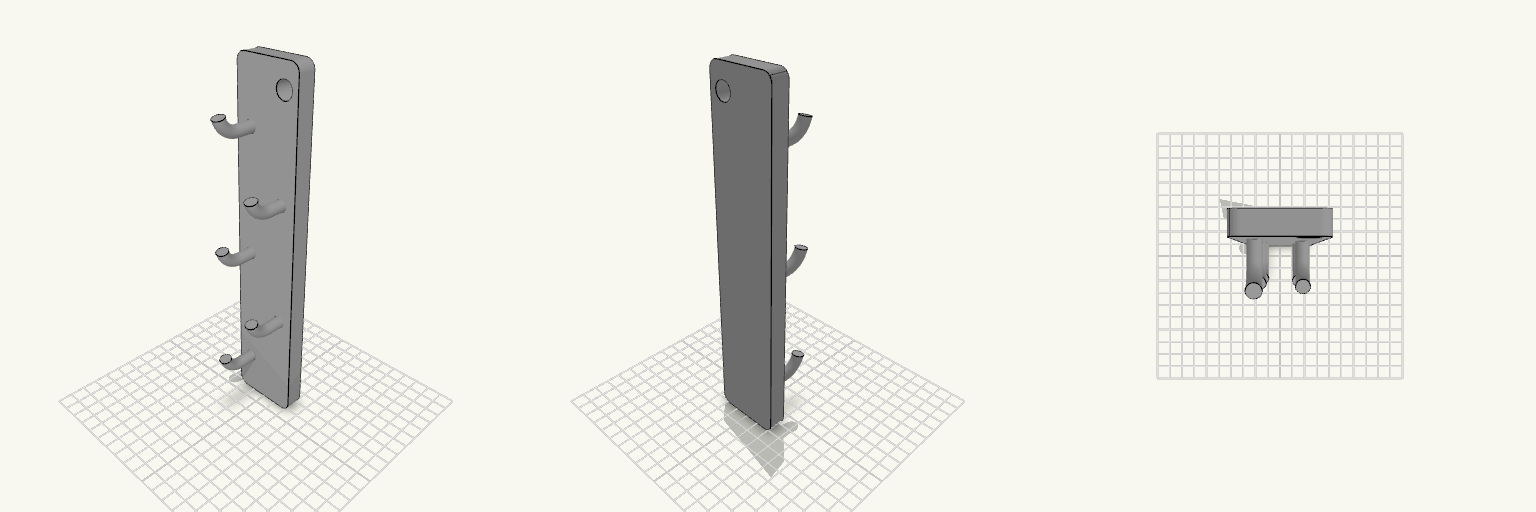
A tall back plate that hangs from a key rack and holds five keys on alternating left and right pegs, so fobs dangle without touching each other. The plate is 46.2 mm wide, 240 mm tall and 12 mm thick, with a 12 mm hang hole at the top right. Each peg is 8 mm in diameter, runs straight for 12 mm, then curves upward through 75° to keep rings seated. Remix hooks Plate thickness (12 mm): the easiest stiffness lever. Pegs are set into the plate face, so going thicker needs no other changes. Peg spacing (42 mm pitch): raise it for longer fobs, lower it to fit more pegs on a shorter plate. Bend angle (75°) and straight run (12 mm): lengthen the run for larger rings, ease the angle for a flatter peg. Hang hole (12 mm): resize to match your rack hook. Pairs with: any horizontal key rack with a post or screw head that fits the hole.
TANKER 3 Water
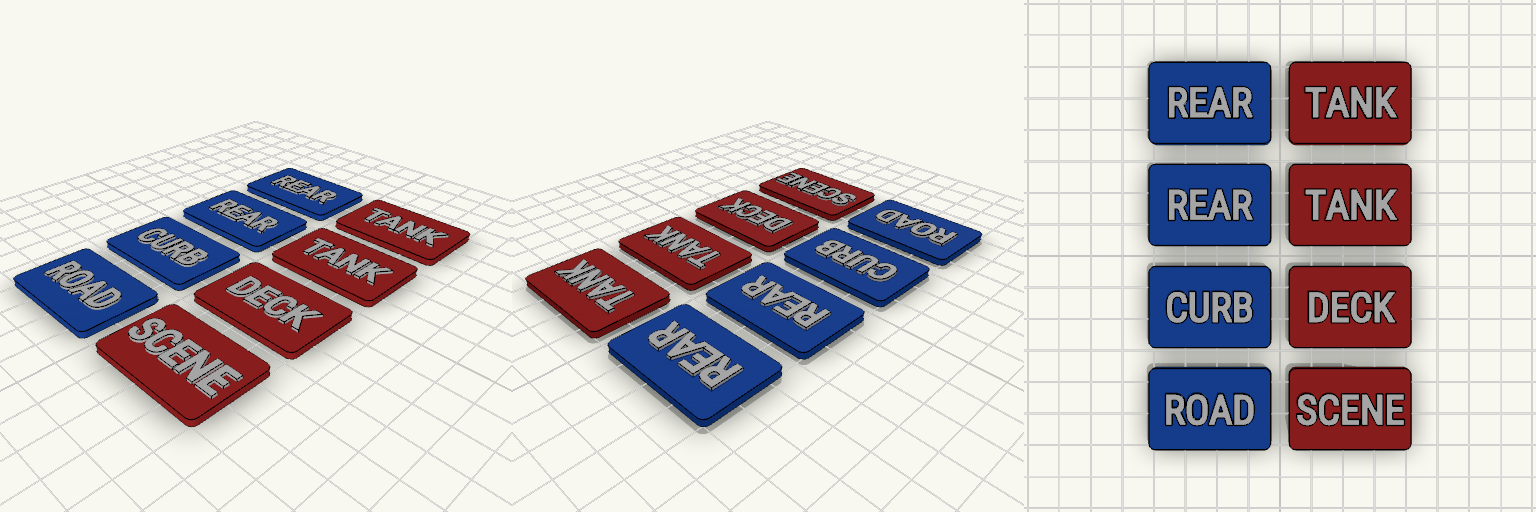
A matched set of eight small label plates with bold raised white lettering, styled like the enamel signage screwed to a garage wall, a shelf edge or the front of a storage bin. Each plate carries a single word — the four blue plates read ROAD, CURB, REAR and REAR, and the four red plates read SCENE, DECK, TANK and TANK — so a wall of bins, hooks, shelves or parking spots can be told apart at a glance. Colour does the sorting: blue for one group, red for the other, both with the same white lettering, so the two families stay distinguishable from across the room while reading as one set. The letters are thickened rather than enlarged, so the strokes carry weight without changing the plate size. The plates are plain rectangles with rounded corners and no fixing hole, leaving the full face free for the text — stick them on with double-sided tape or adhesive, or drill and screw them wherever they are needed. Dimensions Each plate: 1.5 in wide × 1 in tall (38.1 × 25.4 mm), 2 mm thick Rounded corners, no hanging hole Raised lettering: 0.8 mm proud of the face, strokes thickened for a heavier face Lettering centred horizontally and vertically on every plate Plates laid out 32 mm apart in two columns, blue set on the left, red set on the right Set contents Blue: ROAD, CURB, REAR, REAR Red: SCENE, DECK, TANK, TANK Print notes All eight plates sit flat on the bed and print without supports A single filament swap at letter height produces the two-tone face; painting the raised text works just as well The whole set prints in one go and comes off as eight separate tags The same layout takes any short word you want to swap in, as long as the plate size and the two-tone face stay the same.