Trinket Box With Captive Hinge
Created 1 months ago
Description
Most 3D-printed boxes rely on thin plastic living hinges that fatigue and snap off after a week of use, or require separate filament fragments as pins that eventually back out. This print-in-place trinket box uses a five-knuckle mechanical barrel hinge with integrated teardrop pins to prevent bridging collapse. A front thumb-tab with an offset detent provides a positive snap closure so the lid doesn't flap open when jostled in a drawer.
- Dimensions: 70 mm x 50 mm x 30 mm overall footprint.
- Walls: 2 mm solid perimeters for rigidity.
- Tolerances: 0.4 mm clearance inside the hinge barrel to prevent the knuckles from fusing during extrusion.
- Printing: Print fully closed, flat on the base. Requires no supports.
Photos
Technical views
More like this
Explore more in Storage & Organization →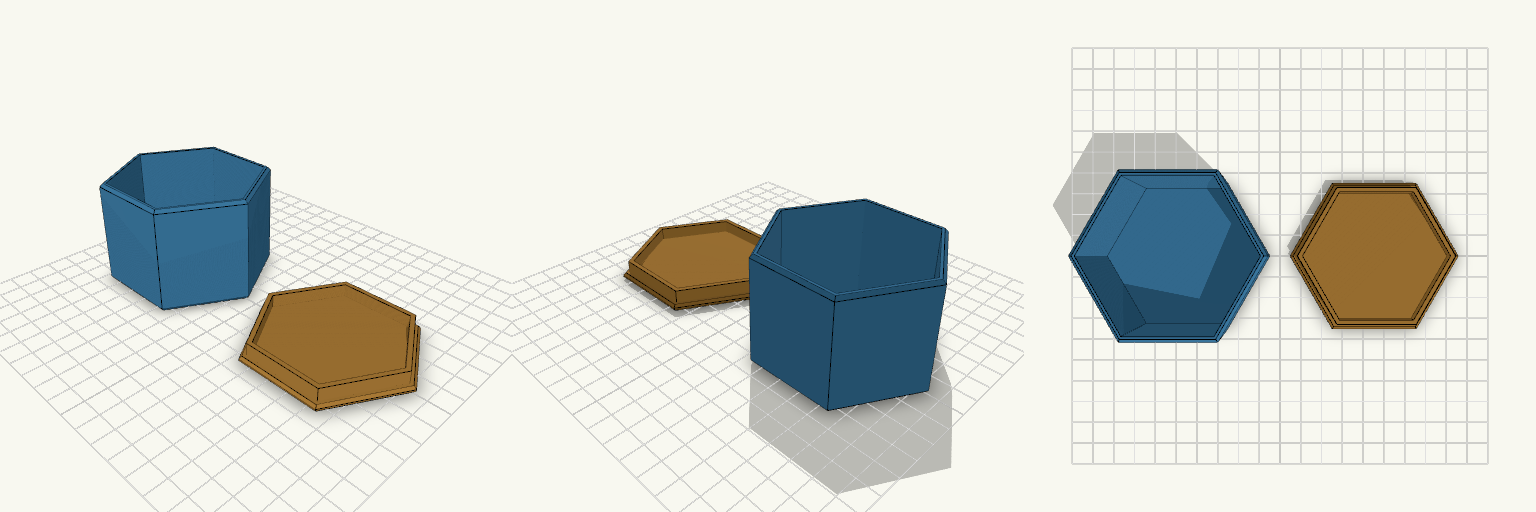
Hexagonal Box with Lid
A hexagonal box with a matching lid, printed as two separate pieces. The box is 50 mm tall and 80 mm across the corners, with 2.4 mm walls and a 3 mm floor. The lid is a 3 mm hexagonal plate with a 6 mm hollow lip underneath. The lip sits inside the box opening with about 0.4 mm of clearance per side, so the lid stays put without a tight press fit. Box: 80 mm across corners, 50 mm tall, chamfered base edge Lid: 80 mm across corners, 3 mm plate, 6 mm inner lip Print the lid flat with the lip facing up No supports needed for either piece
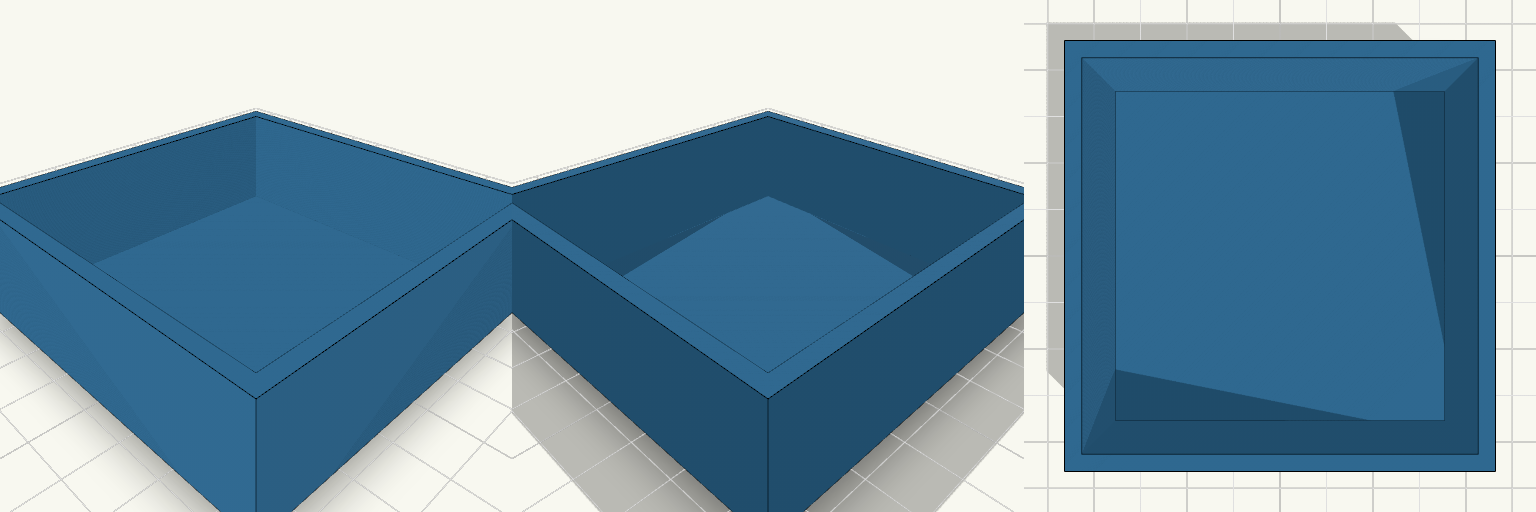
Open-Top Square Box 75 × 75 × 25 mm
What it's for A plain open-topped square box with a closed floor, sized to hold small parts, tools, or loose odds and ends on a desk or workbench. The straight sides and flat base keep it stable on the print plate and easy to drop things into from above. Dimensions Outer footprint: 75 × 75 mm Height: 25 mm Wall thickness: 3 mm Floor thickness: 3 mm Top: fully open, no lid Print notes Prints upright as it sits, with no supports needed for the vertical walls. A 3 mm wall and floor hold up well in PLA or PETG at a standard layer height; thicker walls take a slightly wider nozzle or more perimeters comfortably. Remix ideas Add a lid or a stacking lip so several boxes can sit on top of one another. Round the outer corners for a softer look and less sharp handling. Divide the interior with a grid to sort small hardware.
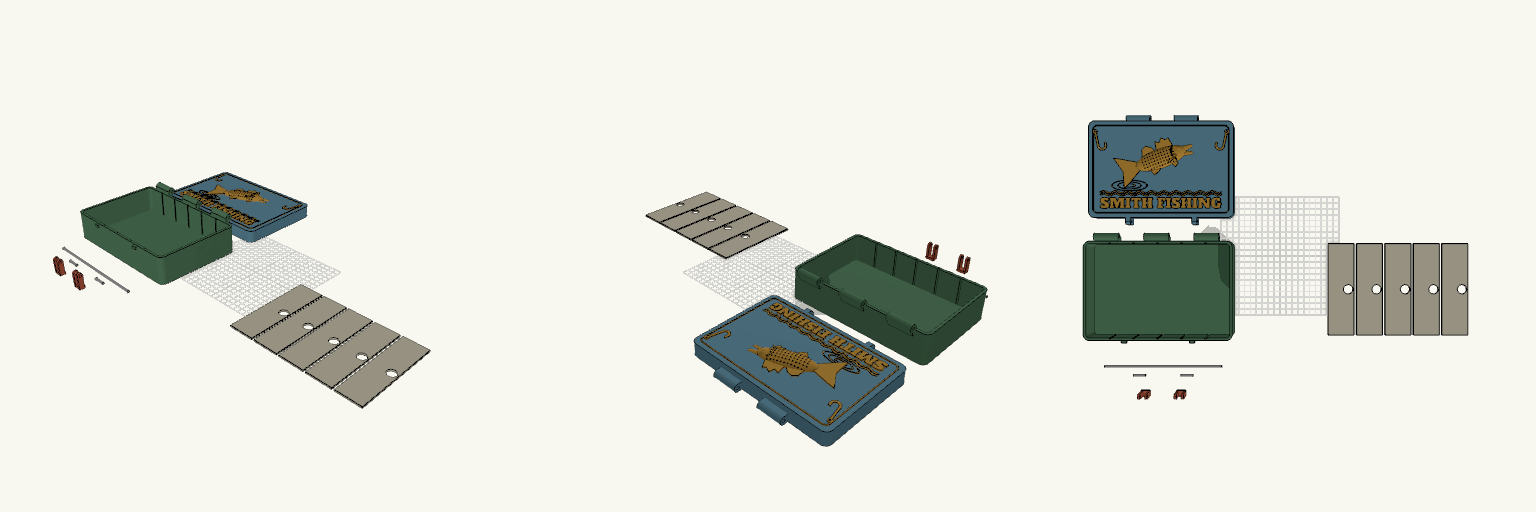
Hinged Bass Tackle Box with Dividers
What it's for A hinged tackle box for bass fishing gear, with a locking front latch, removable thick dividers and a leaping bass on the lid with SMITH FISHING lettering. Dimensions Base: 240 × 160 × 50 mm, 4 mm walls, 3 mm floor Lid: 240 × 160 × 22 mm with raised artwork Dividers: 5 pieces, 2.6 mm thick, sliding in 3.2 mm grooves Hinge: 5 knuckles with a separate 4.2 mm pin Latches: 2 front latches with pivot pins Remix ideas Change the lettering to a different name Add more divider grooves for smaller compartments Swap the lid artwork for another species
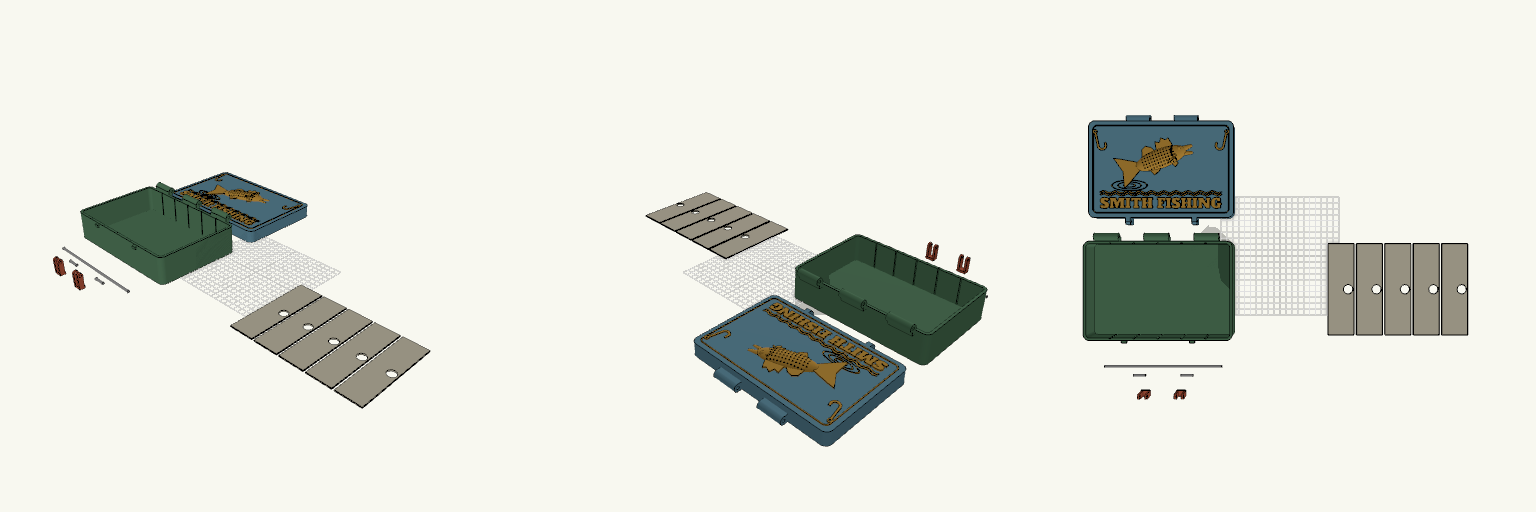
Bass Tackle Box With Hinged Lid
Tackle boxes that pop open in the boat, rattle hooks into the soft plastics, or lose a lid hinge get replaced. This one is a hinged bass tackle box with a locking front latch, adjustable dividers and a leaping largemouth bass on the lid, with SMITH FISHING raised underneath. Load-bearing numbers Base: 240 × 160 × 50 mm, 4 mm walls, 3 mm floor, rounded vertical corners. Lid: 240 × 160 × 22 mm, with a raised bass, ripples, waves, hooks and a border on top. Dividers: 5 removable cross dividers, 1.8 mm thick, sliding in 2.4 mm grooves at 38.5 mm spacing. Hinge: 5 interleaved knuckles across the back, joined by a 4.2 mm pin (197 mm long, printed separately). Latches: 2 front latches with 4.2 mm pivot pins. Each hooks under a ledge on the base. Printing Print every piece in the layout shown: base, lid, dividers, latches and pins are all separate. Lid: print upright. The underside of the top plate bridges across the cavity, so use supports or good bridging settings. Layer height 0.2 mm, PETG or ASA, 3+ perimeters. Hinge and latch pins can be glued or capped at the ends to keep them in.
Clicker Keycap__Panda
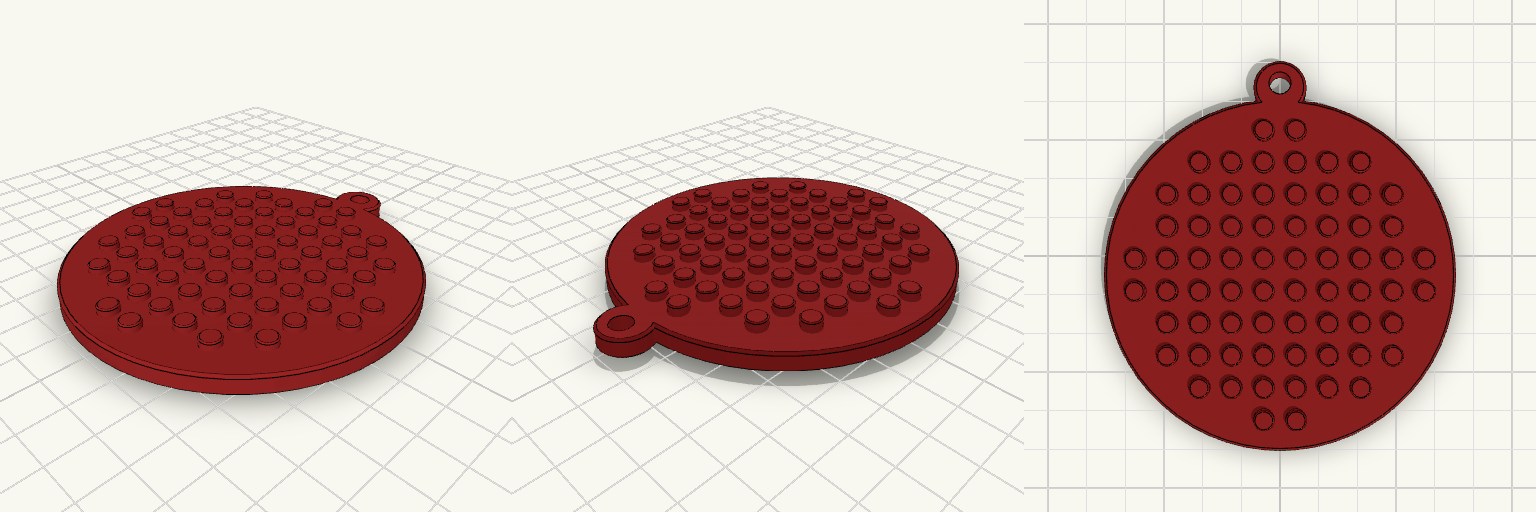
A round 88 mm ornament disc, 4.8 mm thick, with a grid of LEGO-compatible studs on the face and a hanging loop at the top. Printed in red, flat, with no supports. Remix hooks Stud diameter: 5.0 mm now (standard is 4.8 mm). Raise it to 5.05 for a firmer grip, or drop it to 4.9 if bricks sit too tight on your printer. Stud height: 1.8 mm. Taller studs give a deeper grip but need more bridging care. Disc thickness: 4.8 mm, or 1.5 LEGO plates. Use 3.2 mm for one plate or 9.6 mm for a full brick height. Disc diameter: 88 mm on an 8 mm stud pitch. The stud grid is cut to a 37 mm radius, which leaves a plain rim. Loop: 13 mm outer, 5.5 mm hole. Widen it for ribbon. Pairs with: 1x1 and 2x2 bricks, tiles, and small minifigure scenes.
Mini 19-Cone Henna Carousel Stand
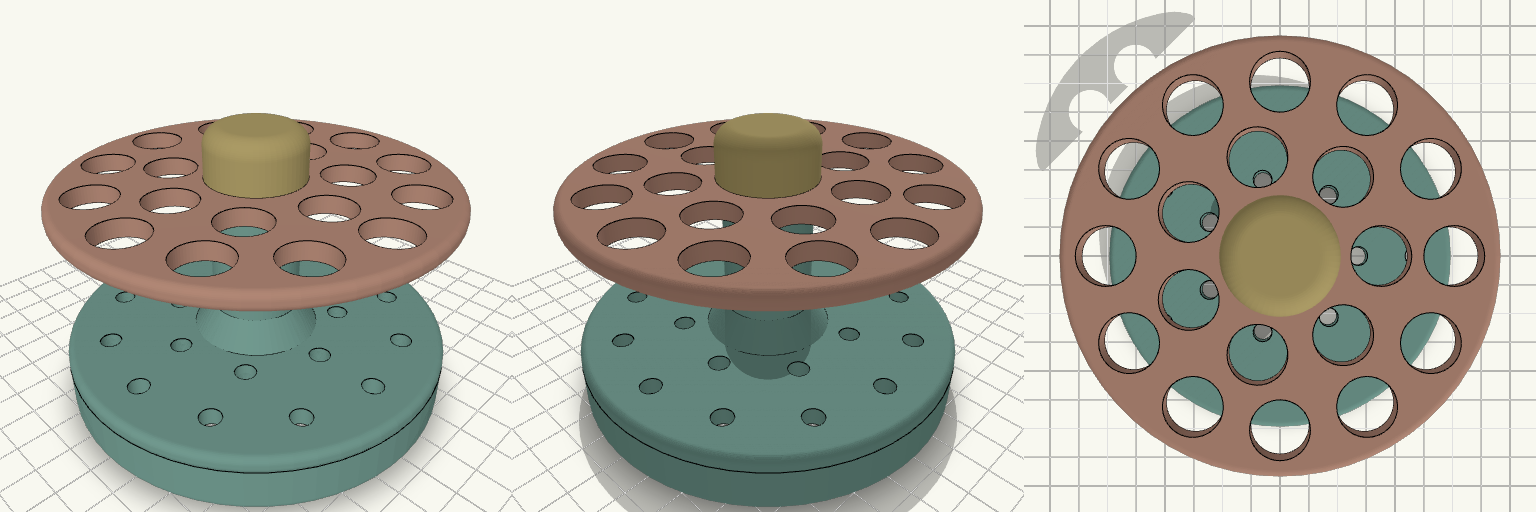
A compact two-tier henna cone stand: 110 mm trays, 60 mm apart, holding 19 cones tip-down, joined by a 25 mm central column and a screw cap. The top tray's 15 mm holes sit directly over 6 mm tip holes in the lower tray. A foot ring under the lower tray keeps cone tips off the table. Remix hooks Tray spacing: 60 mm now. Raise it for longer cones. Ring layout: 12 holes at 43 mm radius plus 7 at 25 mm radius. Wall between rings is about 3 mm, so adding holes means growing the tray. Tray diameter: 110 mm. Scale it up and add a third ring for more capacity. Hole size: 15 mm top, 6 mm bottom. Adjust to your cone brand. Pairs with: a turntable disc or non-slip mat under the foot ring.