living room plinth
Created 4 days ago
Description
Two 100 × 100 mm L-sections, 10 mm leg width and 10 mm thick, laid flat and nested together to save print-bed space.
Fit and layout
- One piece sits normally; the other is flipped onto its back and turned so the two interlock with a 1 mm gap.
- Combined footprint: about 111 × 111 mm.
- Check before printing: the 1 mm gap needs a bed that prints cleanly at that spacing; widen it if the pieces fuse.
- Not a fit for beds under 115 mm square.
Images
More like this
Explore more in Workshop & Tools →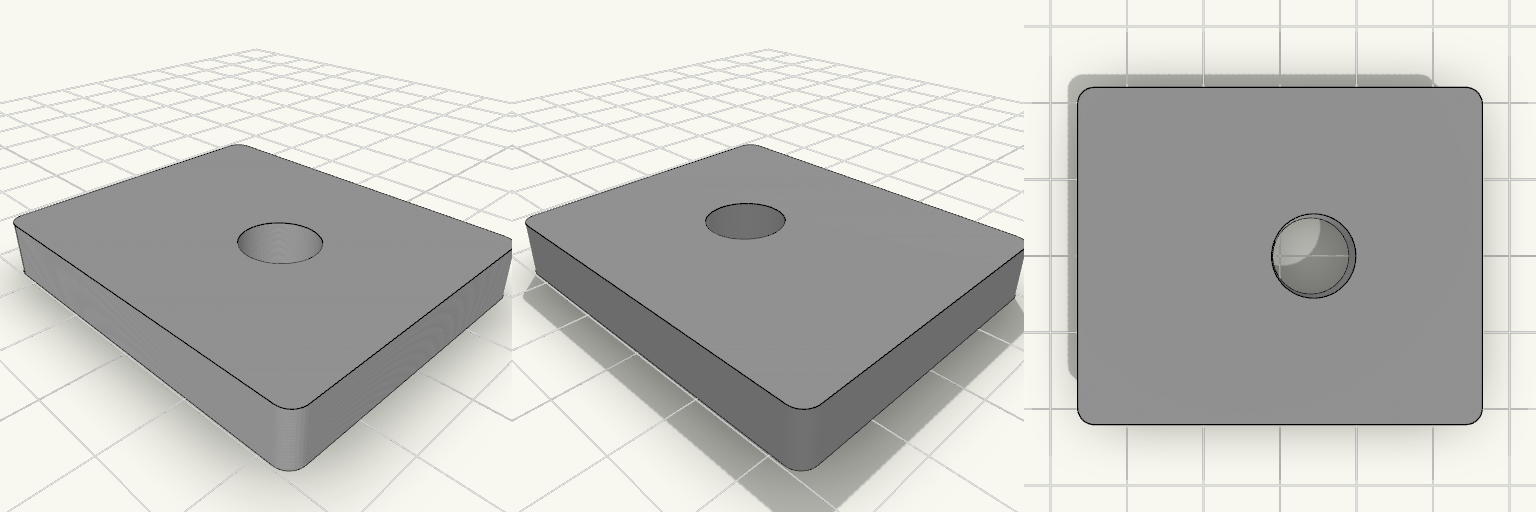
Elliptical Pedal Insert 48x40 Offset Hole
What it's for Central reinforcement insert for an elliptical trainer pedal, bonded into the damaged opening. Flat top, ribbed underside. Dimensions Base: 48 × 40 × 7 mm, rounded corners Through-hole: 10 mm, centered at 24 mm along the length and 4 mm toward the top edge from the width center 18 mm boss around the hole, 5 ribs to a 3 mm frame Remix ideas Change the hole offset for a different pedal Add or remove ribs Thicken the frame for heavier loads
Canal en L con Paredes Altas
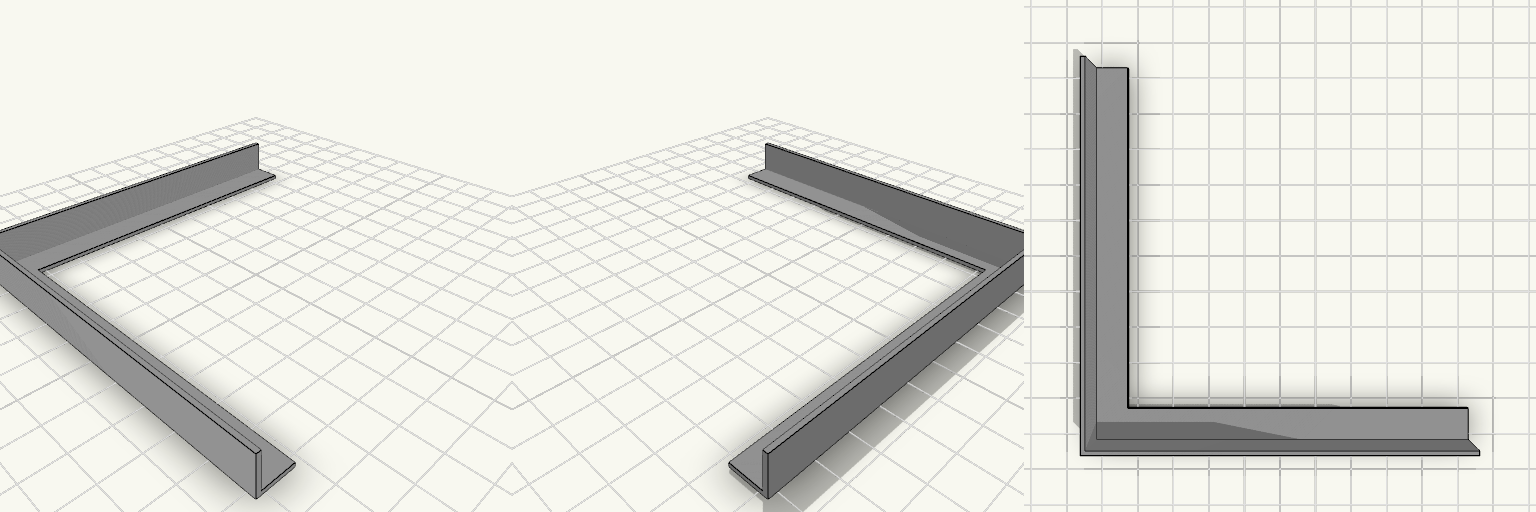
Una tira en L de 200 mm medidos por el centro, con dos brazos en ángulo recto, 10 mm de ancho y base de 1 mm. Las dos paredes exteriores, las más largas, se elevan 10 mm sobre la base y forman un canal de esquina abierto por dentro. Base: 1 mm de grosor Paredes exteriores: 1,2 mm de espesor, 10 mm por encima de la base Bordes interiores (más cortos): sin pared Altura total: 11 mm
Кольцо 37/33 мм, толщина 5 мм
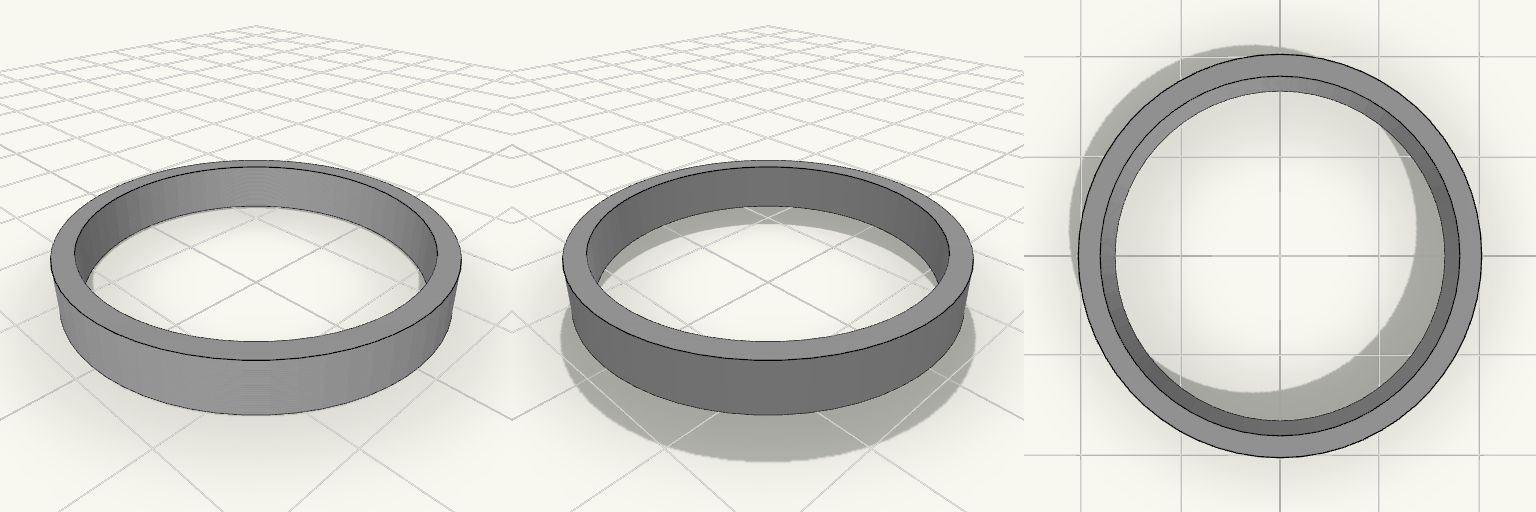
Простое круглое кольцо-втулка с ровными торцами. What it's for Прокладка, проставка, втулка или заготовка для переходного кольца. Печатается лёжа, без поддержек. Dimensions Наружный диаметр: 37 мм Внутренний диаметр: 33 мм Толщина стенки: 2 мм Высота (толщина кольца): 5 мм Remix ideas Добавить фаски на кромках. Увеличить внутренний диаметр на 0,2–0,4 мм для посадки с зазором. Добавить выступ или паз для фиксации.
sink drain lever, G*b*rit
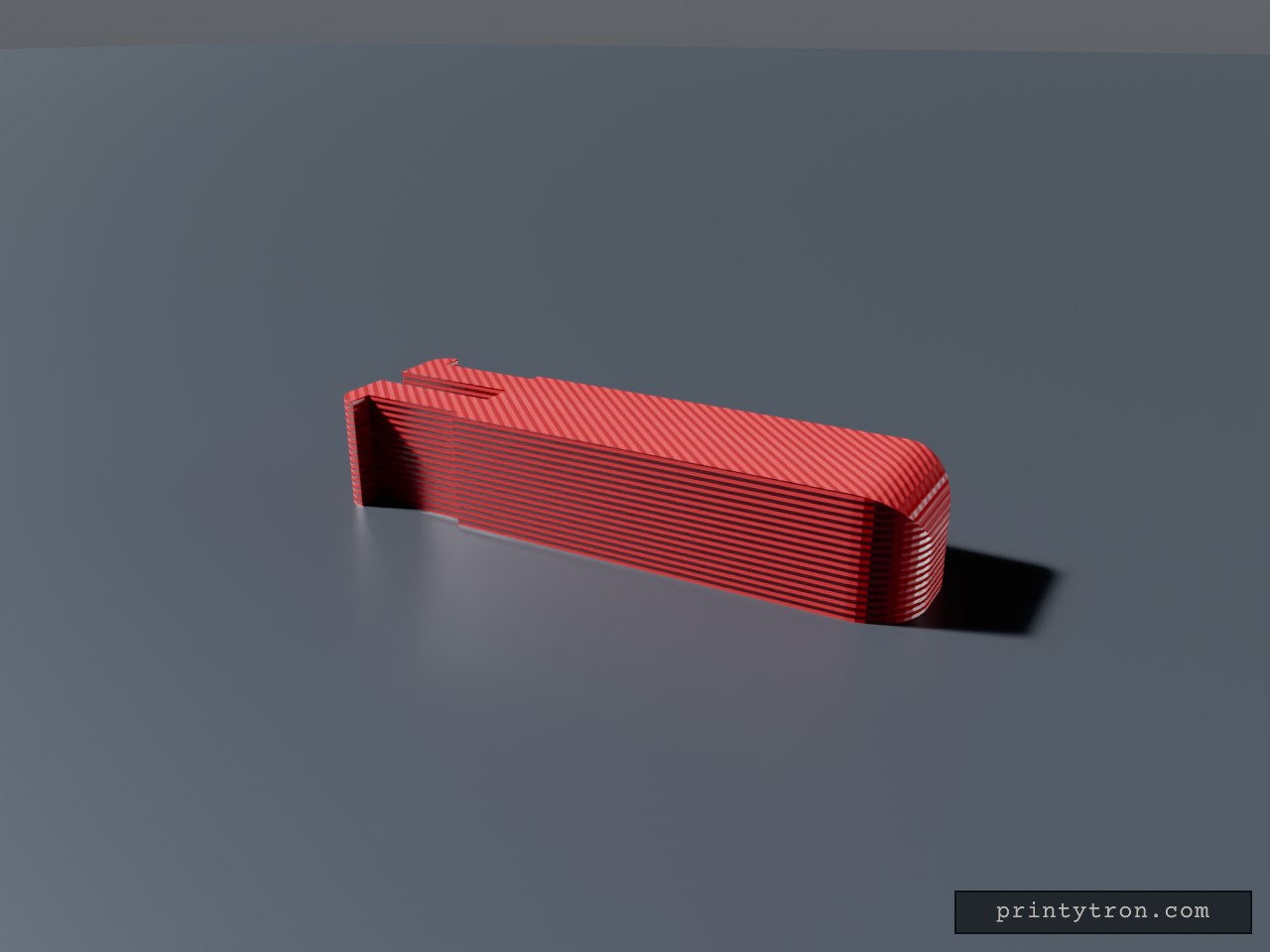
A small rectangular block, 26 mm overall, made of a 20 mm body and a 6 mm slotted end section. A narrow slot is cut into the 7.5 mm end face: 1.5 mm wide, running 6 mm into the length and through the full 5 mm height, so it reads as a thin open channel down that end. The slotted 6 mm keeps the full 7.5 mm width, while the rest of the body is narrowed to 6.5 mm, so a 1 mm shoulder sits on each side where the two sections meet. On the two flat side faces — not on the long corners — a straight rectangular step is cut 1 mm deep over the full 5 mm height. It starts 6 mm in from the slotted end and stops 1 mm short of the end face, so the last millimetre keeps its full width and a small square notch is left at the end. There is no angle anywhere in this cut. The far end from the slot is rounded: both vertical corners and the top edge there carry a 2.4 mm radius, blending into one soft rounded end — about as much as a 5 mm tall block can take before the curve meets itself halfway. The outer corners at the slotted end carry a small 0.9 mm radius; the side steps and the notch itself stay sharp, and the remaining top and bottom edges stay square. It works as a spacer, shim or register that a thin rib or plate edge drops into, with the side step giving that end a shoulder to seat against. Starting values Overall length: 26 mm — a 20 mm body plus the 6 mm slotted end section Body cross-section: 6.5 × 5 mm; the last 6 mm at the slotted end is 7.5 × 5 mm (1 mm shoulder each side) End slot: 1.5 mm wide, 6 mm deep along the length, through the full 5 mm height, centred Side steps: 1 mm deep on both flat side faces, constant depth, running full height, starting 6 mm from the end and ending 1 mm before the end face Far-end vertical corners and top edge: 2.4 mm radius, rounded Slotted-end outer corners: 0.9 mm radius; side steps and notch corners sharp Prints as one piece, no supports needed for any of the features above Remix hooks Body length is the free dimension. The 20 mm is the span between the rounded end and the start of the slotted section — stretch or shorten it to set the gap, and nothing else about the part has to change. The 6 mm slotted section is the fixed end, so all the length adjustment happens at the plain end. The width step is the fit dial. The 6.5 mm body and the 7.5 mm slotted end are two independent numbers: match the narrow body to the channel it slides into and the wider end to whatever it shoulders against. Equalising them removes the shoulder entirely and gives a plain constant-width block. Where the step falls. The 7.5 mm section currently runs the last 6 mm, tied to the slot depth; move that boundary to change how much of the part is full width. Slot width is the tightest tolerance. At 1.5 mm it takes a thin rib, sheet-metal edge or card; resize it to suit whatever it has to straddle, and remember a printed slot usually needs a little clearance over the nominal thickness. Slot depth sets the character. At 6 mm it is a deep open channel relative to the 26 mm part; shorten it to a millimetre or two and it becomes a shallow locating register instead. Side step depth. At 1 mm the relief is shallow and forgiving; go deeper for a part that shoulders harder against a pocket wall, or take it to zero for plain flat sides. The 1 mm land before the end face is what forms the notch — widen or remove it to change how the part locks against a shoulder. The far-end radius is already near its ceiling. 2.4 mm is close to the limit on a 5 mm block, so going rounder means growing the height, not the radius. Drop it to 1.5 mm for a snugger square look, or zero for a sharp end. Slotted-end radius is the tight one. 0.9 mm is limited by the short 1 mm end tab; widening that land is the way to buy room for a rounder corner there. Shape of the relief. Swapping the flat step for a ramp, or cutting the corners instead of the flat faces, turns this into a lead-in wedge or a chamfered block. Through vs. blind. The slot cuts the full height, so it is visible from both the top and bottom faces; make it blind and you get a closed-bottom channel. Obvious pairings. A matching 1.5 mm rib or plate edge for the slot to register against, or a mirrored second block so the two slots face each other and trap a thin part between them.
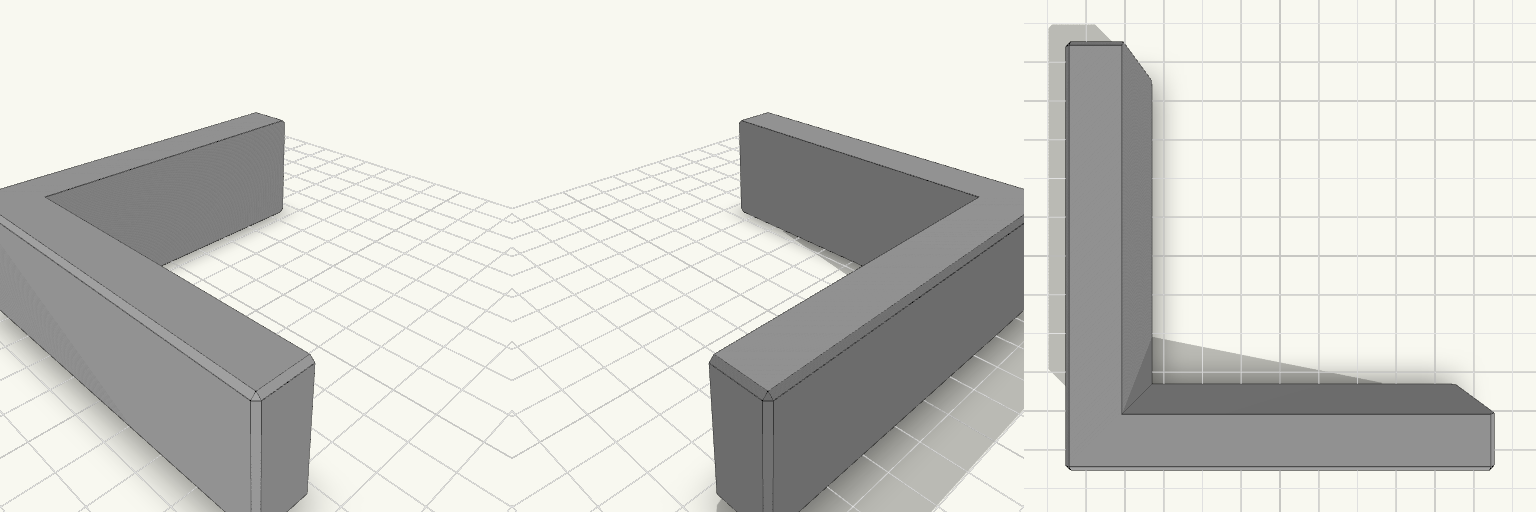
90 Degree Corner Clamping Jig
An L-shaped corner jig that holds two boards at a true 90 degrees while glue sets. It is made for picture frame joints, where a loose corner tends to drift into a parallelogram. Each arm has a channel that cradles a board up to 20 mm thick, and the two channels meet at a square inside corner. The 12 mm walls hold their shape under clamp pressure, and the outer edges are chamfered for a clean, easy-to-handle part. Fits stock up to 20 mm thick Square 90 degree inside corner 90 mm arms, 30 mm tall Clamp slots on each arm for squeezing the boards into the corner Flat base prints without supports Print it in PETG or PLA with several perimeters for stiffness. Keep glue off the channel walls, or line them with tape so the jig does not bond to the work.
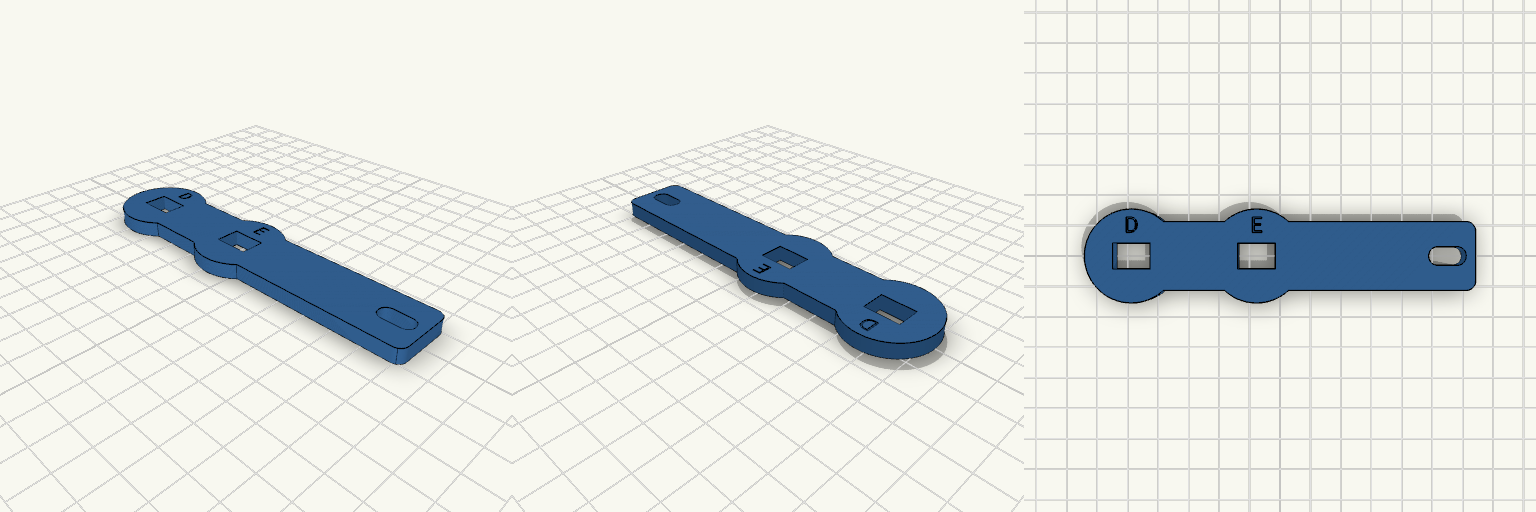
Industrial Flat-Plate Oxygen Cylinder Wrench
A flat, plate-style take on the Allied 66080 oxygen wrench, pared down to an industrial silhouette: twin round socket heads at one end, each stamped with its letter, and a chain slot at the tail. The D socket sits in the end head and the E socket in a second head beside it — both rectangular now, 12 mm along the wrench by 8.4 mm across, sized around the standard 5/16" spindle that D and E post valves share. The letters engraved on the top face above each socket are the only thing telling the two apart, which is exactly the point. The whole tool lives in a single 5 mm plate, 125 × 30 mm, so it lies flat in a pocket or a kit bag and prints as one piece with nothing to assemble. Design notes D socket: end head, 12 × 8.4 mm rectangle, letter engraved on the top face above it. E socket: second round head alongside, same 12 × 8.4 mm rectangle, its own engraved letter. Chain slot: oblong, 12 × 6 mm with rounded ends at the tail, sized for a chain or lanyard. Flat plate body: 125 × 30 × 5 mm overall, no supports needed through the flat sections. Open-end jaw: removed to make room for the second head, leaving a clean two-socket profile. Thread a chain or lanyard through the tail slot and the wrench stays with the cylinder instead of wandering off between refills — the optional chain is the small detail that keeps the tool where it's needed. Both sockets are built to the standard 5/16" spindle rather than a specific drawing, and the 12 mm socket length is an approximation, so measure a valve flat-to-flat before leaning on the fit.