1950s-Style 36 mm Dress Watch Prototype
Created today
Description
A dimensionally accurate mockup of an early-1950s Swiss dress watch, built to real measurements rather than as a visual approximation. The round middle case is 36.0 mm across with gently curved sides, a thin stepped bezel, a domed crystal sitting proud of the case, and short downturned lugs. The crown sits at 3 o'clock and stands 2 mm clear of the case side, bringing the overall width to 38.0 mm. Lug-to-lug is 43.2 mm, total thickness 10.3 mm to the highest point of the crystal, and the gap between the lugs is 18.0 mm.
The strap prints in place with no pins or screws to add: each link is hinged on integrated pins, with roughly 0.4 mm of clearance in the hinges so the links free up after printing. The first links wrap the lugs with about 0.35 mm of clearance. The strap is sized for an 18 cm wrist, running about 190 mm around the closed loop: 9 links plus the buckle on the upper half, 14 links on the lower half, with the adjustment holes spread across the last 7 links for fit. A buckle frame with a fixed prong closes on those holes. At that length the strap will not lie flat across most print beds, so print it on the diagonal or split it at a hinge. Work the hinges loose once it comes off the plate and check the clearances on your own printer before committing to a long print.
- Case: 36.0 mm diameter, 43.2 mm lug-to-lug, 10.3 mm thick
- Lug width: 18.0 mm; strap 17.4 mm wide
- Crown: 3 o'clock, 2.2 mm across, 38.0 mm overall width
- Crystal: domed, 30.8 mm across, the highest point of the watch
- Strap: articulated print-in-place links, about 190 mm closed loop for an 18 cm wrist
- Hinge clearance: about 0.4 mm between links, 0.35 mm at the lug wraps
- Buckle: frame and fixed prong with adjustment holes over the last 7 links
- Separate bodies: caseback, middle case with lugs, bezel, crystal, crown and strap print as individual pieces
The crystal and bezel meet the case on flush faces, so slice them as separate pieces rather than fused. Sized for FDM printing with wall thicknesses that hold up at this scale.
Images
More like this
Explore more in Decor & Display →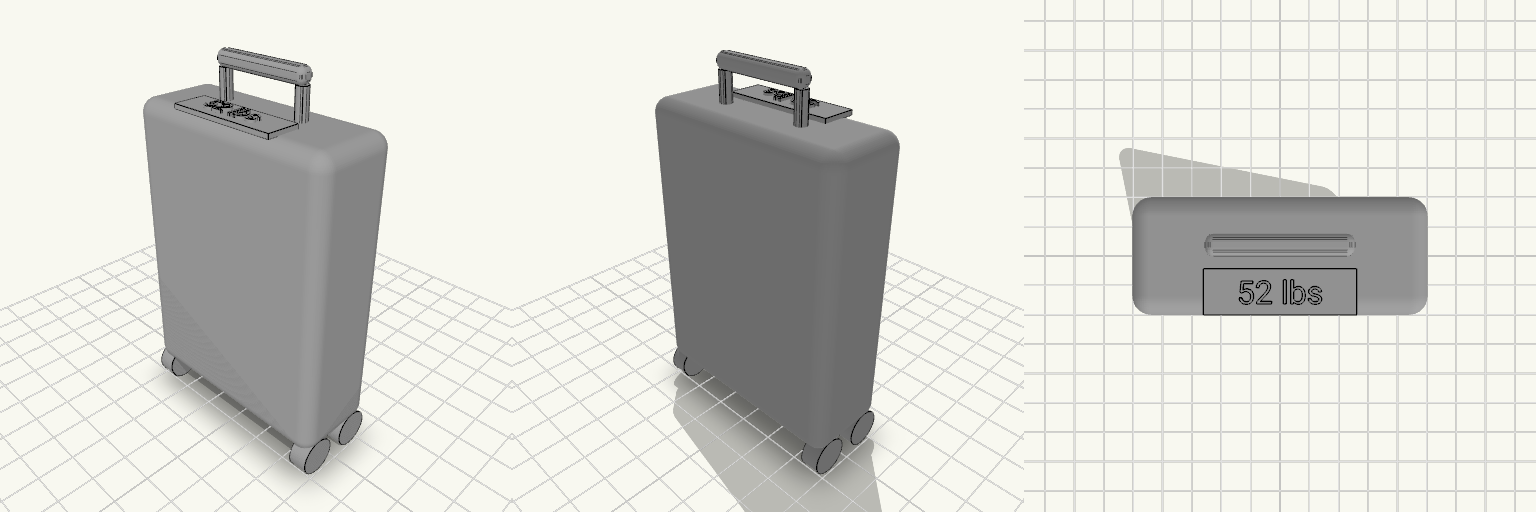
Miniature Suitcase with Handle, Wheels and Weight Display
What it's for A miniature suitcase standing upright on four sideways-mounted wheels, with a pull handle on top and a small thin scale plate set into the top face just in front of the handle. The plate carries a raised readout of 52 lbs, so the piece reads as a luggage scale at a glance. It works as a small desk ornament, a travel-themed display piece, or a scale prop for a dollhouse or diorama. The whole thing is one plain neutral finish, with no colour coding or recessed front screen. Dimensions Overall footprint: 60 × 24 × 100 mm (width × depth × height, as it sits on the print plate) Wheels: mounted sideways, axles running across the width of the case, so the body rests on them Weight plate: a small thin panel on the top face, in front of the handle Readout: raised 52 lbs lettering, picked as a believable airline-limit weight — say if you want a different figure Print notes The model prints as a single piece lying on its wheels, so no supports are needed under the body. The raised readout is small — a 0.4 mm nozzle with fine layer heights keeps the digits and the "lbs" legible, and a 0.25 mm nozzle gives crisper text. The thin top plate is shallow, so check that your bridging over that area is clean. Remix ideas Change the readout to a different weight, or leave the plate blank for a custom label. Swap the handle for a telescoping version, or add corner guards to the body. Scale the case up to hold small items, or down to keyring size. Finish A single neutral colour suits the plain, serious look — the design relies on shape and the raised text rather than colour contrast, so any filament works.
Dos placas 210 x 60 mm con letras
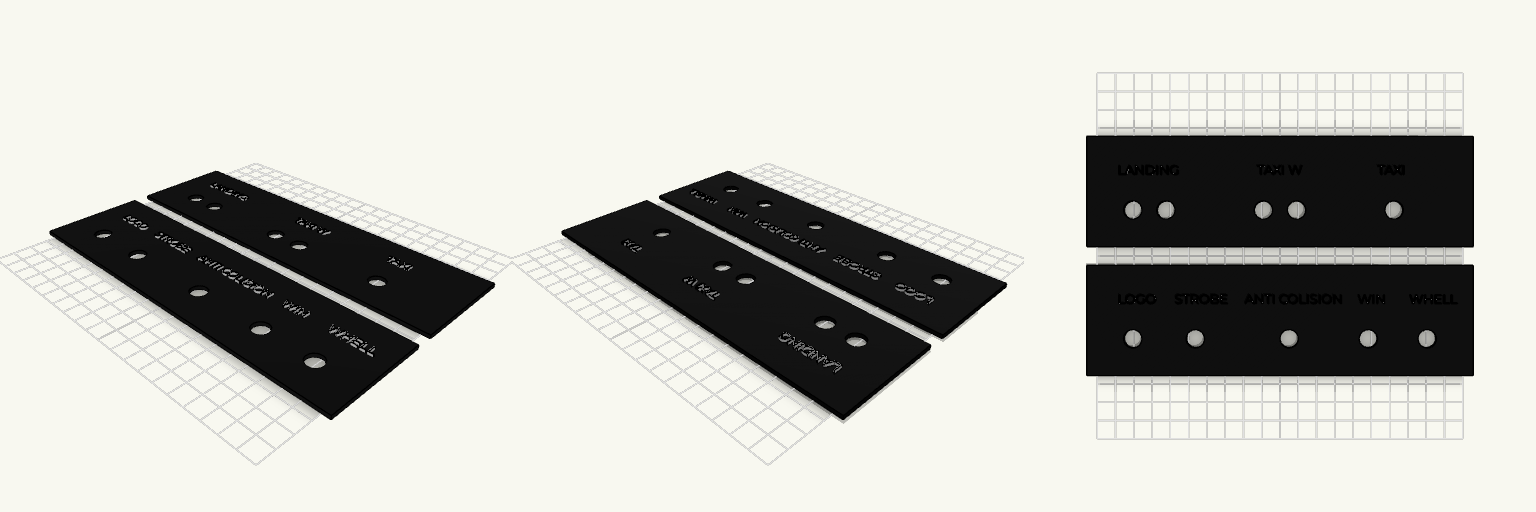
Dos placas rectangulares de 210 × 60 × 2 mm con letras en relieve de 1,5 mm en blanco sobre placa negra. Placa 1: LANDING, TAXI W y TAXI, con cinco agujeros pasantes de 10 mm. Placa 2: LOGO, STROBE, ANTI COLISION, WIN y WHELL, sin agujeros. Letras de 5 mm de alto en Montserrat. Altura total con letras: 3,5 mm.
55كعبة مجزءة
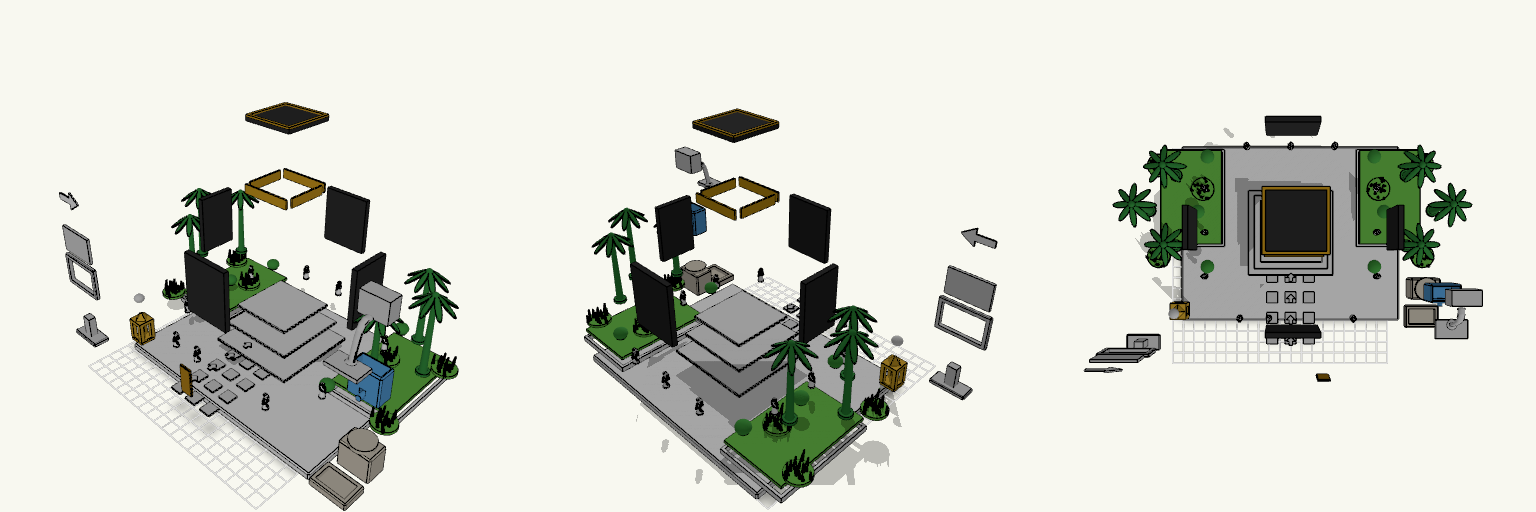
Exploded miniature of a masjid scene with every component spread apart with visible gaps. Parts: white base, platform tiers, four black Kaaba walls, roof, door, gold bands, walkway tiles, arrows, palms, bushes, grass, pilgrims, Zamzam station, Maqam Ibrahim and blue sign parts. Layout: exploded only, no assembled copy. Export: the download is one file; separating individual parts happens outside this model.
Castle Marble Run with Spiral Track
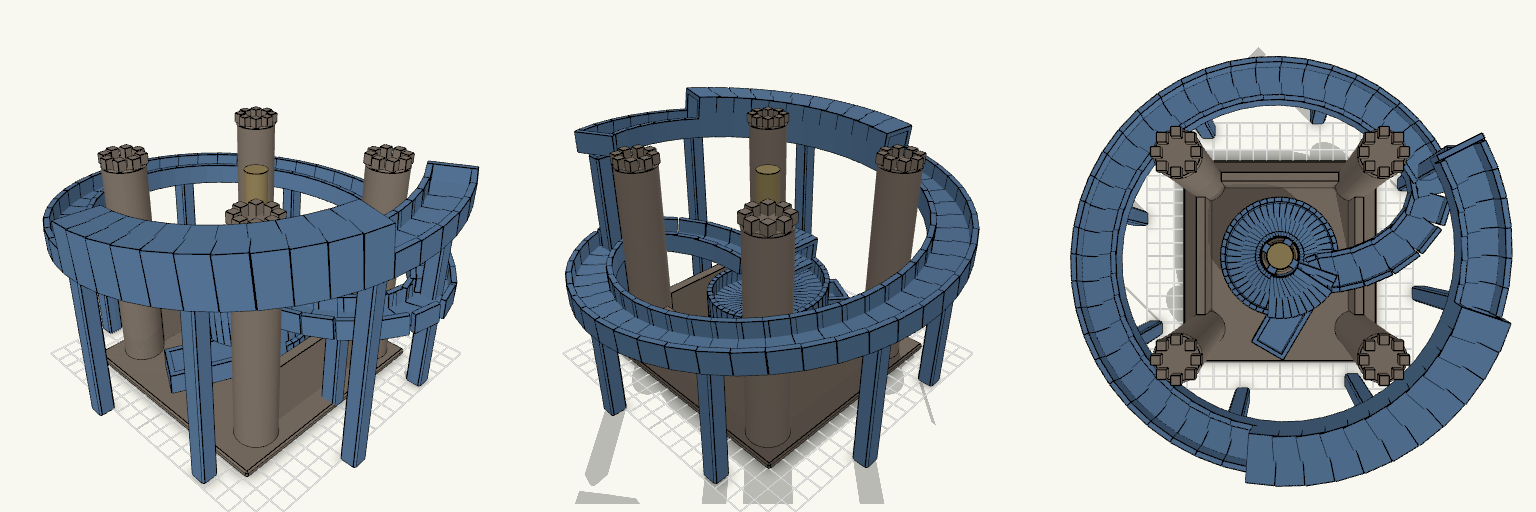
A castle-themed marble run built around a single continuous track. The marble enters at the top of a central keep, spirals down three full laps, passes through covered tunnel sections, and leaves along a straight exit ramp at the front. The track has no steps, gaps or pads. It descends at a constant slope, so the marble rolls without bumps or sudden speed changes. Channel width 20 mm with 10 mm side walls, sized for a 16 mm marble Three spiral laps with a tunnel section on each lap Exit ramp with the same slope as the spiral and an end wall to stop the marble Four crenellated corner towers with curtain walls on the back and sides Support arms connect the track to the central keep The front is left open so the exit ramp stays clear. Print the track at a fine layer height for the smoothest surface.
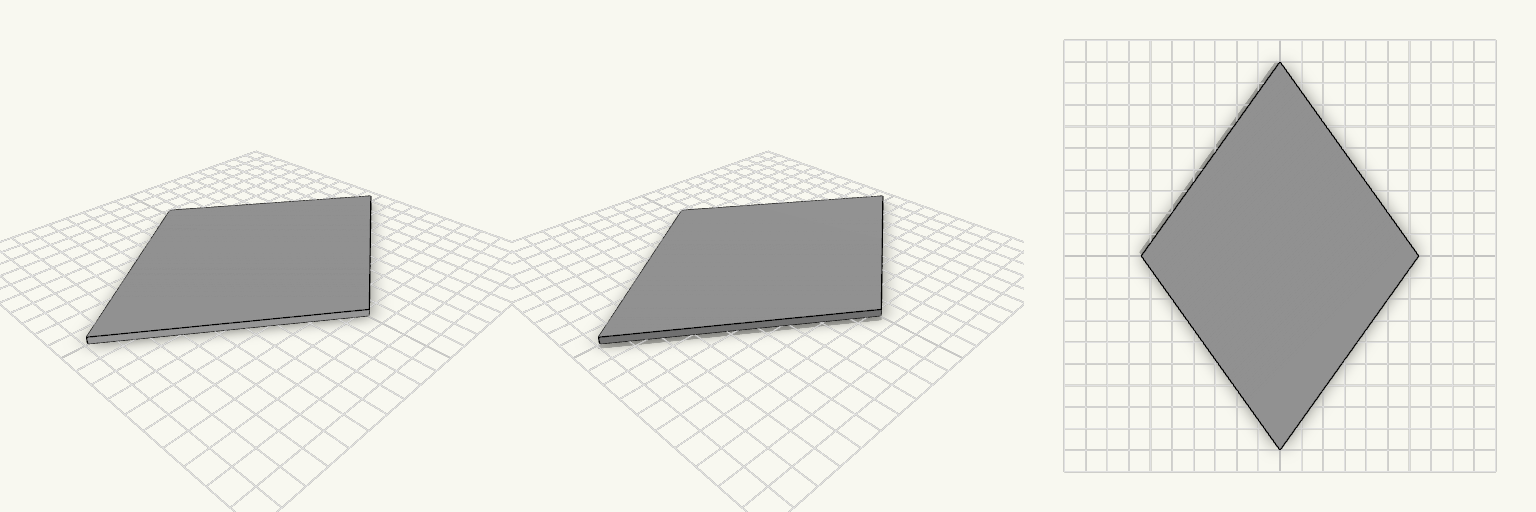
177.8 x 127 mm Diamond Panel Insert
Flat diamond panel insert, 177.8 mm point to point and 127 mm across the widest part, 3 mm thick. There is no specific host frame or device in the design, so the opening is the thing to match: this is a plain flat diamond with sharp corners and no holes, lip, or bevel. Fits: a diamond-shaped opening or groove sized for 177.8 mm length and 127 mm width, with clearance for the 3 mm thickness. Replaces: a flat diamond panel insert of the same point-to-point and across dimensions. It does not include any mounting features. Check before printing: the opening’s long diagonal and short diagonal, plus groove depth and clearance for 3 mm material. If the opening is 7 in by 5 in, confirm the actual clearance; the sharp corners need matching square corners or relief. Does not fit: frames that rely on screw holes, a retaining lip, rounded corners, or a beveled edge. It also does not fit openings smaller than 177.8 x 127 mm.
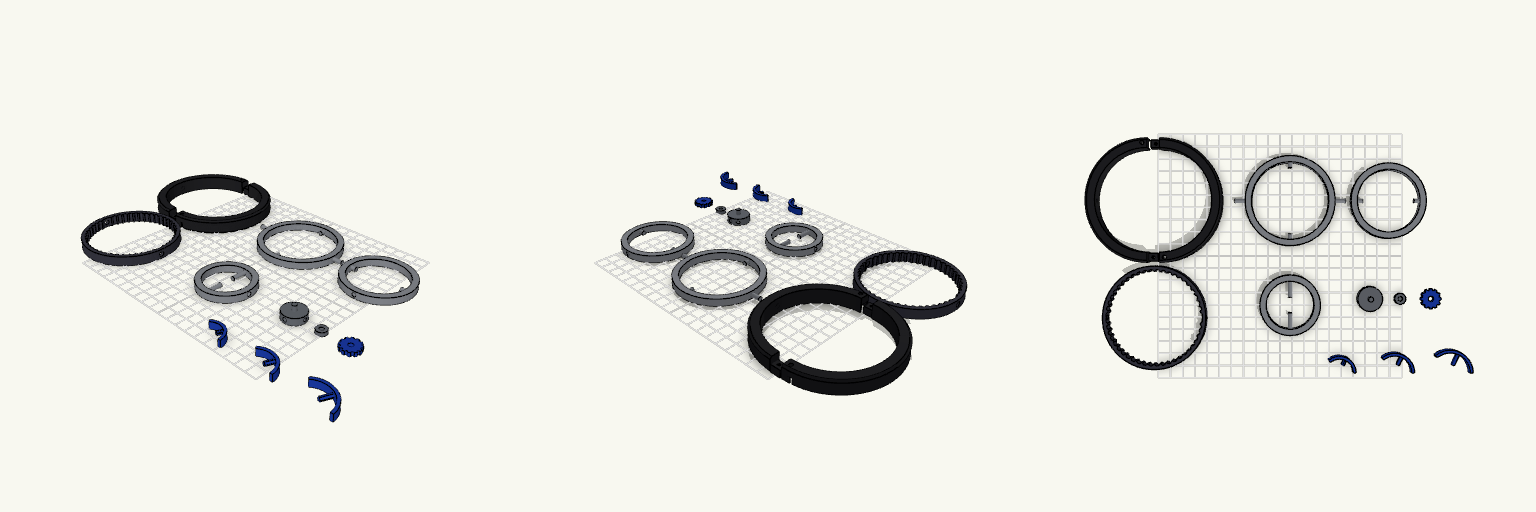
Modular Orrery Kit, 100 mm, 12 Parts
A 12-piece kit for a 100 mm gimbal-ring orrery, laid out as separate parts. Each part lies flat on the build plate, so no support is planned for any of them. The parts are not joined to each other. The frame is split into two halves joined by offset tabs and M3 screws. The three silver rings pivot on integral pins that seat in blind sockets in the neighbouring part. The hub carries three blue arcs and a blue gear held by a cap. Parts Frame halves (2): dark, 100 mm outer diameter, 12 mm deep, 84 mm bore. Each has a pivot socket and tab-and-pocket joints. Gear ring (1): 48 positions with the two pivot positions left empty, 83.6 mm outer diameter, 8 mm deep. It is decorative and meshes with nothing. Silver rings (3): 73 mm, 61 mm and 49 mm outer diameter, 6 mm thick. They are nested and joined by 3.6 mm pins in 4.0 mm sockets. Hub (1) and cap (1): 20 mm hub with a 4 mm boss. Blue arcs (3): 130° arcs at different radii. Each swings on its own 3 mm pin. Blue gear (1): 12 teeth, 4.4 mm bore, held on the hub boss by the cap. Assembly order Seat the gear ring in one frame half. Insert the outer ring pins through the gear ring into the frame sockets. Close the second half and fasten the two joints with M3 screws, with the 2.6 mm pilot holes in the tabs as the thread. Press the inner rings together from outside in, then fit the hub, arcs, gear and cap. Notes Print time is not estimated and the 120-minute limit is not verified. Clearances and movement are untested. Arc swing is not limited, so an arc can hit the ring pins. The blue gear has no mating gear.