3x3 Inch Best Dad Dumbbell Plaque
Created today
Description
A 3 in × 3 in (76.2 mm) square plaque with a raised dumbbell above the text "YOU ARE THE BEST DAD". Intended as a desk or shelf gift for a dad who lifts.
- Size: 76.2 × 76.2 × 4 mm base, raised art to 6 mm
- Recessed field with a raised rim, chamfered outer edge
- Raised dumbbell and Bebas Neue lettering, 2 mm relief
- Prints flat, no supports needed
- Suited to PLA or PETG; two-colour printing by pausing at the 4 mm layer
Images
More like this
Explore more in Gifts, Seasonal & Personalized →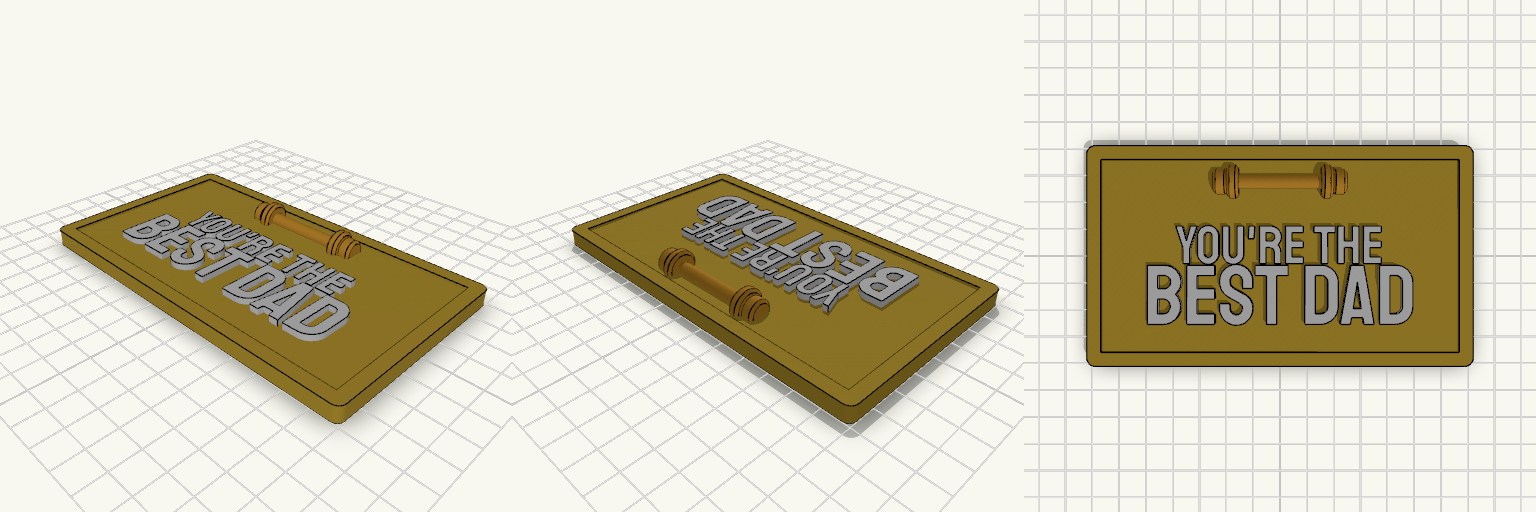
Best Dad Plaque with Dumbbell
A rectangular gold plaque carrying the message "YOU'RE THE BEST DAD" in Staatliches capitals, with a dumbbell motif above the lettering. The plate has a recessed panel that frames the text, and the lettering sits raised inside it. The dumbbell is half sunk into the plate so it reads as a relief in the surface rather than a loose object — the whole thing prints as one solid piece with nothing to glue on. The plaque measures 140 × 80 mm and is 6 mm thick, with the lettering about 96 mm wide and the dumbbell about 48 mm long. The raised elements are shallow enough to print cleanly without supports, and the separately coloured areas — gold plate, white text, orange-amber dumbbell — make it straightforward to swap filament between the parts or print in multiple colours. Recessed panel with raised lettering reading "YOU'RE THE BEST DAD" Dumbbell relief above the text, half sunk into the plate Prints as one piece, no assembly required 140 × 80 mm footprint, 6 mm thick — a desk, shelf or wall-mounted size Colour-separated areas for multi-filament or filament-swap printing No supports needed
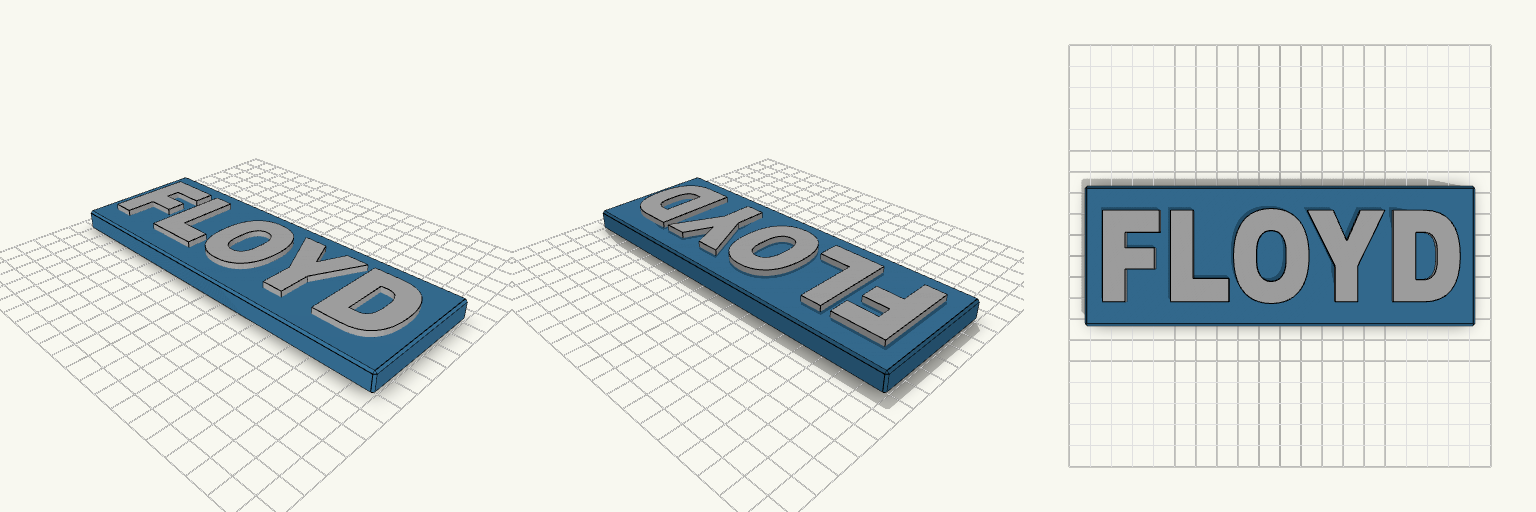
Bold Block-Letter FLOYD Name Sign
A confident single-word nameplate: a 179 × 64 mm slab, 10 mm thick, with FLOYD rising 3 mm off the face in heavy block capitals for a total height of 13 mm. The letters stretch to roughly 162 × 43 mm, running almost the full length of the top face and leaving only a slim border around them. It reads as signage first and decoration second — the kind of bold lettering that belongs over a door, on a wall, or fixed to a workshop board, and with 10 mm of depth behind it, it also stands on its own as a chunky desk or shelf piece. Sized for a Bambu Lab A1 mini, the sign uses the bed's full width in one direction only, so it prints as one piece with no scaling needed. That width fit is tight: only about 0.5 mm of margin remains on the long side, so a skirt, brim, or calibration offset could push it past the bed edge — a slightly smaller scale is safer if the slicer complains. The 10 mm body uses noticeably more filament than a thin plate, so keep that in mind if material use or weight matters. Design notes Raised lettering sits proud of the plate, catching light and shadow and allowing a contrasting colour with a filament swap at the right layer. The top face, the lettering and the sides are all square-edged; the plate has a flat back and prints from a single flat base without supports. Wide, thick strokes keep the text legible from across a room and sturdy enough to handle. The lettering is proportioned to the plate, so shrinking it uniformly in the slicer keeps the composition intact. Pairs well with a wall bracket, a small stand, or adhesive pads on the back — or just set it down as it is. A plain blue plate with white letters is only one finish — a dark plate with bright lettering, a painted recess, or a single-colour print all work with the same geometry.
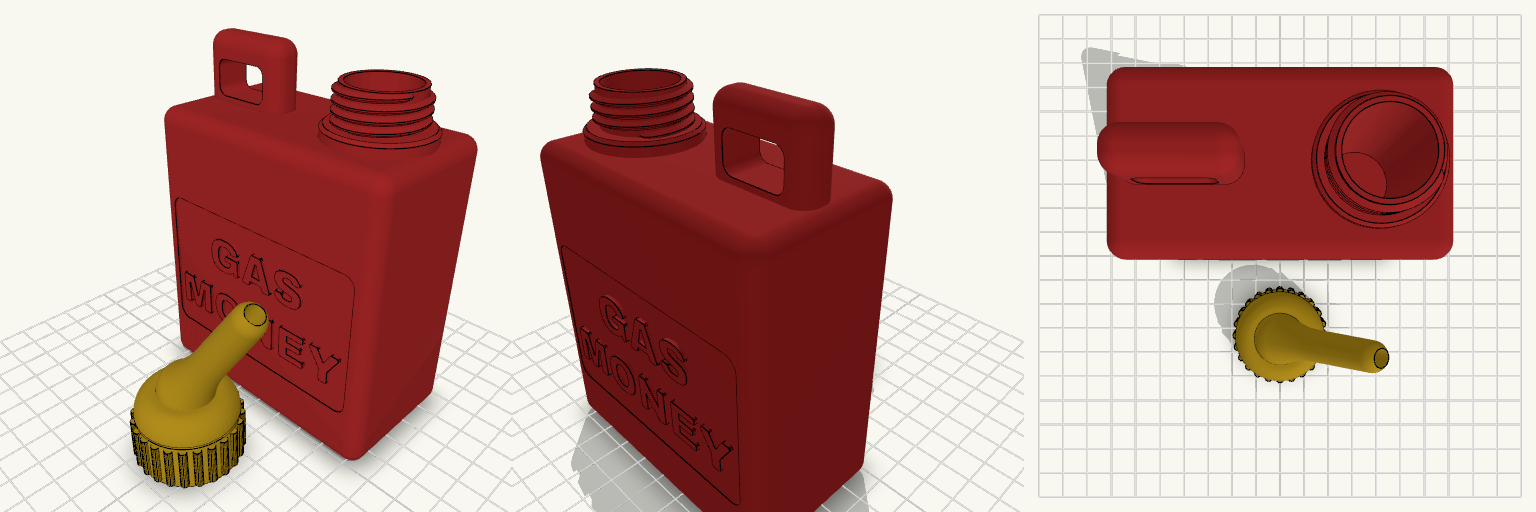
Rolled US Bill Holder Shaped Like Gas Can
A two-piece holder for a rolled US bill, built as a gas can. The Can Body carries a male-threaded neck and the Nozzle carries the matching female threads; the neck is the load point, not the spout. Unscrew the nozzle, drop the roll into the cash tube, screw it back on. What it fits A rolled US bill of about 66 mm drops into a 22 mm cash tube that runs down from the neck inside a 26 mm round column, so the roll cannot fall into the body and get lost. The tube bottoms out 68 mm below the top of the male threads, so a 66 mm roll tops out about 2 mm below the thread top and never reaches the thread zone or the nozzle's recess. The body behind the column stays hollow, so it costs little filament, and the cavity roof is a 45° gable rather than a flat ceiling. Front and back each carry a shallow recessed panel with GAS over MONEY raised out of it at 13 mm, corners softened so the lettering looks moulded rather than cut. The handle's outer corners are rounded to match. The Nozzle is closed — no through-hole. Its threaded base is 18 mm tall with 24 vertical ribs around it for grip when unscrewing. The base top is one continuous domed curve, flat across the top, rising from the 34 mm base. The spout root flares to about 19 mm and tapers over roughly the first 22 mm into a 50 mm spout that finishes at 10 mm at the tip; a 6 mm blind bore at the tip makes it read as an open spout. What it replaces The screw-on nozzle takes the place of a fuel can's spout; the neck is the fill point here, not a pour opening. Check before printing Thread fit is the one thing to verify. The nozzle's threaded recess is 12 mm deep and the neck's exposed thread is 13 mm, so there is no slack: if it binds before it seats, shave a millimetre off the neck or deepen the recess slightly. Print the nozzle on its own first and test it on the neck before committing to the body; thread clearance varies with printer and material. Below the 68 mm tube depth, the next measurement to check is the 22 mm bore against your bill roll — a tight roll that measures over that will not drop in. Both the gabled roof and the 45° cone under the cash tube are shaped to print without supports, and the domed nozzle top and flared spout root now meet in a single flowing transition with no ledge. On the plate: Can Body 90 × 50.4 × 122 mm and Nozzle 51.7 × 36.6 × 71.1 mm, two separate pieces. What it does not fit Flat or folded notes, coins, or more than one rolled bill. Rolls longer than about 70 mm from the thread top, or fatter than the 22 mm tube bore. It holds no liquid and is not a fuel container.
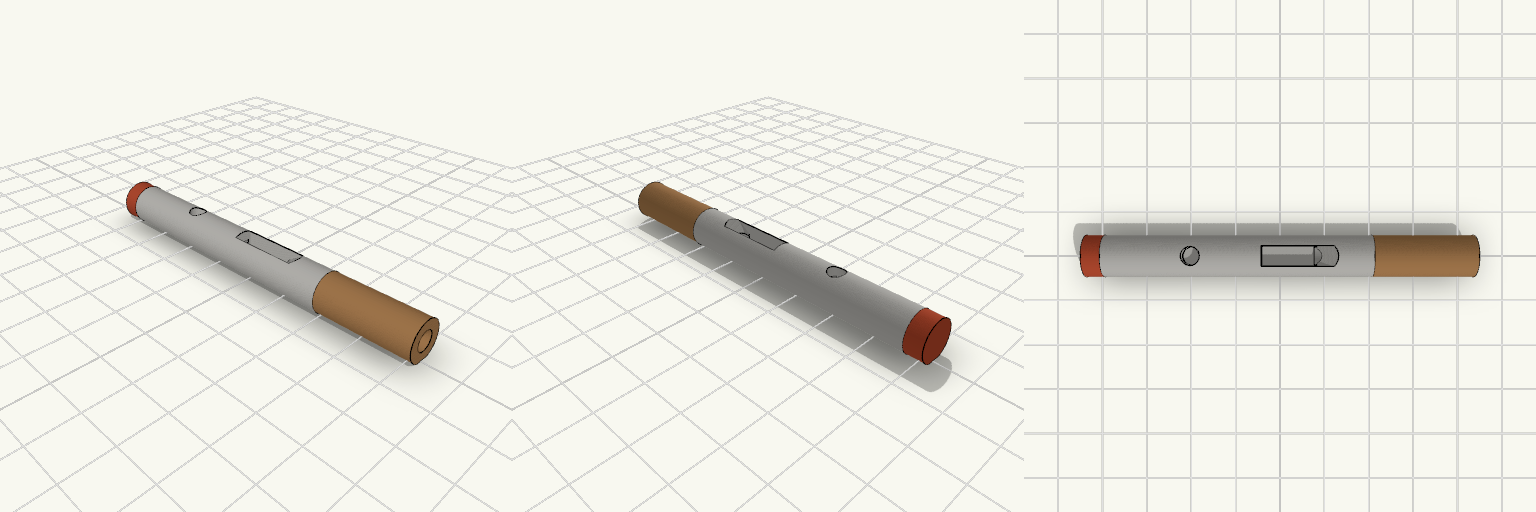
Film-Noir Cigarette Fipple Whistle
A cigarette you can't smoke but can play: an 84 mm-long fipple whistle disguised as a filter-tipped stick, complete with an orange ember tip, a white paper body and a tan filter. Inhale through the filter end and air slips through the intake hole near the ember, runs a thin flat duct across a window and breaks over a sharpened edge — the classic whistle mechanism, wearing a noir prop's silhouette. It is an inhale-only instrument; blowing back out through it will sound weak or not at all. This version is tuned for a softer, lower note: the duct is narrow and shallow, the window is long with a gentle ramp, and the intake is widened a touch to keep the hiss down. A gentle, steady inhale gives the smoothest sound; a hard pull turns breathy. Design notes Three colour-coded sections in the viewer: Ember Tip, Paper Body and Filter, printed as a single piece. The underside is flattened, so it sits stable on the plate and needs no supports. Keep your lips clear of the intake hole while you inhale — that hole is the voice. Tone stays tunable: a longer window takes it darker, a slightly more open duct brings back volume if it comes out too faint. Pairs well with a trench coat, a rainy window, and anyone who appreciates a joke that also functions.
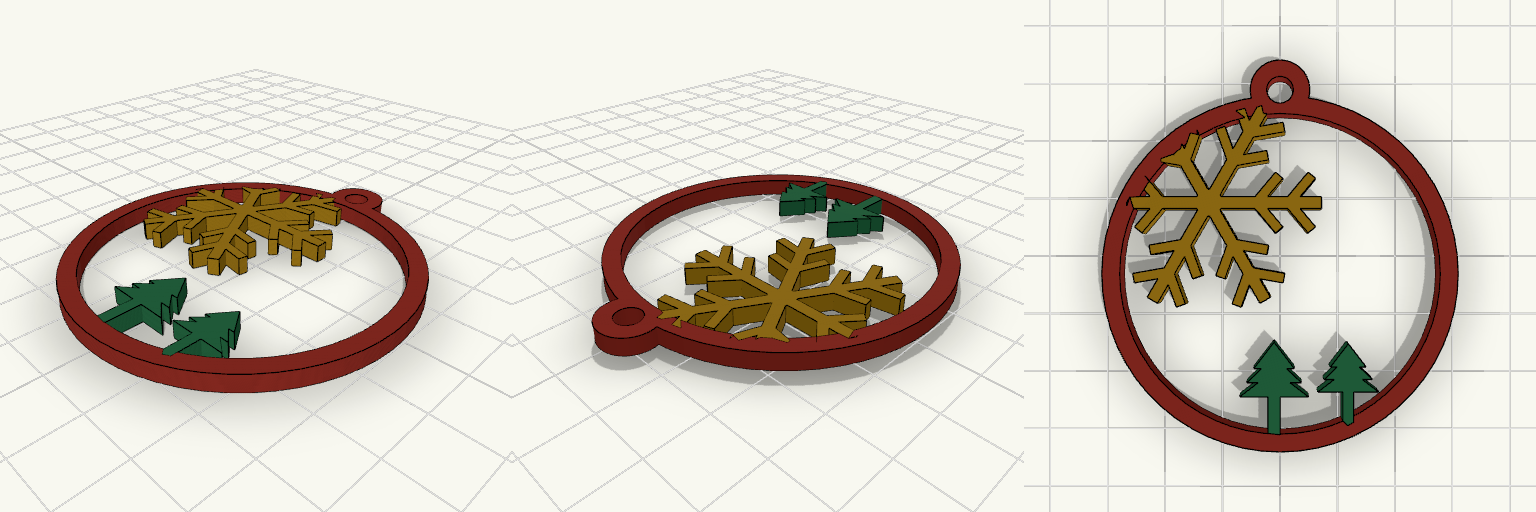
Evergreen Ring — Open Christmas Tree Ornament
Evergreen Ring reduces the Christmas ornament to a clean silhouette: an open circular ring with a hanging loop, a pair of small three-tier trees tucked into the lower-right corner, and a large six-armed snowflake filling the top-left, its outer arms running into the ring and clipped by it. The right-hand tree sits fully inside the hoop, its tiers clear of the ring, with only its trunk running down into the bottom of the ring. The companion tree to the left is about 1.5 mm larger, with roughly 1 mm separating the pair, so the motif reads as a deliberate little grove rather than a repeat. The snowflake is centred about 12 mm in from the corner, and the arms that meet the ring are what hold it in place. Ring, trees and snowflake all stand the same 3 mm tall, giving the piece a single even plane that sits flat against a branch, a window or a gift tag. Every element is joined to the hoop, so the whole ornament prints as one solid piece with no assembly and no loose parts. Dimensions Ring: 60 mm across, 66 mm tall overall including the hanging loop, 3 mm thick Trees: two small trees occupying roughly 23.4 × 15.6 mm combined, 3 mm thick Snowflake: about 32.8 × 34 mm, 3 mm thick Features Open-ring ornament with an integrated hanging loop Two small three-tier trees side by side in the lower-right corner, with the tiers fully clear of the ring One tree about 1.5 mm larger than the other Large branched snowflake in the top-left corner, its outer arms cut off by the ring and fused to it Only the tree trunks and the snowflake's outer arms meet the ring, keeping the scene connected Uniform 3 mm thickness across every part Prints as a single piece, no supports needed Print notes Lay the ornament flat on the plate; the even thickness means no tall overhangs Any filament works — use contrasting colours for the trees and snowflake if you print in multiple colours
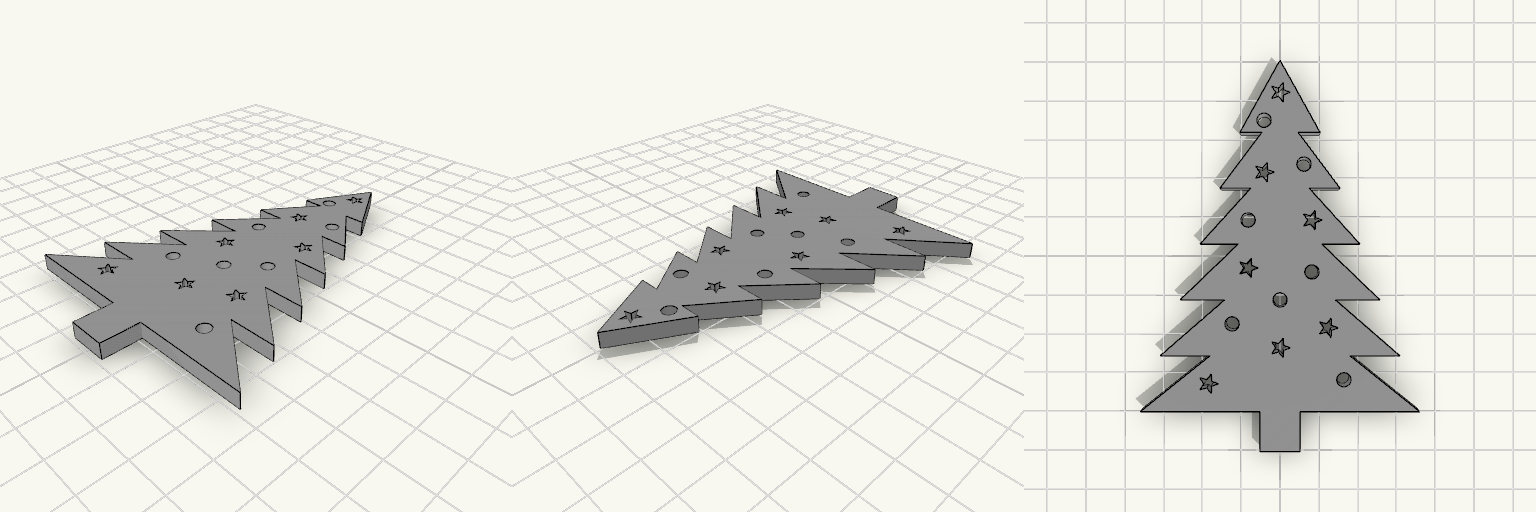
Flat Six-Tier Christmas Tree Cutout
What it's for A flat, two-dimensional Christmas tree cutout with six stacked, tapering tiers over a short trunk. The tip is a plain point — no star, no topper — and the silhouette stays clean and unbroken. Seven small stars and seven small circles are scattered across the tiers as through-holes in those same shapes, punching light through the flat body and adding detail without any surface relief. It prints as one flat piece and comes off the plate ready to use, with no assembly and no supports. Dimensions Overall footprint: 70 mm wide × 98 mm tall Thickness: a constant 4 mm Tiers: six stacked branches Star holes: 7 through-holes, roughly 2.6 mm across the points Circle holes: 7 through-holes, 3.6 mm across Top: plain pointed tip, no star All of the star and circle holes sit inside the tree's outline, including the ones near the tip, so nothing breaks the outer silhouette. Print notes Print flat on the plate. The constant 4 mm body means there are no overhangs and no supports are needed. The holes are small, so a 0.4 mm nozzle prints them cleanly; the star points are sharp and may round off slightly. The flat faces are a good place for a colour change or a two-tone filament swap. Remix ideas Scale the outline up or down for a larger wall piece or a small tag. Thin the body to 2–3 mm for a lighter decoration, or thicken it for a freestanding table piece. Enlarge the star and circle holes for a stronger see-through effect, or change their count for a denser or sparser look. Add a name across the trunk, or add a hanging hole if you want to suspend it.