Angled Travel Mug Drying Rack
Created 1 months ago
Description
A countertop drying rack with a built-in 270x180mm drip tray, designed to hold washed bottles and travel mugs upside down. The six pegs are angled at 15 degrees to ensure trapped water drains out entirely, preventing stagnant moisture and bottle funk.
Starting Parameters
- Peg layout: Set at an 85mm pitch on the X-axis and 90mm on the Y-axis. Expand this grid if accommodating oversized vacuum flasks or wider mugs.
- Peg dimensions: Currently 100mm long and 12mm thick, sunk into 22mm base bosses for leverage resistance. Extend the Z-length for tall carafes or increase the thickness if printing in a brittle filament.
- Drainage: The 15mm high outer wall keeps runoff contained. A remixer could slope the inner tray floor or add an edge spout for direct sink drainage.
Photos
Technical views
More like this
Explore more in Kitchen & Bathroom →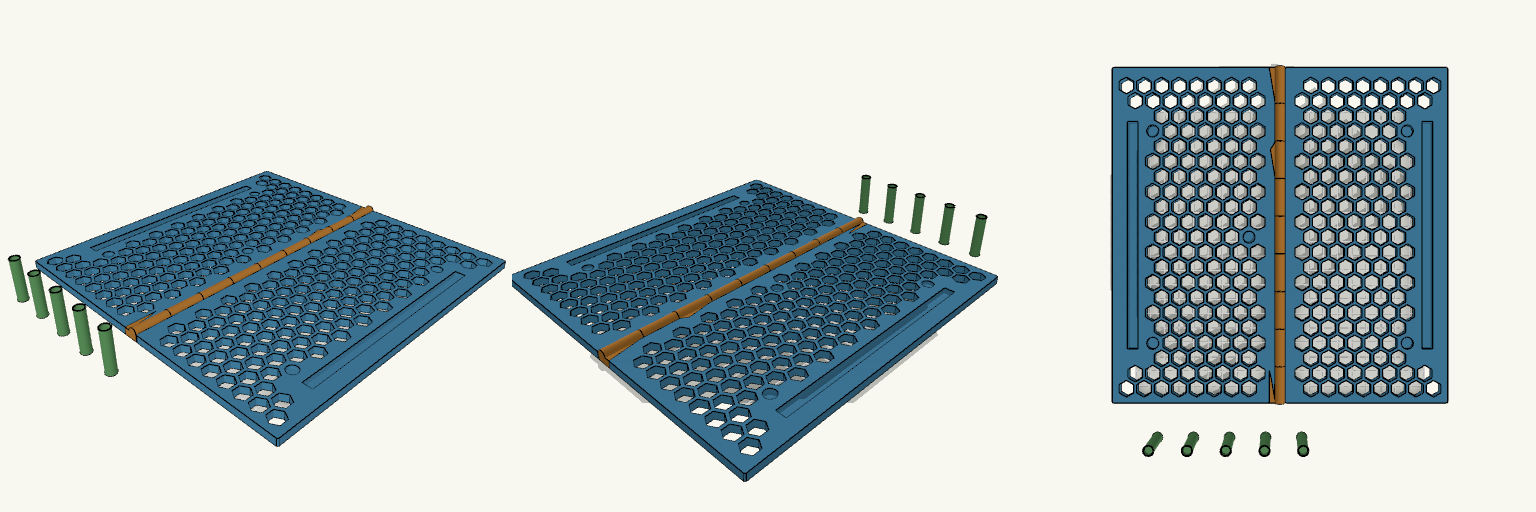
Bifold — Magnetic Folding Hex Drying Tray
Bifold is a two-panel folding drying tray, 230 mm square when open, with a dense honeycomb of hex holes for draining. A captured-pin hinge joins the panels, and magnets hold the tray closed for travel. Five magnetic legs store in a long groove along the outer edge. The magnet pockets sit directly in the honeycomb lattice, in place of individual hex cells. That removes the solid patches that used to surround each pocket, so the tray stays as open as possible. Features 5 mm panels, 230 mm overall Print-in-place captured-pin hinge Hex holes about 10 mm across the flats, 2 mm ribs 8.2 mm × 2.75 mm magnet pockets, set into hex cells 7.4 mm wide, 3.6 mm deep, 156 mm long leg grooves In the box Five 7 mm legs with 6.2 mm × 2.8 mm magnet holes in both ends Print notes Print flat with the hinge side up. Legs print best in PETG with extra walls. Print a short hinge test first, since clearances are tight.
Asma Beisembayeva
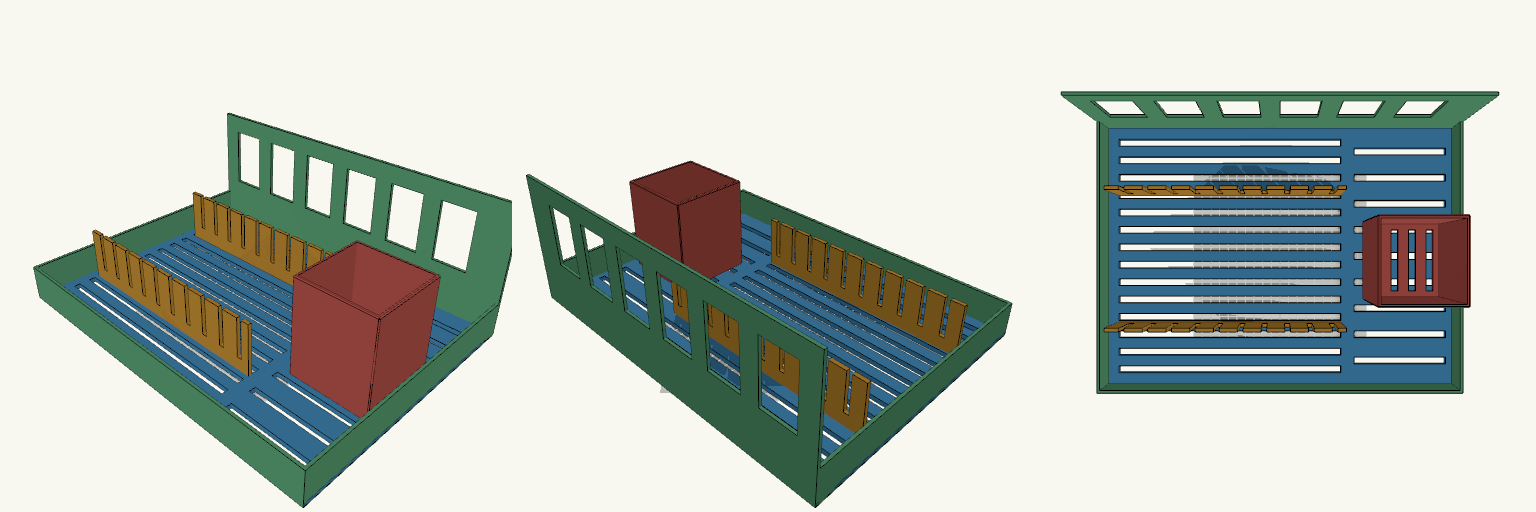
A dish drying rack with a slotted base, raised sides, a tall back panel, a vertical-slot plate section, and a separate cutlery holder. The base drains along its length through parallel slots, while the plate section holds plates upright. Specifications Overall size: 400 × 300 × 150 mm. Base: 5 mm thick with parallel 8 mm drainage slots. Sides: 40 mm front and end walls; full-height back panel with window cutouts. Plate section: two 4 mm thick rails, 65 mm tall, spaced 150 mm apart, with vertical slots at 25 mm pitch. Cutlery holder: separate 90 × 90 × 110 mm open box with drain slots in its floor; prints on its own. Print check: the 400 mm length needs a bed at least that long, or split the rack into sections.
Spice Rack revA
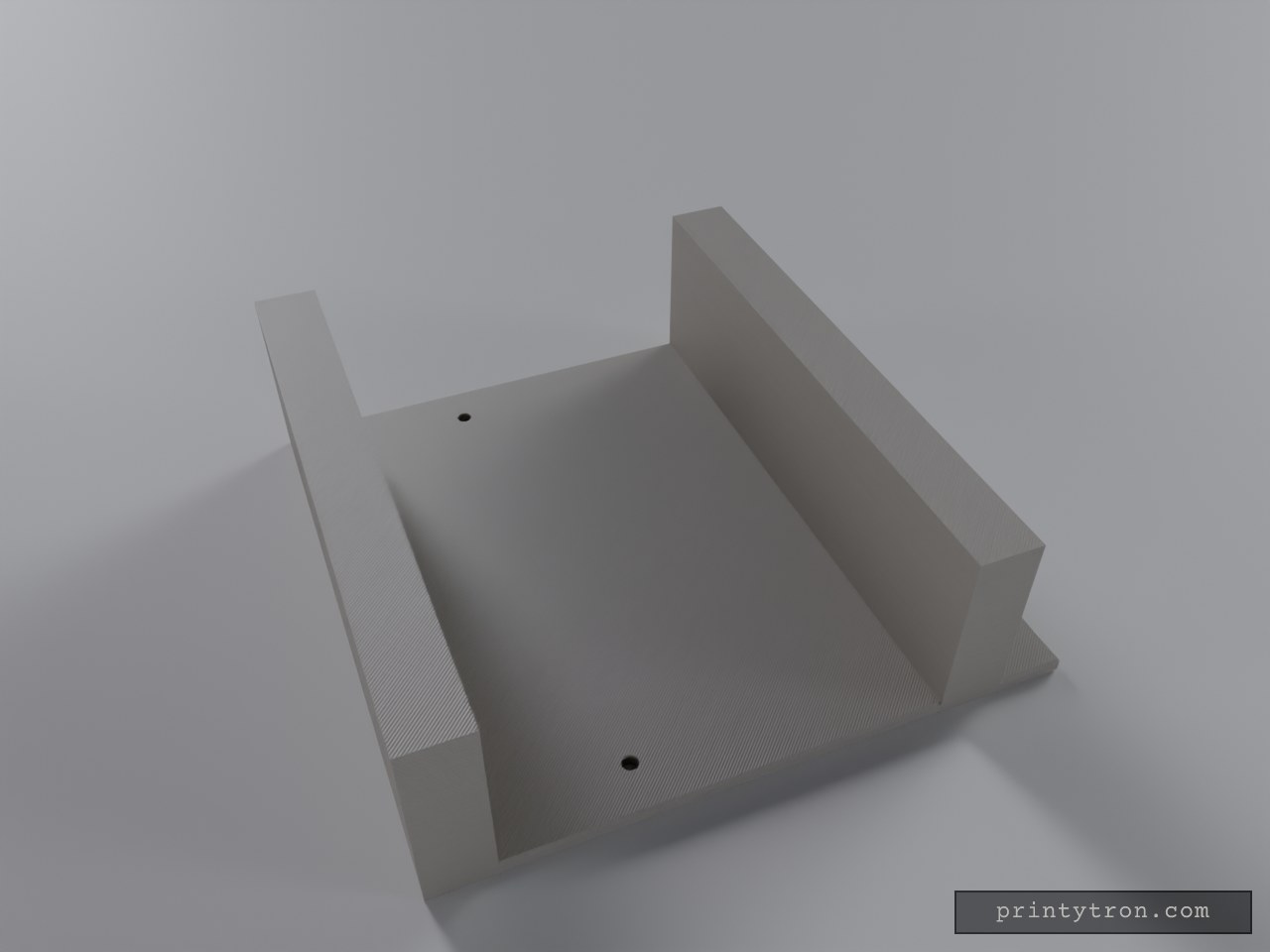
A two-tier spice rack that mounts on the inside of a cabinet door. A flat back plate carries two shelf tiers that project forward, so jars ride on the door rather than on the cabinet shelves and the door can close over them. The upper tier sits 137 mm above the lower shelf, leaving enough height for 105 mm spice jars on the bottom shelf with roughly 14 mm of finger room once a jar is lifted over the 14 mm front lip. Specs Overall size: 175 mm wide, about 174 mm tall, 55 mm deep. Fits an 18 cm print bed. Tiers: two, set 137 mm apart. The top tier ends about 155 mm up the plate. Jar fit: each tier holds jars around 48 mm across. A 14 mm front lip and end walls keep jars in place as the door swings. Door clearance: the tiers project 55 mm from the door. Check the gap between the closed door and the cabinet shelves before printing; hinges and shelf edges can reduce it. Mounting: four countersunk 4.5 mm screw holes through the back plate, with the upper holes at 163 mm up the plate and 12 mm of plate above them. The countersink suits M3.5/#6 flat-head screws; check screw length against the door thickness so they do not break through the front face. Print orientation: back plate down with the shelves growing upward, so no supports are needed. Measure the door-to-shelf clearance and jar diameter before committing to a full print; the depth and tier spacing depend on both.
Leanto — Sawtooth Taco Rack
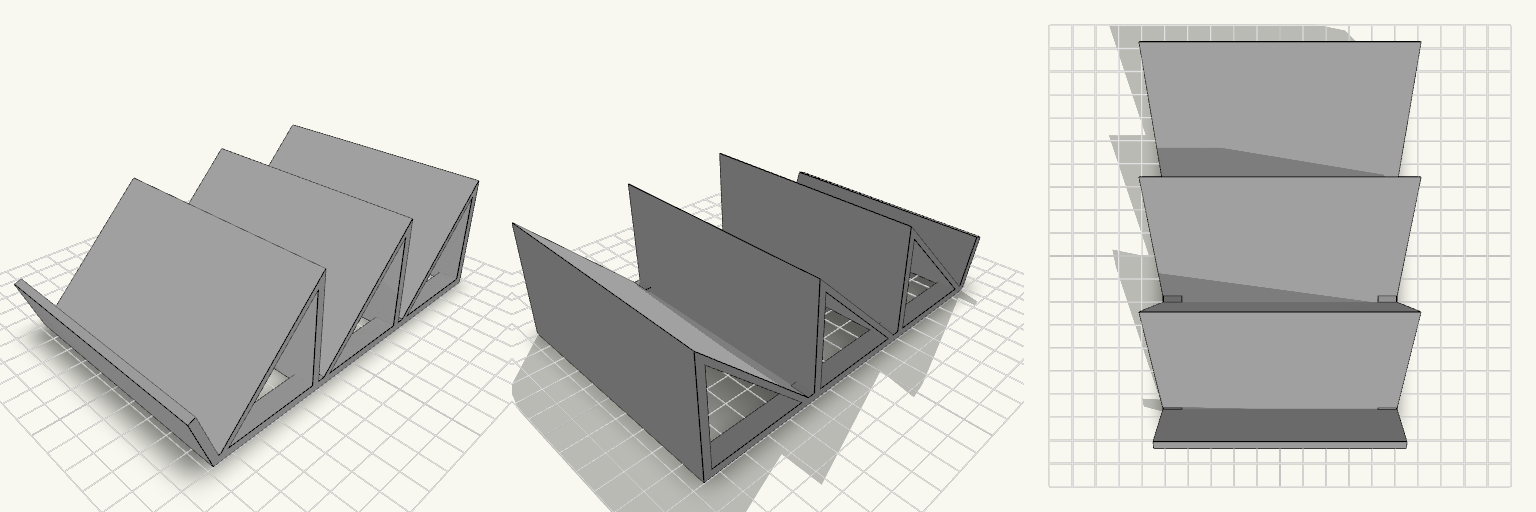
Leanto is a minimal plate-top rack that holds three hard taco shells upright at a 45° slant, one behind the other. The profile is a true sawtooth: each slanted surface ends in a vertical wall that also stops the next shell, with no solid base underneath. Features Three 45° ramps, 48 mm pitch, 48 mm tall vertical backs Open underside, 3 mm shell walls One forward-leaning stop at the front to hold the first shell Two thin side runners tie the teeth together Dimensions About 100 mm wide and 150 mm front to back Fits on a standard dinner plate
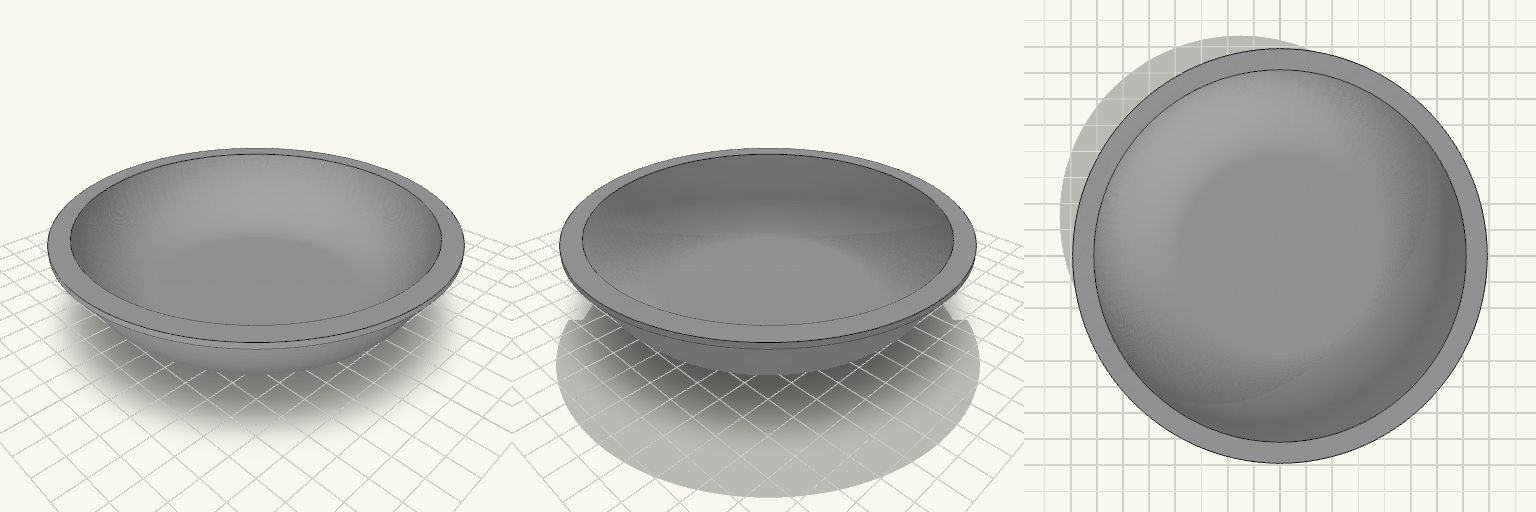
Brim — Flat-Bottom Rounded Bowl
Brim is a shallow serving bowl with a flat 75 mm base that sweeps up in a smooth curve to a wide, flat rim. The flat base keeps it stable on a table and easy to print without supports on the bottom face. Dimensions Outer rim diameter: 138 mm Rim width: 5 mm, flat and horizontal Opening inside the rim: 128 mm Depth: 30 mm Flat bottom diameter: 75 mm Wall thickness: 2 mm throughout Print notes Print rim-up or base-down; base-down is the natural orientation. The steepening curve near the rim may need supports or slow cooling.
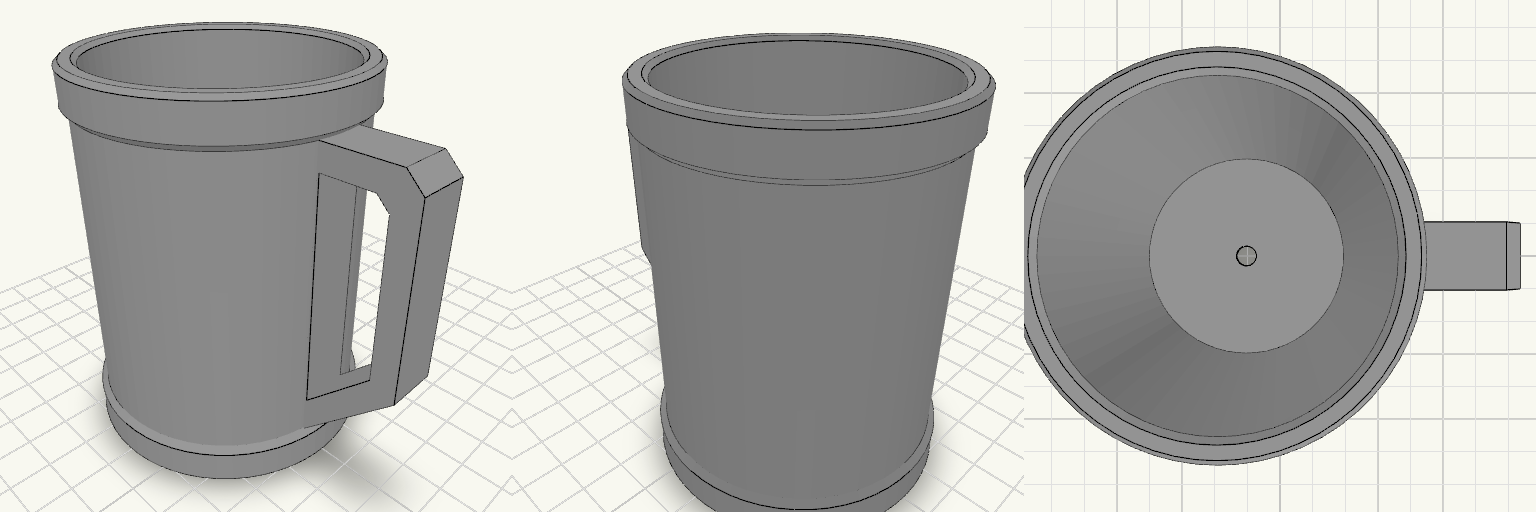
Caneca porta-latas com alça em peça única
Caneca porta-latas em peça única para latas de 269 ml. O corpo cilíndrico tem Ø externo de 64,6 mm e 90 mm de altura, com cavidade reta de Ø 58,6 mm e 87 mm de profundidade útil. A parede tem 3,0 mm e o fundo 3 mm; um furo de Ø 6 mm no centro do fundo alivia o ar, e um chanfro de 1 × 45° na borda interna do topo guia a entrada da lata. Duas faixas salientes de Ø 67,6 mm reforçam o desenho: uma na base, de Z=0 a 10, e outra no topo, de Z=80 a 90, ambas com chanfros de 45°. Entre Z=10 e Z=80 o corpo é liso, para receber adesivo. A alça fica em um dos lados, com 12 mm de largura e avanço até X=54. Ela sobe até Z=80, encostando no início da faixa superior, e mantém topo plano com barra vertical na ponta; a diagonal de 45° fica embaixo. As barras do perfil têm cerca de 6 mm, e as quinas externas e as do furo são chanfradas a 45°. O vão interno acompanha o perfil, com teto em Z=74; o chanfro na quina ajuda a impressão, mas o trecho ainda forma uma ponte e pode pedir suporte. Altura total: 90 mm Pegada na mesa de impressão: 87,8 × 67,6 mm Cavidade: Ø 58,6 mm por 87 mm de profundidade útil Parede de 3,0 mm e fundo de 3 mm Furo de alívio de ar: Ø 6 mm Faixas salientes: Ø 67,6 mm, base de Z=0 a 10 e topo de Z=80 a 90 Alça: 12 mm de largura, até X=54, topo em Z=80, barras de cerca de 6 mm e chanfros de 45° Vão da alça: teto em Z=74, com chanfro na quina; pode pedir suporte sob a ponte