Spice Rack revA
Created 10 days ago
Description
A two-tier spice rack that mounts on the inside of a cabinet door. A flat back plate carries two shelf tiers that project forward, so jars ride on the door rather than on the cabinet shelves and the door can close over them. The upper tier sits 137 mm above the lower shelf, leaving enough height for 105 mm spice jars on the bottom shelf with roughly 14 mm of finger room once a jar is lifted over the 14 mm front lip.
Specs
- Overall size: 175 mm wide, about 174 mm tall, 55 mm deep. Fits an 18 cm print bed.
- Tiers: two, set 137 mm apart. The top tier ends about 155 mm up the plate.
- Jar fit: each tier holds jars around 48 mm across. A 14 mm front lip and end walls keep jars in place as the door swings.
- Door clearance: the tiers project 55 mm from the door. Check the gap between the closed door and the cabinet shelves before printing; hinges and shelf edges can reduce it.
- Mounting: four countersunk 4.5 mm screw holes through the back plate, with the upper holes at 163 mm up the plate and 12 mm of plate above them. The countersink suits M3.5/#6 flat-head screws; check screw length against the door thickness so they do not break through the front face.
- Print orientation: back plate down with the shelves growing upward, so no supports are needed.
Measure the door-to-shelf clearance and jar diameter before committing to a full print; the depth and tier spacing depend on both.
Photos
Technical views
More like this
Explore more in Kitchen & Bathroom →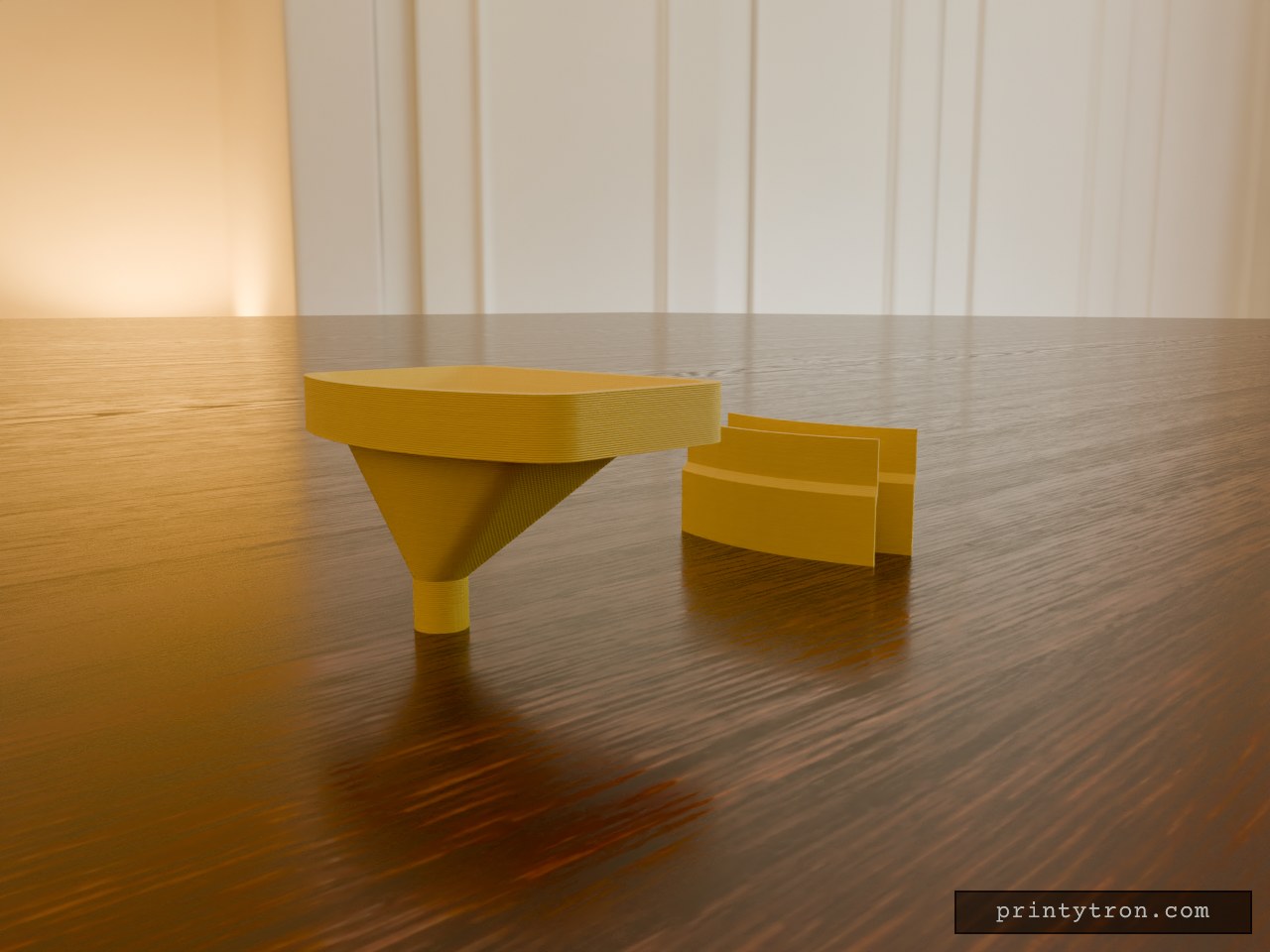
5 Gallon Bucket Urine diverter Funnel With Glue-On Clip
A urine diverter for a 5-gallon bucket. This funnel has a curved outer edge and a skirt, and it comes with a separate curved clip strip that glues to the bucket wall so the skirt hooks over it. I the clip is too near the edge because of taper at the bucket top, just print 2 and glue together (I only printed bottom half of second) Key numbers Bucket inside diameter: 296 mm (clip and funnel curve at 148 mm radius) Clip: about 44° of arc, around 114 mm long, 54 mm tall, 2.5 mm thick Profile: lower section glues flat to the bucket wall, then steps in 2.5 mm so the top stands off the wall by the skirt thickness Skirt: 20 mm tall, 2.5 mm thick, drops into the gap behind the clip's upper lip Spout: 19 mm outside, 15 mm bore Print: clip standing upright, brim needed for support; glue the lower face to the bucket wall
90mm Can Ring Pull Lever Tool
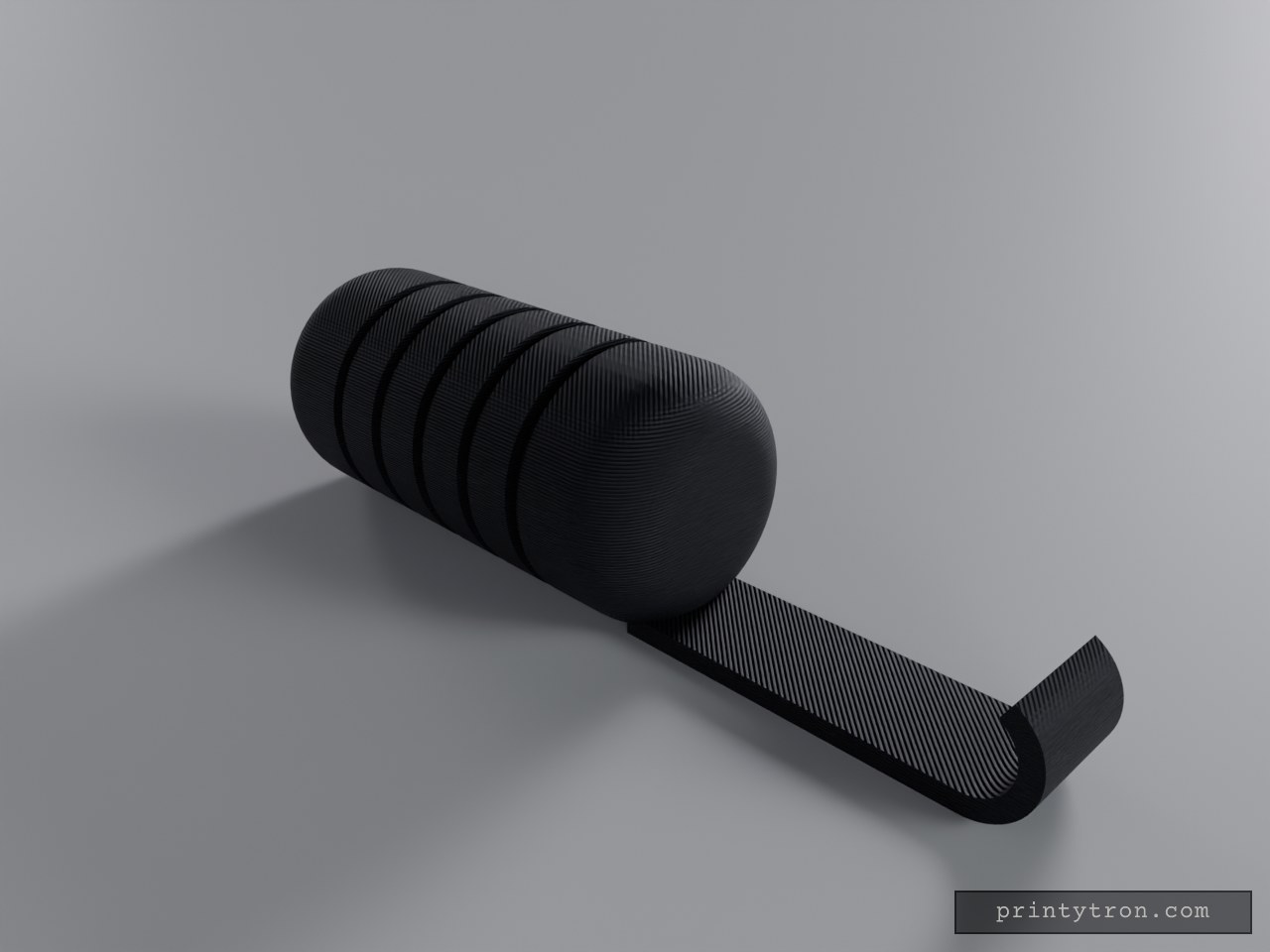
A hand-held lever for lifting can ring pulls without using fingernails. A thin curved hook slides under the ring, and a thick barrel handle gives the leverage to lift it. Suited to anyone with limited grip strength or short nails. Specifications Overall length: 90 mm Handle: 25 mm diameter barrel, about 55 mm long, with ring grooves for grip Hook blade: 2 mm thick, 12 mm wide, curved upward at the tip to slide under the ring Construction: single welded body, printed as one piece Orientation: print with the handle and blade lying flat on the bed. Supports may be needed under the barrel's curved underside. Material: PETG or PLA. PETG is preferred for the 2 mm blade because it flexes before it breaks. Use: ring-pull cans such as beans, soups and drinks Notes The 2 mm blade is the thinnest part. Print it with at least 3 perimeters for strength. The grip grooves are shallow, so the handle stays easy to wash.
65° Kitchen Counter iPad Stand
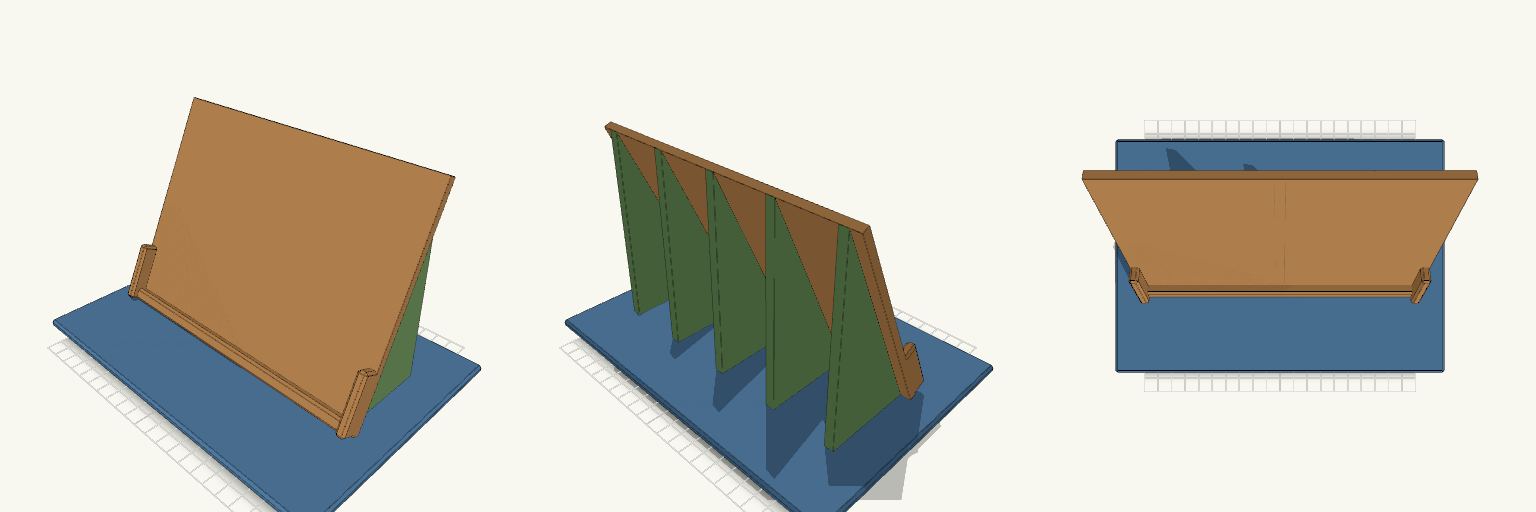
A wide, flat iPad stand for kitchen counters. The cradle sits at 65° from horizontal, a steep reading angle for recipes while standing. The underside of the base has a shallow recess that leaves a perimeter rim, so the edge seals against the counter and crumbs and flour are less likely to creep under. What it's for Reading recipes on an iPad at standing height without bending over. Use on a kitchen counter, where the wide base resists tipping. The stopper at the bottom of the cradle holds the iPad's lower edge, and the two side tabs keep it from sliding sideways. Dimensions Base: 240 × 170 × 5 mm, with 1.5 mm chamfered edges. Underside recess: 228 × 158 mm, 1.6 mm deep, leaving a rim around the perimeter. Cradle plate: 200 × 150 × 5 mm, tilted at 65° from horizontal. Bottom stopper: 8 mm deep and 11 mm tall, measured from the plate. Side tabs: 6 mm wide, 40 mm long and 16 mm tall, one on each side. Supports: five ribs, each 6 mm thick, spaced 45 mm apart under the cradle. Overall height: about 143 mm. Print notes Print the base face-down on the bed. The underside recess then faces up and needs no supports. PETG or ASA suits a kitchen better than PLA, which softens in heat. The cradle prints as one piece with the base and ribs, so no assembly is needed. Remix ideas Add a raised lip on top of the base to catch spills. Change the tilt angle for a lower or steeper view. Narrow the cradle and tabs for a smaller tablet. Add a cable slot in the stopper for charging while reading. Stick a thin rubber or silicone pad inside the rim for extra grip.
Bag Holder Stand with Spring Clamp Ring
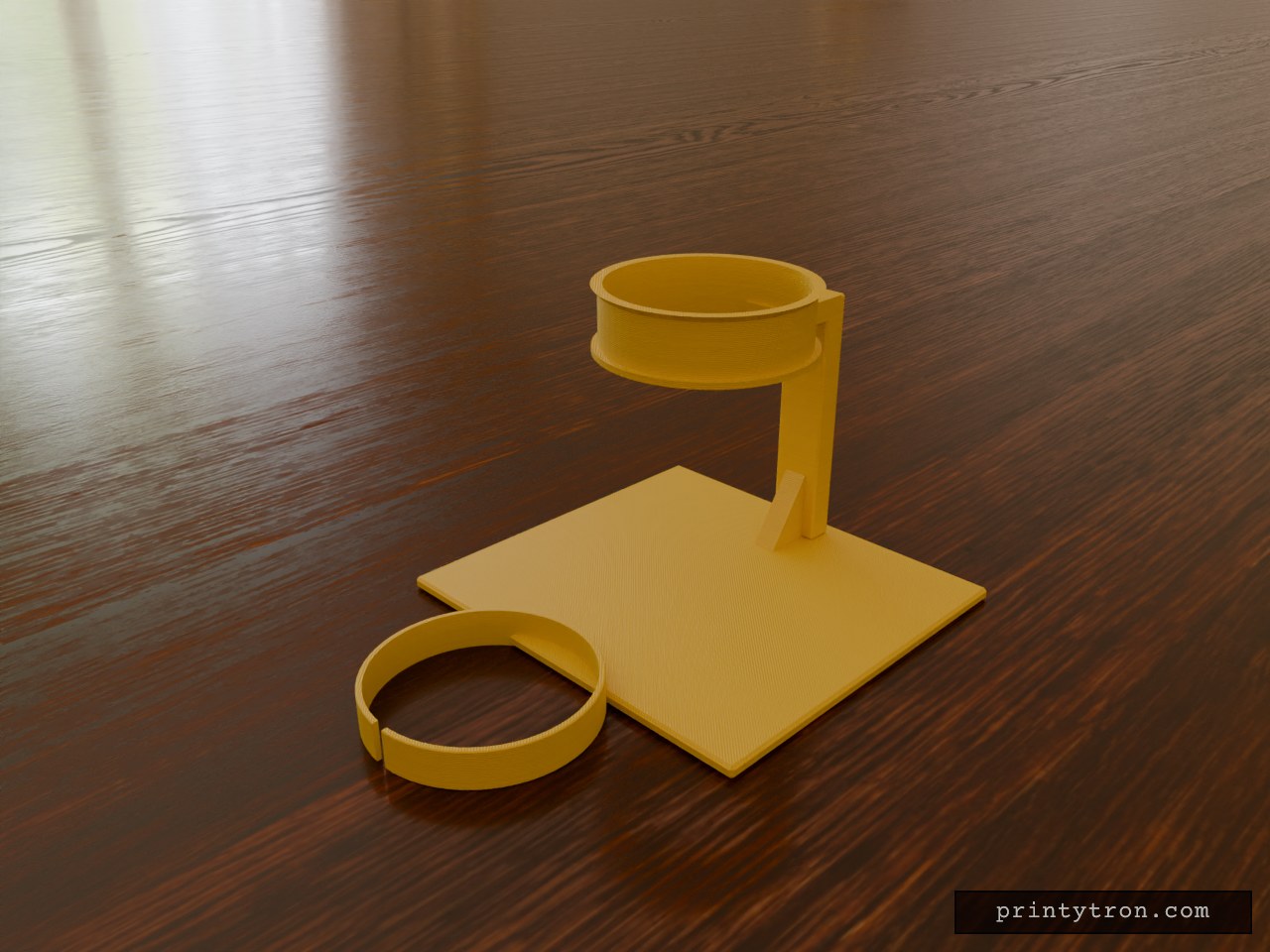
A freestanding stand that holds a freezer or piping bag open so both hands are free for filling. The bag mouth is pulled through a 120 mm inside-diameter ring, folded over the outside, and secured with a separate split clip that grips the folded rim all the way round. The base is a wide 270 × 250 mm plate with a rear post, so the stand resists tipping when a bag is loaded. The ring sits at the top of the post, 165 mm above the plate, with a flared lip to keep the fold from slipping off. Ring: 120 mm inside diameter, 40 mm tall, on a short arm off the post Base: 270 × 250 mm, 8 mm thick, chamfered edges, with a gusset on the post Clip: split spring ring, 24 mm tall, with finger tabs for opening Parts: base with post, ring, and clip are colour-labelled; the clip prints separately Material: PETG suggested for the clip so it keeps its spring To use, pull the bag mouth up through the ring, fold it down over the outside, then snap the clip over the fold. The ring height suits bags up to roughly 165 mm long; longer bags will rest on the base. The clip's grip has not been test-printed, so the gap may need adjusting for thicker or thinner bag film.
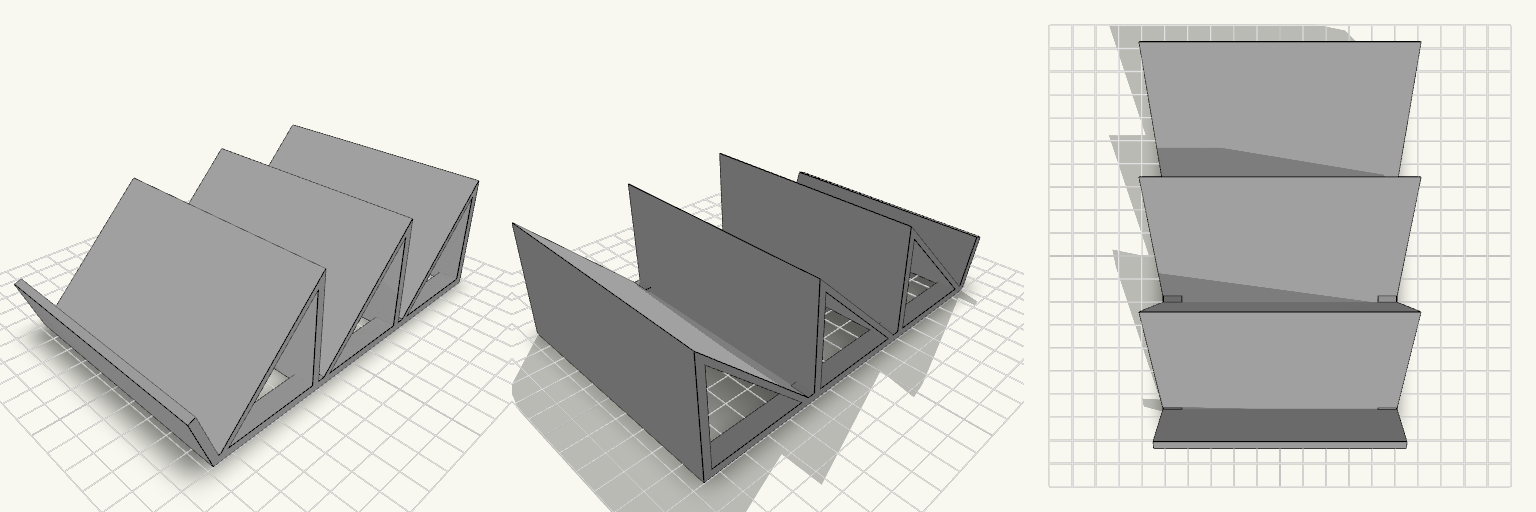
Leanto — Sawtooth Taco Rack
Leanto is a minimal plate-top rack that holds three hard taco shells upright at a 45° slant, one behind the other. The profile is a true sawtooth: each slanted surface ends in a vertical wall that also stops the next shell, with no solid base underneath. Features Three 45° ramps, 48 mm pitch, 48 mm tall vertical backs Open underside, 3 mm shell walls One forward-leaning stop at the front to hold the first shell Two thin side runners tie the teeth together Dimensions About 100 mm wide and 150 mm front to back Fits on a standard dinner plate
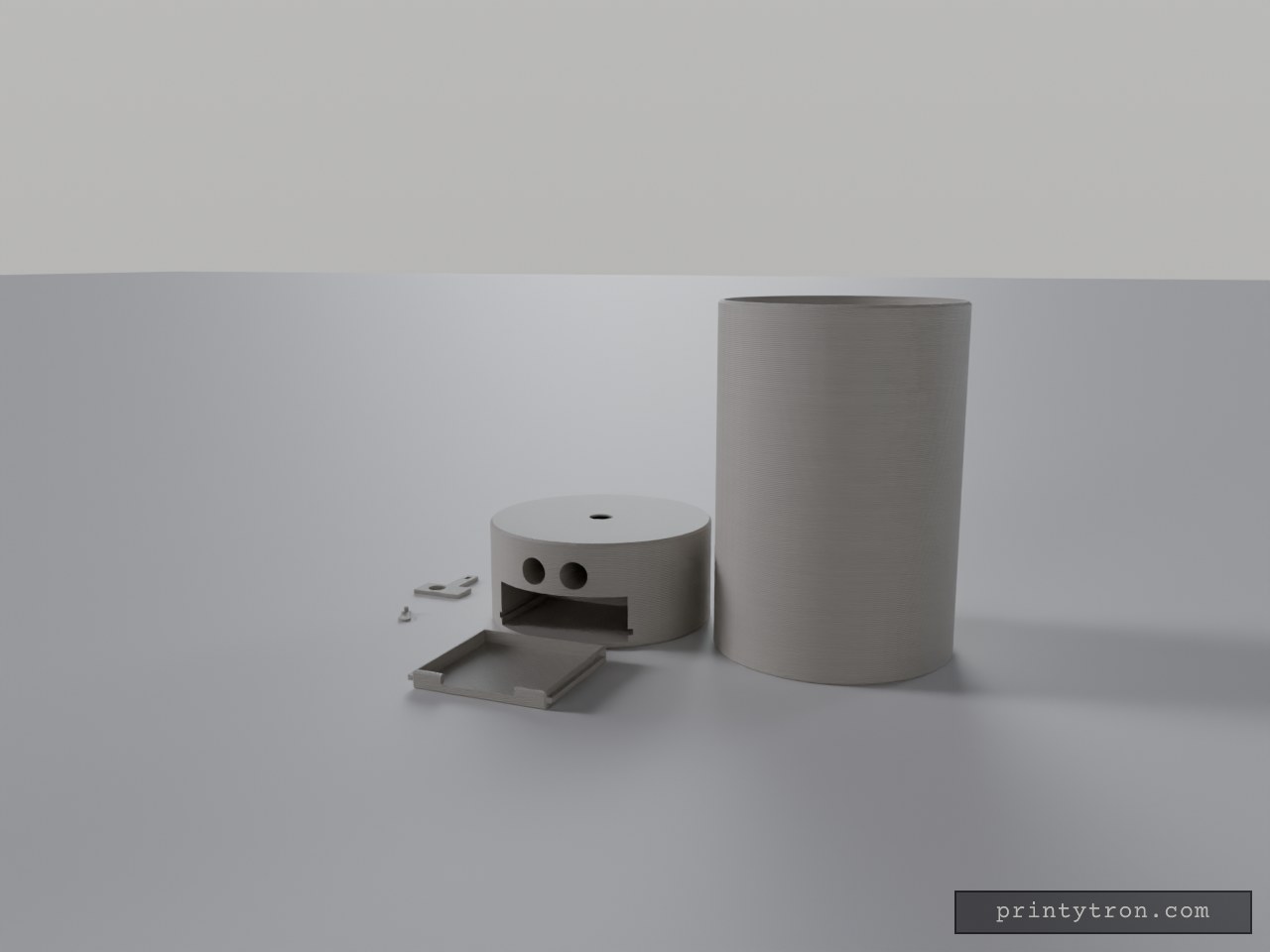
Sentinel Cylinder Candy Dispenser
A candy dispenser with a watchful streak: the body stands as one straight 105 mm cylinder from foot to rim, and two eye holes on the front give it the look of a sentinel standing guard over the opening below. Those eyes are through-holes opening into a pocket for an ultrasonic sensor, so a wave of the hand can trip the servo below the gate slot and slide the gate open, dropping candy into the hand opening below. That opening is a genuine hole cut clean through the front wall, about 63 mm wide and 21 mm tall, sized for an average hand rather than a large one. A retractable catch tray rides on side rails on its floor, just under the outlet, with a low notch at the front so you can scoop the candy out with your fingers. A cone at the floor of the candy cylinder funnels the sweets down to the outlet, and the whole thing stands 200 mm tall — a tall column that holds a serious load of candy while keeping a modest footprint on the counter. All five pieces are laid out separately on the plate, each oriented for printing without supports. The candy cylinder is silk white, the base pink, the catch tray light blue, and the gate slider and servo horn white. The printed parts Base Housing — a round 105 mm pink body, 48 mm tall. The hand opening sits at the front bottom, open through the wall. The two sensor eye holes sit just above it, also cut clean through, so the sensor has a clear line of sight out the front. The servo bay is sized for an SG90: the servo slides in from the back wall, shaft up, with its mounting ears resting in a slot cut into the housing. A round recess above the body lets the shaft boss sit so the horn runs flush under the gate. The wider body leaves room to open the sensor pocket to full size. Candy Cylinder — a 105 mm open cylinder, 152 mm tall, in silk white, with roughly 3 mm walls, flush with the base so the body reads as one uninterrupted column. A wide, shallow cone at its floor feeds the outlet; everything above it is candy storage. Gate Slider — a flat 26.3 × 33.8 × 2.3 mm white plate that slides sideways in a slot across the outlet, just under the candy cylinder floor. A solid bar covers the outlet when closed; a 12 mm hole lines up when open. Its tail has a slot for the servo horn pin, and about 60° of servo sweep moves the gate roughly 13.6 mm — enough to fully open or close the outlet. Servo Horn — a 10.1 × 13.3 × 3.2 mm white horn with a pin that rides in the gate’s tail slot. The servo below the gate slot turns it to shift the gate. Catch Tray — a 64.5 × 57 × 7.5 mm light-blue tray that slides into the hand opening on two side ribs set in matching grooves, and sits directly under the outlet. Its back and side walls are about 1.5 mm thick, the front wall carries a low scoop notch, and the front edge stands about 1.5 mm proud of the housing as a pull tab. The rails are 3 mm wide with about 0.5 mm clearance in the grooves. There is no end stop, so the tray pulls out completely; a small snap bump would add a stopping point. It prints flat and needs no supports. Before you print The servo pocket matches an SG90: about 12.6 mm wide and 23 mm tall, with a mounting-ear slot. The sensor pocket and eye holes are undersized for an HC-SR04. Open those up while keeping the outside dimensions, or plan on a smaller sensor. The wall between the servo bay and the hand opening is thin, about 0.6 mm at final scale. Print the base with extra perimeters. The 152 mm cylinder is a tall, thin-walled tube — print it upright as laid out, and print it slowly. Check that it fits your printer’s height; if not, split it into two stacking rings. The gate slot has only about 1.4 mm of material above it before the cylinder floor, and the wall between the hand opening and the sensor pocket is thin. Print the base with extra top layers and extra perimeters for strength. Keep the gate plate flat on the bed so it slides cleanly through its slot, and keep the tray flat so its side rails and walls stay square. The base and candy cylinder have no locating lip, so glue or tape them together. Test-fit a real SG90, ultrasonic sensor and tray before final assembly. Wire the sensor and servo to the same controller. When the sensor sees a hand, the controller turns the servo to open the gate, waits, then turns it back to close. Remix hooks — cap the 105 mm cylinder with a lid, open the outlet up for faster dispensing, open the sensor pocket to HC-SR04 size now that the round base has the room, widen the hand opening, deepen the catch tray, add a small snap bump to give the tray a stopping point, or add a shallow funnel lip around the outlet for easier loading.