Antikythera Mechanism Desk Model
Created today
Description
A simplified, life-size-style display model of the Antikythera mechanism: an upright case with a round front dial, a pointer, an open-backed gear train and a rear hand crank.
- Case 180 x 90 x 190 mm, open at the back to show the gears
- 130 mm front dial with ring grooves and 60 tick marks
- Nine spur gears (20 to 48 teeth, module 1.25) arranged in three layers, with phase-matched teeth so they mesh
- Fixed 4 mm pegs on the front wall carry the compound gears; the main 48-tooth gear is fused to a 6 mm axle that drives the front pointer
- Rear bearing bar supports the axle, with a crank handle on the back
The gear train is a stylised interpretation, not a tooth-accurate copy of the original 30-plus gear mechanism. Print the case, dial, gears, axle and crank separately; the compound gears sit loose on their pegs with 0.3 mm clearance.
Images
More like this
Explore more in Decor & Display →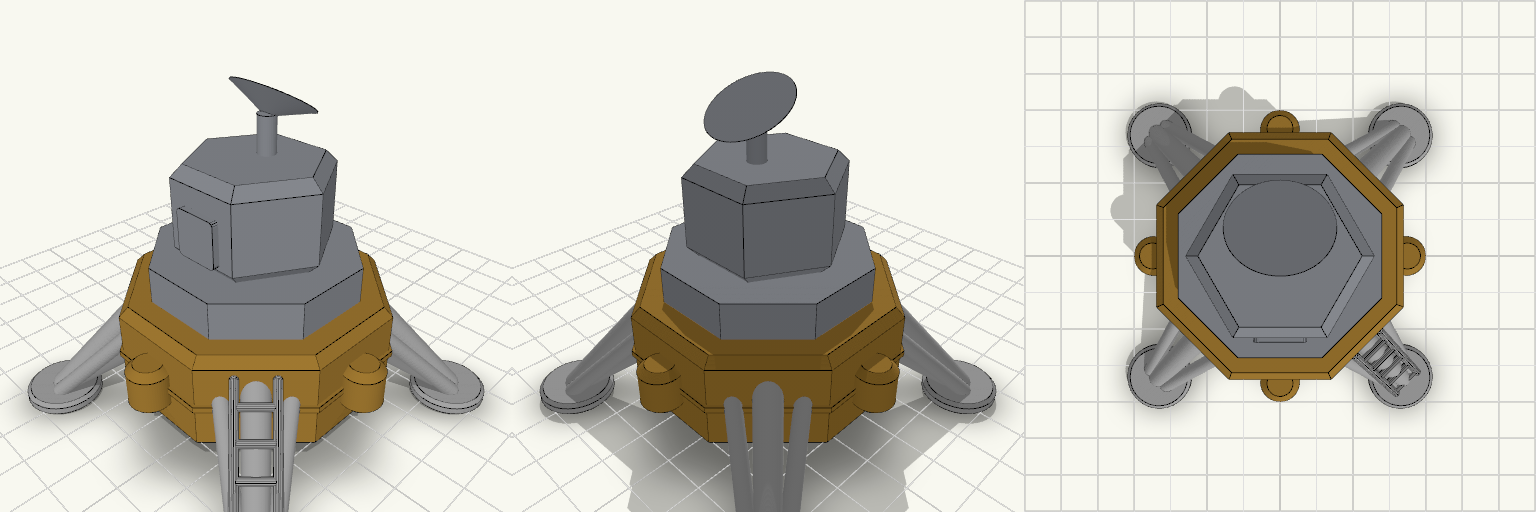
Apollo-Style Lunar Lander Model, 82 mm Footprint
This is a stylized Apollo-style lunar lander display model. It has an octagonal descent stage with four shallow fuel-tank bulges and a panel band around the middle, a faceted hexagonal ascent cabin with a raised front hatch, an engine bell underneath, and four splayed A-frame legs with chamfered footpads. One leg — the front-right — carries a ladder with two rails and rungs, and a tilted dish on an 8 mm mast sits toward the rear of the cabin roof. At roughly 82 mm across the footpads, it is sized as a compact desk or shelf piece. The cabin front is clean apart from the hatch, so the model reads as a lander rather than anything else. The legs are the widest part of the print; the body sits well inside that spread. Specs Footprint: approx. 82 mm across the footpads Descent stage: octagonal, approx. 68 mm across × 22 mm tall, with four shallow fuel-tank bulges and a mid panel band Ascent stage: faceted hexagonal cabin, approx. 42.5 mm across × 43.5 mm tall, with a raised front hatch and a tilted dish on an 8 mm mast Engine bell: approx. 18 mm across × 9 mm tall, mounted low under the central body about 1 mm above the plate, so it reads best from a low viewing angle Legs: four A-frame legs, each with a thick main strut anchored into the descent stage, a lower angled strut and two side struts; chamfered footpads approx. 17 mm Ladder: two rails and rungs on the front-right leg Use: display model for a desk, shelf, or space-themed collection Printing notes The splayed legs and footpads set the build plate footprint; check the 82 mm spread against your plate before scaling up The dish mast, ladder rungs and hatch are the finest features — a smaller layer height keeps them crisp
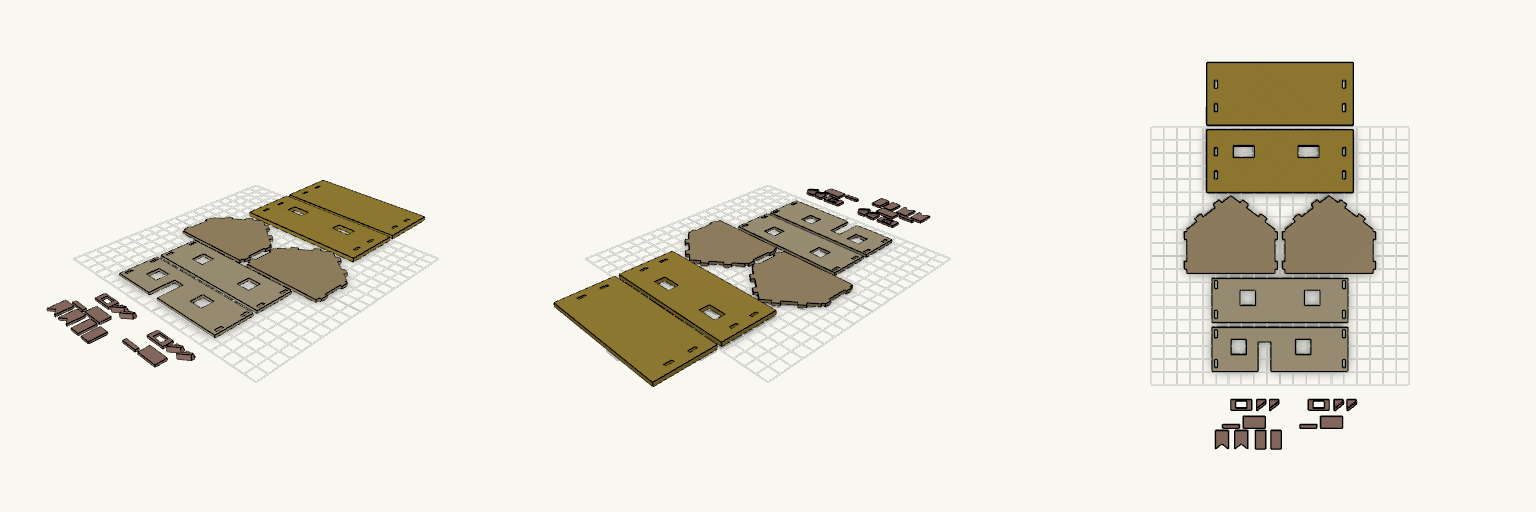
OO Gauge Flat-Pack Thatched Cottage with Dormers
Flat-pack 1:76 (OO gauge) detached cottage with thatched roof panels, dormer windows and a chimney, all printed lying flat. Fit notes Host: OO gauge, 1:76 scale; footprint 105 × 72 mm, 34 mm walls. Wall tabs use 2.4 mm slots for 2 mm tabs; test one tab first. Roof dormer openings are 16.4 × 9.4 mm; check one dormer against them before printing the rest. Each dormer cheek has a 4 mm tall gluing lip along its sloped lower edge, cut to the 37.4° roof pitch, to glue under the roof panel. Not a fit for other scales (N, HO) without resizing.
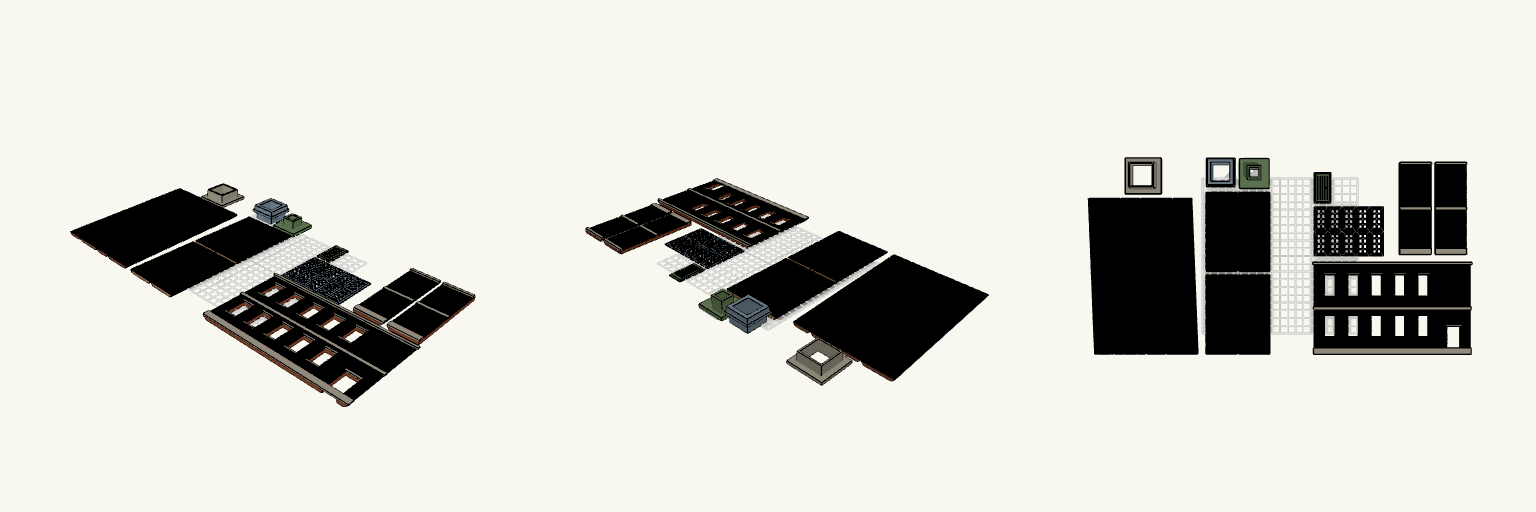
OO Mill Front and part-tapered Chimney Set
A four-panel tapered chimney with a straight brick base, paired with a half-relief two-storey mill front in OO scale. The wall, ten window frames and plank door all print flat. Each window frame and the door now carries a thin web around its outside edge to hold it down during printing. Remix hooks Web width (webw, 1.8 mm): wider grips better; keep it under half the 4 mm spacing so neighbouring webs stay separate. Web thickness (webt, 0.3 mm): roughly one or two layers. Thinner peels off easier, thicker holds harder. Window grid (14 x 28 mm frames, 4 mm spacing): change the spacing if the web is widened. Pairs with: the chimney set on the same plate layout, and a clear or painted glazing insert behind the frames. Print notes Trim the web with a hobby knife after printing, before fitting frames into the wall openings. Wall is 200 mm long and needs its own print separate from the chimney set.
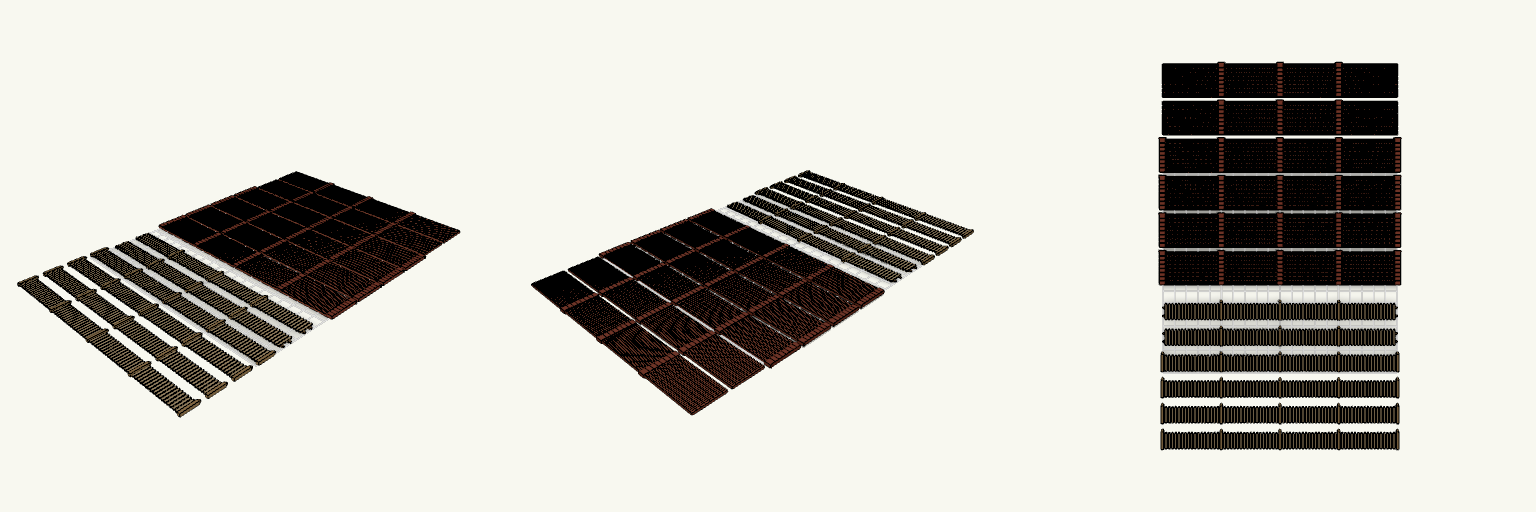
OO Scale Picket Fences and Brick Walls
Flat-pack OO scale (1:76) boundary set: six 200 mm wooden picket fence panels and six 200 mm brick wall panels, all printing on one bed in separate rows. Fences: four with five posts, two with only the three centre posts (50, 100, 150 mm). Posts are 17 mm tall with pyramid tips; slats are 1.6 mm wide, 14 mm tall and pointed. Brick walls: 28 mm tall (7 ft), 1.6 mm thick, soldier bond: upright bricks, with 0.4 mm mortar grooves every 1.4 mm and a course line every 3.5 mm. Pillars are 5 mm wide, 2.4 mm thick, with a small cap, spaced 50 mm apart. Two walls have only the three centre pillars. Remix hooks wh (28) sets wall height; crs (3.5) sets course spacing. pitch (1.4) and gw (0.4) set brick width and mortar line; keep gw at or above one nozzle width. pwid (5) widens the pillars; wall wt (1.6) sets thickness. Swap the pillar count or spacing to match the fence posts. Pairs with the fences as a mixed boundary run; glue panels to a base strip for display.
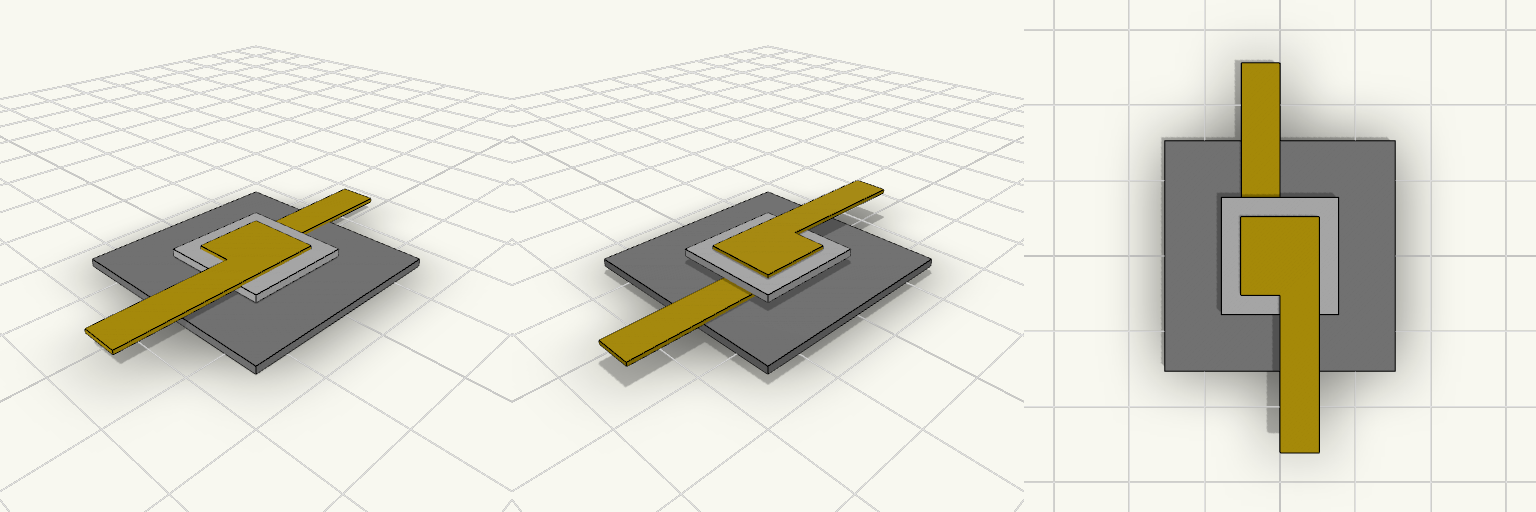
Placa con figura en L y cuadrado blanco
Una placa cuadrada de 30 × 30 mm y 1 mm de espesor sirve de base a tres capas superpuestas: una figura en L amarilla de 0.5 mm de espesor, un cuadrado blanco de 15 × 15 mm y 1 mm centrado sobre ella, y una segunda L amarilla idéntica a la primera, girada 180° sobre el mismo eje central. El conjunto alcanza 3 mm de altura total. Las dos L son iguales: un cuadrado central de 10 × 10 mm centrado en la placa, del que sale un brazo de 5 mm de ancho y 30 mm de largo. El brazo de la L inferior apunta hacia un lado y el de la superior hacia el opuesto, de modo que cada uno sobresale 10 mm del borde de la placa. La pieza ocupa 30 × 50 mm sobre la cama y los dos tramos volados quedan sin apoyo debajo. Placa: 30 × 30 mm, 1 mm de espesor, en gris. Figura en L: dos capas amarillas de 0.5 mm, con el cuadrado de 10 × 10 mm centrado en la placa y brazos de 5 mm de ancho que salen en sentidos opuestos. Cuadrado blanco: 15 × 15 mm, 1 mm de espesor, centrado entre las dos L. Tamaño total: 30 × 50 × 3 mm. Impresión: una sola pieza; los dos extremos de 10 mm que sobresalen necesitan soportes, o bien gira la pieza para evitarlo. Primera capa: al ser la base de 1 mm, cuida la adherencia a la cama para que no se combe en las esquinas.
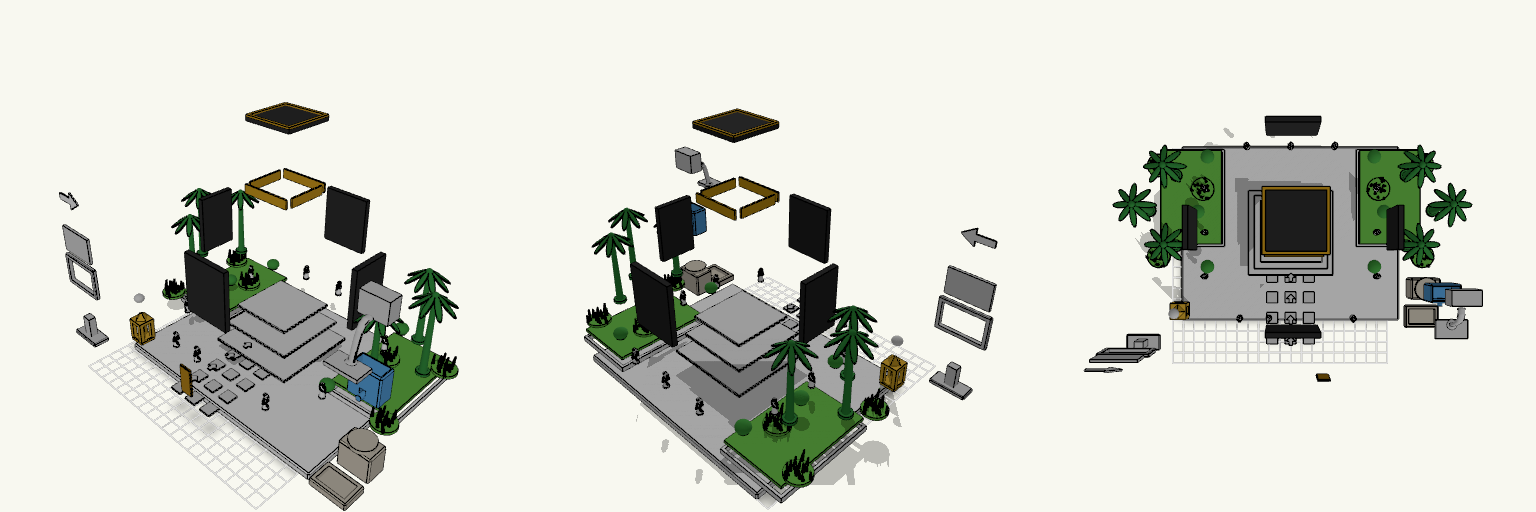
55كعبة مجزءة
Exploded miniature of a masjid scene with every component spread apart with visible gaps. Parts: white base, platform tiers, four black Kaaba walls, roof, door, gold bands, walkway tiles, arrows, palms, bushes, grass, pilgrims, Zamzam station, Maqam Ibrahim and blue sign parts. Layout: exploded only, no assembled copy. Export: the download is one file; separating individual parts happens outside this model.