Yu-Gi-Oh Deck Box With Millennium Scale
Created 3 days ago
Description
Two-bay deck box for sleeved Yu-Gi-Oh! cards with a separate accessory bay for dice and other game items. A plug-in lid carries a Millennium Puzzle triangle with an eye and "Yu-Gi-Oh!" lettering in a regular-weight font. Millennium Items are raised on the outside walls.
- Card bay: 70 mm wide, for sleeved decks
- Accessory bay: 40 mm wide, with a cross divider separating dice from other items
- Front: Millennium Scale and Millennium Eye, 1.2 mm raised relief
- Back: Millennium Ankh and Millennium Ring
- Sides: Millennium Key (left) and Millennium Rod (right)
- Lid: flat plate with plugs for both bays, printed plate-side down
Images
More like this
Explore more in Storage & Organization →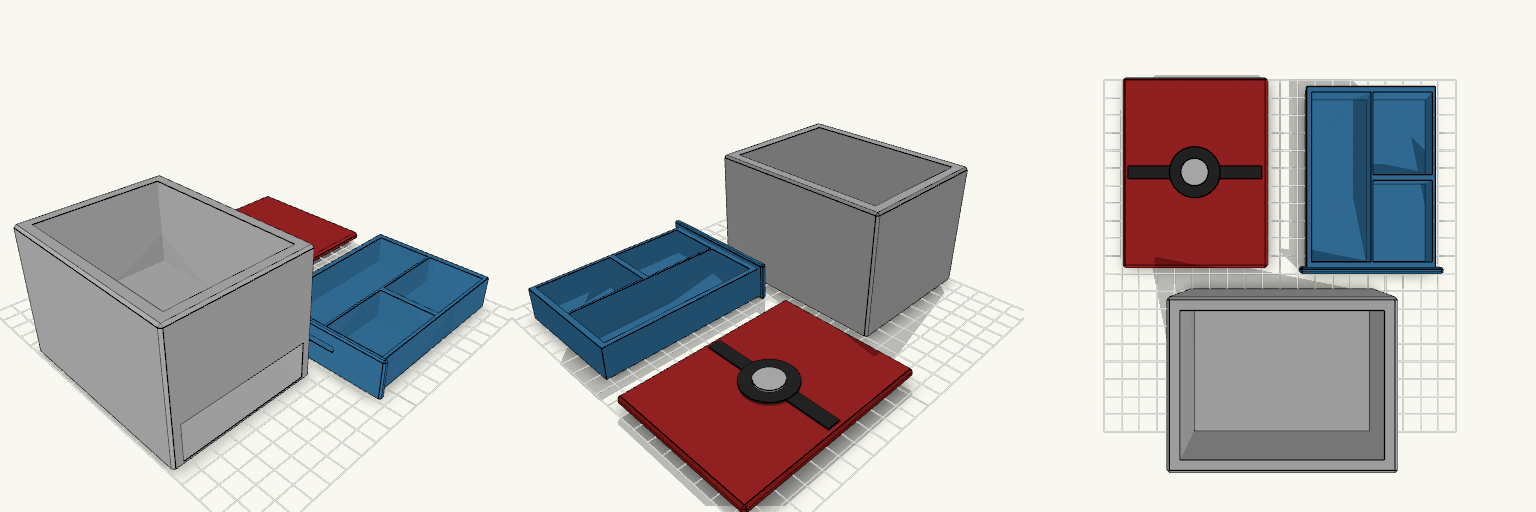
Pokémon Deck Box With Drawer2
A Pokémon-themed deck box with a lift-off Poké Ball lid, a card well and a separate pull-out drawer for dice and counters. Parts are laid out on two plates: the box body alone on plate 1, and the lid and drawer side by side on plate 2. Remix hooks Overall size: the body is 80 x 105 x 70 mm. Change W, D or H to fit larger sleeved decks. Card well: 68 x 93 mm. Widen it for double-sleeved cards. Drawer bays: one long bay for dice and two smaller ones, 32 mm wide. Re-split them for tokens or damage counters. Plate layout: the body is turned 90° so it sits along X on plate 1. Plate 2 is offset 160 mm along Y. Pairs with: a card divider set or a coin-flip token tray.
Bass Tackle Box With Hinged Lid
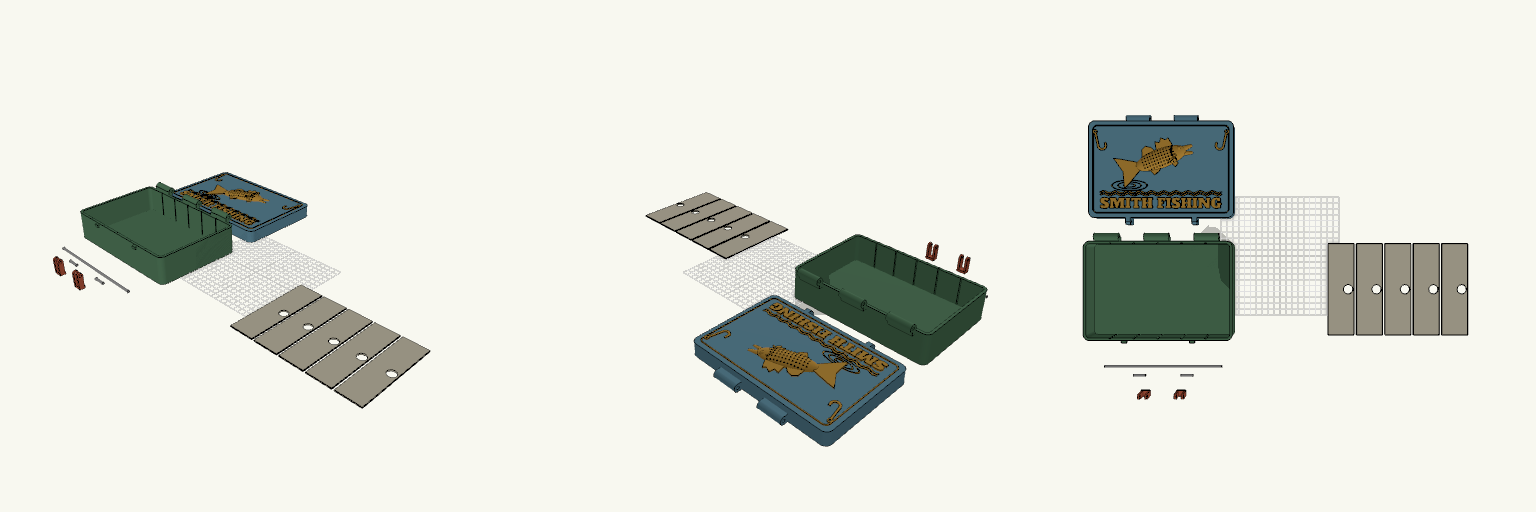
Tackle boxes that pop open in the boat, rattle hooks into the soft plastics, or lose a lid hinge get replaced. This one is a hinged bass tackle box with a locking front latch, adjustable dividers and a leaping largemouth bass on the lid, with SMITH FISHING raised underneath. Load-bearing numbers Base: 240 × 160 × 50 mm, 4 mm walls, 3 mm floor, rounded vertical corners. Lid: 240 × 160 × 22 mm, with a raised bass, ripples, waves, hooks and a border on top. Dividers: 5 removable cross dividers, 1.8 mm thick, sliding in 2.4 mm grooves at 38.5 mm spacing. Hinge: 5 interleaved knuckles across the back, joined by a 4.2 mm pin (197 mm long, printed separately). Latches: 2 front latches with 4.2 mm pivot pins. Each hooks under a ledge on the base. Printing Print every piece in the layout shown: base, lid, dividers, latches and pins are all separate. Lid: print upright. The underside of the top plate bridges across the cavity, so use supports or good bridging settings. Layer height 0.2 mm, PETG or ASA, 3+ perimeters. Hinge and latch pins can be glued or capped at the ends to keep them in.
Two-Piece Pro Controller Wall Holder
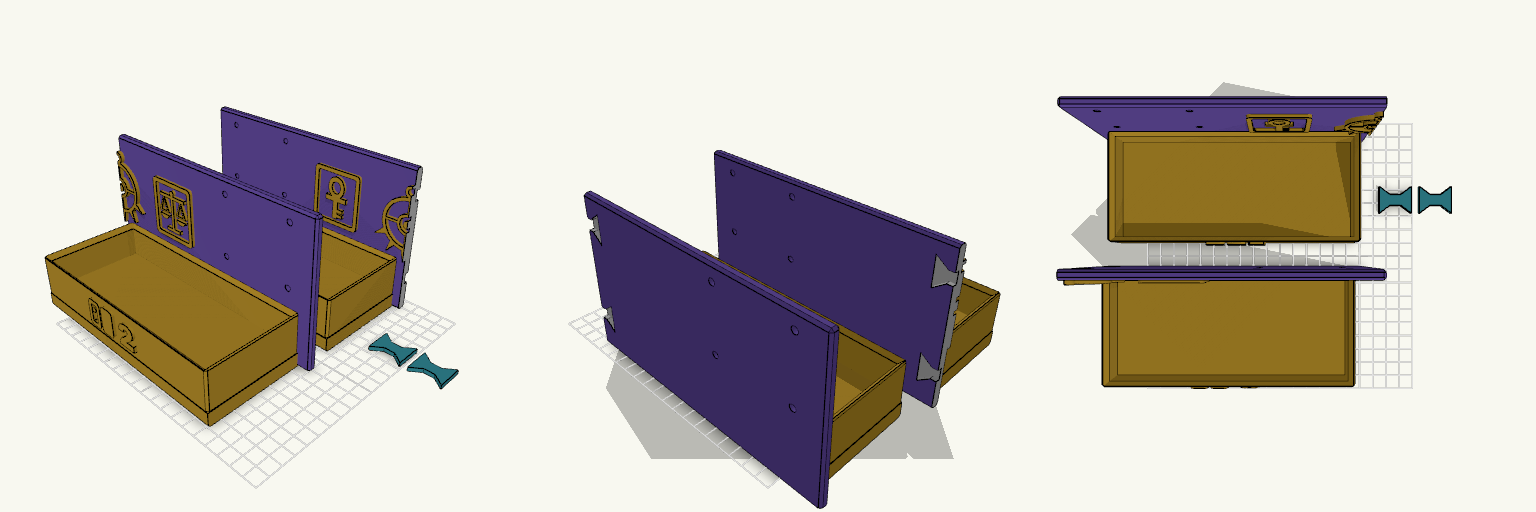
A 380 mm wall holder for a PS5 and a Switch Pro controller is too wide for most print beds, and a single plate can crack along its length. This version prints as two 190 mm halves that lock together with two butterfly keys. Fit and print Split line: centre of the plate, through the Yu-Gi-Oh! ring emblem Keys: two butterfly-shaped keys, 24 mm wide and 20 mm tall, 2.9 mm thick, printed flat Key pockets: cut 3.3 mm deep into the back face, 0.3 mm clearance all round Assembly: press the keys into the back pockets across the seam, then screw the halves to the wall. The wall holds the keys in Mounting: eight countersunk screw holes in total, four per half Printing: halves lie on their backs or stand on the shelf base. No supports are needed for the hollow blocks Pocket sizes are 166 mm wide and 70 mm deep, from typical controller sizes and not from measurements of a specific controller.
Hinged Bass Tackle Box with Dividers
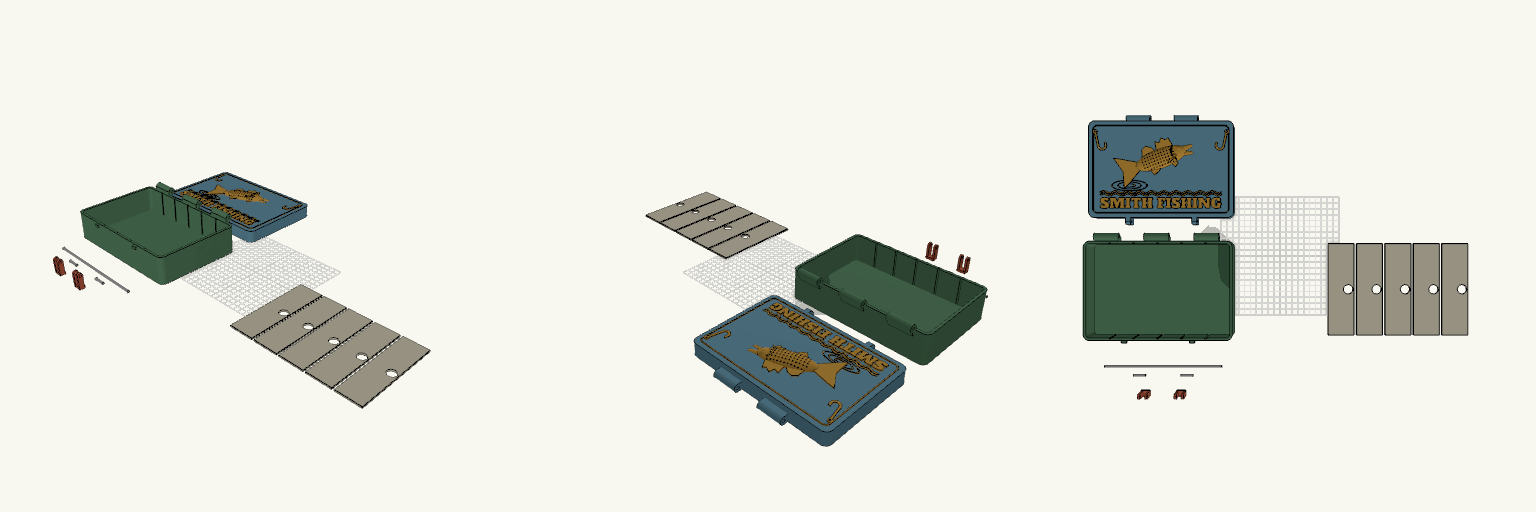
What it's for A hinged tackle box for bass fishing gear, with a locking front latch, removable thick dividers and a leaping bass on the lid with SMITH FISHING lettering. Dimensions Base: 240 × 160 × 50 mm, 4 mm walls, 3 mm floor Lid: 240 × 160 × 22 mm with raised artwork Dividers: 5 pieces, 2.6 mm thick, sliding in 3.2 mm grooves Hinge: 5 knuckles with a separate 4.2 mm pin Latches: 2 front latches with pivot pins Remix ideas Change the lettering to a different name Add more divider grooves for smaller compartments Swap the lid artwork for another species
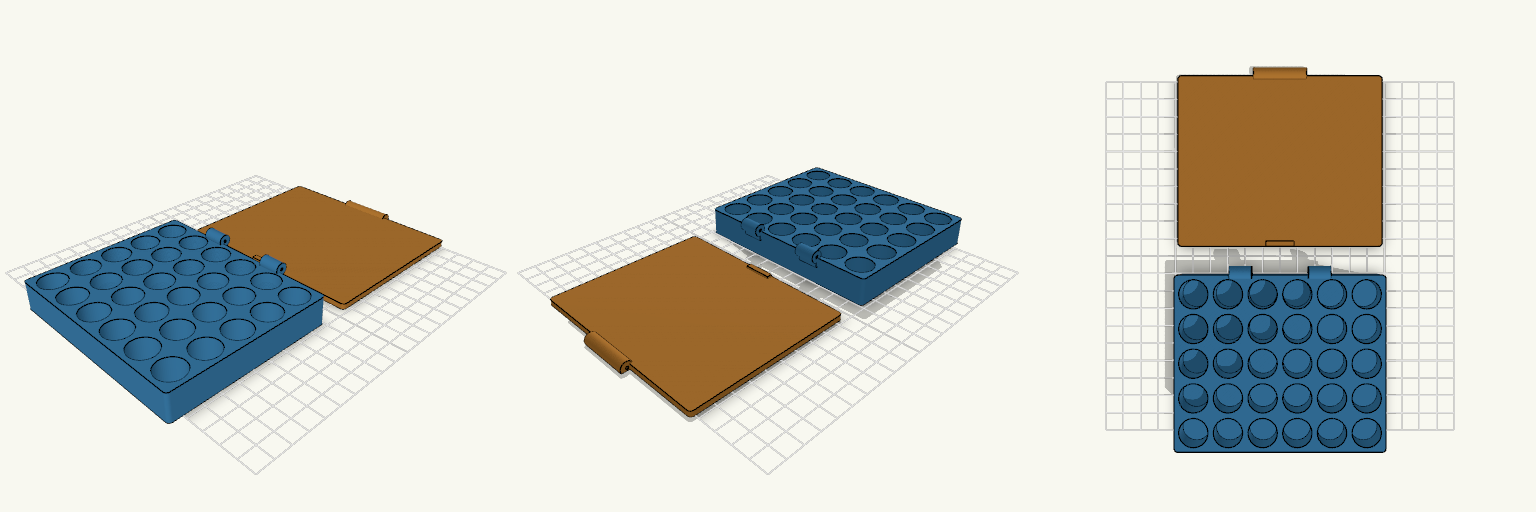
Apothecary Grid Hinged Pill Box
A pharmacy-drawer grid in miniature: thirty round wells in a 6×5 layout, topped by a lid that swings open on a real pin hinge at the back edge. The lid prints flat beside the tray and clicks into the hinge ears once a short pin is slid through. 30 slots, 16 mm wide and 14 mm deep Hinge pin hole sized for a 1.75 mm filament offcut, about 56 mm long Front finger tab on the lid for easy opening Lid and tray print without supports in separate pieces
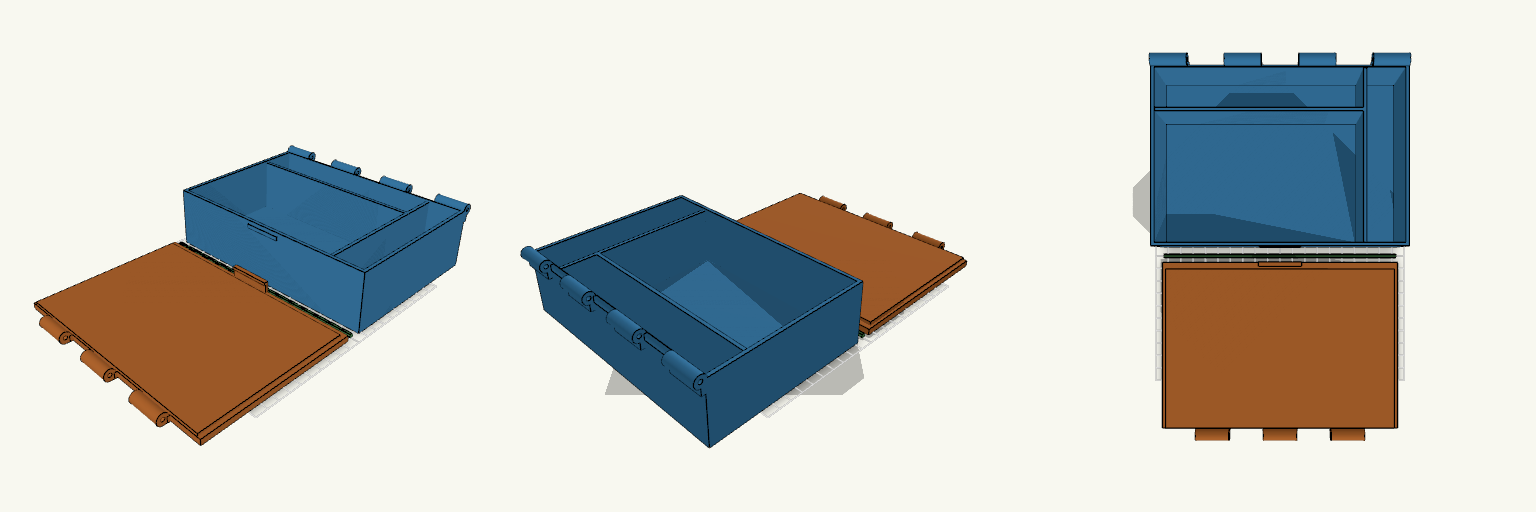
Hinged Latching Box With Front Divider
Small parts slide into one pile the moment the lid comes off; this hinged latching box splits the main space with a divider and adds a full-depth side bay so screws, clips and the like stop mixing. The main compartment clears 152 × 127 × 45 mm, with a 2.5 mm divider set 97 mm back from the front. A 2.5 mm wall separates a 28 mm wide, full-depth compartment on the right, and that bay has no cross divider. The walls stand 2 mm taller than the divider, and the divider top sits level with the underside of the lid lip, so the full 45 mm of height is usable. Fit and compartments Main compartment: 152 × 127 × 45 mm clear (width × depth × height). Right side compartment: 28 mm wide × 127 mm deep × 45 mm high, separated by a 2.5 mm wall and open for its full depth; overall inside width about 182.5 mm. Divider: 2.5 mm thick, 97 mm back from the front of the main compartment; front bay 97 mm deep, rear bay about 27.5 mm clear in the main area. The divider stops at the side-compartment wall so the right bay stays open. Walls and floor: 2.5 mm; the divider is 2 mm shorter than the walls so the lid lip clears it. Lid: 2 mm inner lip locates it on the base. Hinge clearance The lid's back edge has notches where the base's hinge knuckles pass through it. The base's back wall is cut away where the lid's knuckles swing down into it. Both cuts carry roughly 0.3 mm of play, so the lid closes without catching. Latch The hooked tab on the lid is set so the hook sits close over the catch bump without binding. Closed, the gap between the top of the hook and the underside of the catch bump is about 1.3 mm. If it prints too tight to snap over, lengthen the tab by a fraction of a millimetre at a time; if it is too loose, shorten it the same way. Printing and assembly Prints as three separate pieces: base, lid, and hinge pin. Base footprint is about 187.5 × 140.6 mm; the lid is about 187.5 × 142.3 mm; the pin is about 185.5 mm long and 3 mm in diameter. The pieces sit apart on the plate with gaps: the lid is flipped so its flat top face is on the bed, and the 3 mm pin lies flat in the gap. None of the three touch. If a slicer imports the file as one body, use Split to objects or Separate parts. Hinge: seven interleaved knuckles with a 3 mm pin. Use a 3 mm rod or filament, or print the pin. Slide the pin through the knuckles after printing; the lid hinges on it and the front latch holds it shut.