Cast Scratcher Wand, 300mm
Created 3 days ago
Description
A long, thin scratcher wand for reaching down inside a cast. It measures 300 mm long, 8 mm wide and 3 mm thick. Every edge is rounded at 1.4 mm so it slides in smoothly and soothes without catching or scraping skin. One end has a low dome bump, and the other end has a hang hole so the wand can live on a sofa arm, a hook or a loop of cord.
It prints flat on the plate with no supports. The dome peaks at about 4.5 mm.
Remix hooks
- Length (
L, 300 mm): Shorten it for a forearm cast. Lengthen it for a full-leg cast. Stiffness drops as it gets longer, so consider more thickness if you go past 300 mm. - Thickness (
T, 3 mm): Thicker is stiffer but needs a wider gap in the cast. Thinner flexes more and can snap in some filaments. - Width (
W, 8 mm): 8 mm fits most cast gaps. Go narrower for tight padding. - Tip bump: The dome is a flattened sphere (80% height) about 7.6 mm across. Make it taller for a firmer scratch, or remove it for a smooth rounded tip. Add a textured pad or ridges if you want something more aggressive.
- Hang hole (4.5 mm): Fits a small hook, a split ring or thin cord. Enlarge it for a lanyard or carabiner. Move it inward if you want a stronger handle end.
- Edge rounding (1.4 mm): This is close to the maximum for a 3 mm thickness. Reduce it for a crisper profile.
Pairs with
- A sofa-arm hook or a loop of paracord through the hole.
- PETG or nylon for flex and durability. PLA works but is more brittle at this thickness.
- A second copy with a different tip as a spare.
Colour regions
The shaft and handle are one colour, and the bumped tip is another. This is a single printed piece, not an assembly.
Photos
Technical views
More like this
Explore more in Gifts, Seasonal & Personalized →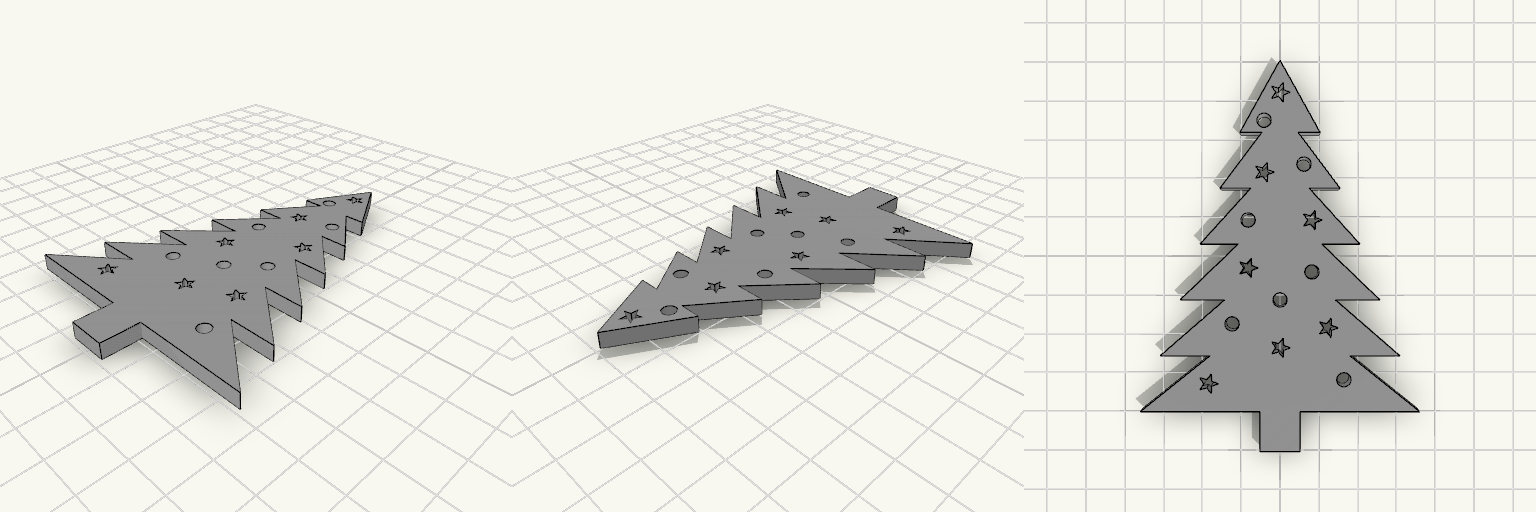
Flat Six-Tier Christmas Tree Cutout
What it's for A flat, two-dimensional Christmas tree cutout with six stacked, tapering tiers over a short trunk. The tip is a plain point — no star, no topper — and the silhouette stays clean and unbroken. Seven small stars and seven small circles are scattered across the tiers as through-holes in those same shapes, punching light through the flat body and adding detail without any surface relief. It prints as one flat piece and comes off the plate ready to use, with no assembly and no supports. Dimensions Overall footprint: 70 mm wide × 98 mm tall Thickness: a constant 4 mm Tiers: six stacked branches Star holes: 7 through-holes, roughly 2.6 mm across the points Circle holes: 7 through-holes, 3.6 mm across Top: plain pointed tip, no star All of the star and circle holes sit inside the tree's outline, including the ones near the tip, so nothing breaks the outer silhouette. Print notes Print flat on the plate. The constant 4 mm body means there are no overhangs and no supports are needed. The holes are small, so a 0.4 mm nozzle prints them cleanly; the star points are sharp and may round off slightly. The flat faces are a good place for a colour change or a two-tone filament swap. Remix ideas Scale the outline up or down for a larger wall piece or a small tag. Thin the body to 2–3 mm for a lighter decoration, or thicken it for a freestanding table piece. Enlarge the star and circle holes for a stronger see-through effect, or change their count for a denser or sparser look. Add a name across the trunk, or add a hanging hole if you want to suspend it.
naamkaartjes elisa
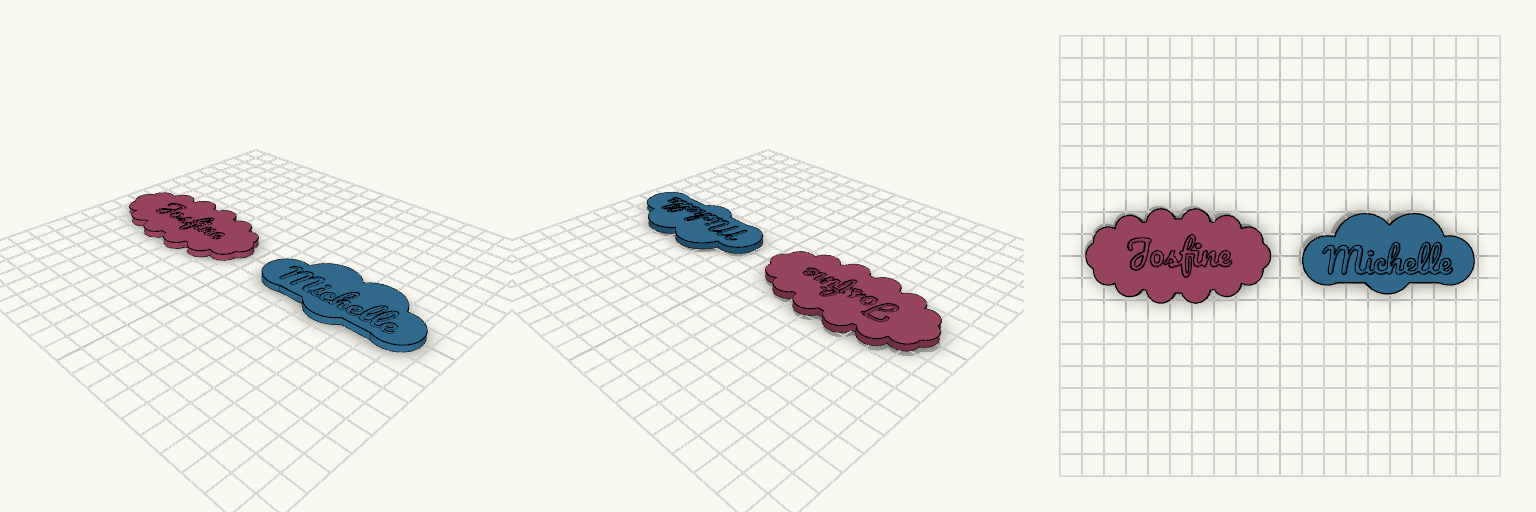
Twee naamkaartjes voor aan een deur: Josfine op een bloemvorm en Michelle op een wolkvorm. De namen zijn in het kaartje verzonken, dus het oppervlak blijft vlak. Josfine: bloemvorm, roze Michelle: wolkvorm, blauw Dikte: 3 mm, naam ca. 1,4 mm diep ingegraven Geen ophanggat: ophangen met lintje, plakstrip of haakje Beide kaartjes printen plat zonder support.
Pop — Bottle Opener Money Clip
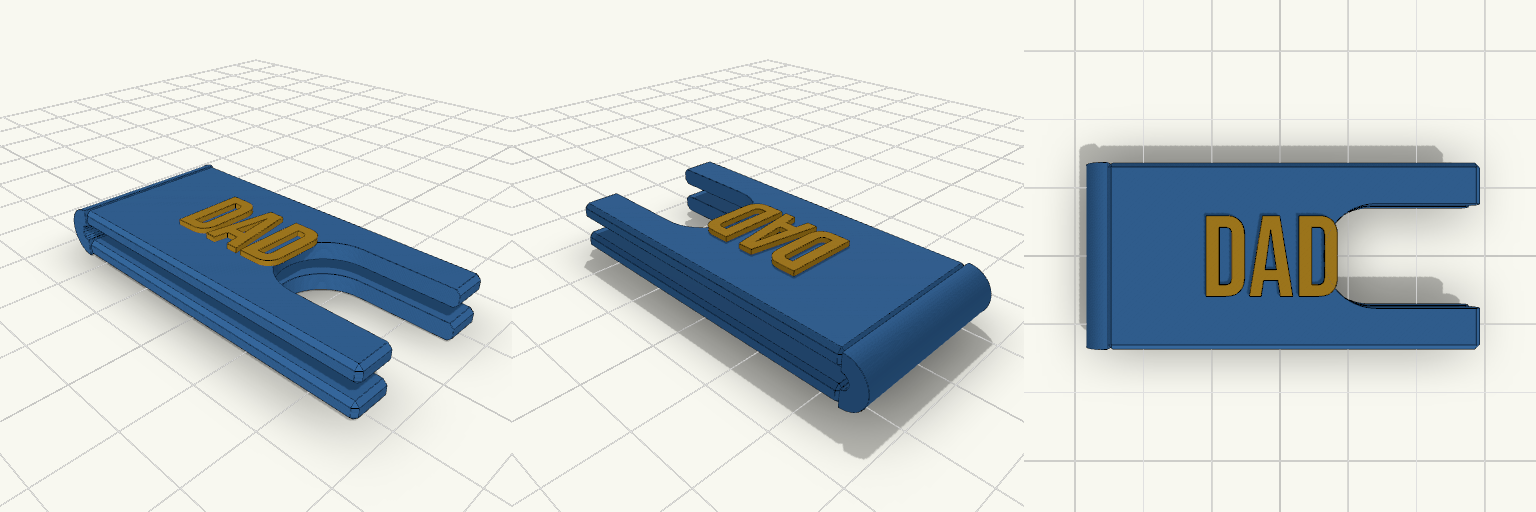
Pop is a U-shaped money clip with a bottle opener slot cut into one short edge, sized as a birthday present for Dad. Two flat leaves are joined by a rounded spring bend, and a raised DAD in Bebas Neue sits on the top face. The result is a single-piece print that holds a folded stack of banknotes and opens a bottle. Dimensions Overall footprint: 50 x 25 mm Leaf thickness: 2.5 mm each Gap between leaves: 2.4 mm, sized for a folded stack of about 8 banknotes Overall height: about 7.4 mm, plus 0.8 mm of raised lettering Chamfered outer edges for a softer feel in the pocket Features Bottle opener slot: a rounded notch open to the short edge, cut through both leaves Spring bend: a rounded fold at the closed end that lets the leaves flex Embossed DAD: raised 0.8 mm on the flat top face Two named regions: the clip body and the DAD lettering, so they can be colored separately Print notes PETG is a good choice for the flex and the stress at the opener slot. Orient the part so the layer lines run around the bend, not across it. The clip prints flat on its bottom face with no supports needed for the main body. Two-color printing works for the lettering, since it is a separate raised region.
4 mm Hanging Hole Snowflake Christmas Ornament
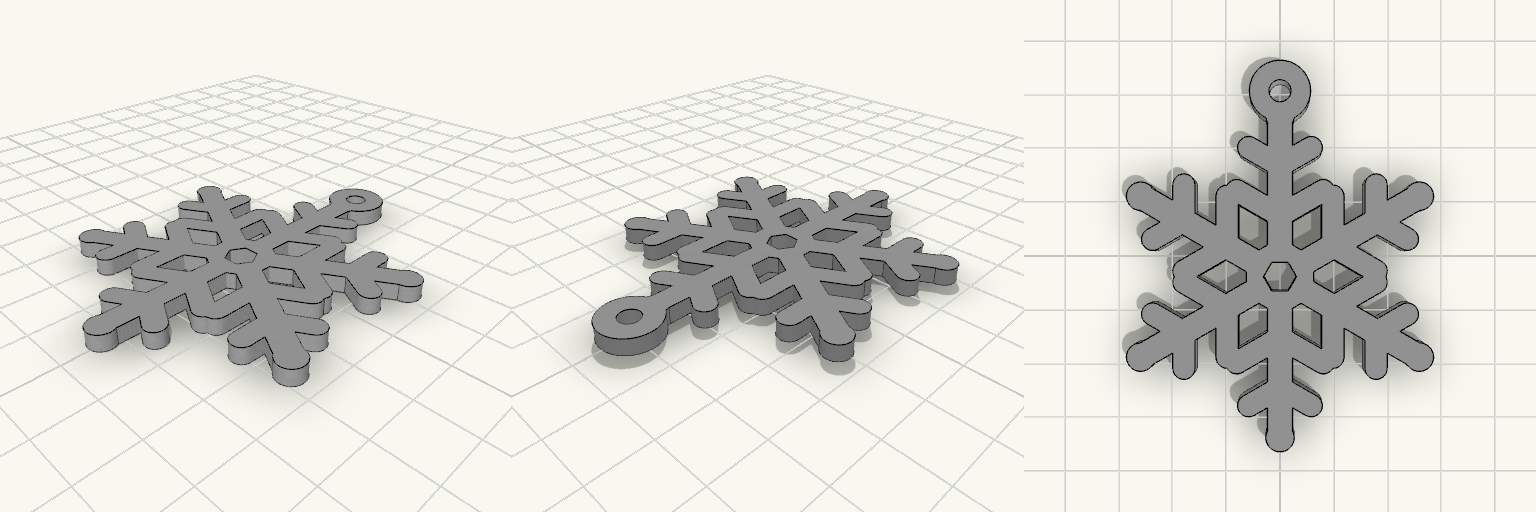
A flat, six-armed snowflake ornament with a 4 mm string hole through a round eyelet that sits on the tip of the top arm. It prints as one solid piece, 3 mm thick, flat on the bed with nothing to support. Fits String, twine or thin ribbon up to roughly 4 mm through the eyelet; a knot or bead wider than the hole keeps it from pulling through. A tree branch, hook or nail with about 71 mm of clear height, so the eyelet and the point below it hang free. Does not fit / not included No hook, clip, stand or separate hanger — the eyelet is part of the print itself. No text, logo or engraved date; nothing is lettered on it. Not a multi-part kit; there is nothing to assemble. Check before printing Overall footprint is 55.3 mm wide across the flat sides and 70.5 mm tall including the eyelet, at 3 mm thick. Confirm the hanging spot leaves that much room and that your cord end passes the 4 mm hole — a hole that prints slightly tight may need a quick ream with a 4 mm drill bit. What is on the part Six broad arms, 4.5 mm wide with rounded ends, joined by side branches 4 mm wide — thick enough to handle and pack away each year. A 14 mm hexagon at the centre with a 6 mm hole through it, which trims filament without thinning the arms. An 11 mm rounded eyelet overlapping the full width of the top arm, so it reads as an extension of the arm rather than something stuck on. Every arm and branch is solid and properly joined, so the whole ornament stays low on filament while holding up to a season of hanging.
Yuletide Vault — 24-Drawer Advent Calendar
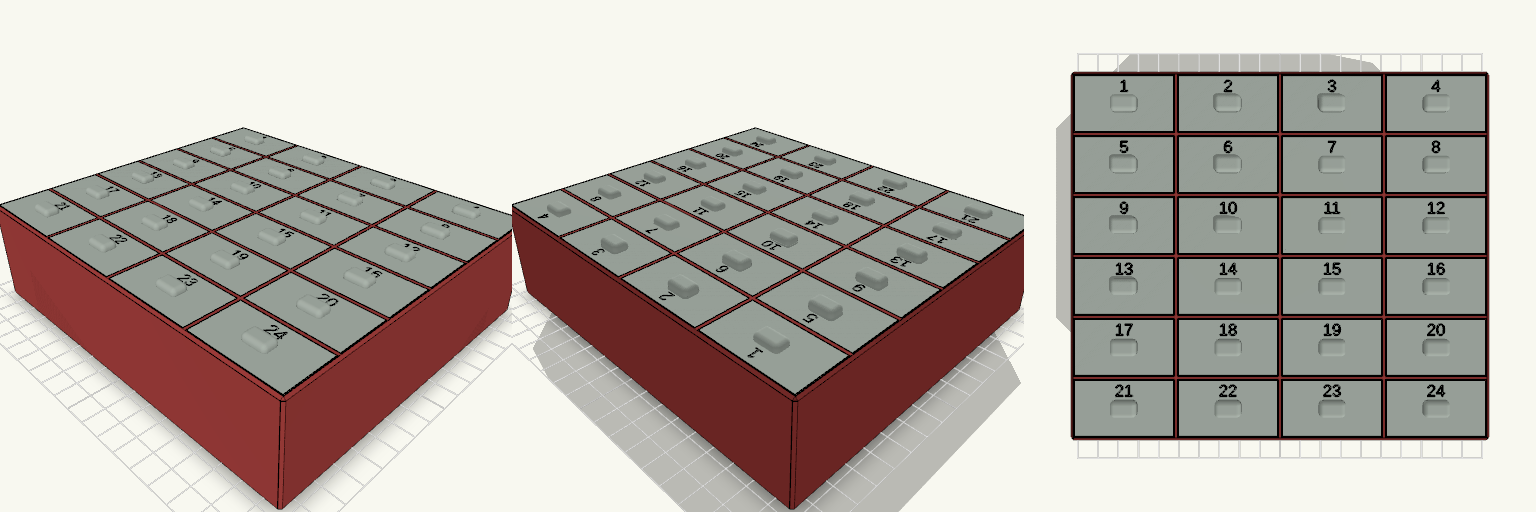
A print-in-place advent calendar with 24 identical sliding drawers in a 4 × 6 grid. Every drawer front carries an engraved number from 1 to 24 and a soft-edged finger handle, so the countdown opens one small compartment at a time. The drawer bodies, fronts and matching frame openings keep clean square corners; only the handles are rounded, giving a comfortable grip without softening the rest of the geometry. Each cavity is sized around a 35 mm × 20 mm candle, making the drawers practical for a daily treat or a small gift. The whole assembly fits the Bambu Lab A1 Mini build plate and prints without supports in the sliding channels. Features 24 identical drawers arranged in 4 columns and 6 rows, numbered 1–24. Square drawer bodies, fronts and frame openings; only the handles are softened, with an edge radius of about 1.5–2 mm. Each drawer has an 11 × 7 mm handle that protrudes 3 mm, centred on the front. Engraved numbers sit 0.6 mm deep in the strip above each handle, clear of the grip area. 0.4 mm clearance on every side and at the back keeps the drawers sliding freely. A stop ridge inside each pocket catches the drawer's back wall after about 40 mm of travel, so drawers cannot fall out accidentally. Drawer cavity: 38.5 × 42 × 22 mm, sized to hold a 35 × 20 mm candle. Dimensions Overall footprint: 175.2 × 154.2 × 49.6 mm including handles — fits the A1 Mini's 180 mm plate. Drawer outside: 41.5 × 45 × 23.5 mm; wall and floor thickness: 1.5 mm. Frame divider walls: 1.2 mm. Print notes The calendar prints as one piece with the drawers already seated in the frame. The back face lies flat on the plate and the fronts and handles face up, which avoids supports in the channels. Print in white PLA for the intended look.
Pieza 3 de noviembre act
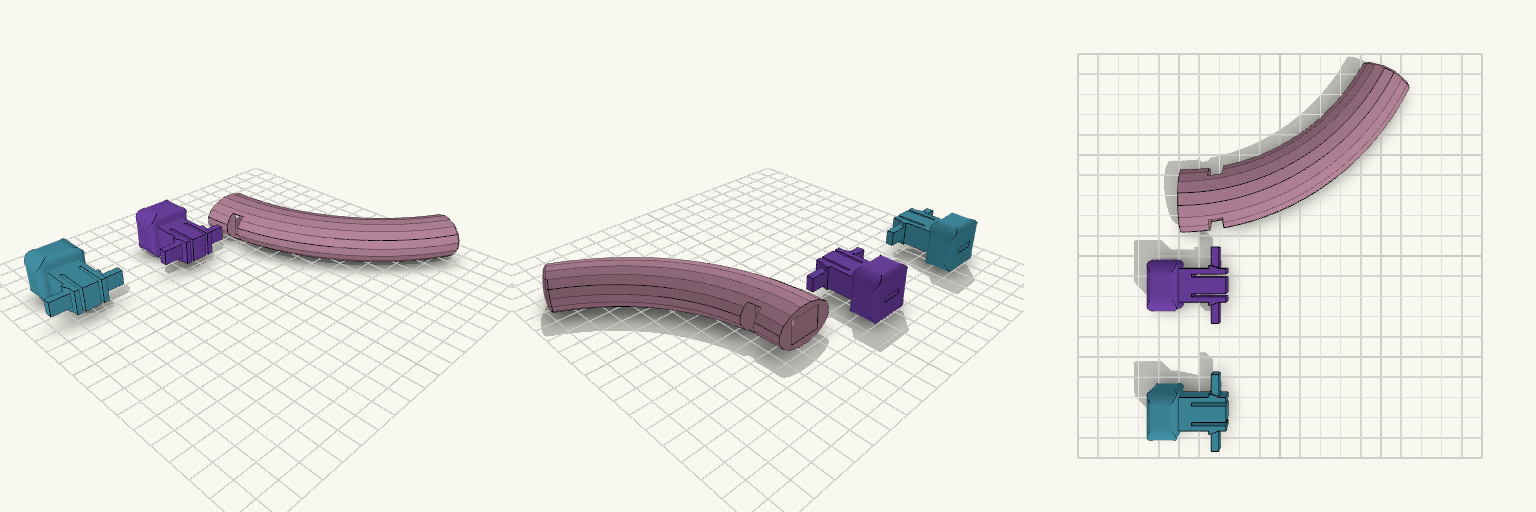
Mango banana de cucharilla adaptada con conector de clic de dos aletas. Sustituye al mango original de la cucharilla: la pieza de la cuchara se aloja en la ranura frontal del conector y el conector se encaja en el alojamiento del mango rosa. La unión es por clic; no usa rosca, bayoneta ni pasador. El conjunto está pensado para una niña con discapacidad que no puede mover la muñeca: el mango se curva hacia dentro, con radio de 110 mm y la punta desplazada unos 65 mm, para acomodar la mano sin girar la muñeca. El modelo incluye el mango rosa y dos conectores idénticos, morado y azul. El mango y los conectores se imprimen por separado y se unen por clic. Los dos conectores van separados 60 mm en el eje Y, con unos 24 mm libres entre sus tapas, para poder imprimirlos juntos sin que se toquen. La tapa visible del conector es redondeada, con esquinas de 7 mm y bordes de 3 mm; el cuerpo y el encaje siguen siendo cuadrados. Qué encaja Cuerpo del conector de 15,6 mm de ancho, 11,6 mm de grosor y 22 mm de largo, con tapa de 24 × 24 mm. Dos aletas de 2,4 mm, separadas del núcleo por ranuras de 1,6 mm; cada una lleva un resalte de 1,5 mm con rampa de entrada. Botones de pellizco de 3,5 mm de ancho: llegan a 18 mm del centro y sobresalen unos 3,3 mm por fuera de la pared del mango, que queda a unos 14,7 mm. Se pellizcan los dos a la vez sin meter los dedos en las ventanas, los resaltes se sueltan y el conector sale tirando recto. Ranura para la pieza de la cuchara: 10 mm de profundidad, 10 mm de largo y 3 mm de alto, centrada en la tapa. Medida a comprobar antes de imprimir La lengüeta de la cuchara debe quedar unos 0,2 mm por lado por debajo de la ranura de 10 × 3 mm; en la práctica, alrededor de 9,6 × 2,6 mm, con 1 cm de inserción. El alojamiento y las ventanas del mango están dimensionados solo para estos conectores. El saliente de los botones es una medida del modelo, no una prueba de agarre: si el pellizco queda justo, imprime primero un conector y compruébalo antes que el mango. Impresión y límites Imprime los conectores tumbados de lado, con las capas a lo largo de las aletas; el mango, tumbado con el alojamiento horizontal. PETG es preferible: en PLA las aletas aguantan pocas repeticiones. Con 3 perímetros en los conectores el clic cede algo más; con 4 o más queda más firme. Los dos conectores caben juntos en la cama con la separación actual; si la cama es pequeña, imprímelos por separado. No sirve para otros mangos ni para alojamientos distintos de este mango rosa. El TPU es demasiado elástico para dar un clic firme. La versión actual no se ha probado imprimiendo: la dureza del clic y el agarre de los botones se confirman con una impresión real.