Elderstab 2.0
Made by HingeGuppy
Created 7 days ago
Description
Wofür es gedacht ist
Ein zweiteiliger Elderstab, dessen Trennstelle an einem Knubbel des Griffs liegt und den Übergang möglichst unauffällig hält. Im Griff sitzt hinter dem Ringmagneten ein kleines Geheimfach für einen gerollten Zettel; die Spitze wird über einen Flatmagneten gehalten.
Maße
- Gesamtlänge zusammengesetzt: ca. 270 mm
- Griff: ca. 120 mm, mit zusätzlichem Knubbel unten; Ringmagnet-Aufnahme 10,4 mm Durchmesser und 4,4 mm tief, die Griff-Oberfläche schließt darüber flach ab
- Geheimfach im Griff: 6,5 mm Durchmesser, 35 mm tief
- Spitze: ca. 150 mm, mit Aufnahme für einen 10-mm-Flatmagnet (2 mm dick) und zusätzlichem Spiel für Filz
- Massiv: Der Stab ist durchgehend massiv; hohl sind nur die Magnetaufnahme und das Geheimfach
Montage
Der Stab wird in zwei Teilen gedruckt. Einen 10 x 3 mm Ringmagneten in den Griff und einen 10 x 2 mm Flatmagnet in die Spitze einkleben. Zwischen die Magnete kommt ein dünner Filzstreifen für einen weicheren Halt. Das Geheimfach hinter dem Ringmagneten nimmt einen eng gerollten Zettel auf.
Remix-Ideen
- Die Spitze kürzen, wenn eine kürzere Gesamtlänge gewünscht ist.
- Die Filzstärke an das gewünschte Magnetspiel anpassen.
- Die Knubbelform des Griffs variieren, solange die Trennstelle verdeckt bleibt.
Images
More like this
Explore more in Gifts, Seasonal & Personalized →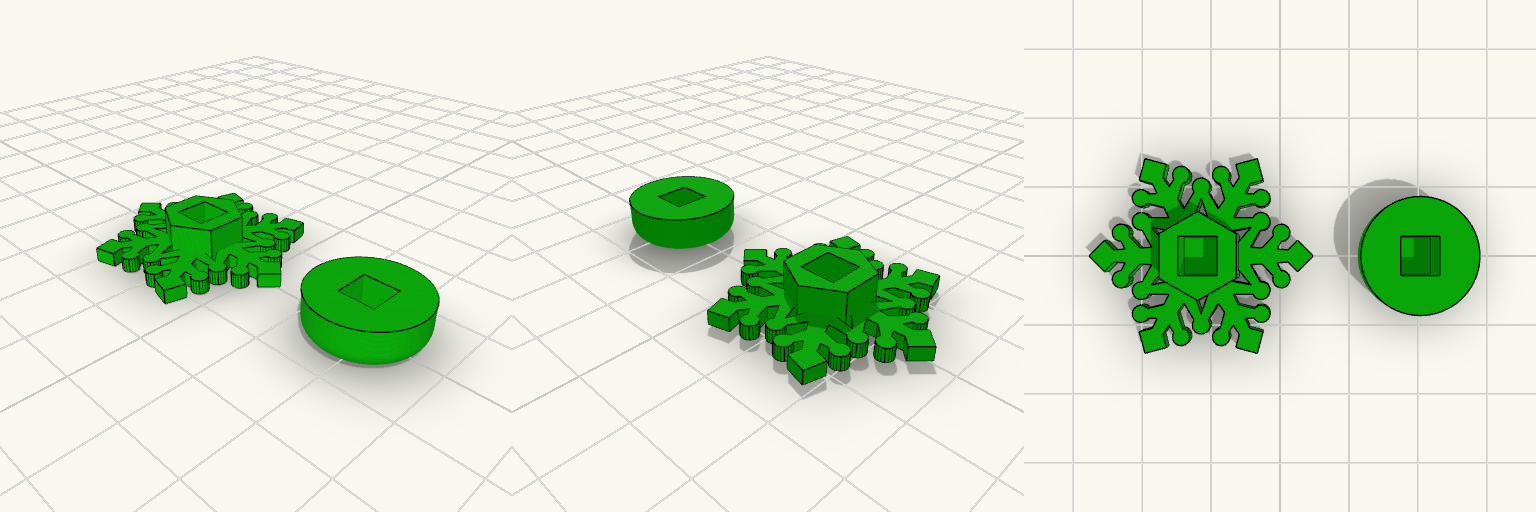
Magnetic Snowflake Shirt Pin Set
What it's for A snowflake pin that holds to a shirt with magnets instead of a safety pin. The snowflake sits on the outside of the fabric. A small backing disc sits inside the shirt. A 5 mm magnetic cube goes in each piece, and the fabric is clamped between them. Dimensions Snowflake: about 31 mm across, 6.3 mm thick at the centre Backing disc: 14 mm diameter, 6.3 mm tall Magnet pockets: 5.3 mm square, open on one side, with a 1 mm floor Remix ideas Make the pockets shallower for thinner magnets Add a ring or chamfer to the backing disc Use a different pattern on the front
Rolled US Bill Holder Shaped Like Gas Can
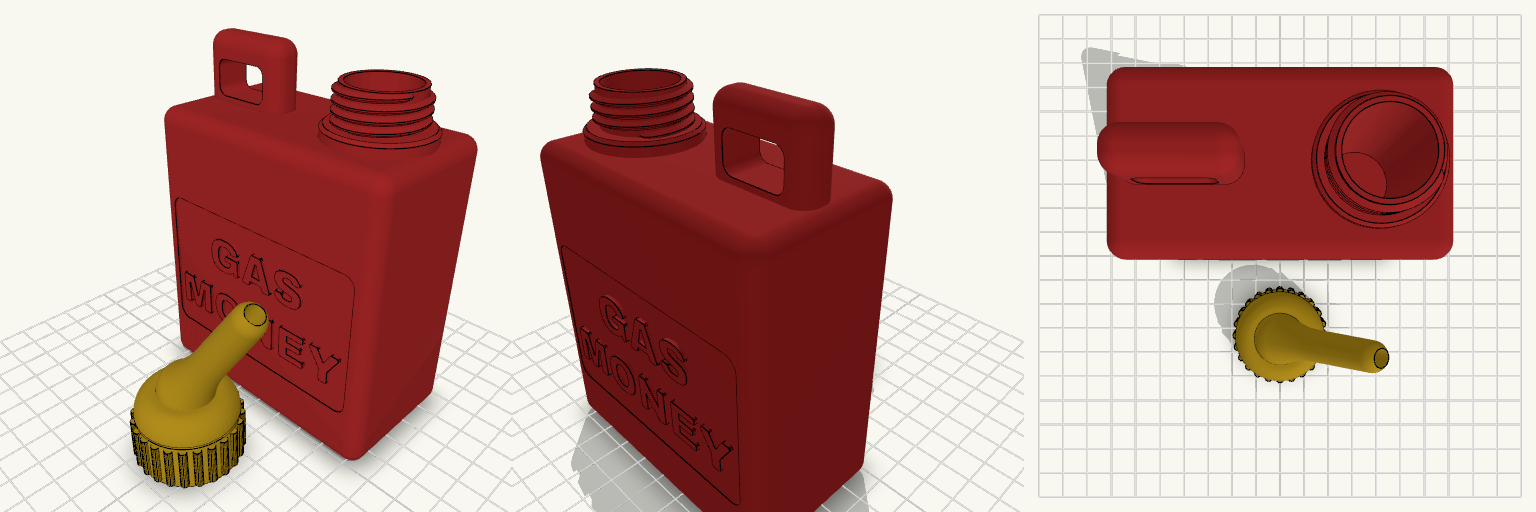
A two-piece holder for a rolled US bill, built as a gas can. The Can Body carries a male-threaded neck and the Nozzle carries the matching female threads; the neck is the load point, not the spout. Unscrew the nozzle, drop the roll into the cash tube, screw it back on. What it fits A rolled US bill of about 66 mm drops into a 22 mm cash tube that runs down from the neck inside a 26 mm round column, so the roll cannot fall into the body and get lost. The tube bottoms out 68 mm below the top of the male threads, so a 66 mm roll tops out about 2 mm below the thread top and never reaches the thread zone or the nozzle's recess. The body behind the column stays hollow, so it costs little filament, and the cavity roof is a 45° gable rather than a flat ceiling. Front and back each carry a shallow recessed panel with GAS over MONEY raised out of it at 13 mm, corners softened so the lettering looks moulded rather than cut. The handle's outer corners are rounded to match. The Nozzle is closed — no through-hole. Its threaded base is 18 mm tall with 24 vertical ribs around it for grip when unscrewing. The base top is one continuous domed curve, flat across the top, rising from the 34 mm base. The spout root flares to about 19 mm and tapers over roughly the first 22 mm into a 50 mm spout that finishes at 10 mm at the tip; a 6 mm blind bore at the tip makes it read as an open spout. What it replaces The screw-on nozzle takes the place of a fuel can's spout; the neck is the fill point here, not a pour opening. Check before printing Thread fit is the one thing to verify. The nozzle's threaded recess is 12 mm deep and the neck's exposed thread is 13 mm, so there is no slack: if it binds before it seats, shave a millimetre off the neck or deepen the recess slightly. Print the nozzle on its own first and test it on the neck before committing to the body; thread clearance varies with printer and material. Below the 68 mm tube depth, the next measurement to check is the 22 mm bore against your bill roll — a tight roll that measures over that will not drop in. Both the gabled roof and the 45° cone under the cash tube are shaped to print without supports, and the domed nozzle top and flared spout root now meet in a single flowing transition with no ledge. On the plate: Can Body 90 × 50.4 × 122 mm and Nozzle 51.7 × 36.6 × 71.1 mm, two separate pieces. What it does not fit Flat or folded notes, coins, or more than one rolled bill. Rolls longer than about 70 mm from the thread top, or fatter than the 22 mm tube bore. It holds no liquid and is not a fuel container.
Cast Scratcher Wand, 300mm
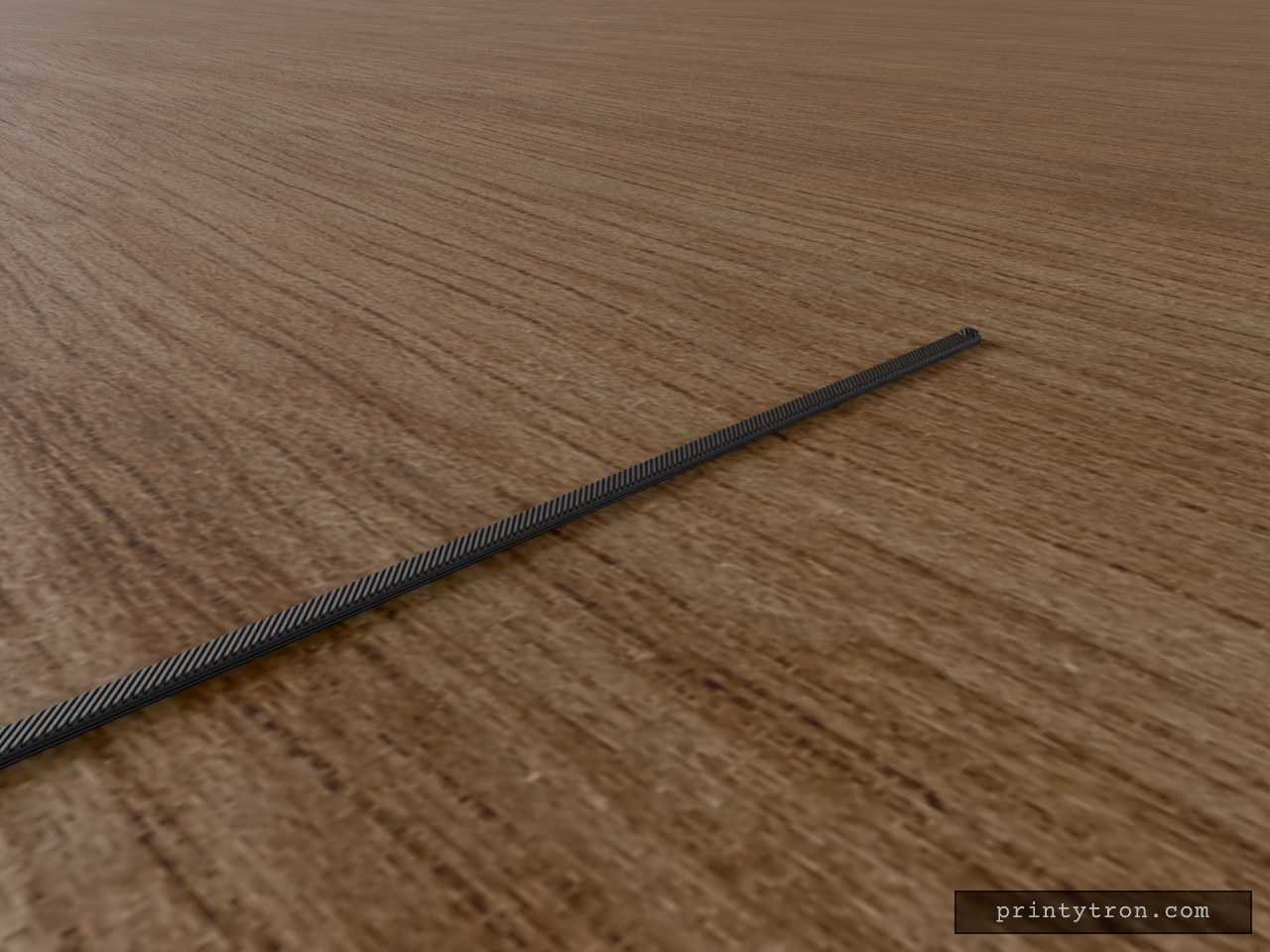
A long, thin scratcher wand for reaching down inside a cast. It measures 300 mm long, 8 mm wide and 3 mm thick. Every edge is rounded at 1.4 mm so it slides in smoothly and soothes without catching or scraping skin. One end has a low dome bump, and the other end has a hang hole so the wand can live on a sofa arm, a hook or a loop of cord. It prints flat on the plate with no supports. The dome peaks at about 4.5 mm. Remix hooks Length (L, 300 mm): Shorten it for a forearm cast. Lengthen it for a full-leg cast. Stiffness drops as it gets longer, so consider more thickness if you go past 300 mm. Thickness (T, 3 mm): Thicker is stiffer but needs a wider gap in the cast. Thinner flexes more and can snap in some filaments. Width (W, 8 mm): 8 mm fits most cast gaps. Go narrower for tight padding. Tip bump: The dome is a flattened sphere (80% height) about 7.6 mm across. Make it taller for a firmer scratch, or remove it for a smooth rounded tip. Add a textured pad or ridges if you want something more aggressive. Hang hole (4.5 mm): Fits a small hook, a split ring or thin cord. Enlarge it for a lanyard or carabiner. Move it inward if you want a stronger handle end. Edge rounding (1.4 mm): This is close to the maximum for a 3 mm thickness. Reduce it for a crisper profile. Pairs with A sofa-arm hook or a loop of paracord through the hole. PETG or nylon for flex and durability. PLA works but is more brittle at this thickness. A second copy with a different tip as a spare. Colour regions The shaft and handle are one colour, and the bumped tip is another. This is a single printed piece, not an assembly.
Snowflake Shirt Pin with Safety Pin Loops
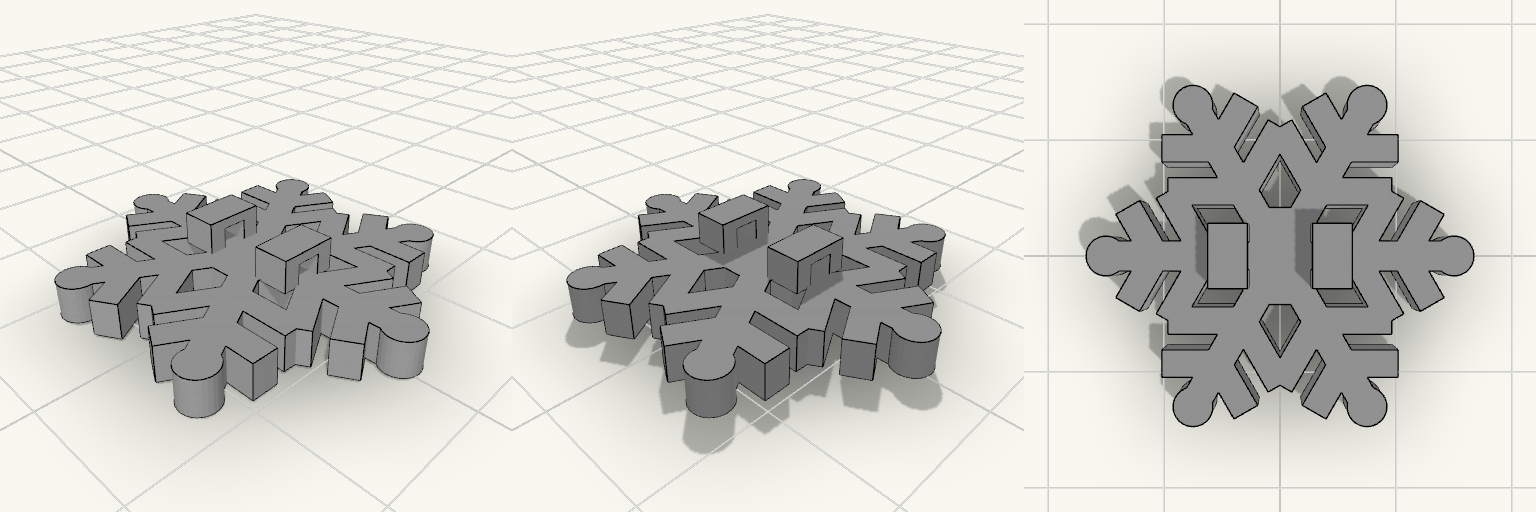
A small snowflake pin with six branched arms, made to be worn on a shirt. Two loops on the back take a standard safety pin, so the snowflake sits on the fabric like a brooch. Six-arm snowflake with side branches and rounded tips Two back loops, 8 mm apart, for threading a safety pin Flat front face prints directly on the plate No supports needed Roughly 31 mm across and under 6 mm thick
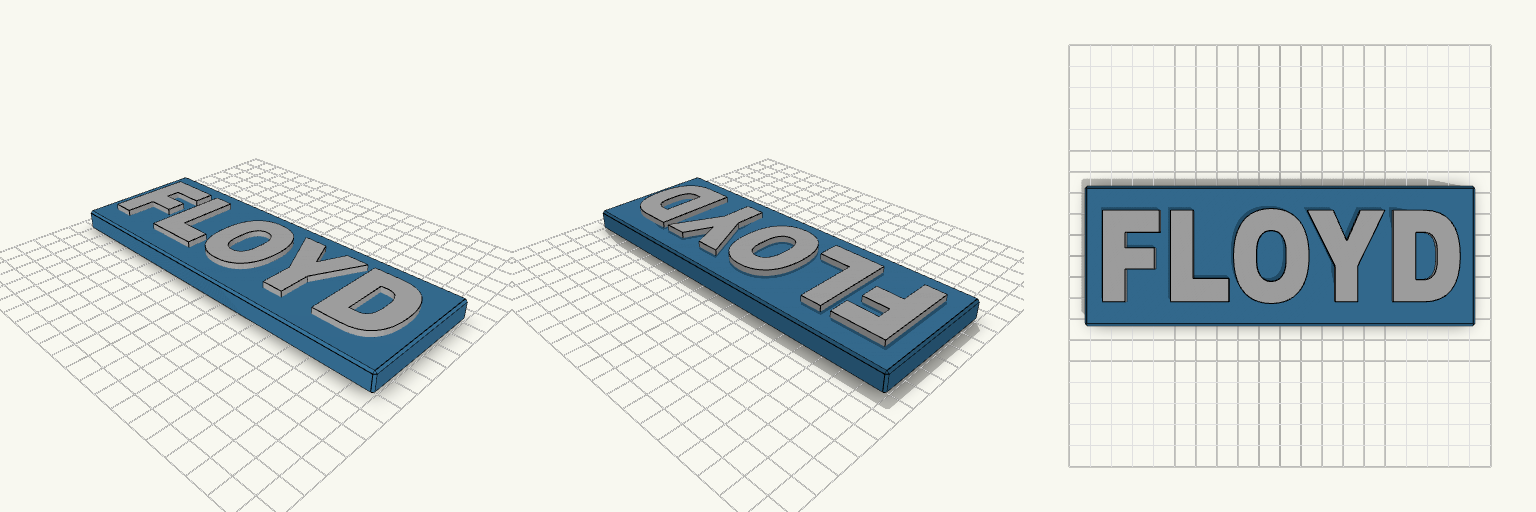
Bold Block-Letter FLOYD Name Sign
A confident single-word nameplate: a 179 × 64 mm slab, 10 mm thick, with FLOYD rising 3 mm off the face in heavy block capitals for a total height of 13 mm. The letters stretch to roughly 162 × 43 mm, running almost the full length of the top face and leaving only a slim border around them. It reads as signage first and decoration second — the kind of bold lettering that belongs over a door, on a wall, or fixed to a workshop board, and with 10 mm of depth behind it, it also stands on its own as a chunky desk or shelf piece. Sized for a Bambu Lab A1 mini, the sign uses the bed's full width in one direction only, so it prints as one piece with no scaling needed. That width fit is tight: only about 0.5 mm of margin remains on the long side, so a skirt, brim, or calibration offset could push it past the bed edge — a slightly smaller scale is safer if the slicer complains. The 10 mm body uses noticeably more filament than a thin plate, so keep that in mind if material use or weight matters. Design notes Raised lettering sits proud of the plate, catching light and shadow and allowing a contrasting colour with a filament swap at the right layer. The top face, the lettering and the sides are all square-edged; the plate has a flat back and prints from a single flat base without supports. Wide, thick strokes keep the text legible from across a room and sturdy enough to handle. The lettering is proportioned to the plate, so shrinking it uniformly in the slicer keeps the composition intact. Pairs well with a wall bracket, a small stand, or adhesive pads on the back — or just set it down as it is. A plain blue plate with white letters is only one finish — a dark plate with bright lettering, a painted recess, or a single-colour print all work with the same geometry.
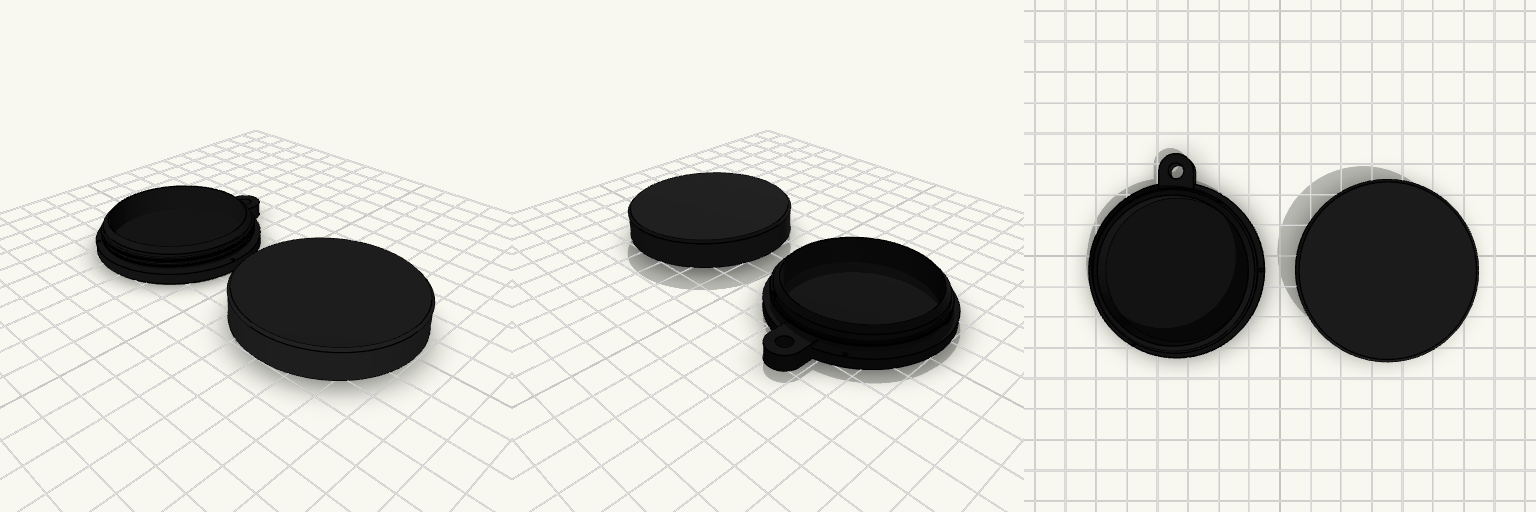
Screw-Top Turbah Case 45 mm
A plain round two-piece case for a 45 × 10 mm turbah. The container has an external coarse thread and the lid has the matching internal thread. Rounded thread edges and a light detent keep the lid from backing off by accident. The lid top is flat and smooth, ready for raised lettering. Starting dimensions Outer diameter: 56 mm Cavity: 46.5 mm diameter, 11.5 mm deep Thread: 2 mm pitch, 52 mm nominal, 0.3 mm radial clearance Lid height: 12 mm Keychain loop: 5 mm hole Remix hooks Clearance: 0.3 mm radial is the starting value. Try 0.4 mm if the lid binds, or 0.2 mm if it spins loose. Detent strength: There are 3 bumps of 0.8 mm radius on the container shoulder and 12 dimples of 0.9 mm radius in the lid. Smaller bumps give a softer click and larger bumps a firmer one. Thread depth: The tooth profile is a single list of points. Flatten it for a stronger, blunter thread, or sharpen it for easier starts. Lid top: The surface is flat, so raised text or a logo can be added there. Keep any lettering about 41 mm wide or less. Outer diameter: 56 mm leaves a sturdy wall around the cavity. Going down to 54 mm would need a finer thread. Pairs with A separate raised-text plate or an imported name outline on the lid. Other keychain hardware through the 5 mm loop.