Flush-Tension Minimalist Wallet
Created 3 months ago
Description
This is a minimalist, print-in-place everyday carry wallet built to hold 5 cards and 10 USD bills without the need for elastic bands or extra hardware.
What it's for
The wallet features two dedicated compartments separated by a solid central divider. The front slot is sized for up to five standard credit cards, while the slightly wider back slot comfortably holds up to ten USD bills folded in half. Integrated leaf-spring clips are built into the outer walls of both slots, applying constant inward tension to securely grip anywhere from a single bill or card all the way up to full capacity.
Features
- Dual Compartments: Dedicated sizing for both standard cards and folded bills.
- Integrated Spring Clips: Outer walls act as flush-fitting leaf springs to maintain friction.
- Thumb Track: A recessed bottom channel allows you to smoothly push your cards and cash up for easy access.
- Scalloped Top: Deep finger grooves at the top make drawing individual cards simple.
Print notes
Designed to be printed entirely upright and in place. No supports or assembly are required. For the best spring tension and longevity on the clips, a material like PETG or ABS is highly recommended.
Images
More like this
Explore more in Keychains & EDC →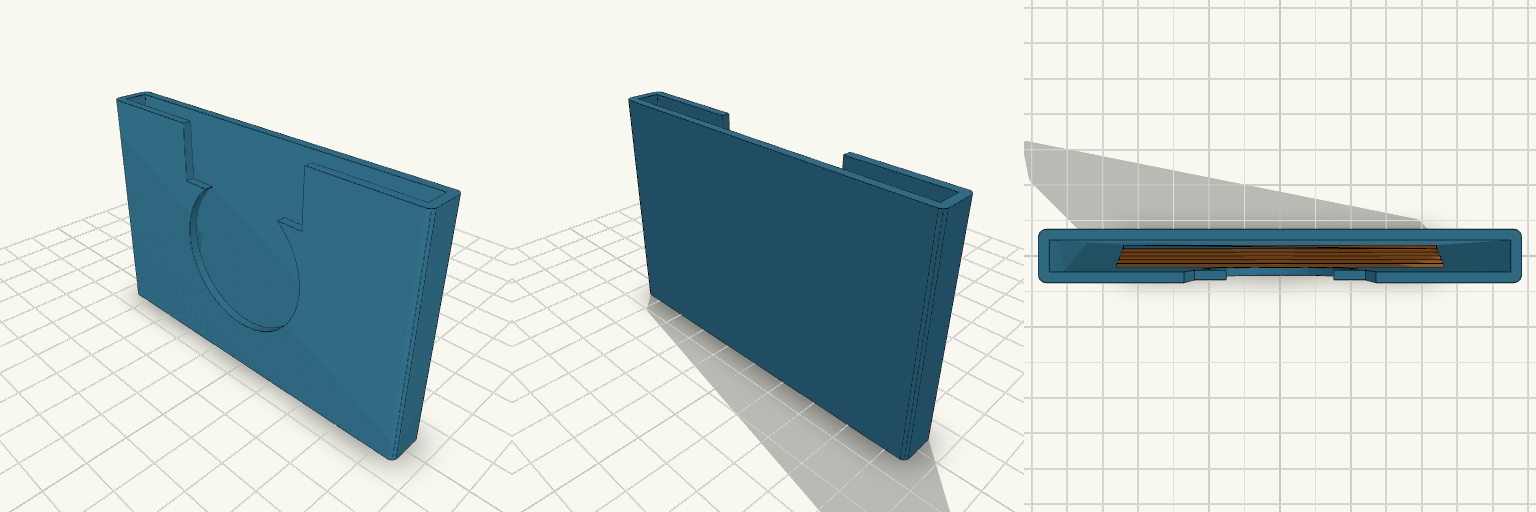
Staircase Slim Card Wallet
A card wallet with the silhouette of a tiny amphitheatre: six standard cards sit in a tall open pocket, and the floor climbs toward the front in 1.5 mm steps so the front card rides highest. A rounded thumb cutout in the front wall lets you push the stack up and out, and the front card pops clear of the rest for a quick grab. The pocket is sized for standard credit cards (85.6 x 54 x 0.76 mm) with a little breathing room, in a slim 90.5 x 10 x 58 mm body. The stepped floor is a separate colour region in the preview so the staircase is easy to read. Design notes Pocket: 86.5 x 55 x 6 mm, open at the top Floor: six steps, each 1.5 mm higher than the one behind, so the front card sits about 7.5 mm above the back one Thumb cutout: round-bottomed notch through the front wall, 36 mm wide Vertical corners rounded at 1.5 mm for a comfortable pocket feel Prints upright or flat; no supports are needed for the main body Remix hooks Taller or shorter steps for a different stagger A narrower thumb notch for a stiffer front wall Fewer steps and a thinner pocket for a 3 or 4 card version
Pocket Snaplink Print-in-Place Carabiner
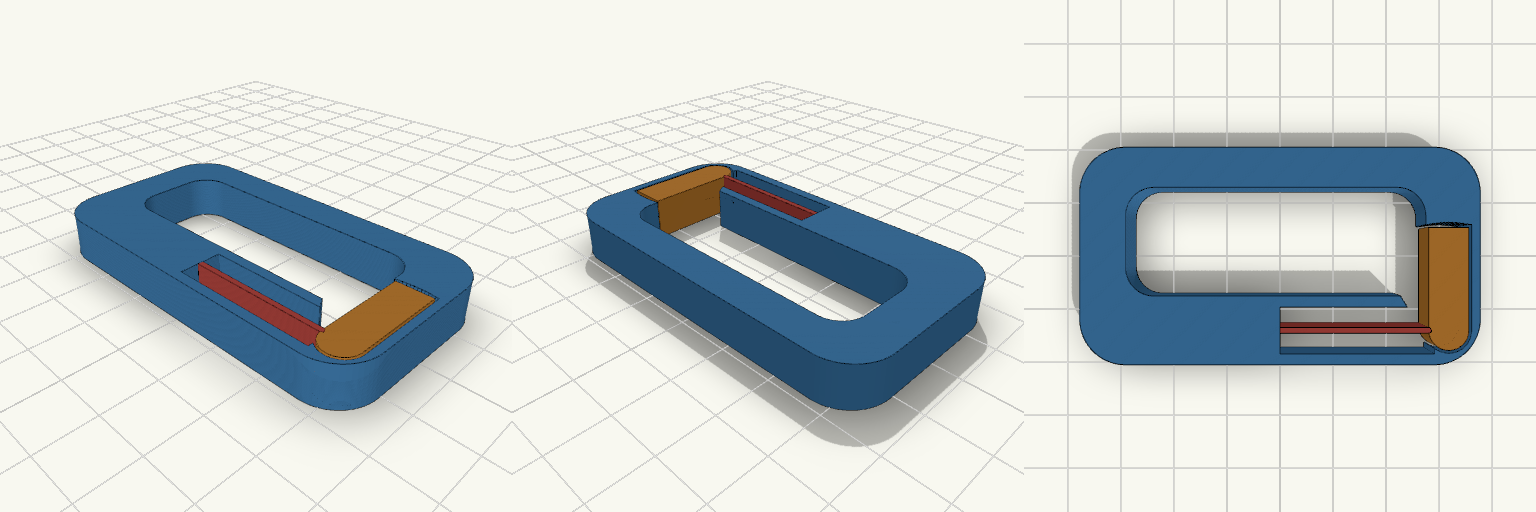
A compact, D-shaped snaplink in the spirit of the little accessory carabiners that hang off backpack straps and key rings. The 70 mm body carries a pivoting gate and a thin flexure spring that nudges it shut, all printed together in one go. Pop the gate open with a thumb, slip a key ring or bottle loop in, and let it snap back. Not rated for climbing or load-bearing safety use. Keep it to keys, bottles and bag clips. Design notes Size: 70 mm long, 38 mm tall, 8 mm thick. Gate: hinged at the right end, swings inward about 32° for a roughly 12 mm opening. Spring: a 1 mm living-hinge arm along the bottom wall returns the gate to closed. Print-in-place: 0.5 mm clearance gaps around the gate and spring, so no assembly is needed. Material: PETG is recommended for the flexing spring arm. Work the gate a few times after printing to free it. Tuning: if the gate sticks or rattles, adjust the clearance for your printer. The spring thickness sets how stiff the gate feels.
Pocket Lighter With Spark Wheel
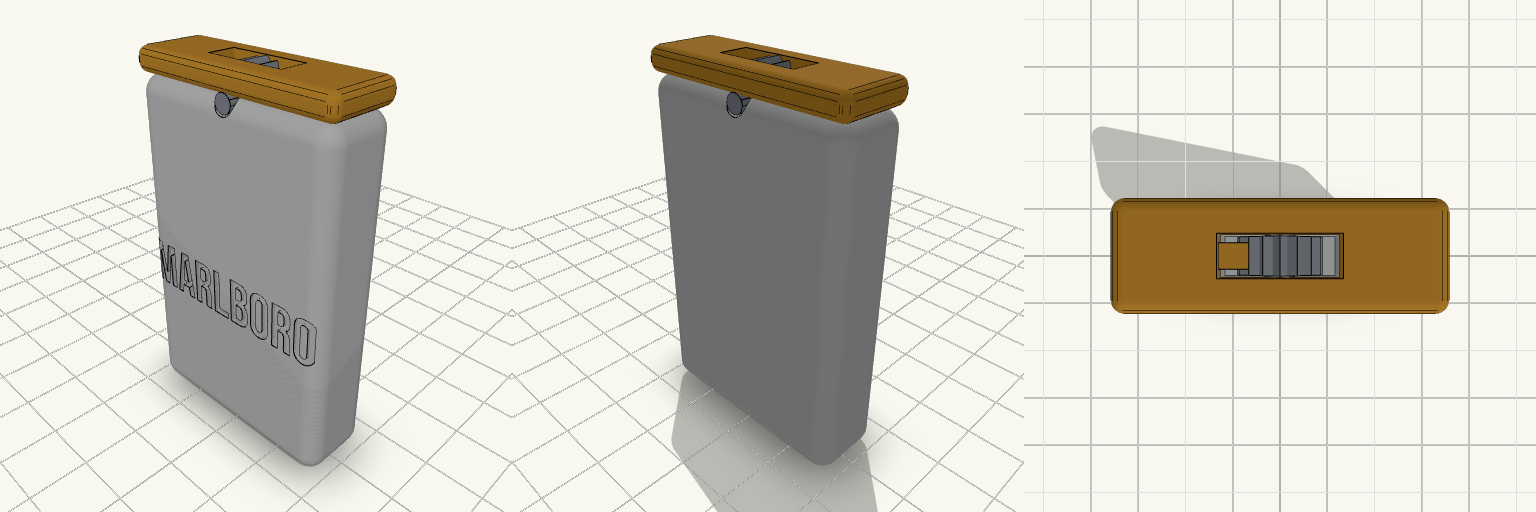
A pocket lighter body with a hinged lid and a spark wheel that clicks as it turns. The wheel carries ratchet teeth and rides on a 3 mm axle spanning both side walls, and a thin flexible pawl in the lid presses against those teeth, so flicking the wheel snaps it tooth to tooth for a mechanical click. The body, the lid and the wheel sit side by side on the plate as separate pieces, so the wheel can be printed in a contrasting colour and dropped in afterwards. The front face is engraved 0.6 mm deep with "MARLBORO" in tall condensed capitals, easy to swap for your own lettering. Overall it measures 38 × 13 × 62 mm with the lid on, a footprint that matches a classic 38 × 13 mm lighter case almost exactly; the height runs about 4 mm over because of the 4 mm lid, which is the simplest thing to change if you want a flush match. Nothing here is final: the click mechanism is the one part worth test-printing before you commit, since the pawl's thickness sets both how loud the snap is and how freely the wheel spins. Remix hooks Click pawl: the thinnest feature and the first thing to tune. A thinner tab gives a softer, quieter click and less drag; a thicker one snaps harder but can bind the wheel. Trim or shim it after a test print. Spark wheel: 10 × 12.6 × 10 mm with 16 teeth. Tooth count and tooth depth carry the character of the click — more, finer teeth give a rapid tick, fewer coarse ones a single heavy snap — and a knurled or coarser profile swaps in without touching anything else. Axle: 3 mm and the one genuinely tight constraint, since it runs through both side walls. Change the wheel and the axle has to change with it. Lid: 38 × 13 × 4 mm. Its wheel opening and the pawl seat are the fitted areas; remove material from the lid face rather than from the wheel seat if a wheel runs tight. Shortening the body by 4 mm brings the closed height down to a flush match. Body: the largest free variable. Profile, height and wall thickness are all open; roughly 1.6–2 mm walls keep the shell printable upright without supports, and anything thinner shows the cavity through the side. Front engraving: the brand text, font width and depth all change independently of the shell — deeper letters catch more shadow, shallower ones survive a fast print better. Keep the text clear of the hinge line so the lid still seats. Hinge: loosen the pin or knuckle a touch for a lid that swings freely, tighten it for one that stays put. Add-ons and variants: a lanyard hole or pocket clip on the base, a textured grip band, or a small tray that holds the lighter with the lid open. If you want a real sound rather than a mechanical one, a pocket for a small buzzer replaces the pawl entirely. Colour changes at the wheel and at the lid boundary do most of the visual work, and the lid reprints on its own if you change your mind about the wheel seat.
Bharat Key — Mini Number Plate Keychain
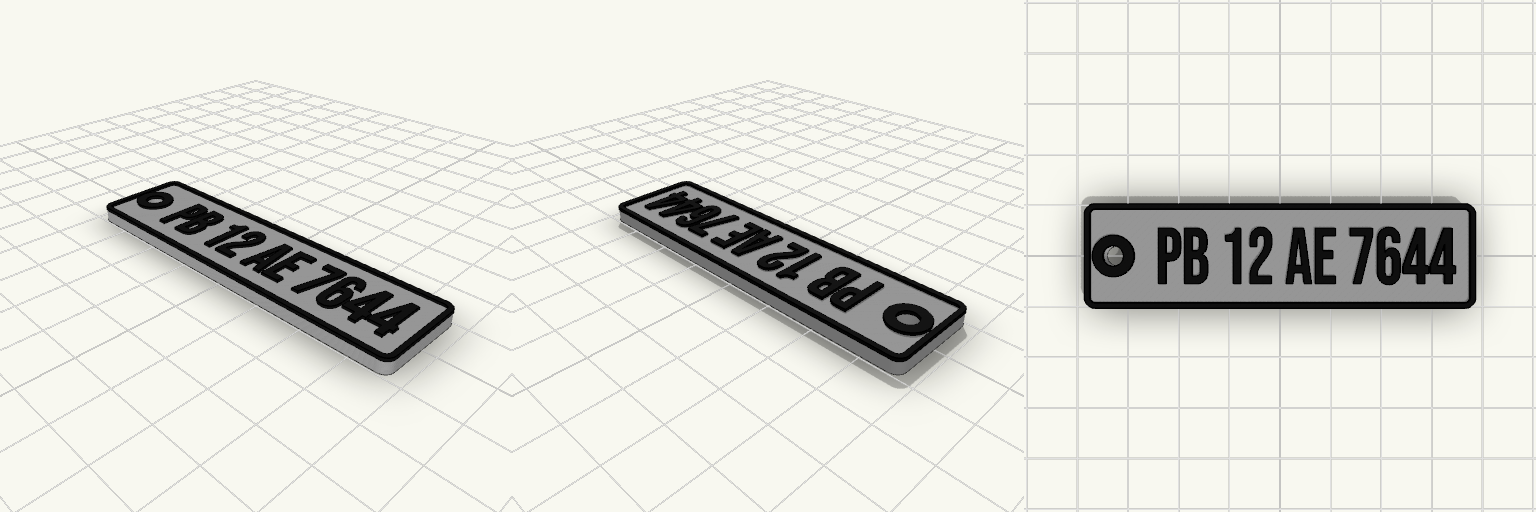
Bharat Key is a miniature Indian-style number plate keychain made to carry the exact registration PB 65 BK 3388. The long, slim plate uses a light grey/white base, a thin raised black border, and bold black lettering raised on one horizontal line. The single keyring hole sits at the extreme left with a raised ring around it for strength, while the registration stays centred in the remaining space. No blue IND strip, flag, extra colour or decoration is present, so the tag keeps a clean plate look while staying sturdy enough for a keyring. Dimensions Plate: 75 × 20 × 2.5 mm Raised border and text: 0.6 mm above the base; border 1 mm wide Lettering block: about 57 × 11 mm, fitted to the space right of the hole Keyring hole: 4 mm diameter, cut fully through at the extreme left Hole ring: raised black ring around the hole for extra strength Features Exact registration text: PB 65 BK 3388 on one horizontal line Bold black lettering raised above a light grey/white base Thin raised black border around the whole plate One circular keyring hole at the extreme left, fully through the plate Raised black ring around the hole to reinforce the keyring area Flat rectangular body with slightly rounded corners and a smooth flat backside Light grey/white base and black details only — no blue, no flag, no logos or decorations Print notes Print flat on the back; no supports are needed. The raised border and lettering sit 0.6 mm above the base and read clearly at miniature scale. Keep the 4 mm hole clear so the plate hangs cleanly on a keyring.
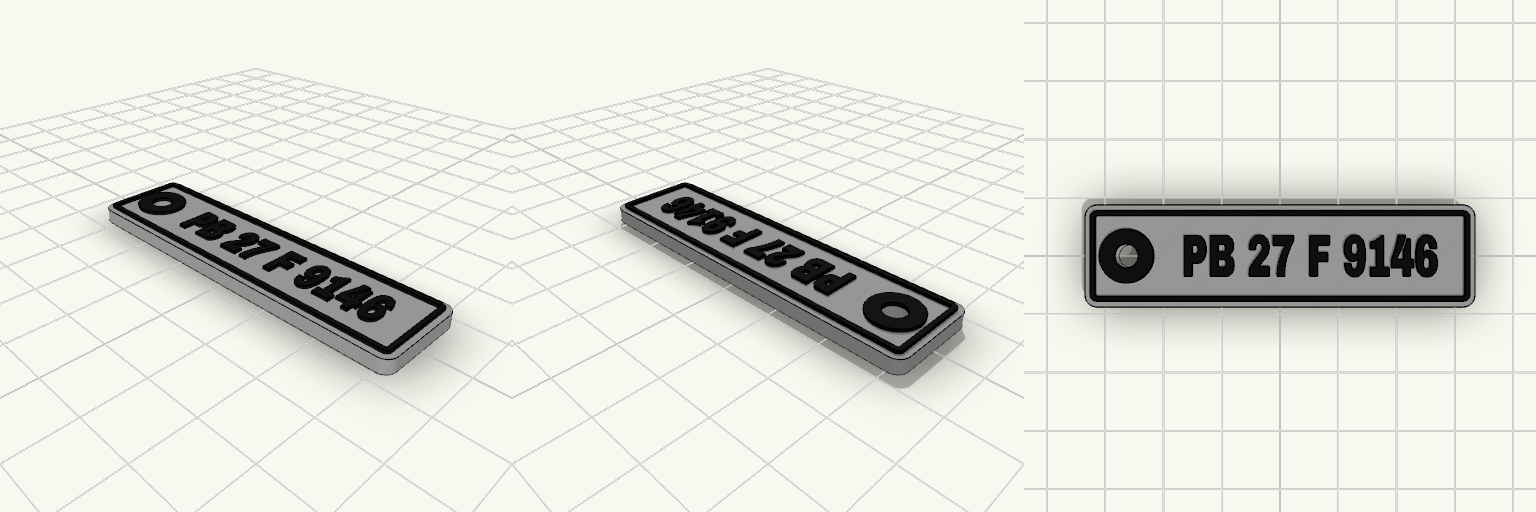
Number Plate Keychain with 4 mm Keyring Hole
A flat 65 × 17 mm number plate keychain built around the three things that ruin a printed tag: a hole that tears out, lettering that runs off the right edge of the plate, and a border crowded with extra frames. The hole sits inside a raised black ring instead of hanging on a thin web of plastic, so a heavy bunch of keys has something solid to pull against. The registration line sits on one horizontal line, raised 0.6 mm so it stays readable instead of rubbing smooth in a week, and it starts clear of the ring so nothing touches the hole. Print and fit Plate: 65 × 17 × 2.5 mm, corners rounded, smooth flat back. Keyring hole: one 4 mm through-hole at the far left, 7 mm in from the end so its ring clears the border, fully open through the base, with its own clear area so it never meets the text. Hole ring: a 9 mm black raised ring around the hole, kept neat and with no other decoration around it. Lettering: "PB 27 F 9146" on one line, raised 0.6 mm in a heavy bold face with even spacing, sized to fit the space between the ring and the right border. Border: a single thin black raised border around the whole plate, 0.6 mm high — no inner frame. Base: light grey, flat and unbroken underneath, prints without supports; the detail all sits on the raised top face, so a two-colour print or a paint fill both work. The text sits a little right of the plate's true centre because the hole takes up the left end — a truly centred line would run into the ring. If you change the registration, shorten the text rather than the plate, or the line will overrun the border on the right side.
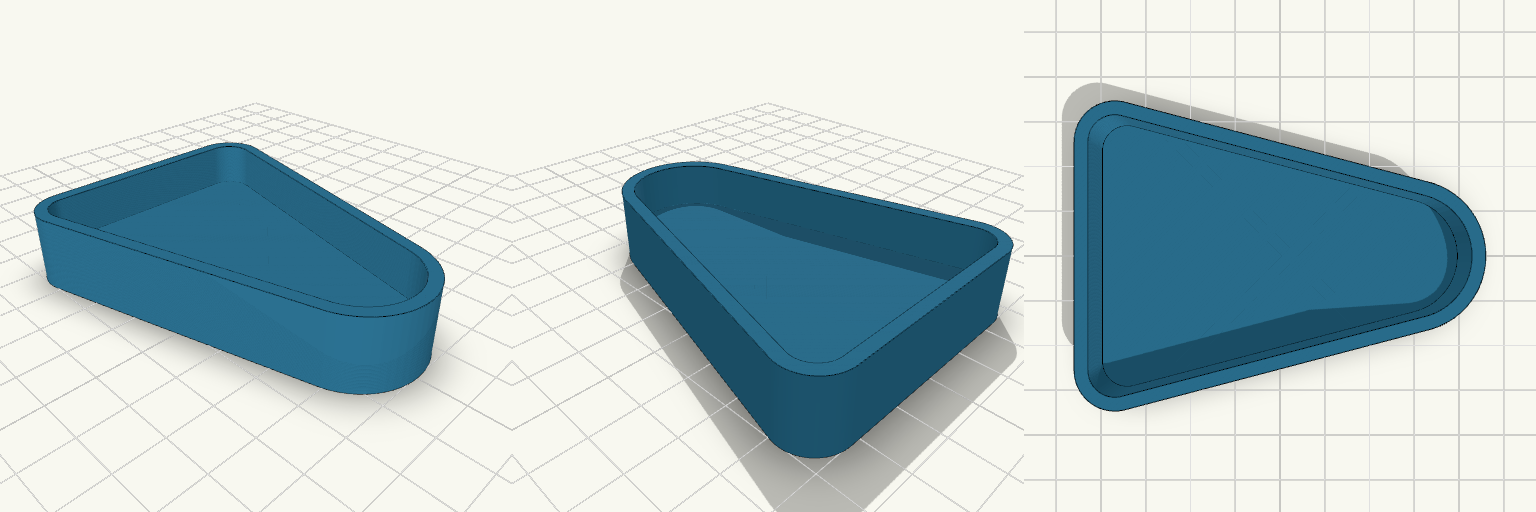
SPD-SL Cleat Covers With Wet-Tile Tread
SPD-SL cleat covers for walking in cycling shoes without clacking across café floors or skating on wet tile. Bare cleats are hard plastic on a hard surface, so they click, slide, and wear down. This cover wraps the cleat and puts a deep cross-hatched tread between the cleat and the floor. The outline is a rounded teardrop, widest at the heel end. It approximates the triangular cleat footprint and has no retention lip, so it relies on a snug fit. Print one and test it on a cleat before printing the pair. Numbers that decide fit and print Cleat footprint allowed for: about 75 mm long by 55 mm wide at the heel end Clearance around the cleat: 0.3 mm per side Side wall: 3 mm Sole thickness: 6 mm, with the cavity above it Overall height: 16 mm Overall size: about 81 mm long by 61 mm wide Tread: diagonal cross-hatch grooves at ±45°, 2.5 mm wide and 3 mm deep, on a 7 mm pitch Material: TPU gives the best grip and a flexible fit. PETG also works. Orientation: print sole-side down. The cavity opens upward, so no supports are needed.