Low-Profile Finger Rest Quadlock compatible
Made by YoItsMe
Created 3 months ago
Description
A Quad Lock compatible attachment designed to stay on the phone. It features a smooth, scooped ridge for finger support while maintaining a slim profile that won't snag in pockets.
- Ergonomic Scoop: A large sweeping cut creates a natural resting spot for a finger.
- Low Profile: Tapers down to just 2mm at the top edge to slide cleanly into pockets.
- Standard Interface: Fits standard Quad Lock cases (requires supports for the base plate overhang during printing).
Images
More like this
Explore more in Desk & Tech →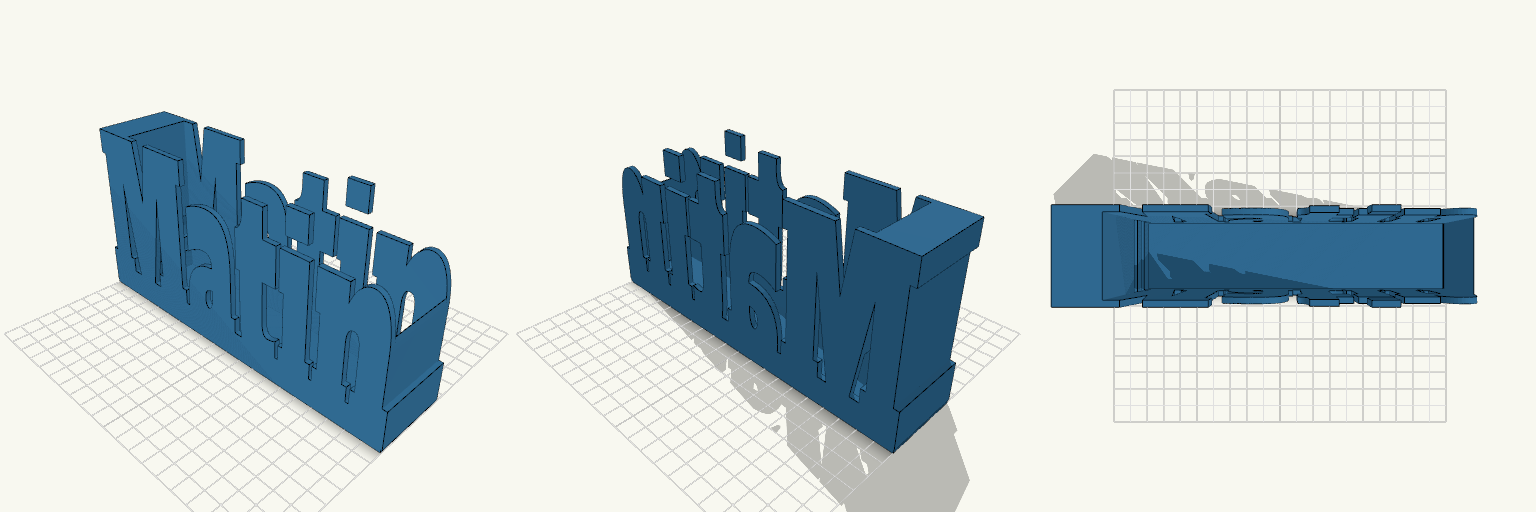
Portalápices Matin
What it's for Portalápices con el contorno de las letras "Matin" en Alfa Slab One, abierto por arriba y sin tapa. El lado izquierdo de la M queda macizo. Dimensions Alto: 100 mm Fondo: 45 mm Ancho: unos 200 mm Paredes de 3 mm y base de 4 mm Remix ideas Mover el límite del cierre de la M. Cambiar el nombre o la altura de las letras. Añadir una base antideslizante.
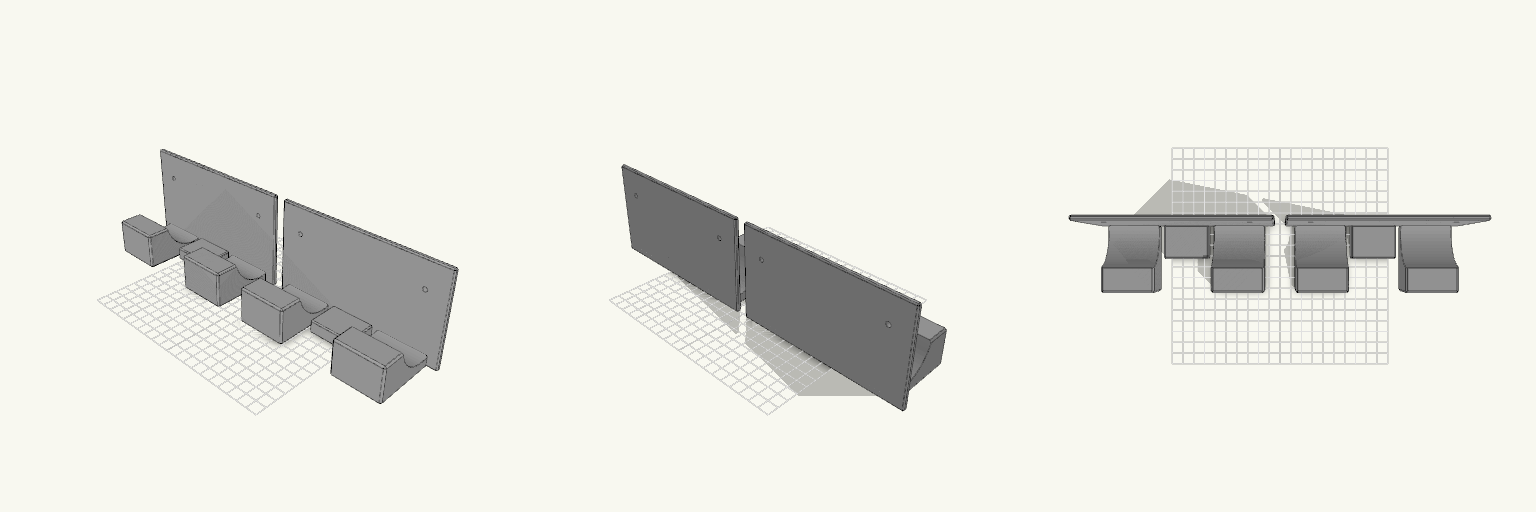
PS5 DualSense Dual Wall Cradle, 160mm
A wall-mounted holder for two PS5 DualSense controllers, side by side. Each controller rests on its grips rather than its face, with the analogue sticks pointing outward and clear of the wall. What it fits Sony PS5 DualSense controllers (CFI-ZCT1 series), one per cradle. Each cradle is 160 mm wide, with a 10 mm gap between the two. Overall width is 330 mm. Two rounded grip troughs per cradle, spaced 96 mm centre to centre, with a low bridge between them. What it does not fit DualSense Edge or any third-party pad. Grip spacing and depth were not checked against them. PS4 DualShock 4 controllers. The grip geometry is different, so they may not seat. Controllers fitted with thick silicone skins or grip caps. The troughs have little spare room. Check before printing Measure the distance between the outer grip tips of your controller and compare it with the 96 mm trough spacing. The fit has not been tested against a physical controller. Mounting 4 mm back plate, 90 mm tall. Four 4.5 mm screw holes, two per cradle, at 120 mm spacing. Screw heads are not countersunk. Use pan or button head screws, and pick anchors that suit your wall material.
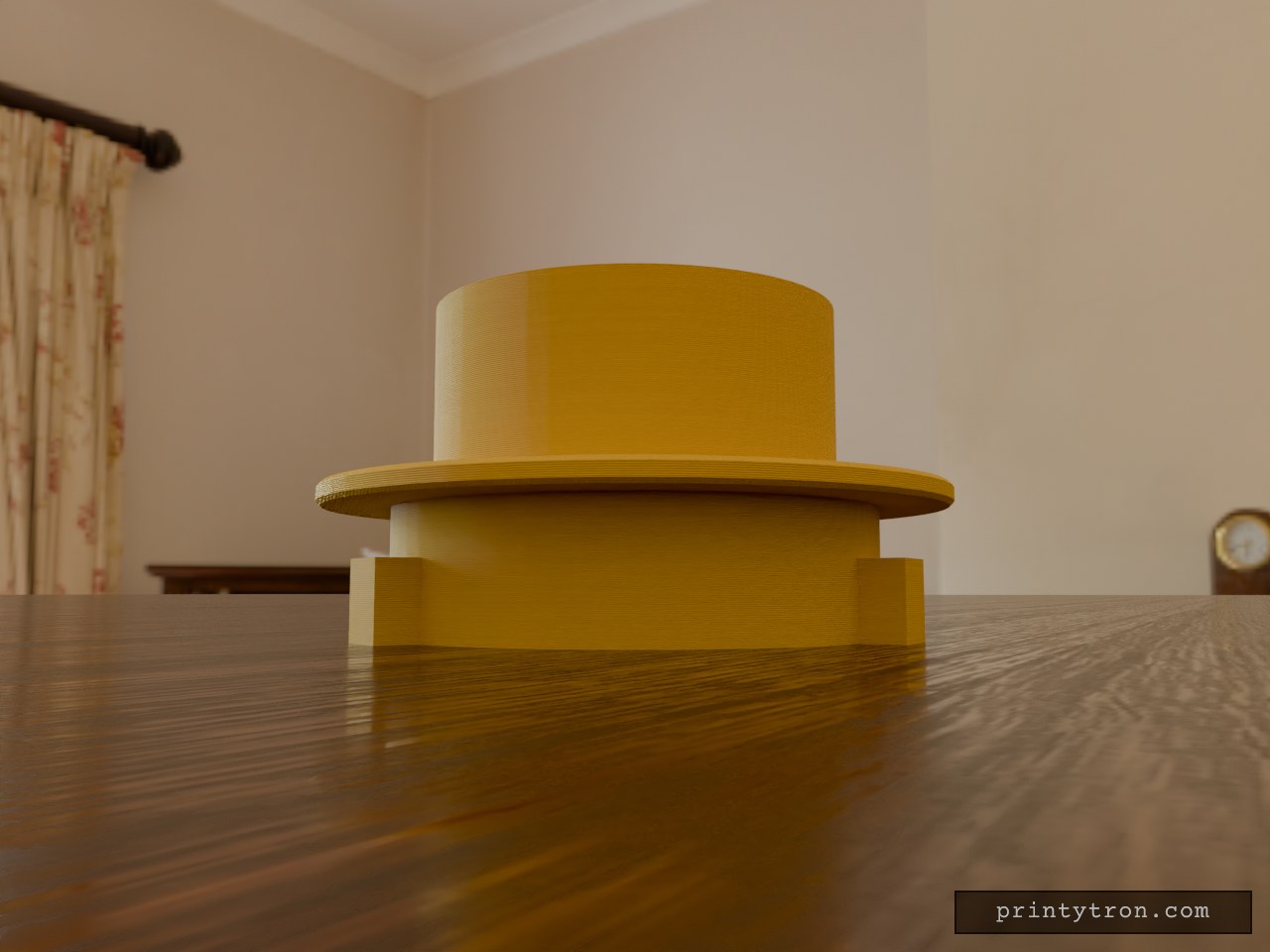
Bowens S Male Bayonet Adapter
Lumenlock ist ein männlicher Bowens-S-Bajonettadapter, mit dem sich Lichtformer und Zubehör mit Bowens-S-Aufnahme an einem passenden Licht montieren lassen. Drei gleichmäßig verteilte Bajonettlaschen greifen in die Gegenaufnahme und verriegeln beim Drehen; der offene Kern hält den Lichtweg frei. Auf der Flanschseite sitzt ein zylindrisches Rundprofil, das den Adapter zu einem röhrenförmigen Zwischenstück macht – der Adapter steht kopfüber, das Rundprofil wächst über den Flansch hinaus, ohne den freien Innendurchmesser zu verengen. Gedruckt wird das Teil einteilig und ohne Montage. Maße Gesamtgröße auf dem Druckbett: 116 × 116 × 60,5 mm Rundprofil: 33 mm hoch ab Flansch, 75 mm Außendurchmesser, 5 mm Wandstärke Höhe ab Flanschoberkante inklusive Laschen: 23,5 mm (Gesamthöhe mit Flansch 27,5 mm) Flansch: 116 mm Durchmesser, 4 mm hoch Spigot: 90 mm Durchmesser Zentrale Öffnung: 74 mm Innendurchmesser, durchgehend durch Flansch, Spigot und Rundprofil Laschen: drei, je 11,9 mm breit und 14 mm tief, 120° versetzt, oben bündig mit der Oberkante des Rings Radialer Überstand der Laschen über den Spigot: 7,5 mm, Außenradius 52,5 mm und damit innerhalb des Flanschradius von 58 mm Merkmale Männliches Bowens-S-Bajonett für Lichtformer und Leuchten Zylindrisches Rundprofil auf dem Flansch als röhrenförmige Verlängerung Rundprofil verändert den Innendurchmesser des Bajonetts nicht – 74 mm bleiben durchgehend frei Bündig abschließende Laschen für sauberes Einführen und Verdrehen Laschen bleiben trotz Überstand innerhalb des Flanschradius, sodass der Adapter flach aufliegt Einteilig und ohne Stützen druckbar Druckhinweise Die Bajonettabmessungen orientieren sich an gängigen Bowens-Werten und sind nicht an einem realen Bajonett geprüft. Teste Laschen und Spigot vor dem finalen Druck an deinem eigenen Licht oder Lichtformer. Das aufgesetzte Rundprofil steht weit über den Flansch hinaus – prüfe vor dem Druck, ob die Höhe zum gewünschten Aufbau passt.
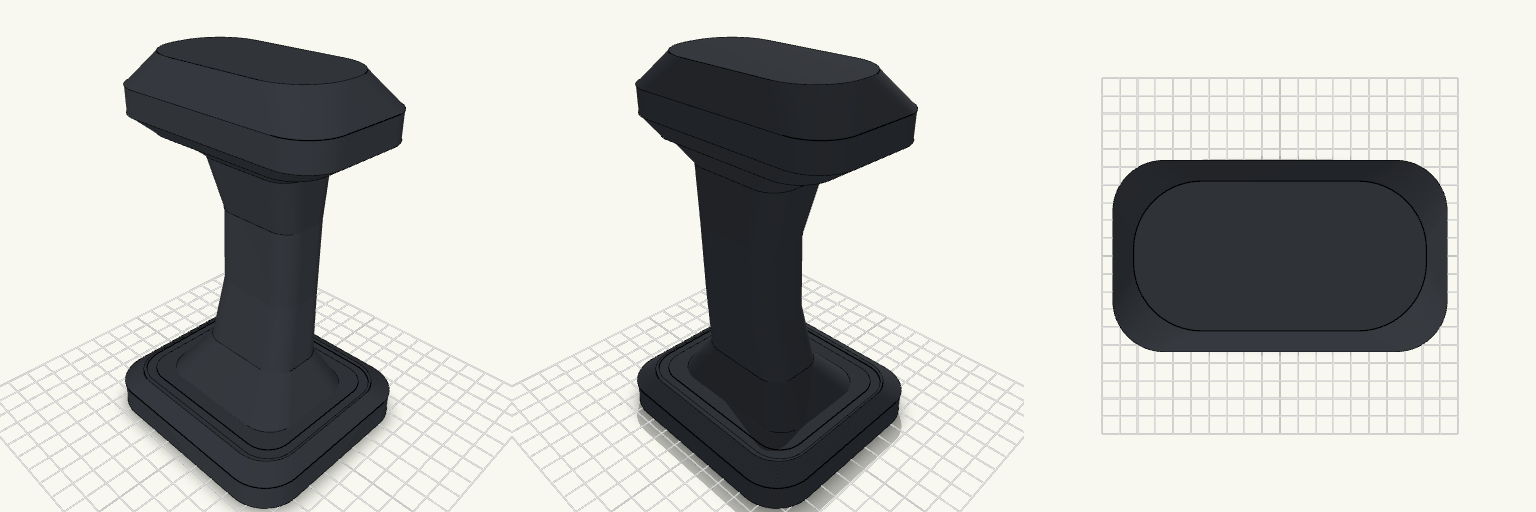
One-Piece Over-Ear Headphone Stand
A single-piece stand for large over-ear gaming headphones, built as a bold futuristic object rather than a plain pole. The base is an asymmetric hexagonal platform, the chamfered column leans back with a sloping front face and a narrow channel running down it, and the wide head grows out of the column through stepped transitions, so there is no thin neck. The whole stand prints as one continuous solid, with nothing to glue or assemble. Size as printed: 160 × 140 × 140 mm (width × depth × height) Base: 160 × 140 mm asymmetric hexagon with a chamfered edge, flat underside and five round recesses for rubber anti-slip pads; the top steps up toward the column and a recessed groove runs around it Column: flares out of the base, measures about 50 mm wide and 30 mm deep at its narrowest, and carries a shallow decorative channel on the front Head: 110 × 65 mm with 14 mm rounded corners, full width through a straight band before narrowing into a domed top — wide enough to spread the load of a large headband Printing: the base sits flat on the bed; the head overhangs the column on both sides, so expect some support or a slow bridge there — check it in your slicer The low, wide footprint keeps the centre of gravity down so the stand stays put with heavy headphones hung on it, while the modest height keeps the whole thing printable in one piece. Large smooth bevels, angular faces and the recessed groove give it a premium architectural look that suits matte black, graphite, dark grey or metallic-looking filament.
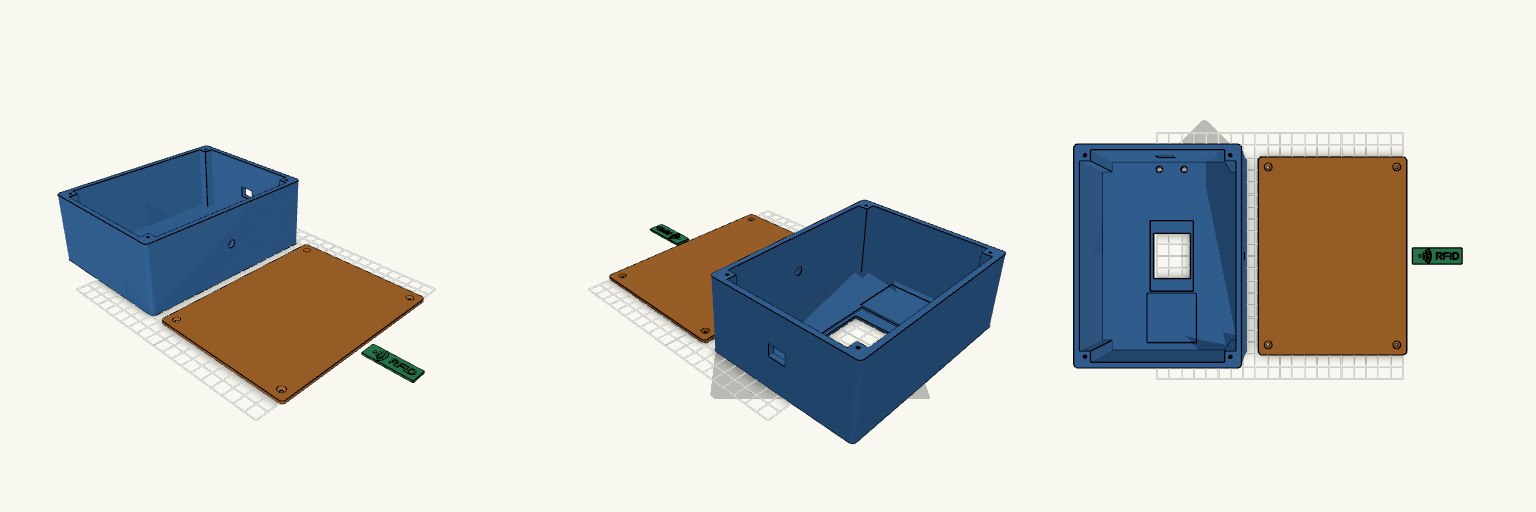
Large LID and Box RFID Reader Enclosure with 1.8-Inch Display
What it's for A complete RFID reader enclosure with a fixed lid and a removable rear cover. The box is open at the back, so the display, RFID reader board, microcontroller and wiring can be reached by taking off the back cover. A separate RFID logo plate glues into the recess on the lid. The model prints as three separate pieces laid out side by side: the box with fixed lid, the back cover, and the logo inlay. Dimensions Box with fixed lid: 120 × 160 × 60 mm, open at the back. Interior is about 112 × 152 mm. Four corner posts carry 2.6 mm pilot holes in their top 19 mm. Lid features: 30 × 37 mm display window with a 35 × 57 mm, 1.5 mm deep underside pocket for a 1.8" ST7735S board; 40 × 40 mm RFID reader zone; 40.4 × 13.4 mm, 1 mm deep logo recess; two 5.2 mm LED holes; a push-button hole centred 30 mm up in the right wall; a cable slot centred in the back wall at the same height. Back cover: 120 × 160 × 2 mm plate with rounded corners and four countersunk screw holes, placed 52 mm either side of centre in X and 72 mm in Y. RFID logo inlay: 40 × 13 mm plate, about 1.8 mm thick, with signal arcs and “RFID” text. Print notes Print the box lid-face-down. The display window and LED holes then come out clean on the build plate, and the corner posts grow upward without supports. The back cover and logo inlay print flat; no supports are needed. Print the back cover screw-face up so the countersinks sit cleanly. A well-squashed first layer helps the screw heads sit below the surface. The back cover screw-hole spacing was set by estimate rather than checked against a printed box. Test-fit the cover before final assembly; if it does not line up, open the holes slightly or move them to match the corner posts. The logo inlay is thicker than the 1 mm lid recess. Sand or shave the back of the plate until it sits flush. Assembly Screw the back cover to the four corner posts through the countersunk holes. Glue the RFID logo inlay into the matching recess on the lid. Open the box from the rear to fit the display, reader board and wiring. Remix ideas Re-space or enlarge the back-cover screw holes for a different post layout, or replace them with a snap-fit lip. Cut a groove in the cover for a foam or O-ring gasket if the enclosure needs sealing. Change the logo text or signal arcs, or leave the inlay out and print a plain lid. Add cut-outs for cable glands, connectors or a different reader module.
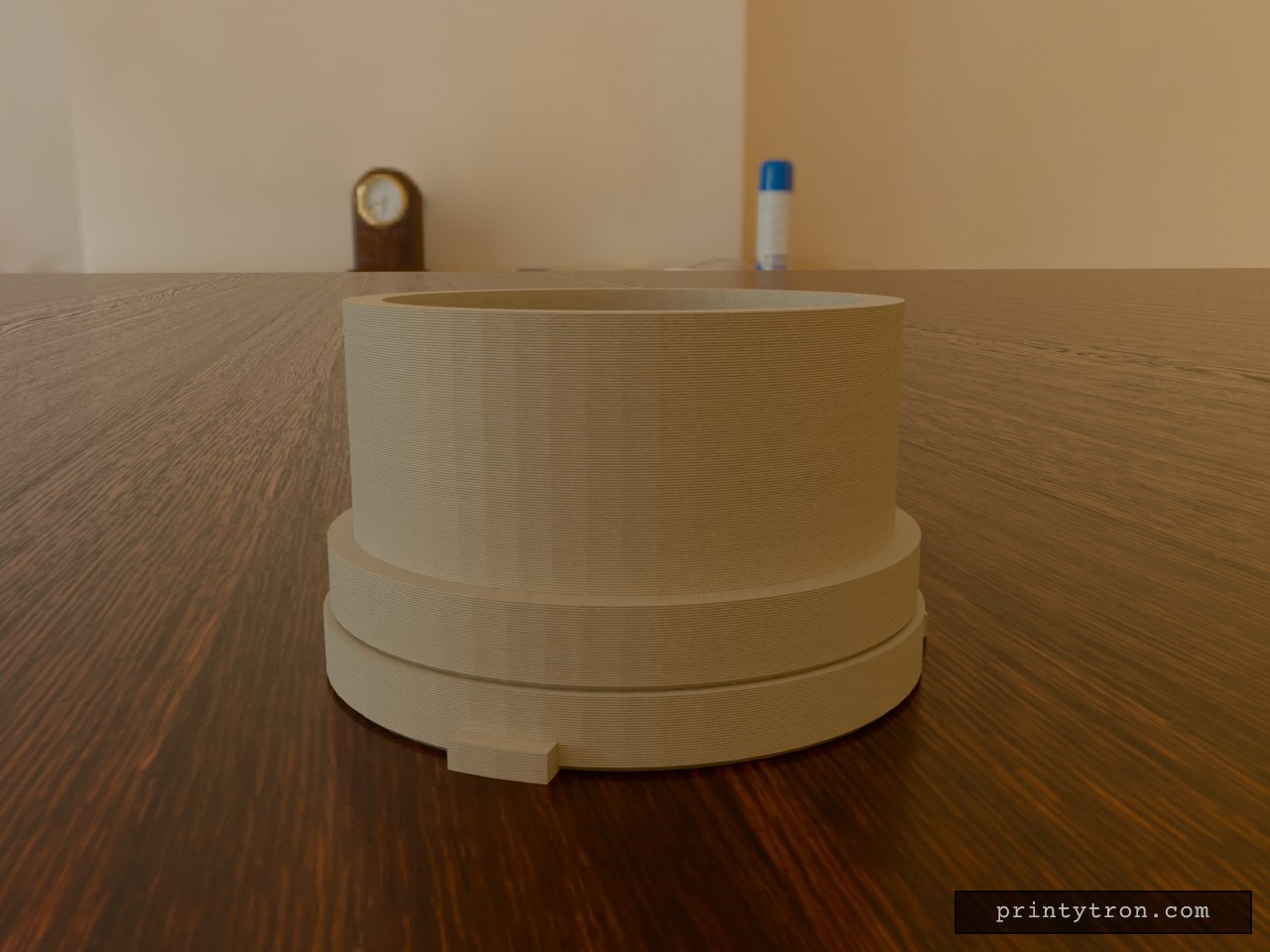
Bowens-Bajonettring als männlicher Anschluss
Wofür Dieser Bajonettring bildet die männliche Seite eines Bowens-Anschlusses: ein Grundkörper mit drei um 120° versetzten Laschen, über die sich ein Lichtformer oder Adapter aufsetzen und verriegeln lässt. In der 75-mm-Bohrung des Rings sitzt ein senkrechtes Rundprofil mit 75 mm Außendurchmesser und 5 mm Wandstärke. Es beginnt auf der Oberkante des Rings, ist 35 mm hoch und lässt innen eine 65-mm-Öffnung frei. So entsteht eine Aufnahme mit durchgehender Rohröffnung für einen Blitzkopf oder ein Übergangsteil. Maße Grundkörper: Ø 82 mm, 6 mm hoch Einsteckbereich: Ø 84 mm, 9 mm hoch Laschen: 3 Stück, 120° Abstand, je 11,9 mm breit, 3,5 mm dick, bis Ø 90 mm reichend Ringbohrung: Ø 75 mm; Wandstärke 3,5 mm am Grundkörper, 4,5 mm am Einsteckbereich Rundprofil: Ø 75 mm außen, 5 mm Wand, Ø 65 mm innen, 35 mm hoch Auflageflansch: Ø 82 mm, 4 mm hoch; das Rohr steht damit auf der Oberkante des Rings und endet bei 50 mm Gesamthöhe Ringhöhe: 15 mm; Grundfläche rund 84 × 84 mm Druckhinweise Der Ring steht mit seiner Grundfläche auf der Druckplatte; das Rundprofil wächst senkrecht daraus nach oben. Der Auflageflansch verbindet das Rohr flächig mit dem Ring und verschmilzt beim Druck mit ihm; das Modell wird einteilig gedruckt. Die Laschen sind mit 3,5 mm das dünnste Element; genug Wände und ein zäher Werkstoff halten sie unter Last formstabil. Die senkrechten Wände des Rundprofils brauchen keine Stützen; prüfe die frei auskragenden Laschen in deinem Slicer. Remix-Ideen Höhe des Rundprofils ändern, etwa für einen anderen Blitzkopf oder eine tiefere Rohrführung. Durchmesser oder Wandstärke des Rundprofils anpassen, solange es in die 75-mm-Ringbohrung passt. Laschen dicker ausführen für strafferen Sitz oder einen zweiten Satz Laschen für ein anderes Verriegelungsmaß. Mit einer Gegenplatte oder einem Gewindeaufsatz auf ein anderes System übergehen.