Ridged Cutlery Grip Sleeve
Created 1 months ago
Description
A chunky, ridged sleeve designed to slide over standard fork and spoon handles, expanding their overall diameter. It provides a more substantial holding surface for individuals with limited hand strength, reducing the exertion required during meals.
- 30mm outer diameter with a fluted exterior for a secure hold
- 100mm overall length fits securely across the palm
- 12x4mm center slot accommodates most flat, stamped cutlery handles
- Soft-cornered bore grips the flatware to prevent spinning under load
Images
More like this
Explore more in Kitchen & Bathroom →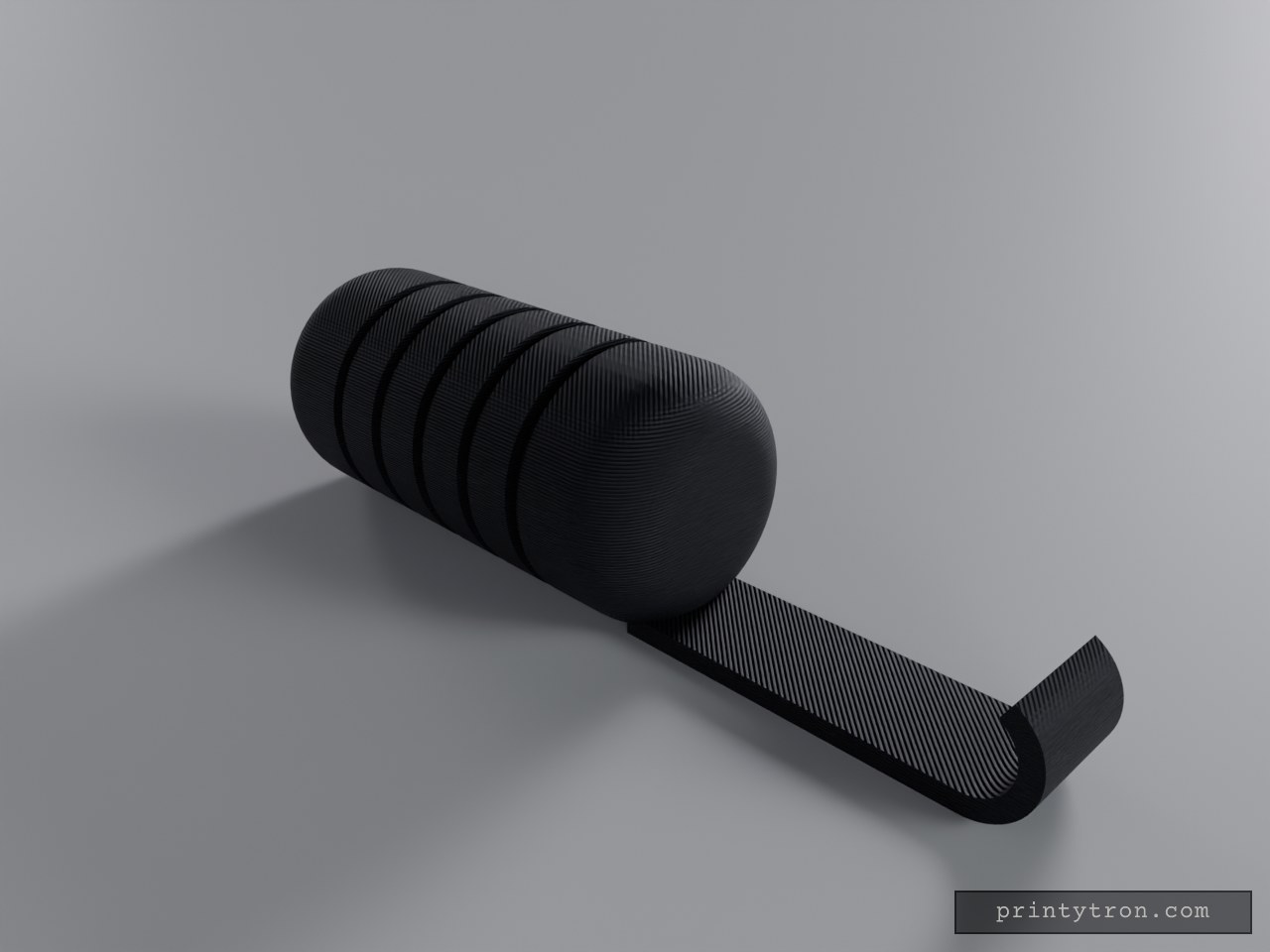
90mm Can Ring Pull Lever Tool
A hand-held lever for lifting can ring pulls without using fingernails. A thin curved hook slides under the ring, and a thick barrel handle gives the leverage to lift it. Suited to anyone with limited grip strength or short nails. Specifications Overall length: 90 mm Handle: 25 mm diameter barrel, about 55 mm long, with ring grooves for grip Hook blade: 2 mm thick, 12 mm wide, curved upward at the tip to slide under the ring Construction: single welded body, printed as one piece Orientation: print with the handle and blade lying flat on the bed. Supports may be needed under the barrel's curved underside. Material: PETG or PLA. PETG is preferred for the 2 mm blade because it flexes before it breaks. Use: ring-pull cans such as beans, soups and drinks Notes The 2 mm blade is the thinnest part. Print it with at least 3 perimeters for strength. The grip grooves are shallow, so the handle stays easy to wash.
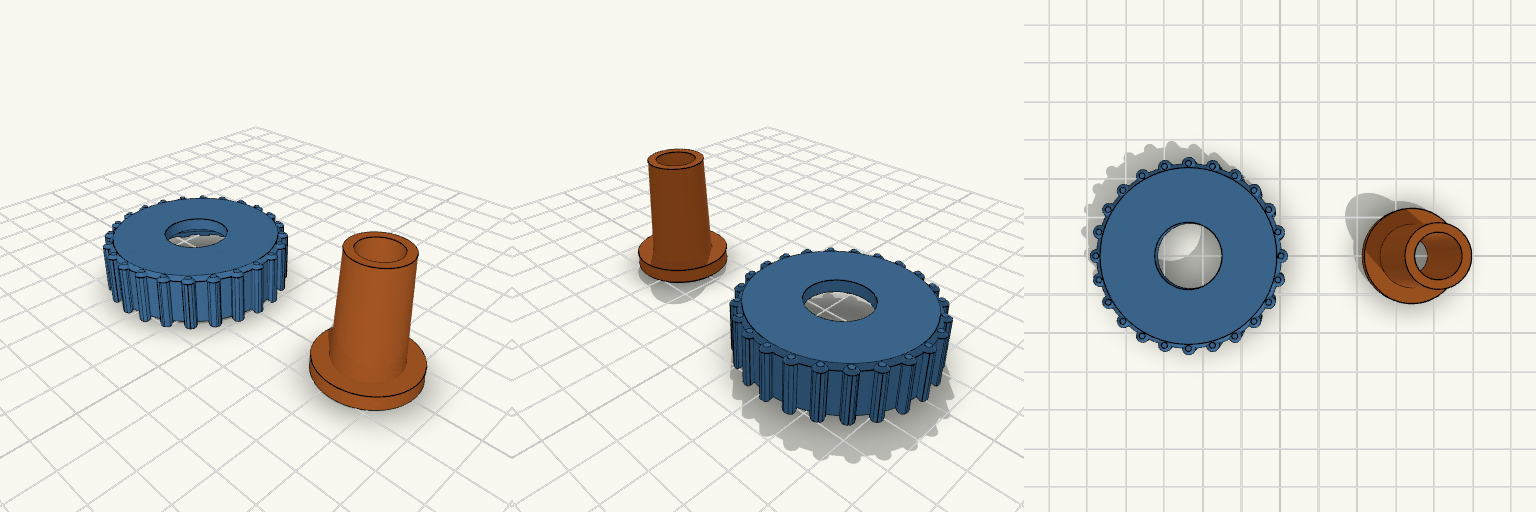
Ribbed Milk Bottle Cap (3 start thread) with Tube Adapter
A low-profile screw cap for a 2L milk bottle, paired with a separate tube adapter that passes through the cap from the inside. The cap has a 3-start internal thread sized for a 37.4 mm bottle thread, a 16 mm hole through the lid, and 24 vertical grip ribs around the outside for easier tightening. The adapter has a 4 mm flange that stops it pulling through the lid, and a tube that tapers from 15.9 mm to 14 mm. Cap: 44 mm body, 13 mm tall, 3 mm lid, 16 mm centre hole Thread: 39.4 mm major diameter, 3.2 mm pitch, 3 starts Adapter: 30 mm overall, 24 mm flange, 10 mm bore Print the cap lid-down and the adapter flange-down
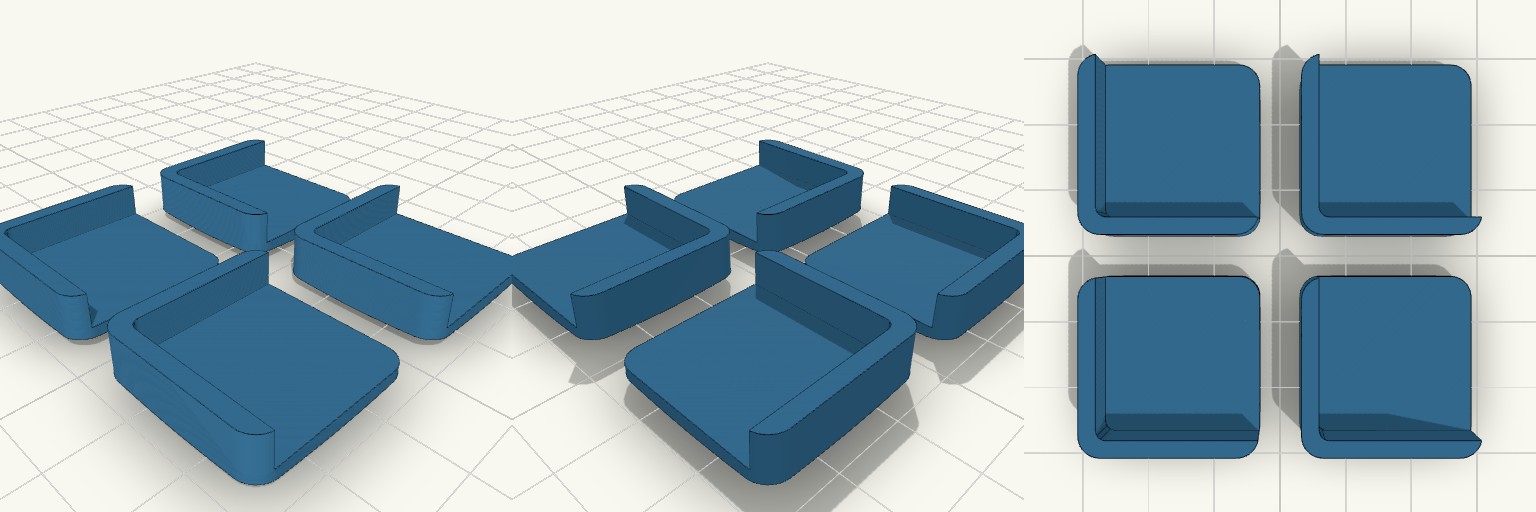
Cutting Board Corner Grip Feet
A set of four corner cups that slip over the corners of a cutting board and grip the counter, so the board stays put under a knife. Each foot is a 25 mm square cup, 8 mm tall, with a corner socket on top and a gently domed, nubbed underside. The socket has 2.4 mm walls on the two outer sides and a 2.5 mm floor, so it is 5.5 mm deep. The two inboard sides are open, so the board corner slides in and the outer walls hold it. The underside rises about 1.2 mm toward the centre and carries 1 mm grip nubs on a 2 mm pitch. Remix hooks Socket depth: the floor is 2.5 mm, which leaves 5.5 mm of grip. Thinner floor or taller cup means a deeper hold. Heavy or thick boards benefit most. Cup footprint: 25 mm is a choice, not a constraint. Go larger for more adhesive area or a wider stance. Wall thickness: 2.4 mm on the outer sides. Raise it for a stiffer clamp, lower it toward 1.6 mm for more flex. Nub size and pitch: 1 mm nubs at 2 mm spacing. Larger, sparser nubs give more bite on rough counters. Finer ones suit smooth laminate. Dome rise: 1.2 mm. Set it to 0 for a flat base with the same texture. Closed-corner variant: add walls on the inboard sides for a full pocket, with a slightly oversize opening for easy loading. Notes for printing and pairing TPU is the sensible material, since PLA nubs will not grip much. A dab of adhesive in the socket helps on heavy boards. Pairs with non-slip shelf liner or rubber pads under the cup as a second grip layer. The 4 feet are laid out in a 2 by 2 grid with 6 mm gaps.
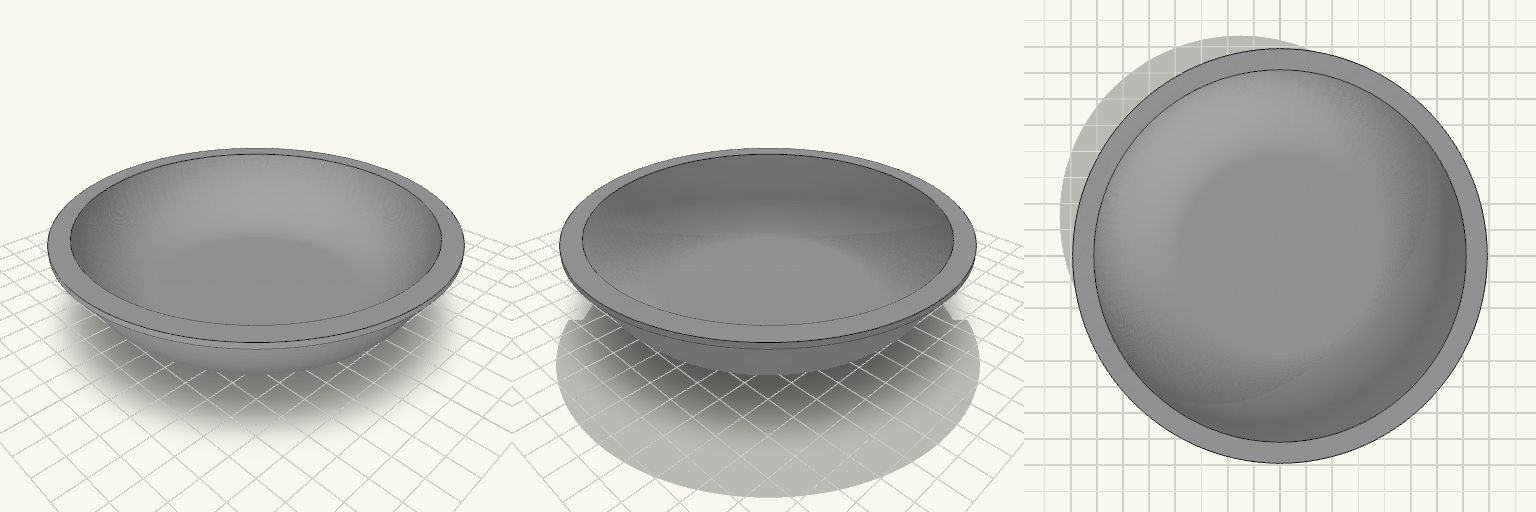
Brim — Flat-Bottom Rounded Bowl
Brim is a shallow serving bowl with a flat 75 mm base that sweeps up in a smooth curve to a wide, flat rim. The flat base keeps it stable on a table and easy to print without supports on the bottom face. Dimensions Outer rim diameter: 138 mm Rim width: 5 mm, flat and horizontal Opening inside the rim: 128 mm Depth: 30 mm Flat bottom diameter: 75 mm Wall thickness: 2 mm throughout Print notes Print rim-up or base-down; base-down is the natural orientation. The steepening curve near the rim may need supports or slow cooling.
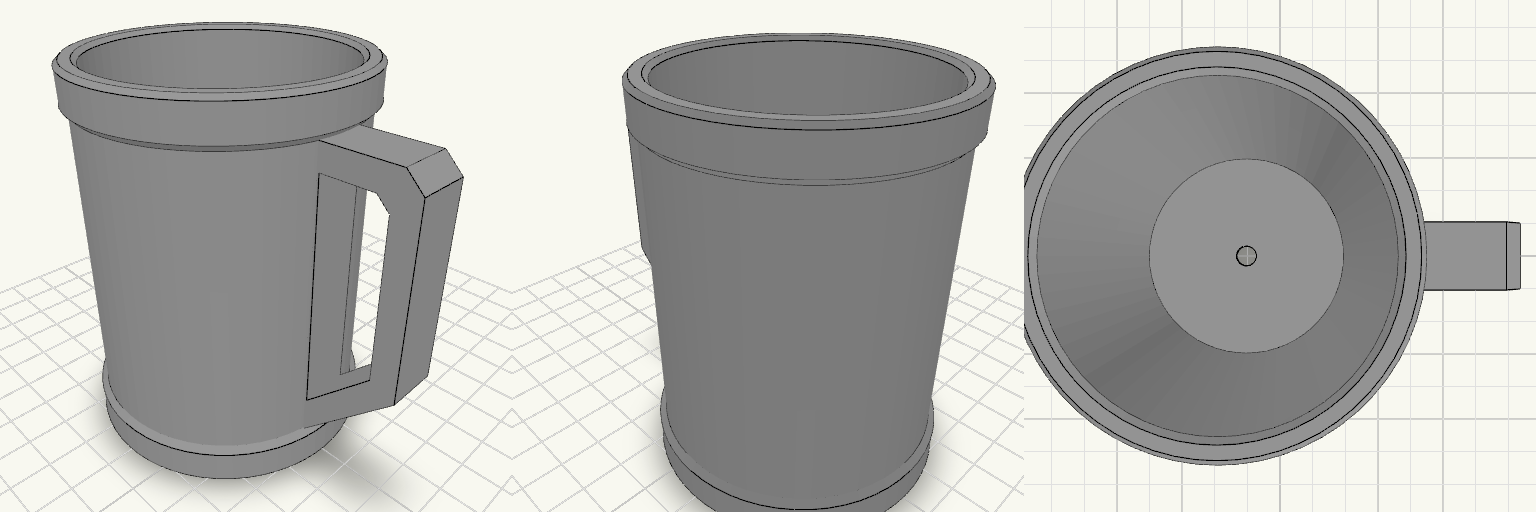
Caneca porta-latas com alça em peça única
Caneca porta-latas em peça única para latas de 269 ml. O corpo cilíndrico tem Ø externo de 64,6 mm e 90 mm de altura, com cavidade reta de Ø 58,6 mm e 87 mm de profundidade útil. A parede tem 3,0 mm e o fundo 3 mm; um furo de Ø 6 mm no centro do fundo alivia o ar, e um chanfro de 1 × 45° na borda interna do topo guia a entrada da lata. Duas faixas salientes de Ø 67,6 mm reforçam o desenho: uma na base, de Z=0 a 10, e outra no topo, de Z=80 a 90, ambas com chanfros de 45°. Entre Z=10 e Z=80 o corpo é liso, para receber adesivo. A alça fica em um dos lados, com 12 mm de largura e avanço até X=54. Ela sobe até Z=80, encostando no início da faixa superior, e mantém topo plano com barra vertical na ponta; a diagonal de 45° fica embaixo. As barras do perfil têm cerca de 6 mm, e as quinas externas e as do furo são chanfradas a 45°. O vão interno acompanha o perfil, com teto em Z=74; o chanfro na quina ajuda a impressão, mas o trecho ainda forma uma ponte e pode pedir suporte. Altura total: 90 mm Pegada na mesa de impressão: 87,8 × 67,6 mm Cavidade: Ø 58,6 mm por 87 mm de profundidade útil Parede de 3,0 mm e fundo de 3 mm Furo de alívio de ar: Ø 6 mm Faixas salientes: Ø 67,6 mm, base de Z=0 a 10 e topo de Z=80 a 90 Alça: 12 mm de largura, até X=54, topo em Z=80, barras de cerca de 6 mm e chanfros de 45° Vão da alça: teto em Z=74, com chanfro na quina; pode pedir suporte sob a ponte
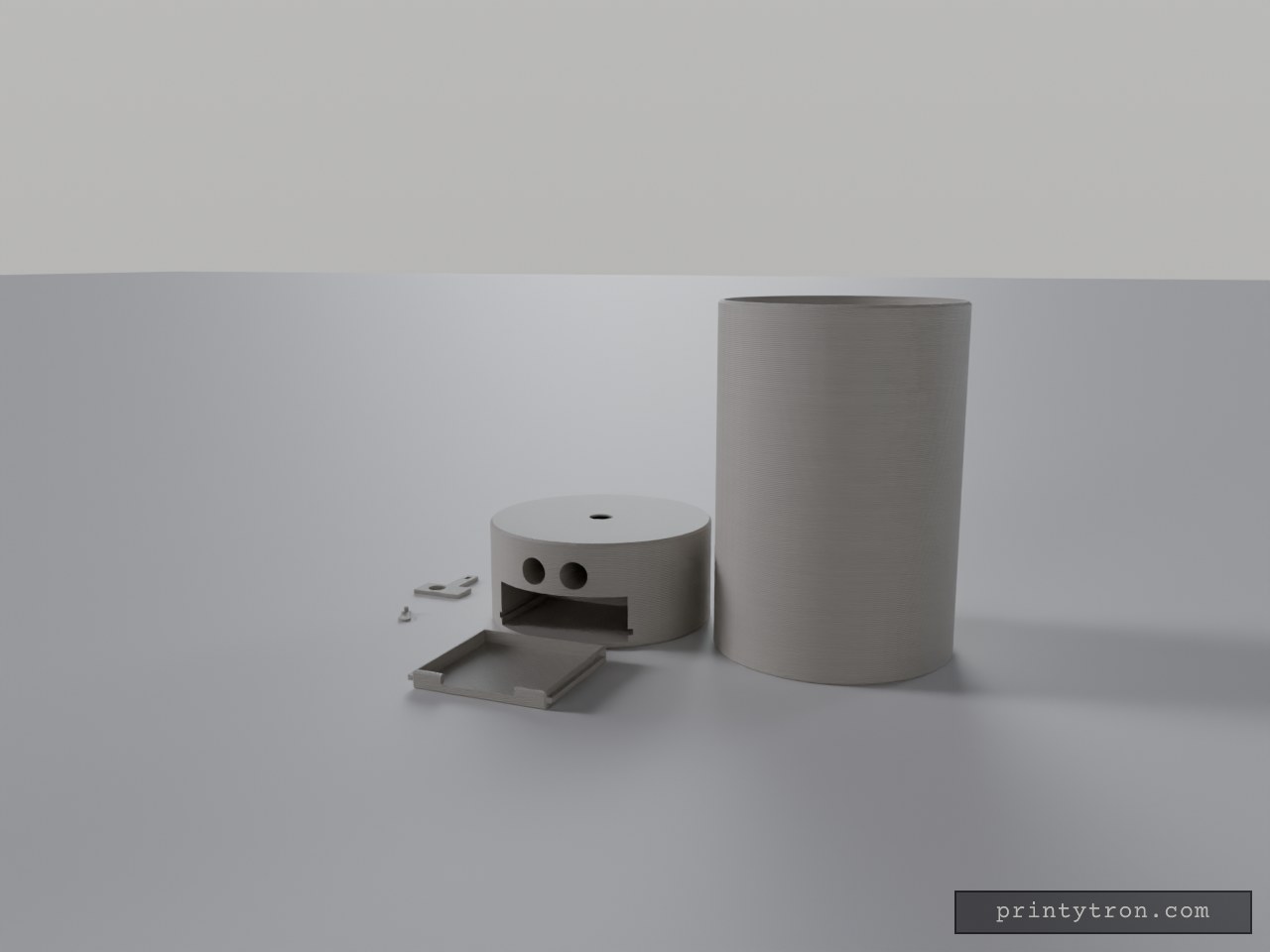
Sentinel Cylinder Candy Dispenser
A candy dispenser with a watchful streak: the body stands as one straight 105 mm cylinder from foot to rim, and two eye holes on the front give it the look of a sentinel standing guard over the opening below. Those eyes are through-holes opening into a pocket for an ultrasonic sensor, so a wave of the hand can trip the servo below the gate slot and slide the gate open, dropping candy into the hand opening below. That opening is a genuine hole cut clean through the front wall, about 63 mm wide and 21 mm tall, sized for an average hand rather than a large one. A retractable catch tray rides on side rails on its floor, just under the outlet, with a low notch at the front so you can scoop the candy out with your fingers. A cone at the floor of the candy cylinder funnels the sweets down to the outlet, and the whole thing stands 200 mm tall — a tall column that holds a serious load of candy while keeping a modest footprint on the counter. All five pieces are laid out separately on the plate, each oriented for printing without supports. The candy cylinder is silk white, the base pink, the catch tray light blue, and the gate slider and servo horn white. The printed parts Base Housing — a round 105 mm pink body, 48 mm tall. The hand opening sits at the front bottom, open through the wall. The two sensor eye holes sit just above it, also cut clean through, so the sensor has a clear line of sight out the front. The servo bay is sized for an SG90: the servo slides in from the back wall, shaft up, with its mounting ears resting in a slot cut into the housing. A round recess above the body lets the shaft boss sit so the horn runs flush under the gate. The wider body leaves room to open the sensor pocket to full size. Candy Cylinder — a 105 mm open cylinder, 152 mm tall, in silk white, with roughly 3 mm walls, flush with the base so the body reads as one uninterrupted column. A wide, shallow cone at its floor feeds the outlet; everything above it is candy storage. Gate Slider — a flat 26.3 × 33.8 × 2.3 mm white plate that slides sideways in a slot across the outlet, just under the candy cylinder floor. A solid bar covers the outlet when closed; a 12 mm hole lines up when open. Its tail has a slot for the servo horn pin, and about 60° of servo sweep moves the gate roughly 13.6 mm — enough to fully open or close the outlet. Servo Horn — a 10.1 × 13.3 × 3.2 mm white horn with a pin that rides in the gate’s tail slot. The servo below the gate slot turns it to shift the gate. Catch Tray — a 64.5 × 57 × 7.5 mm light-blue tray that slides into the hand opening on two side ribs set in matching grooves, and sits directly under the outlet. Its back and side walls are about 1.5 mm thick, the front wall carries a low scoop notch, and the front edge stands about 1.5 mm proud of the housing as a pull tab. The rails are 3 mm wide with about 0.5 mm clearance in the grooves. There is no end stop, so the tray pulls out completely; a small snap bump would add a stopping point. It prints flat and needs no supports. Before you print The servo pocket matches an SG90: about 12.6 mm wide and 23 mm tall, with a mounting-ear slot. The sensor pocket and eye holes are undersized for an HC-SR04. Open those up while keeping the outside dimensions, or plan on a smaller sensor. The wall between the servo bay and the hand opening is thin, about 0.6 mm at final scale. Print the base with extra perimeters. The 152 mm cylinder is a tall, thin-walled tube — print it upright as laid out, and print it slowly. Check that it fits your printer’s height; if not, split it into two stacking rings. The gate slot has only about 1.4 mm of material above it before the cylinder floor, and the wall between the hand opening and the sensor pocket is thin. Print the base with extra top layers and extra perimeters for strength. Keep the gate plate flat on the bed so it slides cleanly through its slot, and keep the tray flat so its side rails and walls stay square. The base and candy cylinder have no locating lip, so glue or tape them together. Test-fit a real SG90, ultrasonic sensor and tray before final assembly. Wire the sensor and servo to the same controller. When the sensor sees a hand, the controller turns the servo to open the gate, waits, then turns it back to close. Remix hooks — cap the 105 mm cylinder with a lid, open the outlet up for faster dispensing, open the sensor pocket to HC-SR04 size now that the round base has the room, widen the hand opening, deepen the catch tray, add a small snap bump to give the tray a stopping point, or add a shallow funnel lip around the outlet for easier loading.