Two-Speed Constant Mesh Gearbox
Made by ChipperAardvark
Created today
Description
A chunky, build-it-yourself two-speed constant-mesh transmission that turns mechanical principles into a tangible display piece. Gears and shafts lie flat on the plate for straightforward printing, and the base plate carries a bold BENZE nameplate where the original labels once sat. The open frame shows the internals clearly, making it a handy desk-side demo of how a constant-mesh gearbox shifts ratio.
Design Features
- Two-Speed Setup: Includes a 15-tooth and 25-tooth spur gear arrangement.
- Constant Mesh: The gears are always engaged. A sliding dog clutch (the dog slider) locks the freely spinning gears to the output shaft to change the ratio.
- Assembly: Parts drop onto the base frame's posts. The high gear goes on the top of the output shaft (pocket facing down), the low gear goes on the bottom (pocket facing up), and the slider sits in between them on the hex shaft.
- Nameplate: The base plate is personalized with the name BENZE, replacing the former ENGINE, WHEELS, and SHIFT labels.
Images
More like this
Explore more in Decor & Display →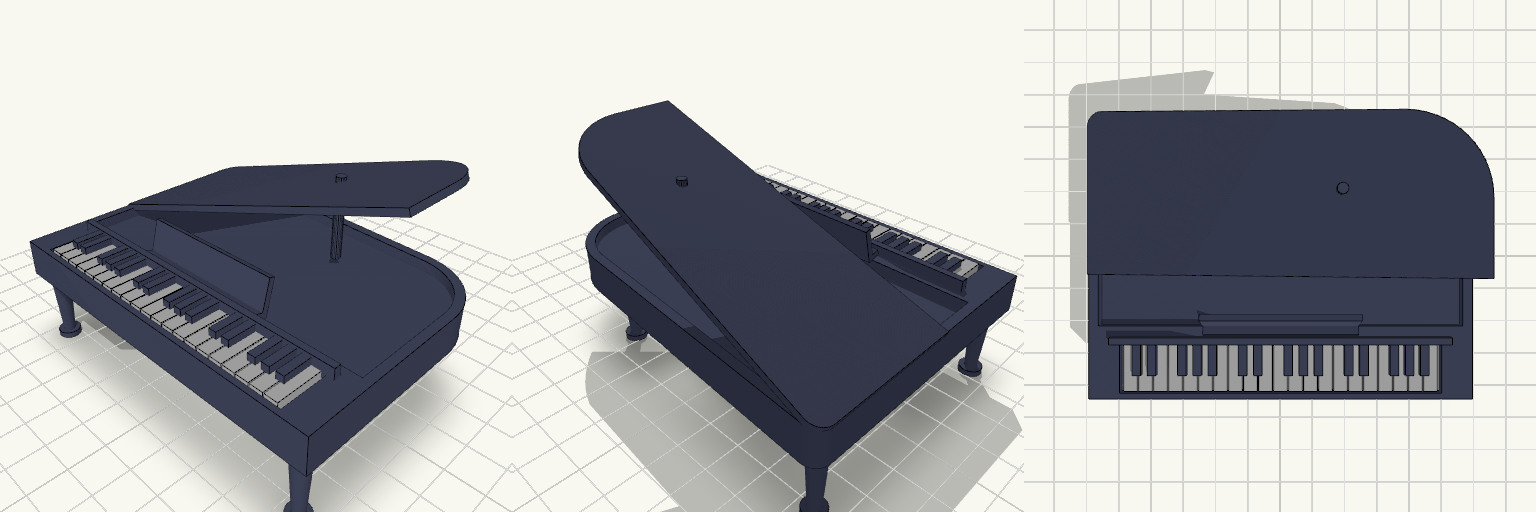
Miniature Two-Material Grand Piano, 100 mm Wide
A miniature grand piano that prints as one assembled piece: a curved case with a propped-open lid, four tapered legs, a music stand and a keyboard of 21 white keys running nearly the full width of the front. The body and black keys are PLA; the white keys are PETG, carried on a plate that drops into a recessed pocket in the case and is held in place by the key slip in front, so the two materials are retained mechanically rather than relying on PLA/PETG adhesion. Overall size: 100 × 75 × 61 mm. White key plate: 84 × 14 × 5.2 mm, 21 white keys with black keys in standard groups of two and three. PLA: case, lid, legs, music stand and black keys. PETG: white keys only. Print upright on its legs; the tilted lid overhangs and needs supports — keep them clear of the key pocket. Two separate colour regions: assign PLA and PETG to them in the slicer, use a purge tower and expect a fair amount of purge waste. The black keys are PLA, the same colour as the body, so they read as body colour unless the material is swapped. The model is a single watertight piece with no glue and no post-print fitting of keys or trim. Detail is sized for a 0.4 mm nozzle, and the widened keyboard leaves only a couple of millimetres of case wall at the front corners, so a well-tuned first layer helps there.
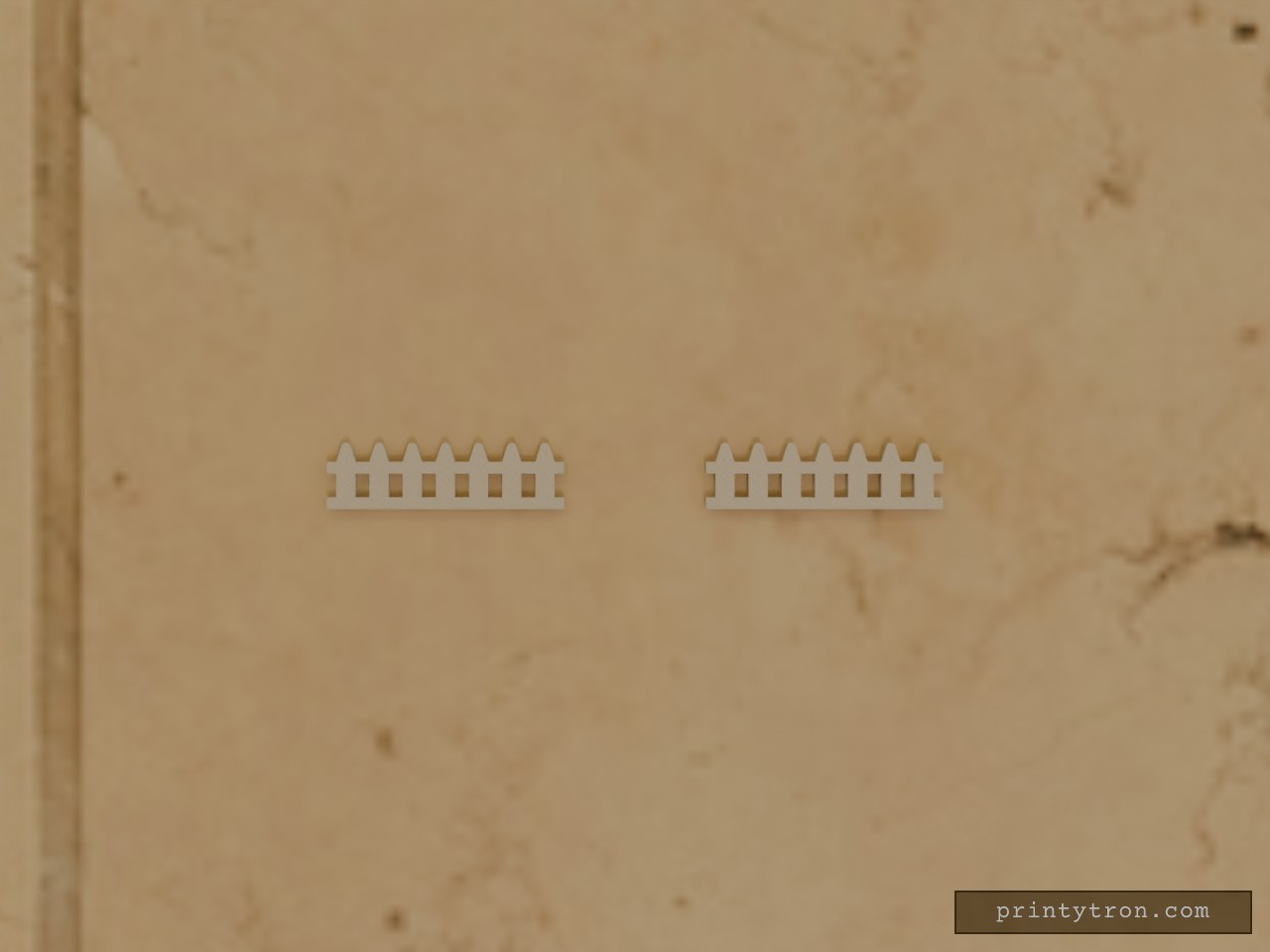
Two 100 mm Picket Fence Panels
Two mirrored flat picket fence panels for either side of a pedestrian crossing diorama. Each panel is 100 × 28 × 3 mm with seven rounded-point pickets joined by two horizontal rails. The pair spans 260 mm with a 60 mm gap for the crossing, fitting A4 landscape. Pickets: 8 mm wide, 6 mm gaps, rounded pointed tops Rails: 5 mm tall, near top and bottom, full 100 mm length Thickness: 3 mm throughout Print: flat on the bed, no supports, no holes, no text Material: PLA or PETG Footprint: 260 × 28 mm
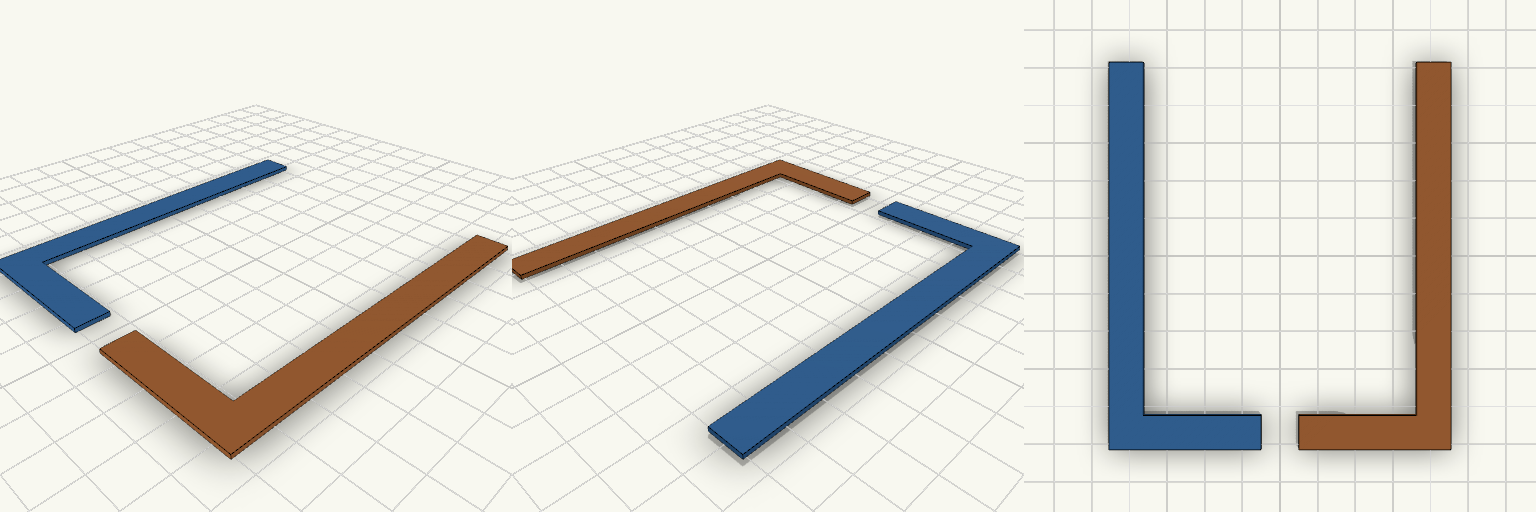
Flaches L und gespiegeltes L
What it's for Zwei flache Buchstaben-L als Paar: ein normales L und eine spiegelverkehrte Version. Geeignet für Schablonen, Beschriftungen, Dekoration oder Modellbau. Dimensions Je Buchstabe: 40 mm breit, 102 mm hoch, 1,1 mm dick Strichbreite überall 9 mm Abstand zwischen beiden Buchstaben: 10 mm (gesamt 90 mm breit) Remix ideas Abgerundete Ecken oder Fasen an den Kanten Bohrungen zum Aufhängen oder Verschrauben Dickere Ausführung für mehr Steifigkeit
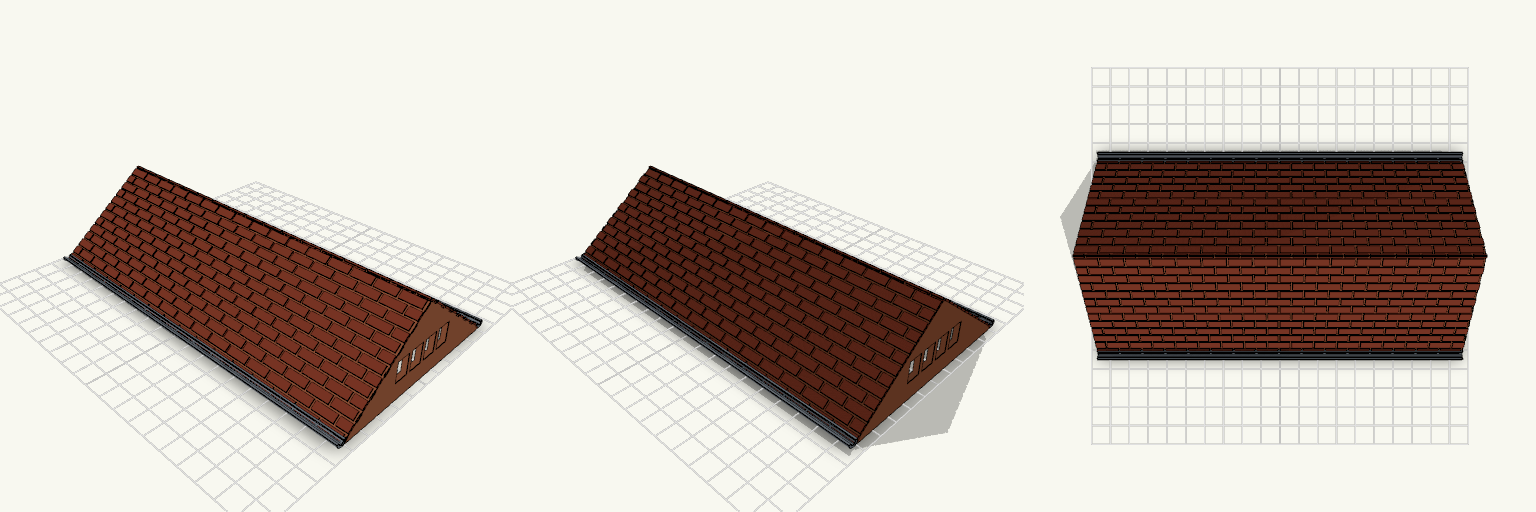
Toiture 192×103 mm, fenêtres 4 carreaux
Toiture creuse de 192 × 103 mm pour une maison de 192 × 101,19 mm, hauteur 40 mm, avec pignons fermés percés chacun d'une fenêtre à 4 carreaux alignés. À vérifier avant impression Largeur de la maison : 101,19 mm (le toit déborde d'environ 0,9 mm de chaque côté). Longueur : 192 mm, pignons affleurant les murs. Caractéristiques Coque de 2,5 mm, dessous ouvert. Motif de briques sur les deux pentes. Demi-gouttières Ø3 mm ouvertes vers le haut. Fenêtres : 4 carreaux de 6 × 8 mm, montants de 2 mm. Incompatibilités Aucun ergot ni emboîtement : le toit se colle ou se maintient sur les murs.
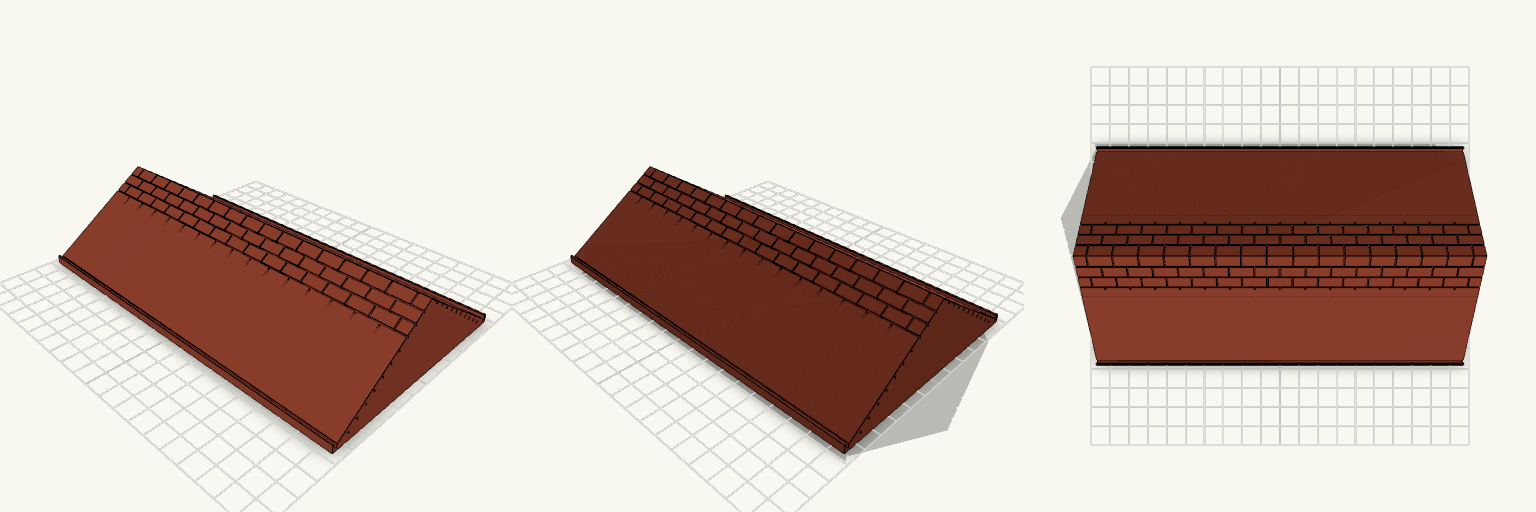
Toit creux avec demi-gouttières
Toit à deux pentes creux, ouvert en dessous, dont le bas des pentes se termine au milieu de gouttières arrondies en U, de sorte que seule la moitié extérieure du canal reste visible. Joints d'ardoise gravés sur les deux pentes. Pistes de remix Hauteur du toit : 40 mm au faîtage, donc des pentes d'environ 36°. Réduire cette valeur donne un toit plus plat. Gouttière : profil de 5 × 4 mm, canal rond de 3,4 mm. Élargir le canal pour un meilleur écoulement. Position de fin de pente : le bas des pentes s'arrête à 54,5 mm de l'axe, au centre du canal. Décaler cette valeur change la part de gouttière visible. Compatible avec un garage de 192 mm de large à quatre portes de 40 mm.
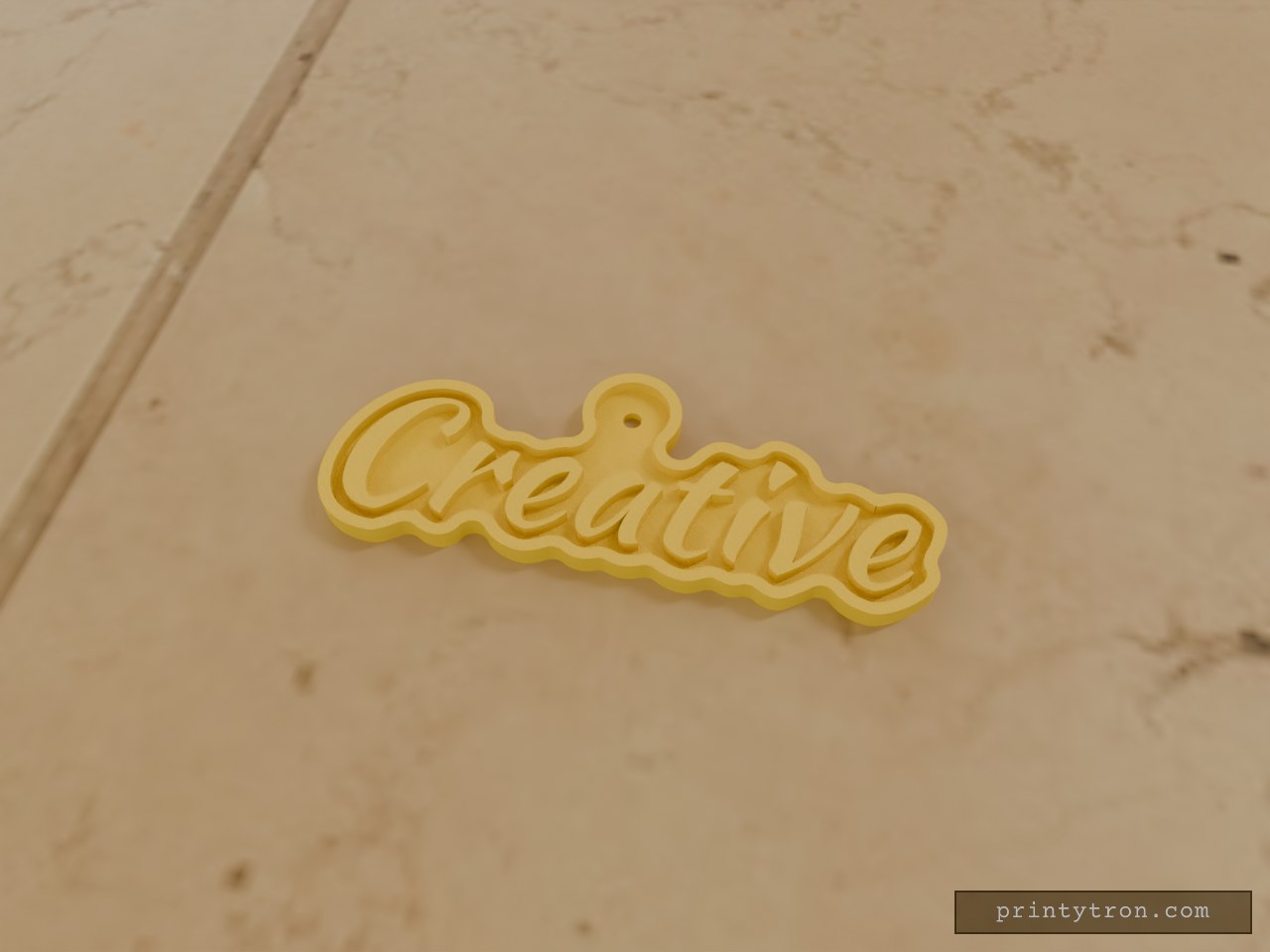
Creative with Raised Border
A wall sign that reads Creative in a brushed script — the fix for a sign that ends up a plain rectangle of plastic with the lettering lost inside it. The backing follows the outline of the letters instead of being a plate, and a raised border traces that same shape, so the sign keeps the word's silhouette on the wall rather than a slab around it. Because the border, backing and lettering are separate colour areas, you can swap filament at the layer changes and get a two- or three-tone sign off a single-colour printer. Sizes Overall footprint: 126 × 49 mm Lettering: 116 × 29.5 mm, 3 mm proud of the backing Backing: 2 mm thick, cut to the lettering outline Border: 5 mm tall, rounded, tracing the same outline Hanging: one round tab above the lettering with a 4 mm hole Hang it from the single tab — check the tab clears your hook or screw head before you commit to a wall position. Print flat on the backing, no supports needed.