104-Cell AA Battery Vault
Created 1 months ago
Description
This heavy-duty grid vault keeps 104 AA cells locked down and separated.
The front closure uses a single wide flex-arm cantilever built straight into the lid. It swings down to snap automatically over a retaining ledge on the base, holding the lid firmly shut until you pull the finger grip outward.
- Clearance: 0.4 mm gap on all latch and hinge mechanisms
- Lid Mechanism: Print-in-place folded hinge
- Print Layout: Prints fully open and flat on the bed
Images
More like this
Explore more in Storage & Organization →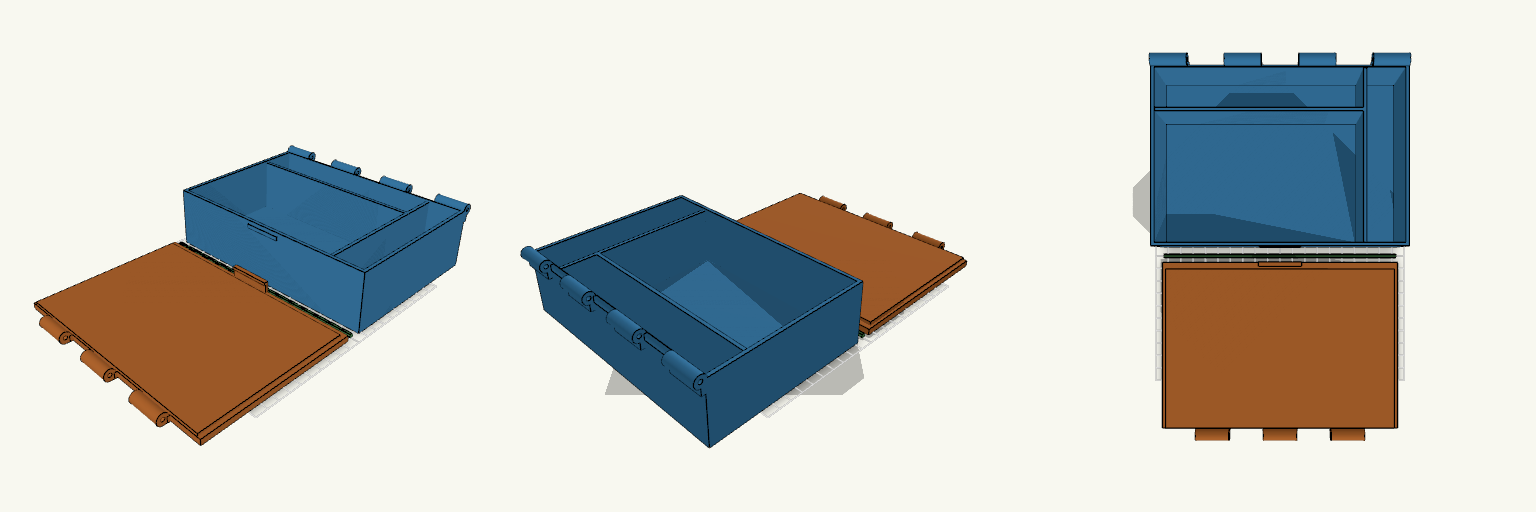
Hinged Latching Box With Front Divider
Small parts slide into one pile the moment the lid comes off; this hinged latching box splits the main space with a divider and adds a full-depth side bay so screws, clips and the like stop mixing. The main compartment clears 152 × 127 × 45 mm, with a 2.5 mm divider set 97 mm back from the front. A 2.5 mm wall separates a 28 mm wide, full-depth compartment on the right, and that bay has no cross divider. The walls stand 2 mm taller than the divider, and the divider top sits level with the underside of the lid lip, so the full 45 mm of height is usable. Fit and compartments Main compartment: 152 × 127 × 45 mm clear (width × depth × height). Right side compartment: 28 mm wide × 127 mm deep × 45 mm high, separated by a 2.5 mm wall and open for its full depth; overall inside width about 182.5 mm. Divider: 2.5 mm thick, 97 mm back from the front of the main compartment; front bay 97 mm deep, rear bay about 27.5 mm clear in the main area. The divider stops at the side-compartment wall so the right bay stays open. Walls and floor: 2.5 mm; the divider is 2 mm shorter than the walls so the lid lip clears it. Lid: 2 mm inner lip locates it on the base. Hinge clearance The lid's back edge has notches where the base's hinge knuckles pass through it. The base's back wall is cut away where the lid's knuckles swing down into it. Both cuts carry roughly 0.3 mm of play, so the lid closes without catching. Latch The hooked tab on the lid is set so the hook sits close over the catch bump without binding. Closed, the gap between the top of the hook and the underside of the catch bump is about 1.3 mm. If it prints too tight to snap over, lengthen the tab by a fraction of a millimetre at a time; if it is too loose, shorten it the same way. Printing and assembly Prints as three separate pieces: base, lid, and hinge pin. Base footprint is about 187.5 × 140.6 mm; the lid is about 187.5 × 142.3 mm; the pin is about 185.5 mm long and 3 mm in diameter. The pieces sit apart on the plate with gaps: the lid is flipped so its flat top face is on the bed, and the 3 mm pin lies flat in the gap. None of the three touch. If a slicer imports the file as one body, use Split to objects or Separate parts. Hinge: seven interleaved knuckles with a 3 mm pin. Use a 3 mm rod or filament, or print the pin. Slide the pin through the knuckles after printing; the lid hinges on it and the front latch holds it shut.
Bass Tackle Box With Hinged Lid
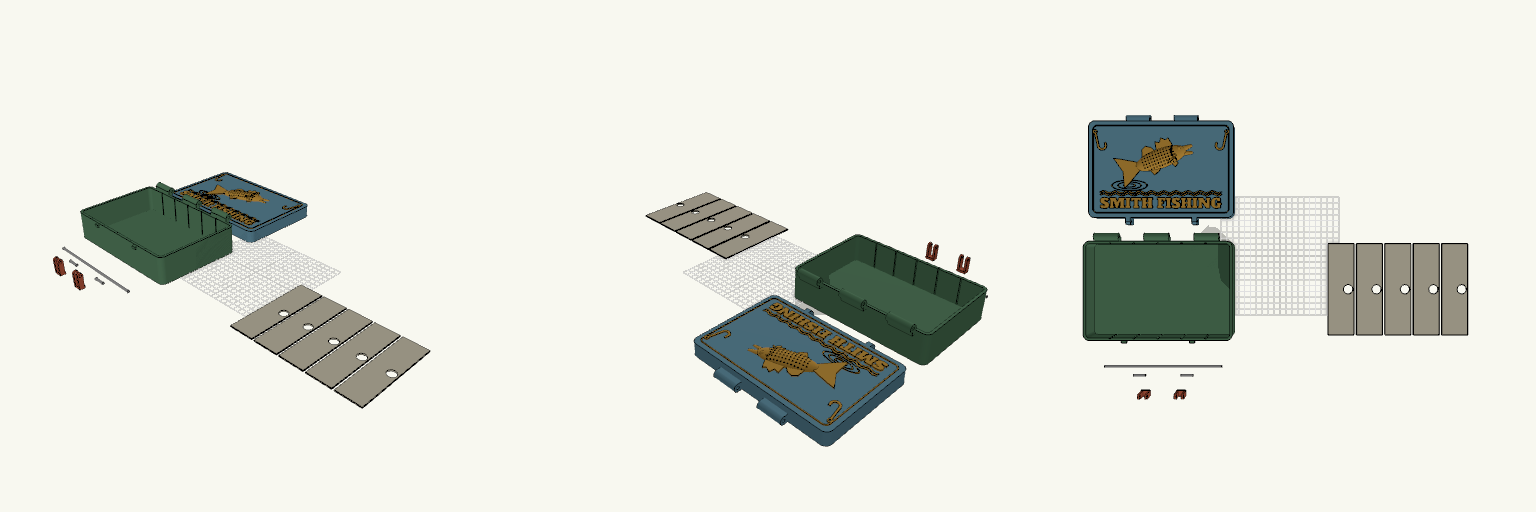
Tackle boxes that pop open in the boat, rattle hooks into the soft plastics, or lose a lid hinge get replaced. This one is a hinged bass tackle box with a locking front latch, adjustable dividers and a leaping largemouth bass on the lid, with SMITH FISHING raised underneath. Load-bearing numbers Base: 240 × 160 × 50 mm, 4 mm walls, 3 mm floor, rounded vertical corners. Lid: 240 × 160 × 22 mm, with a raised bass, ripples, waves, hooks and a border on top. Dividers: 5 removable cross dividers, 1.8 mm thick, sliding in 2.4 mm grooves at 38.5 mm spacing. Hinge: 5 interleaved knuckles across the back, joined by a 4.2 mm pin (197 mm long, printed separately). Latches: 2 front latches with 4.2 mm pivot pins. Each hooks under a ledge on the base. Printing Print every piece in the layout shown: base, lid, dividers, latches and pins are all separate. Lid: print upright. The underside of the top plate bridges across the cavity, so use supports or good bridging settings. Layer height 0.2 mm, PETG or ASA, 3+ perimeters. Hinge and latch pins can be glued or capped at the ends to keep them in.
5 Bölmeli Vidalı Kapaklı Saklama Kabı
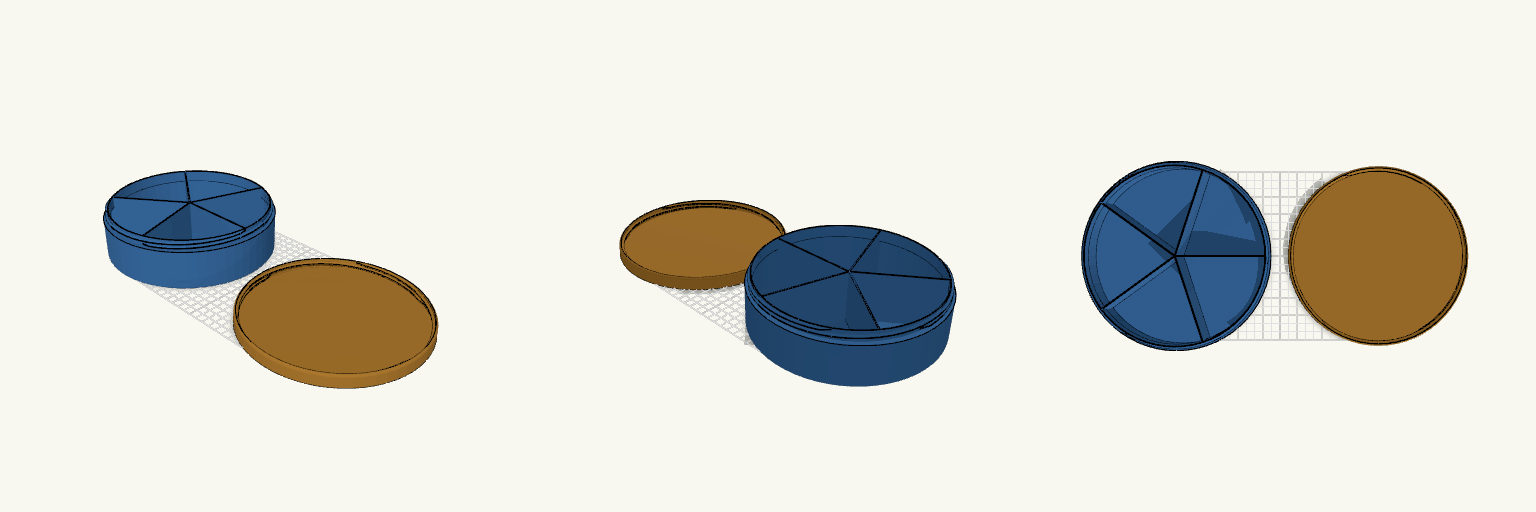
210 mm çapında, 60 mm yüksekliğinde yuvarlak bir saklama kabı. İçi, merkezden duvara 72° aralıkla çıkan beş bölmeyle eşit gözlere ayrılmış; bölmeler dişli boyun bölgesinde de devam ettiği için kapak takılıyken gözeler birbirine karışmaz. Kapak, gövdenin üstündeki dış dişe vidalanır; taşırken kendiliğinden açılmaz. Gövde ve kapak ayrı ayrı basılır. Remix için başlangıç değerleri Gövde: 210 mm çap, 60 mm yükseklik; yan duvar ve taban 1,6 mm, iç bölmeler 1,2 mm Kapak: 210 mm çap, 14,3 mm yükseklik, üst et 2,4 mm; düz yüzü tablaya gelecek şekilde basılır Diş: 12 mm boy, 5 mm adım, 3 ağızlı (hatve 15 mm), 0,5 mm boşluk; kapatmak için yaklaşık 0,8 tur (yaklaşık 290°) Diş çapı 204 mm, boyun iç çapı 197 mm; gövdenin üstündeki basamak her yanda yaklaşık 3 mm kalıyor Nereleri değiştirmek mantıklı Göz sayısı: bölmeler merkezden eşit açıyla çıktığı için sayıyı değiştirmek bölme açılarını da değiştirir; açıyı 72°'den farklı seçersen gözler eşit olmaktan çıkar, bunu bilerek yap. Bölme kalınlığı: 1,2 mm ince ve malzeme dostu; daha ağır parçalar koyacaksan kalınlaştır, ama göz hacmi daralır. Diş boşluğu: 0,5 mm baskıda rahat çalışıyor; makinen sıkı basıyorsa düşür, kapağı sık açıp kapatacaksan artır. Dış çap ve yükseklik: 210 × 60 mm raf ve çekmece için uygun bir başlangıç; aynı dişi koruyup gövdeyi derinleştirmek en kolay varyant. Alt kısımdaki diş dibi duvarı ince kaldığı için o bölgeyi basarken katman ayarlarına dikkat etmek gerekir. Beş gözü sayesinde dökme parçaları, vida ve küçük donanımı ya da atölye malzemesini tek kapta ayrı ayrı tutmak için uygundur; aynı diş ölçüsünü koruyan daha sığ bir gövde ya da daha çok gözlü bir üst katman iyi bir eşleşme olur.
Two-Piece Pro Controller Wall Holder
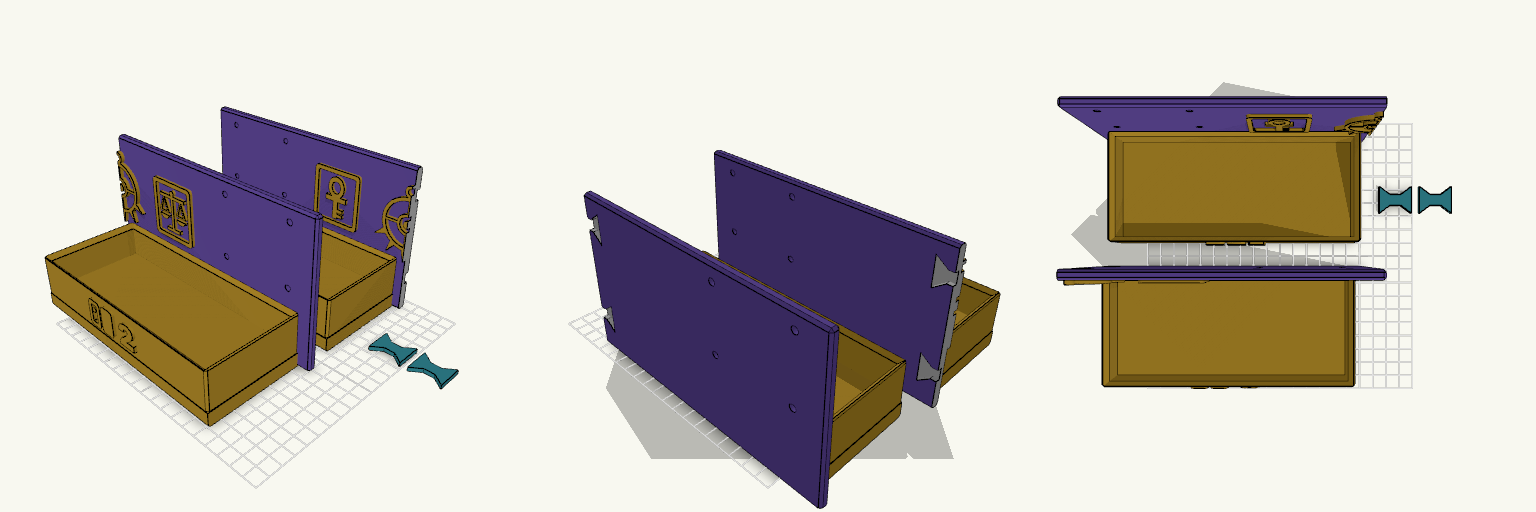
A 380 mm wall holder for a PS5 and a Switch Pro controller is too wide for most print beds, and a single plate can crack along its length. This version prints as two 190 mm halves that lock together with two butterfly keys. Fit and print Split line: centre of the plate, through the Yu-Gi-Oh! ring emblem Keys: two butterfly-shaped keys, 24 mm wide and 20 mm tall, 2.9 mm thick, printed flat Key pockets: cut 3.3 mm deep into the back face, 0.3 mm clearance all round Assembly: press the keys into the back pockets across the seam, then screw the halves to the wall. The wall holds the keys in Mounting: eight countersunk screw holes in total, four per half Printing: halves lie on their backs or stand on the shelf base. No supports are needed for the hollow blocks Pocket sizes are 166 mm wide and 70 mm deep, from typical controller sizes and not from measurements of a specific controller.
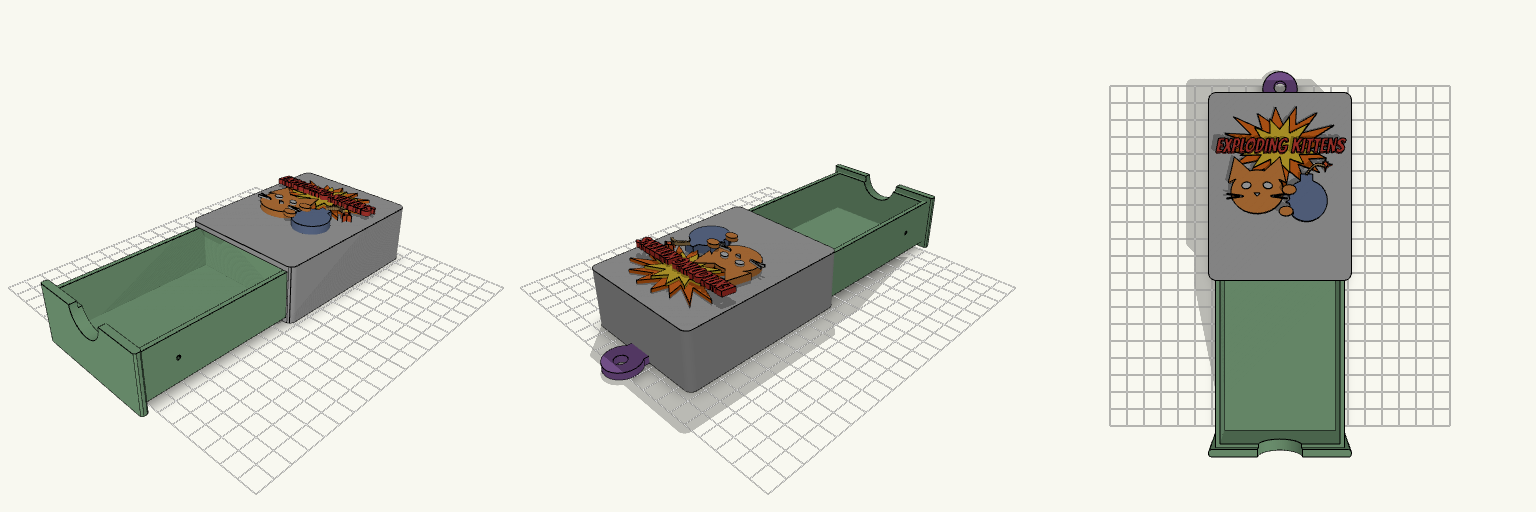
Exploding Kittens Drawer Card Case
What it's for A two-part slide-out card case sized for a single poker-size deck, with the Exploding Kittens artwork carried on the top of the sleeve. The relief shows an angry cat beside a round bomb, bite marks cut into the bomb's edge, a dotted fuse and a spark. A large jagged orange explosion with an uneven outline and a smaller yellow core sits flat on the lid, centred on the title. Because the blast is fused to the surface rather than floating above it, the cat and bomb rise through it, so the explosion reads as a backdrop behind them and both stay clearly visible. The red "EXPLODING KITTENS" lettering stands on the core, kept low so it rises only about 3 mm above the blast. The drawer has a front pull panel with a thumb notch and slides out of the sleeve; a small snap detent on each side wall clicks it shut and lets go with a firm pull. A fused keychain loop on the back of the sleeve lets the case clip to a bag with a carabiner or split ring. Dimensions Sleeve: 76 × 100 × 34 mm, open at the front Drawer: 76 × 99 × 34 mm, with a front pull panel and thumb notch Card well: one compartment, about 64.6 × 91.5 mm, sized for a 63.5 × 89 mm deck Explosion: 57.8 × 44.8 mm blast, 2 mm thick, fused to the lid; core 42.2 × 29.2 × 1.5 mm on top of it Title lettering: 68 × 8 mm, standing on the core about 3 mm above the blast Bomb relief: 5 mm tall, with the paws and fuse lowered to sit level on top of it Keychain loop: 20 mm round lug, 4 mm thick, with a 7 mm hole, fused to the back of the sleeve and reaching about 70 mm out on Y Detents: one small bump per sleeve wall, with matching dimples on the drawer sides Print notes Print the sleeve upside down or with supports under the top, since the ceiling spans the full width. Print the drawer flat on its floor. The keychain lug sits flat on the build plate and needs no supports, but at 4 mm thick it is the lightest part of the case — thicken it if the case will hang from a heavy bag. The enlarged loop pushes the footprint out to roughly 70 mm on Y beyond the sleeve; check it against your plate before starting a full-bed print. Drawer clearance is 0.3 mm per side; adjust if the drawer binds. Sleeved cards need roughly 2 mm more in both the width and length of the well. The lowered red lettering sits directly on the orange and yellow blast, so contrast is low at small scales; check a render before printing the lid art very small. Detent tension has not been test-printed; sand or adjust the bumps if the drawer is too stiff or too loose. Remix ideas Widen the card well for a sleeved or double-sleeved deck. Burst the explosion over the top of the cat and bomb instead of behind them, accepting that it would hide most of the cat. Swap the round bomb for a C4 brick. Add a divider for tokens or a rules card. Thicken the keychain lug to 6 mm and widen the hole further for heavier bags. Trade the detents for a magnetic catch if you prefer a quieter close.
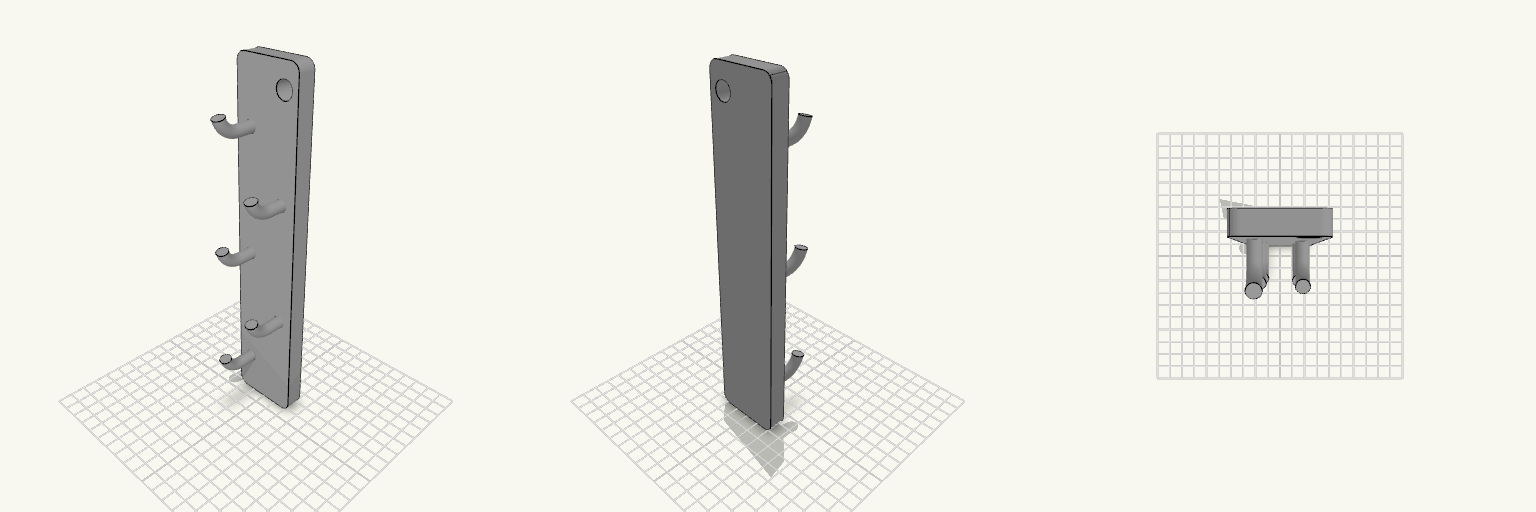
Staggered 5-Key Hook Extender
A tall back plate that hangs from a key rack and holds five keys on alternating left and right pegs, so fobs dangle without touching each other. The plate is 46.2 mm wide, 240 mm tall and 12 mm thick, with a 12 mm hang hole at the top right. Each peg is 8 mm in diameter, runs straight for 12 mm, then curves upward through 75° to keep rings seated. Remix hooks Plate thickness (12 mm): the easiest stiffness lever. Pegs are set into the plate face, so going thicker needs no other changes. Peg spacing (42 mm pitch): raise it for longer fobs, lower it to fit more pegs on a shorter plate. Bend angle (75°) and straight run (12 mm): lengthen the run for larger rings, ease the angle for a flatter peg. Hang hole (12 mm): resize to match your rack hook. Pairs with: any horizontal key rack with a post or screw head that fits the hole.