150mm Bayonet Twist Vault
Made by a Guest
Created 1 months ago
Remixed 2 times
Description
A 150mm mechanical drop-in vault, built around a 50mm twist-lift track.
This replaces the friction fit of the original 150mm Borg Friendship Vault with a proper bayonet mechanism. The outer cage runs three 18mm tall helical tracks to guide the core. The top cap terminates in a 40mm hexagonal drive plug; dropping it onto the core and twisting counter-clockwise forces the payload to lift 50mm out of the chassis.
- Bore Clearance: The 98mm core runs inside a 102mm cage bore. Verify your machine holds tolerances on large cylinders.
- Support-Free: The massive 90mm flat bridges of the original have been replaced by mechanical vertical slots with 45-degree angled roofs. No supports needed for the cage or core lugs.
- Payload Capacity: The hollow inner void measures 76mm in diameter by 110mm deep.
To assemble, line up the core lugs with the vertical entry slots on the inner walls of the cage, push down to the top stop, and twist right to lock it securely to the bottom.
Photos
Technical views
More like this
Explore more in Gifts, Seasonal & Personalized →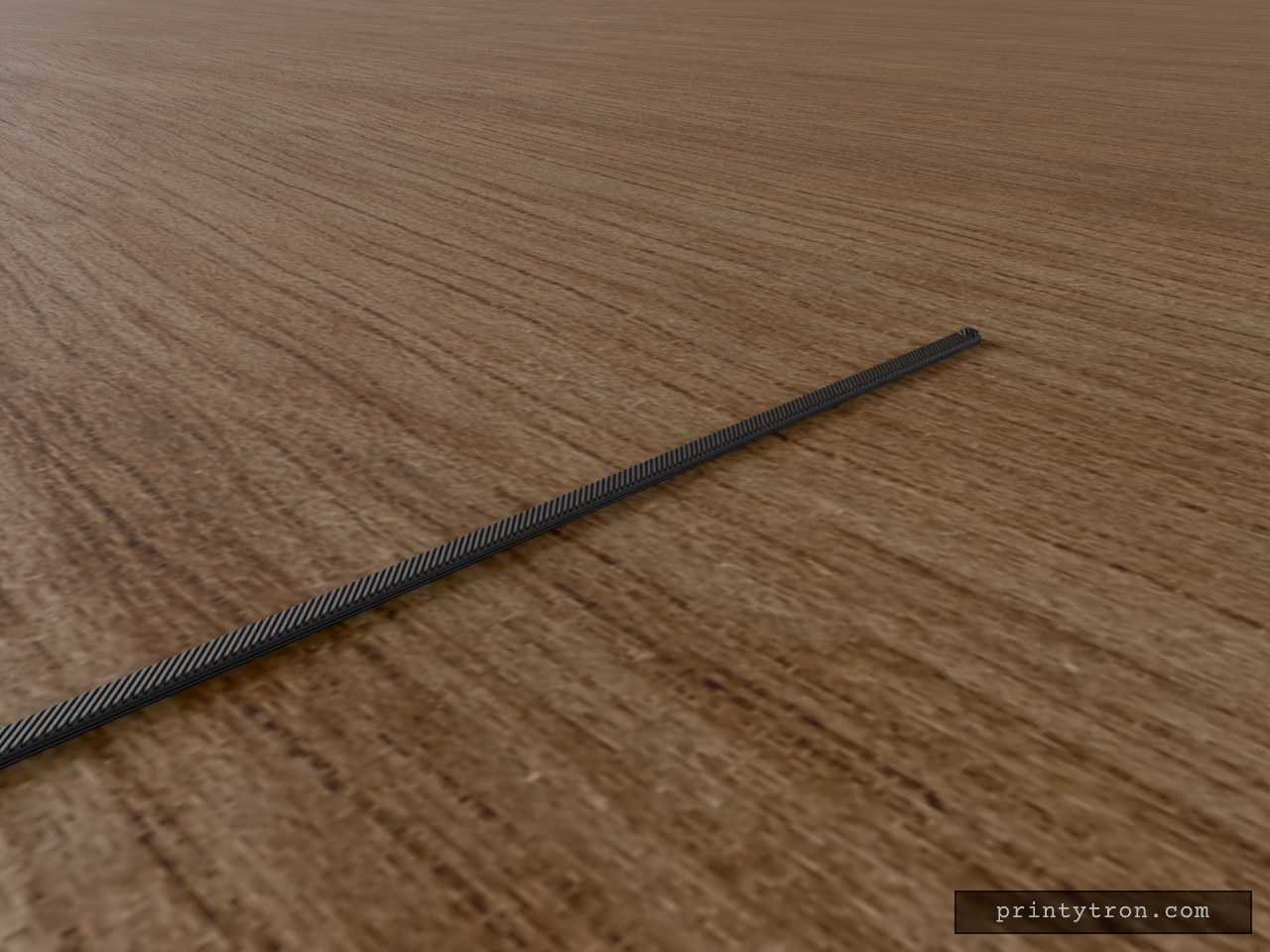
Cast Scratcher Wand, 300mm
A long, thin scratcher wand for reaching down inside a cast. It measures 300 mm long, 8 mm wide and 3 mm thick. Every edge is rounded at 1.4 mm so it slides in smoothly and soothes without catching or scraping skin. One end has a low dome bump, and the other end has a hang hole so the wand can live on a sofa arm, a hook or a loop of cord. It prints flat on the plate with no supports. The dome peaks at about 4.5 mm. Remix hooks Length (L, 300 mm): Shorten it for a forearm cast. Lengthen it for a full-leg cast. Stiffness drops as it gets longer, so consider more thickness if you go past 300 mm. Thickness (T, 3 mm): Thicker is stiffer but needs a wider gap in the cast. Thinner flexes more and can snap in some filaments. Width (W, 8 mm): 8 mm fits most cast gaps. Go narrower for tight padding. Tip bump: The dome is a flattened sphere (80% height) about 7.6 mm across. Make it taller for a firmer scratch, or remove it for a smooth rounded tip. Add a textured pad or ridges if you want something more aggressive. Hang hole (4.5 mm): Fits a small hook, a split ring or thin cord. Enlarge it for a lanyard or carabiner. Move it inward if you want a stronger handle end. Edge rounding (1.4 mm): This is close to the maximum for a 3 mm thickness. Reduce it for a crisper profile. Pairs with A sofa-arm hook or a loop of paracord through the hole. PETG or nylon for flex and durability. PLA works but is more brittle at this thickness. A second copy with a different tip as a spare. Colour regions The shaft and handle are one colour, and the bumped tip is another. This is a single printed piece, not an assembly.
Snowflake Shirt Pin with Safety Pin Loops
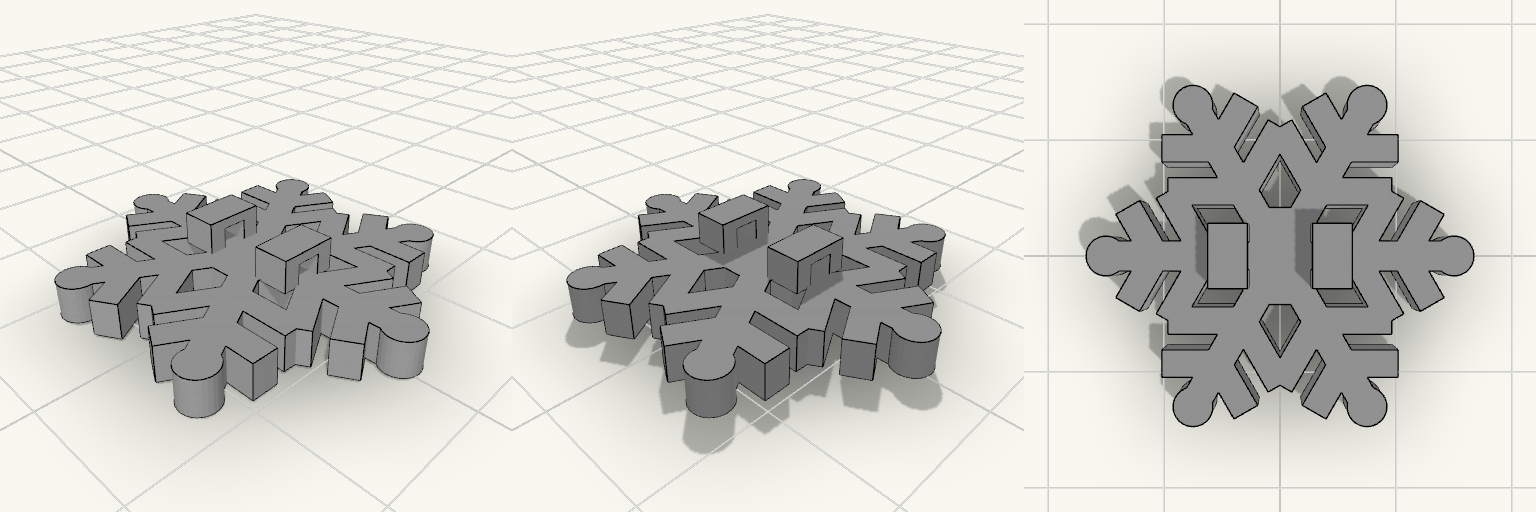
A small snowflake pin with six branched arms, made to be worn on a shirt. Two loops on the back take a standard safety pin, so the snowflake sits on the fabric like a brooch. Six-arm snowflake with side branches and rounded tips Two back loops, 8 mm apart, for threading a safety pin Flat front face prints directly on the plate No supports needed Roughly 31 mm across and under 6 mm thick
Bold Block-Letter FLOYD Name Sign
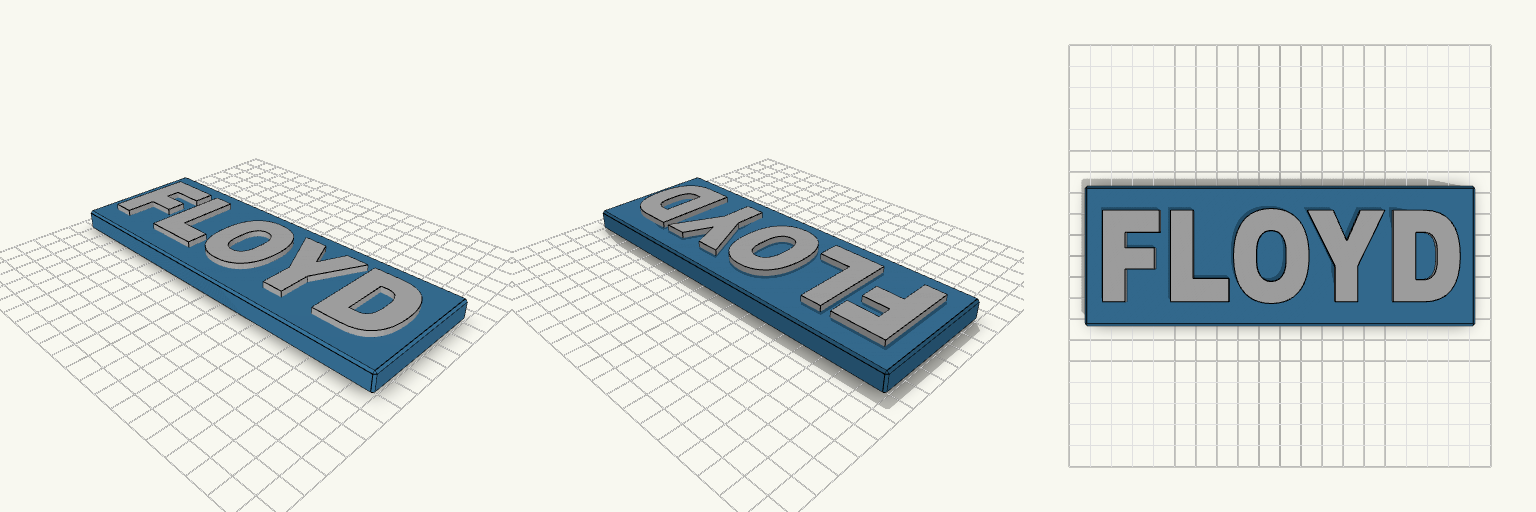
A confident single-word nameplate: a 179 × 64 mm slab, 10 mm thick, with FLOYD rising 3 mm off the face in heavy block capitals for a total height of 13 mm. The letters stretch to roughly 162 × 43 mm, running almost the full length of the top face and leaving only a slim border around them. It reads as signage first and decoration second — the kind of bold lettering that belongs over a door, on a wall, or fixed to a workshop board, and with 10 mm of depth behind it, it also stands on its own as a chunky desk or shelf piece. Sized for a Bambu Lab A1 mini, the sign uses the bed's full width in one direction only, so it prints as one piece with no scaling needed. That width fit is tight: only about 0.5 mm of margin remains on the long side, so a skirt, brim, or calibration offset could push it past the bed edge — a slightly smaller scale is safer if the slicer complains. The 10 mm body uses noticeably more filament than a thin plate, so keep that in mind if material use or weight matters. Design notes Raised lettering sits proud of the plate, catching light and shadow and allowing a contrasting colour with a filament swap at the right layer. The top face, the lettering and the sides are all square-edged; the plate has a flat back and prints from a single flat base without supports. Wide, thick strokes keep the text legible from across a room and sturdy enough to handle. The lettering is proportioned to the plate, so shrinking it uniformly in the slicer keeps the composition intact. Pairs well with a wall bracket, a small stand, or adhesive pads on the back — or just set it down as it is. A plain blue plate with white letters is only one finish — a dark plate with bright lettering, a painted recess, or a single-colour print all work with the same geometry.
Magnetic Snowflake Shirt Pin Set
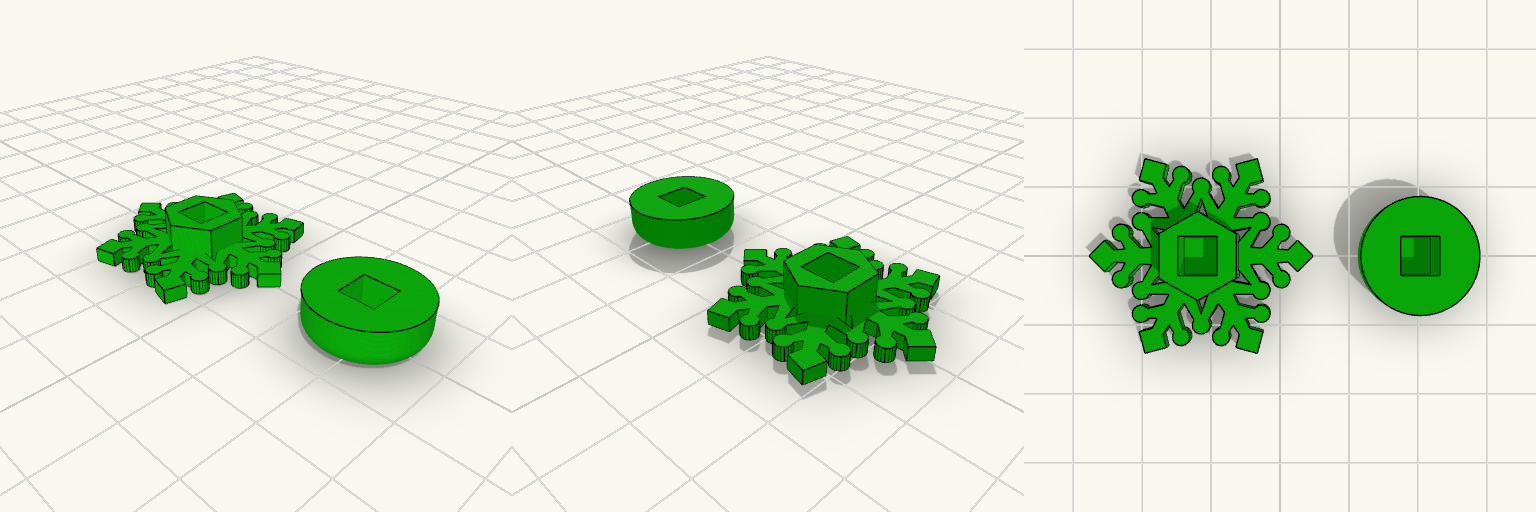
What it's for A snowflake pin that holds to a shirt with magnets instead of a safety pin. The snowflake sits on the outside of the fabric. A small backing disc sits inside the shirt. A 5 mm magnetic cube goes in each piece, and the fabric is clamped between them. Dimensions Snowflake: about 31 mm across, 6.3 mm thick at the centre Backing disc: 14 mm diameter, 6.3 mm tall Magnet pockets: 5.3 mm square, open on one side, with a 1 mm floor Remix ideas Make the pockets shallower for thinner magnets Add a ring or chamfer to the backing disc Use a different pattern on the front
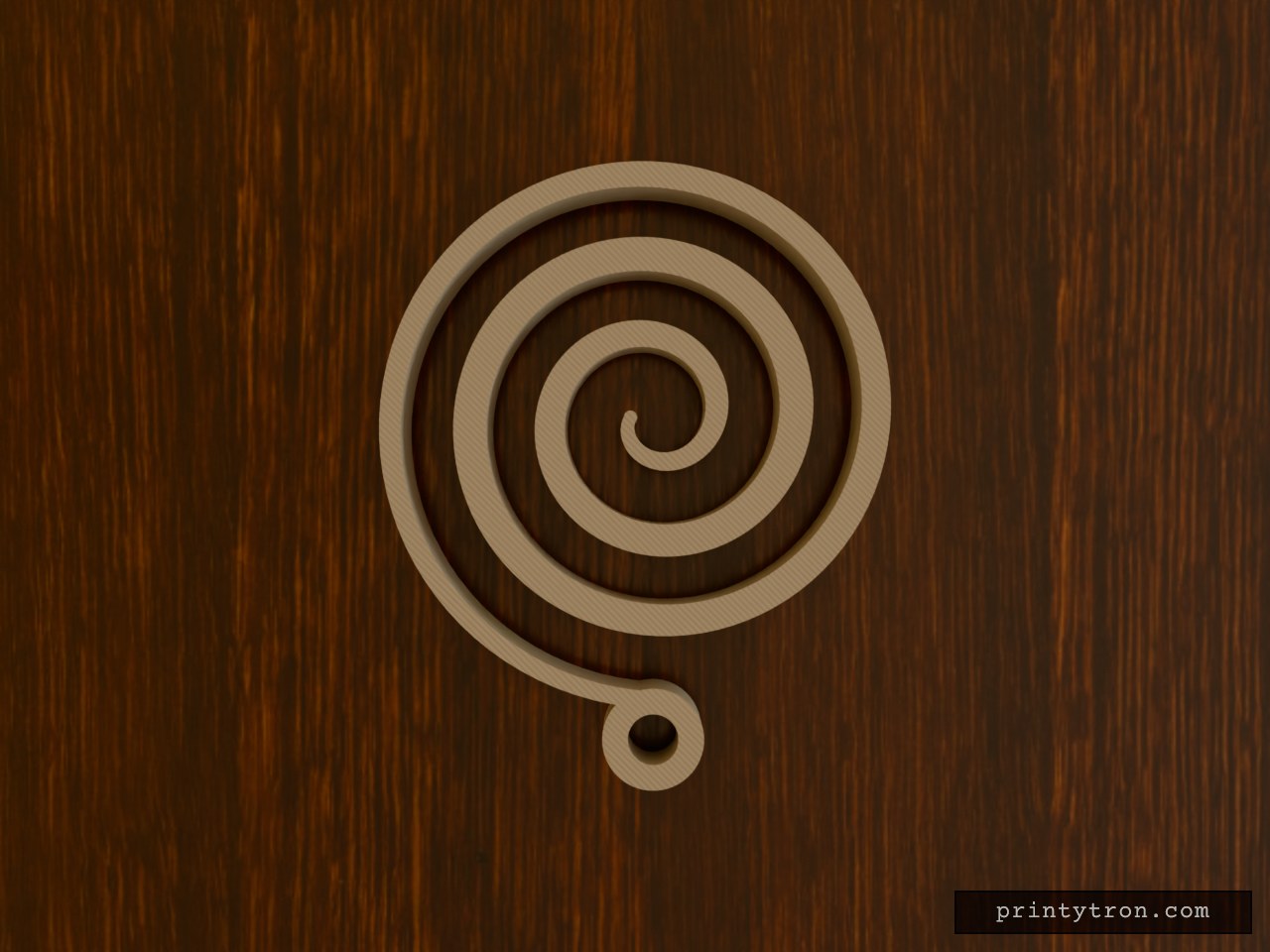
Flat Round Spiral Curl Ornament Medallion, 50 mm
A flat, round hanging ornament shaped as a smooth spiral curl. The spiral is one continuous band that swells through the middle and thins to fine points at both ends, like a calligraphy stroke, with even spacing between turns. It lies flat, so the ornament sits close against a tree branch or a wall instead of projecting outward. A round hanging loop sits at the top at the 12 o'clock position, and the whole ornament prints as one piece in a single color. Specs Overall size: about 45 × 56 mm, 5 mm thick Spiral: one continuous band, tapered to fine points at both ends, heaviest at the middle Turns: about 3.5, evenly spaced Hanging loop at the top, sized for thread, ribbon or a wire hook Single color, one-piece print Flat face: hangs flush against the tree or a wall Prints without supports on its flat face Loop joint: the tapered outer end meets the ring over a small area, so this is the weak point — hang it gently or reinforce that joint if it sees rough use
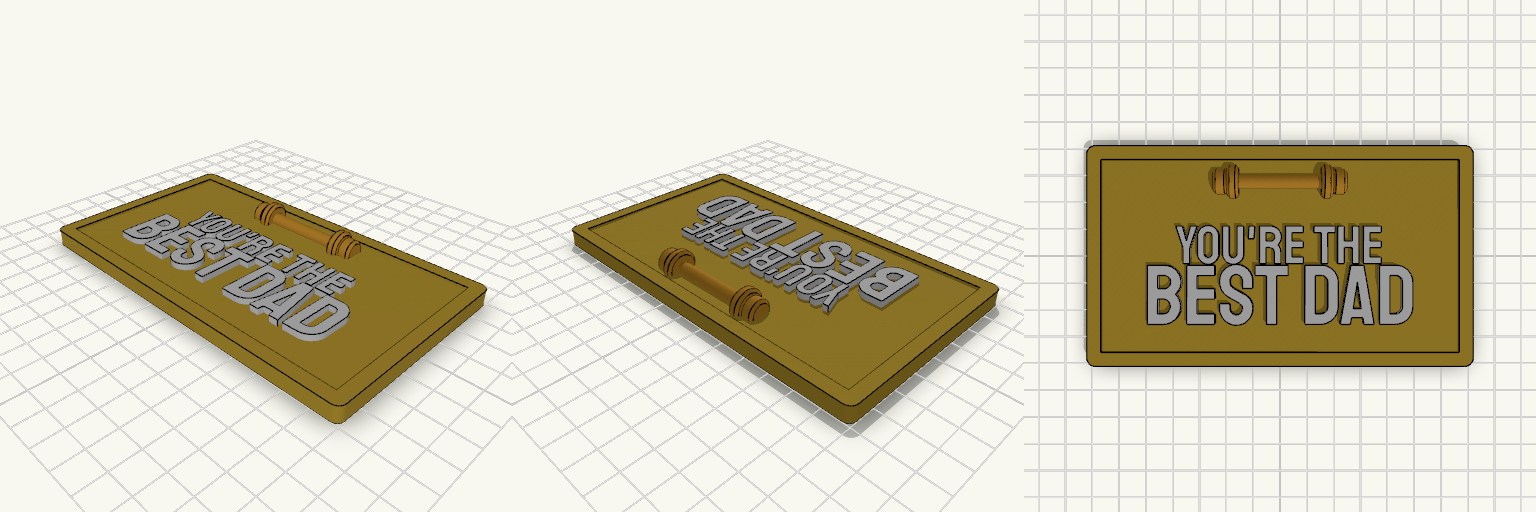
Best Dad Plaque with Dumbbell
A rectangular gold plaque carrying the message "YOU'RE THE BEST DAD" in Staatliches capitals, with a dumbbell motif above the lettering. The plate has a recessed panel that frames the text, and the lettering sits raised inside it. The dumbbell is half sunk into the plate so it reads as a relief in the surface rather than a loose object — the whole thing prints as one solid piece with nothing to glue on. The plaque measures 140 × 80 mm and is 6 mm thick, with the lettering about 96 mm wide and the dumbbell about 48 mm long. The raised elements are shallow enough to print cleanly without supports, and the separately coloured areas — gold plate, white text, orange-amber dumbbell — make it straightforward to swap filament between the parts or print in multiple colours. Recessed panel with raised lettering reading "YOU'RE THE BEST DAD" Dumbbell relief above the text, half sunk into the plate Prints as one piece, no assembly required 140 × 80 mm footprint, 6 mm thick — a desk, shelf or wall-mounted size Colour-separated areas for multi-filament or filament-swap printing No supports needed