20mm Ring Magnet Chalk Holder, 10mm Spring
Made by TitaniumVole
Created 3 days ago
Description
A three-piece spring-fed chalk holder: barrel with magnet base, press-fit top cap, and follower plunger. It is built around a 20 mm OD x 5 mm ring magnet and a 10 mm OD x 30 mm compression spring.
What it fits
- Ring magnet: 20 mm OD x 5 mm (pocket is 20.3 x 5.1 mm, glue in place)
- Spring: 10 mm OD, 8.8 mm ID, 0.6 mm wire, 30 mm long
- Chalk: about 9.5–10 mm diameter (bore is 11 mm)
Check before printing
Measure the actual chalk and magnet. The 11 mm bore and 20.3 mm pocket have no room for much deviation.
Not compatible with
- Chalk over 10.5 mm diameter
- Springs over about 10.5 mm OD
- Magnets larger than 20.3 mm OD or taller than 5.1 mm
Parts
Barrel (65 mm tall, 34 mm flared base, two dust-relief slots), top cap with spring boss, and a plunger that sits between the spring and chalk. Glue the spring to the cap.
Images
More like this
Explore more in Workshop & Tools →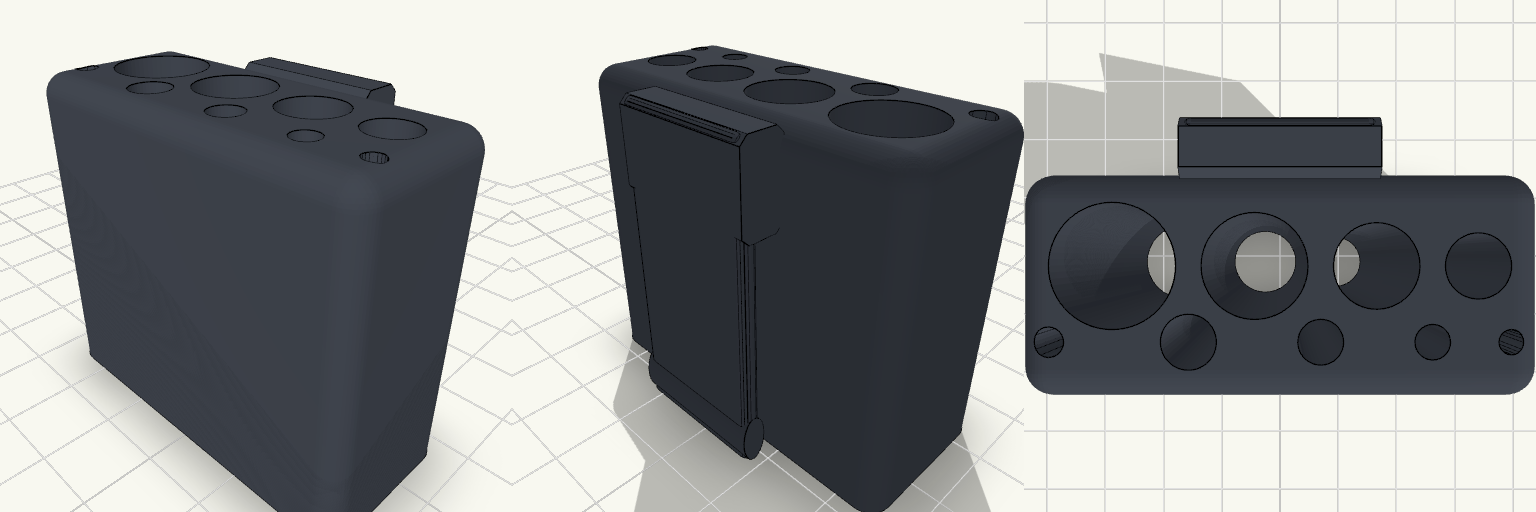
Two-Row Honeycomb Hex Key Pouch
A two-row pouch for nine hex keys from 2 to 12 mm. The back row holds the four large holes and the front row holds five small ones, set into the gaps and ends of the back row so the pouch stays compact. A belt strap runs up the back, and an oval hook at the bottom holds the pouch against the belt. Remix hooks Wall thickness: 1.6 mm between neighbouring holes. This drives the row spacing and the overall depth. Hole list: back row 12.5, 10.5, 8.5 and 6.5 mm. Front row 5.5, 4.5, 3.5, 3 and 2.5 mm. Each has 0.5 mm of clearance. Height: 45 mm. Increase it for longer keys. Strap: 20 mm wide and 2.5 mm thick, standing 3 mm off the body. Lower hook: an oval rod, 6.8 × 3.4 mm, that attaches to the strap only. It leaves about 2.5 mm of clearance to the body. Pairs with: the single-row variant, if you want a slimmer pouch that is wider.
SlotKeeper — Rectangular Velcro Strap Ring
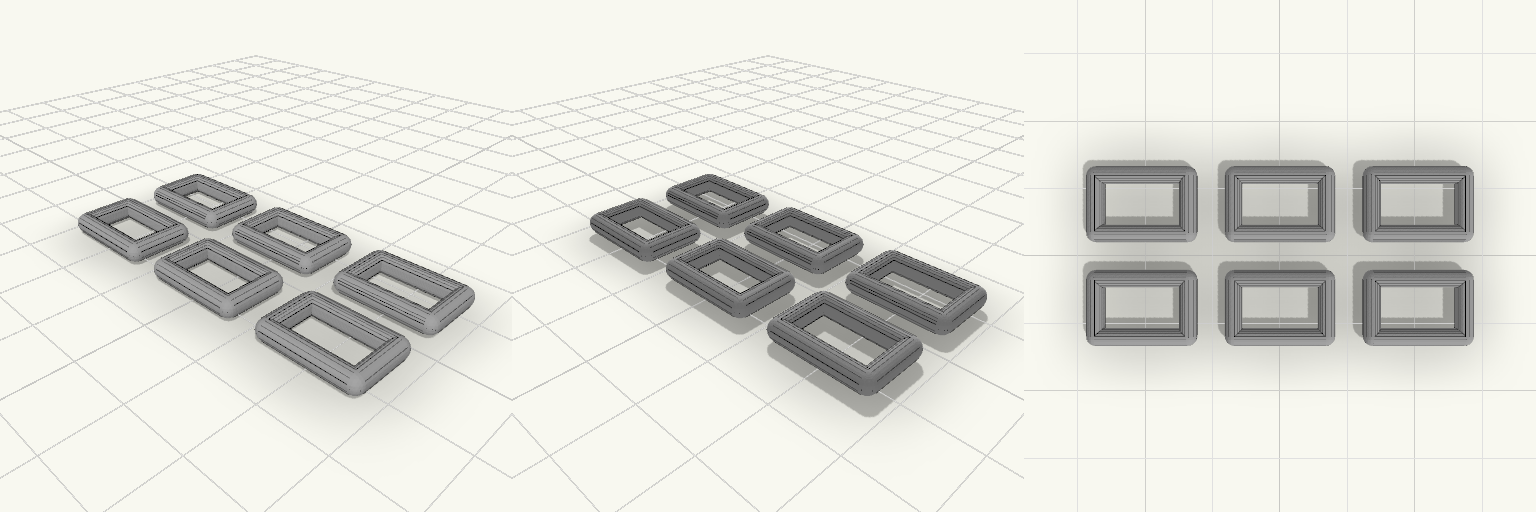
SlotKeeper is a compact rectangular slot ring for velcro straps, built as a single 3 mm-thick keeper/loop. The 11 × 6 mm internal opening gives webbing a clean pass-through, while the 16 × 11 mm outer body and 2.5 mm walls keep the ring solid and simple to print. The edges carry the design: a 1.4 mm rounding on the outside and a 1.0 mm flare around the top and bottom of the opening give it a soft, pill-like profile, so nothing sharp touches the strap on either face. The opening itself is a clean, square-cornered 11 × 6 mm rectangle, so the webbing sits flat right into the corners. The file comes as a set of six identical keepers arranged in a 3 × 2 grid on the plate, so a batch of straps can be kitted out in one print. The whole grid covers 56 × 26 mm of bed at 3 mm tall. Dimensions Internal slot: 11 × 6 mm at its narrowest point Outer body (each keeper): 16 × 11 mm Overall thickness: 3 mm Wall thickness: 2.5 mm Outer edge rounding: 1.4 mm Opening edge flare: 1.0 mm Print-plate footprint (6-up grid): 56 × 26 mm Features Six keepers per print, laid out 3 × 2 and separated for individual use Soft, pill-like profile instead of a boxy ring Rounded outer edges all round, with the opening edges flared to match A narrow flat band remains on the top and bottom faces — enough to sit flat, little enough that no hard corner meets the webbing Square inner corners for a true 11 × 6 mm rectangular slot Thick 2.5 mm walls for a strong loop Print notes Each keeper prints as one solid piece with no extra assembly; the six copies are already spaced on the plate. The 2.5 mm walls and 3 mm overall thickness give a sturdy loop, and the softened profiles mean no sharp edges come off the plate against the strap.
sidways and 2mm indent final cable lock sideways servo
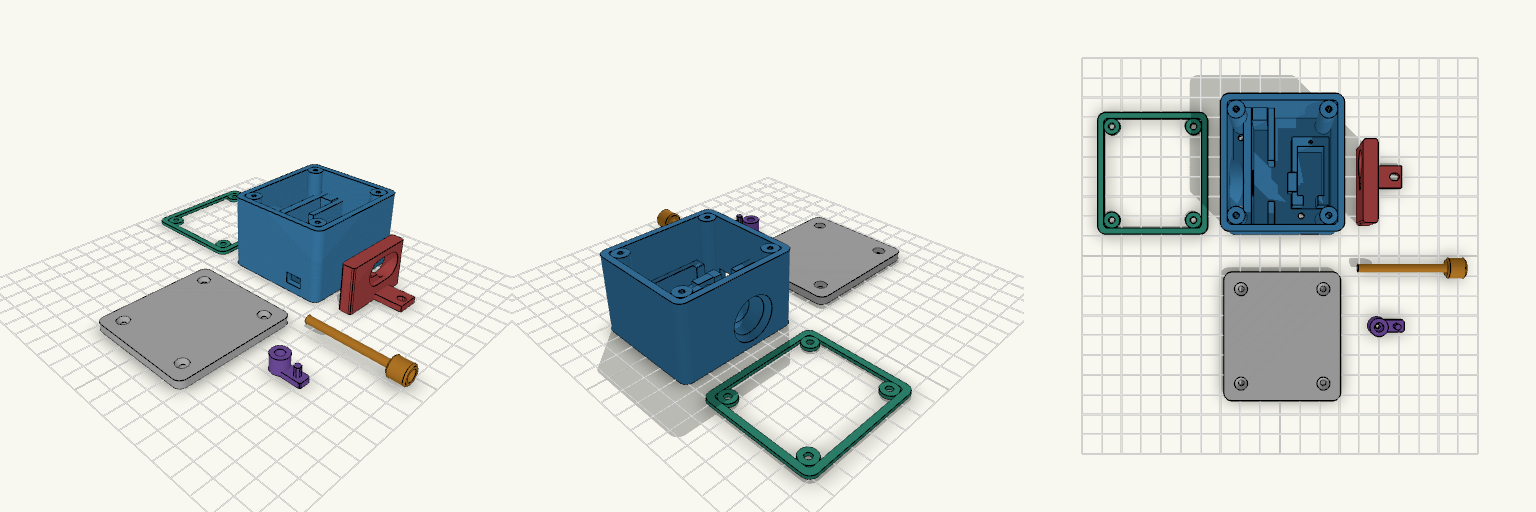
Servo-operated cable lock for a paddleboard rental system, printed in five rigid parts plus a flat TPU gasket. A sliding keyhole plate retains a round cable terminal. A servo arm moves the plate to the release position, where it stops against a wall block. Specs Gasket: 1.5 mm flat TPU, matches the housing rim, with pads and 3.4 mm holes for the four cover screw posts Gasket print: flat on the bed, TPU 95A, slow speed, 100% infill or 4+ walls Terminal head: 10 mm round, 7 mm locking slot, 14 mm release hole Servo: 9 g micro servo, lowered into a floor indent, lead exits the -Y wall Rigid parts: PETG or ASA, 4-6 walls Sealing: the gasket reduces water entry at the cover joint. It is not tested and the lock is not claimed to be waterproof Not load-tested
Stepped Tray Drill Bit Organizer
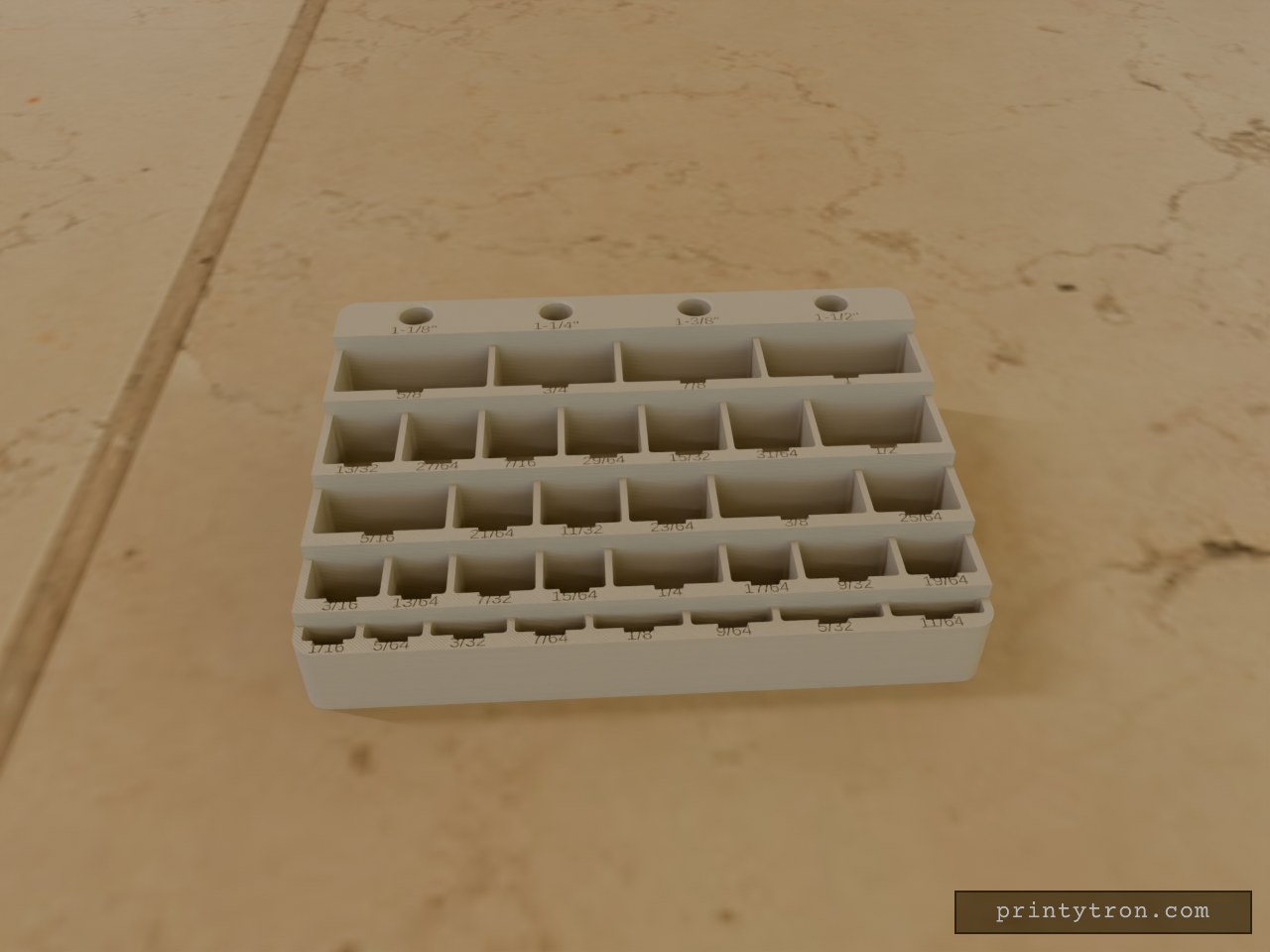
A one-piece, low-profile drill bit organizer built from open-top tray pockets that each hold several bits of one size. Five stepped rows rise toward the back so every engraved label stays visible from the front, and four round holders at the rear take oversized bits by their reduced 1/2" shanks. What it's for Sorting fractional bits from 1/16" to 1" into labeled multi-bit trays. Parking 1-1/8", 1-1/4", 1-3/8" and 1-1/2" bits in single dedicated holders. Benchtop storage with no lid, drawers or moving parts. Dimensions Footprint: 230 mm wide by roughly 160 mm deep, inside the 230 × 170 mm target. Tier heights step from 28 mm at the front to 58 mm at the rear, under the 65 mm limit. Row 1 (1/16"–11/64"): single-file narrow trays, 5–6 bits each. Row 2 (3/16"–19/64"): 4–8 bits each, with 1/4" as the large tray. Row 3 (5/16"–25/64"): 5/16" and 3/8" are enlarged, 8 bits each. Row 4 (13/32"–1/2"): 4 bits each, with 1/2" enlarged to 6. Row 5 (5/8", 3/4", 7/8", 1"): 3, 2, 2 and 2 bits, wider than the smaller trays. Rear holders: four 13.5 mm holes, 35 mm deep, about 54 mm apart. Each pocket has a front finger scoop, an engraved label on the rim, and rounded inner corners. Four 12 mm recessed rubber-foot pockets on the underside. Remix ideas Change the bit counts per tray to match a personal set. Add matching lids or stacking posts. Swap the rear holders for 3/8" shank-reducer sockets. Print in PETG or PLA+ with a 3–4 wall perimeter for extra rigidity.
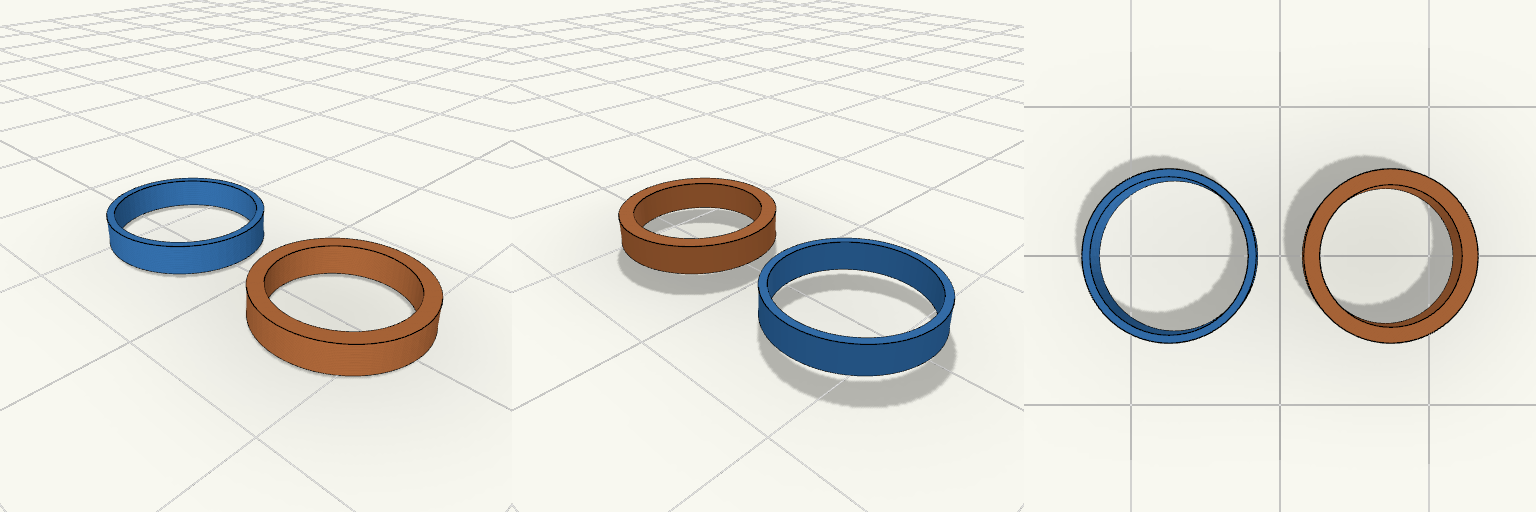
Anillos de 10 mm y 9 mm de interior
Dos anillos planos para cuando el diámetro interior tiene que ser exacto: uno entra donde hace falta un interior de 10 mm y el otro donde hace falta uno de 9 mm, sin depender de lo que marque el taladro. Los dos miden 11 mm por fuera y 2 mm de alto, así que quedan bajos y se imprimen tumbados en la cama, sin soportes. Medidas que deciden el ajuste Anillo de 10 mm — 10 mm de interior, 11 mm de exterior, 2 mm de alto; la pared queda en 0,5 mm. Anillo de 9 mm — 9 mm de interior, 11 mm de exterior, 2 mm de alto; la pared queda en 1 mm. El exterior es el mismo en los dos (11 mm), así que la diferencia está solo en el agujero. Se imprimen planos sobre la cama, sin soportes ni post-procesado. La pared de 0,5 mm del anillo de 10 mm es la parte delicada: imprime con una boquilla de 0,4 mm o menos y revisa que la primera capa haya cerrado bien antes de darle uso. El de 9 mm, con 1 mm de pared, aguanta más trote. Con solo 2 mm de alto, los dos son piezas de poca altura: si la primera capa no queda limpia, el anillo pierde el ajuste que buscabas.
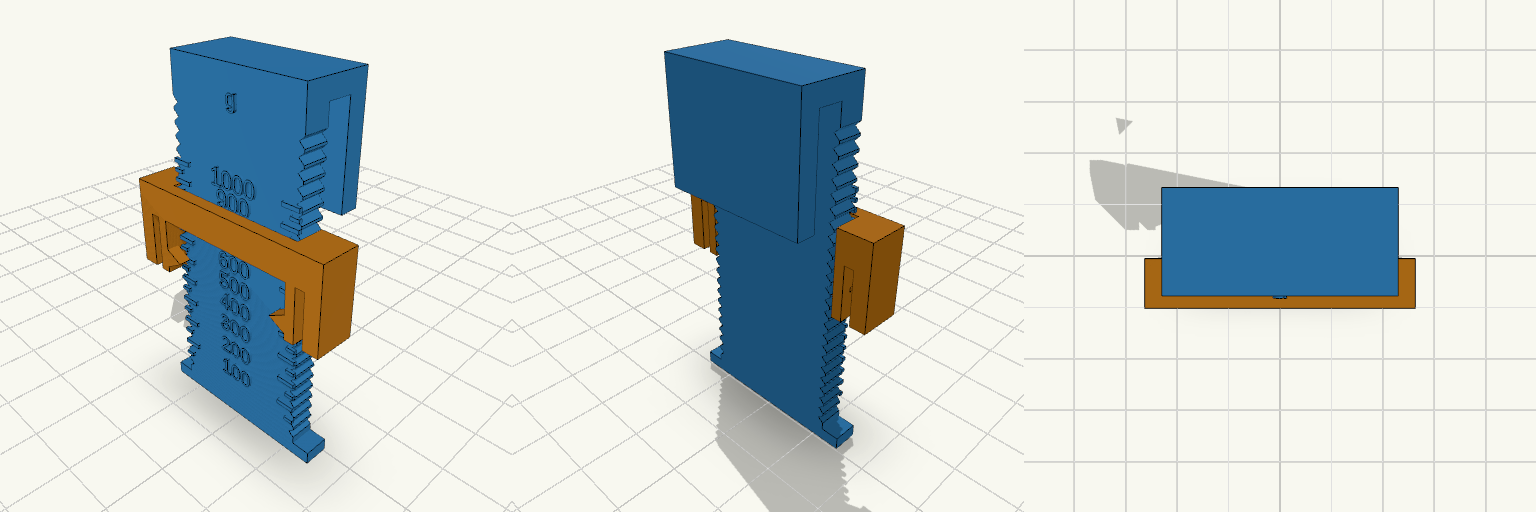
SpoolScope — Filament Remaining Gauge
SpoolScope is a two-part gauge for estimating how much filament remains on a standard spool, made for spools that sit out of easy view in an AMS or on a shelf. The rail hooks over the flange rim; the sliding block rides on it with light detents, so you can push it down until it touches the filament, lift the gauge away and read the result. Raised ticks and numbers plus an unambiguous arrow on the block make the measurement clear without needing line-of-sight while the gauge is in place. Features Two printed parts: a rail with a rim hook, and a detented sliding block. Gram scale from 0 to 1000 g, with ticks every 50 g and numbers every 100 g. Ticks follow filament geometry rather than an even spacing: closer together near full, wider apart near empty. Arrows on the block tip directly toward the scale, and the detents hold the reading after the gauge is lifted off. Hook gap of 4 mm, sized to clear flanges from 2.8 mm to 3.6 mm thick. Dimensions Flange diameter: 200 mm. Hub outer diameter: 95 mm (from a measured Polymaker spool). Full-roll diameter: 170 mm (estimated from a 1 kg PLA roll on a 95 mm hub and a 65.6 mm spool width). Hook gap: 4 mm. Fitting and calibration Sized around Polymaker and Inland 1 kg spools; other brands are worth checking against the hub and flange figures above. The scale can be shifted by a single fixed offset if a first print reads consistently high or low, so a weight check against a known spool is worth doing before trusting the numbers. If the error differs between a full and an empty spool, the hub and full-roll values are the ones to correct. Print notes Both parts are laid out flat on the print plate. The block contacts the filament at its outer edges rather than at the centre, so a reading can sit slightly high; a weight check against a known spool is the best way to confirm the scale.