Two-Row Honeycomb Hex Key Pouch
Made by NapKar
Created today
Description
A two-row pouch for nine hex keys from 2 to 12 mm. The back row holds the four large holes and the front row holds five small ones, set into the gaps and ends of the back row so the pouch stays compact. A belt strap runs up the back, and an oval hook at the bottom holds the pouch against the belt.
Remix hooks
- Wall thickness: 1.6 mm between neighbouring holes. This drives the row spacing and the overall depth.
- Hole list: back row 12.5, 10.5, 8.5 and 6.5 mm. Front row 5.5, 4.5, 3.5, 3 and 2.5 mm. Each has 0.5 mm of clearance.
- Height: 45 mm. Increase it for longer keys.
- Strap: 20 mm wide and 2.5 mm thick, standing 3 mm off the body.
- Lower hook: an oval rod, 6.8 × 3.4 mm, that attaches to the strap only. It leaves about 2.5 mm of clearance to the body.
- Pairs with: the single-row variant, if you want a slimmer pouch that is wider.
Images
More like this
Explore more in Workshop & Tools →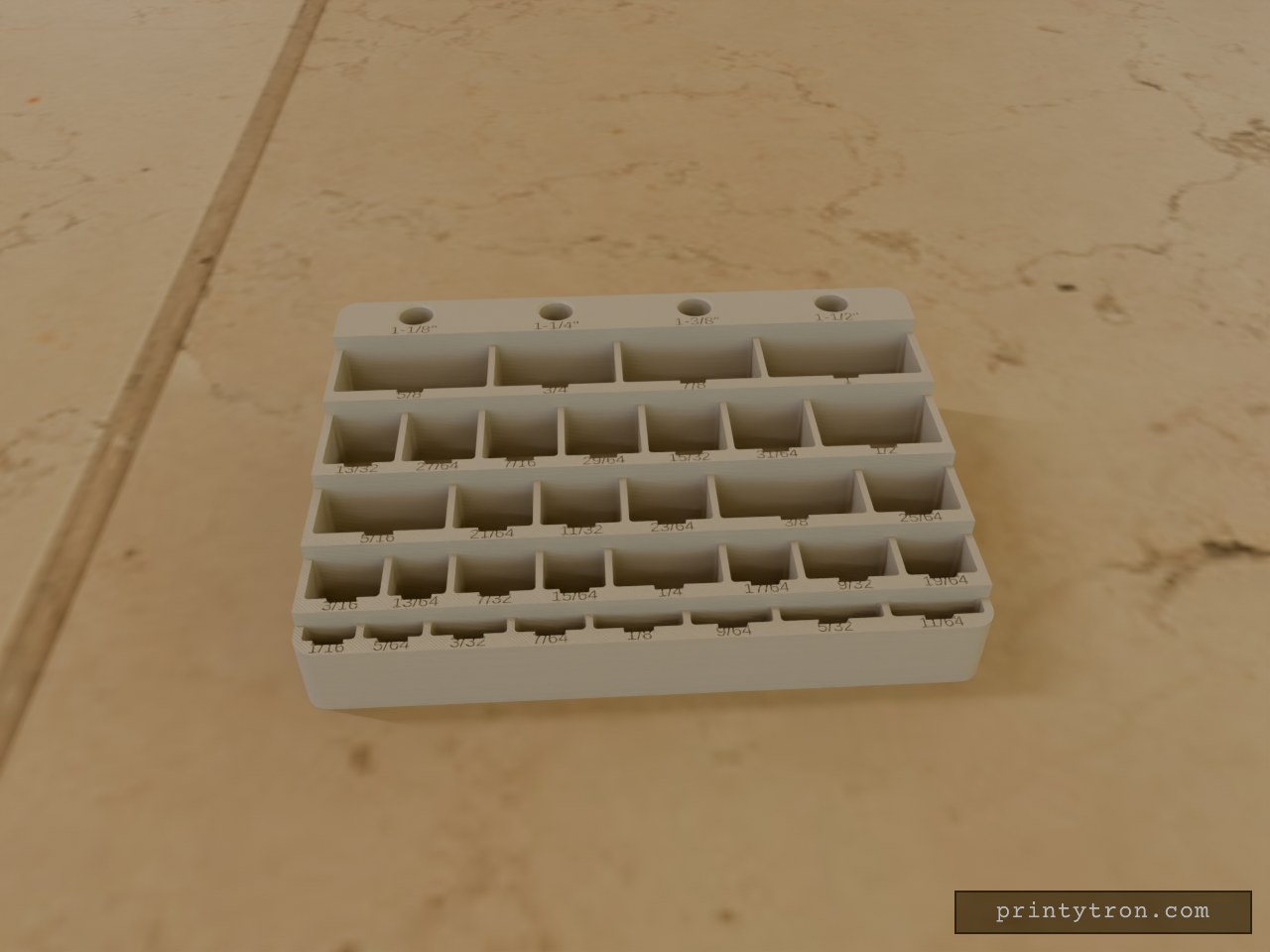
Stepped Tray Drill Bit Organizer
A one-piece, low-profile drill bit organizer built from open-top tray pockets that each hold several bits of one size. Five stepped rows rise toward the back so every engraved label stays visible from the front, and four round holders at the rear take oversized bits by their reduced 1/2" shanks. What it's for Sorting fractional bits from 1/16" to 1" into labeled multi-bit trays. Parking 1-1/8", 1-1/4", 1-3/8" and 1-1/2" bits in single dedicated holders. Benchtop storage with no lid, drawers or moving parts. Dimensions Footprint: 230 mm wide by roughly 160 mm deep, inside the 230 × 170 mm target. Tier heights step from 28 mm at the front to 58 mm at the rear, under the 65 mm limit. Row 1 (1/16"–11/64"): single-file narrow trays, 5–6 bits each. Row 2 (3/16"–19/64"): 4–8 bits each, with 1/4" as the large tray. Row 3 (5/16"–25/64"): 5/16" and 3/8" are enlarged, 8 bits each. Row 4 (13/32"–1/2"): 4 bits each, with 1/2" enlarged to 6. Row 5 (5/8", 3/4", 7/8", 1"): 3, 2, 2 and 2 bits, wider than the smaller trays. Rear holders: four 13.5 mm holes, 35 mm deep, about 54 mm apart. Each pocket has a front finger scoop, an engraved label on the rim, and rounded inner corners. Four 12 mm recessed rubber-foot pockets on the underside. Remix ideas Change the bit counts per tray to match a personal set. Add matching lids or stacking posts. Swap the rear holders for 3/8" shank-reducer sockets. Print in PETG or PLA+ with a 3–4 wall perimeter for extra rigidity.
20mm Ring Magnet Chalk Holder, 10mm Spring
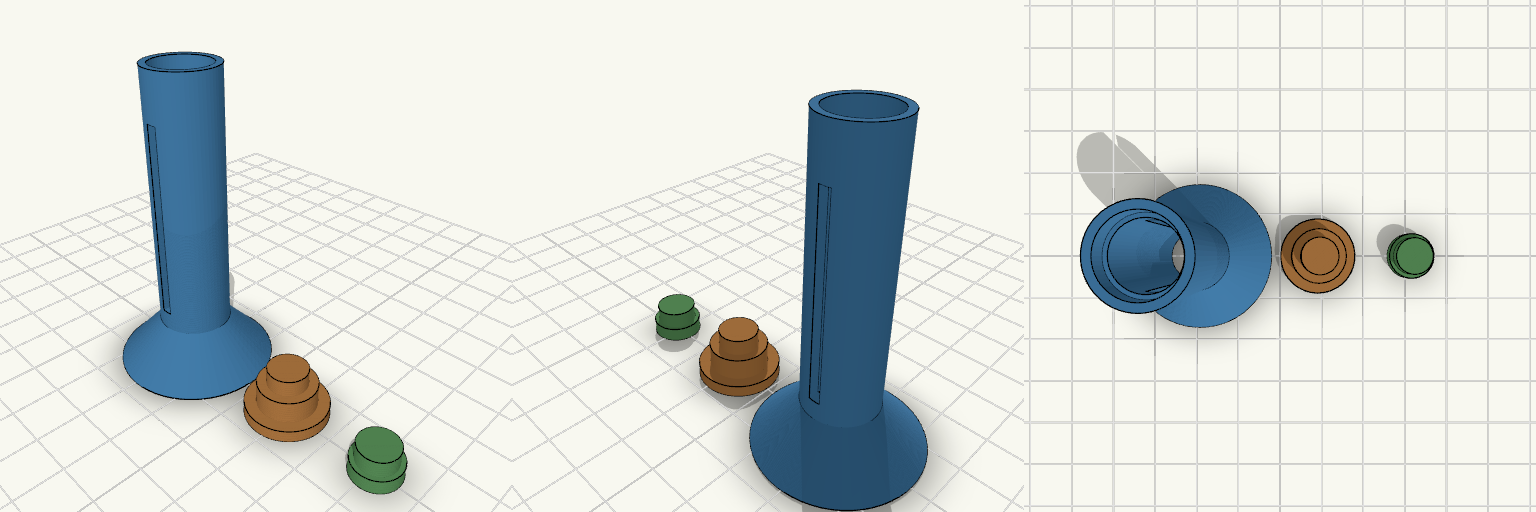
A three-piece spring-fed chalk holder: barrel with magnet base, press-fit top cap, and follower plunger. It is built around a 20 mm OD x 5 mm ring magnet and a 10 mm OD x 30 mm compression spring. What it fits Ring magnet: 20 mm OD x 5 mm (pocket is 20.3 x 5.1 mm, glue in place) Spring: 10 mm OD, 8.8 mm ID, 0.6 mm wire, 30 mm long Chalk: about 9.5–10 mm diameter (bore is 11 mm) Check before printing Measure the actual chalk and magnet. The 11 mm bore and 20.3 mm pocket have no room for much deviation. Not compatible with Chalk over 10.5 mm diameter Springs over about 10.5 mm OD Magnets larger than 20.3 mm OD or taller than 5.1 mm Parts Barrel (65 mm tall, 34 mm flared base, two dust-relief slots), top cap with spring boss, and a plunger that sits between the spring and chalk. Glue the spring to the cap.
sidways and 2mm indent final cable lock sideways servo
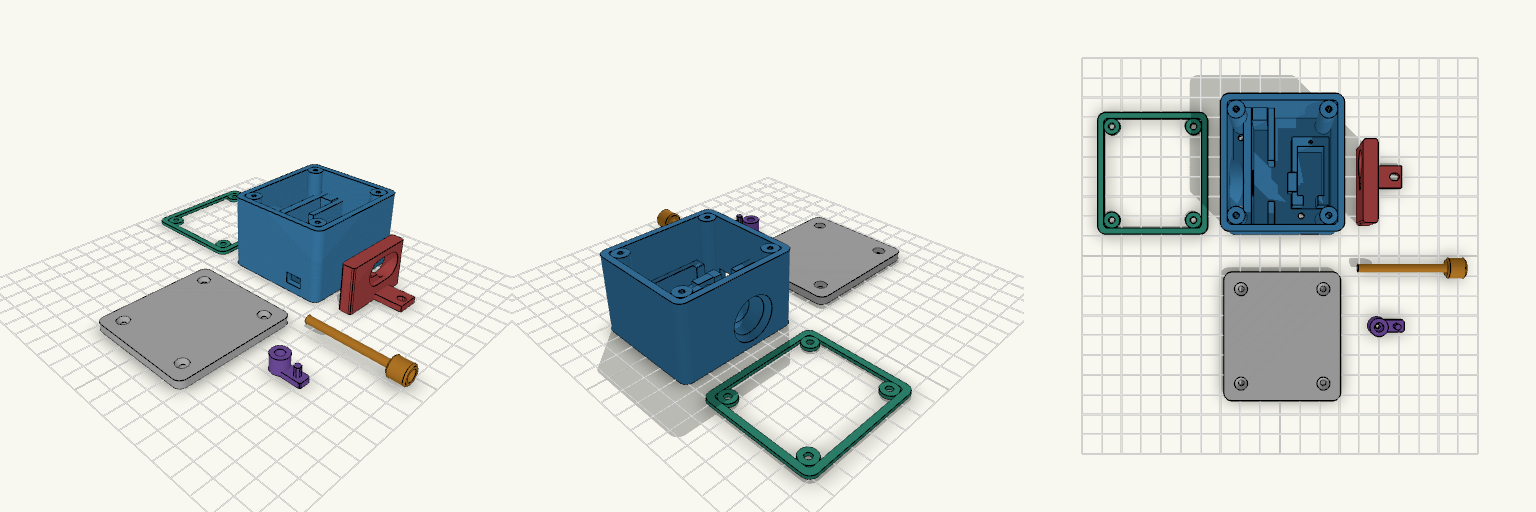
Servo-operated cable lock for a paddleboard rental system, printed in five rigid parts plus a flat TPU gasket. A sliding keyhole plate retains a round cable terminal. A servo arm moves the plate to the release position, where it stops against a wall block. Specs Gasket: 1.5 mm flat TPU, matches the housing rim, with pads and 3.4 mm holes for the four cover screw posts Gasket print: flat on the bed, TPU 95A, slow speed, 100% infill or 4+ walls Terminal head: 10 mm round, 7 mm locking slot, 14 mm release hole Servo: 9 g micro servo, lowered into a floor indent, lead exits the -Y wall Rigid parts: PETG or ASA, 4-6 walls Sealing: the gasket reduces water entry at the cover joint. It is not tested and the lock is not claimed to be waterproof Not load-tested
Plumbing-Aisle Hex Adapter, 3/8 to 1/2 Inch
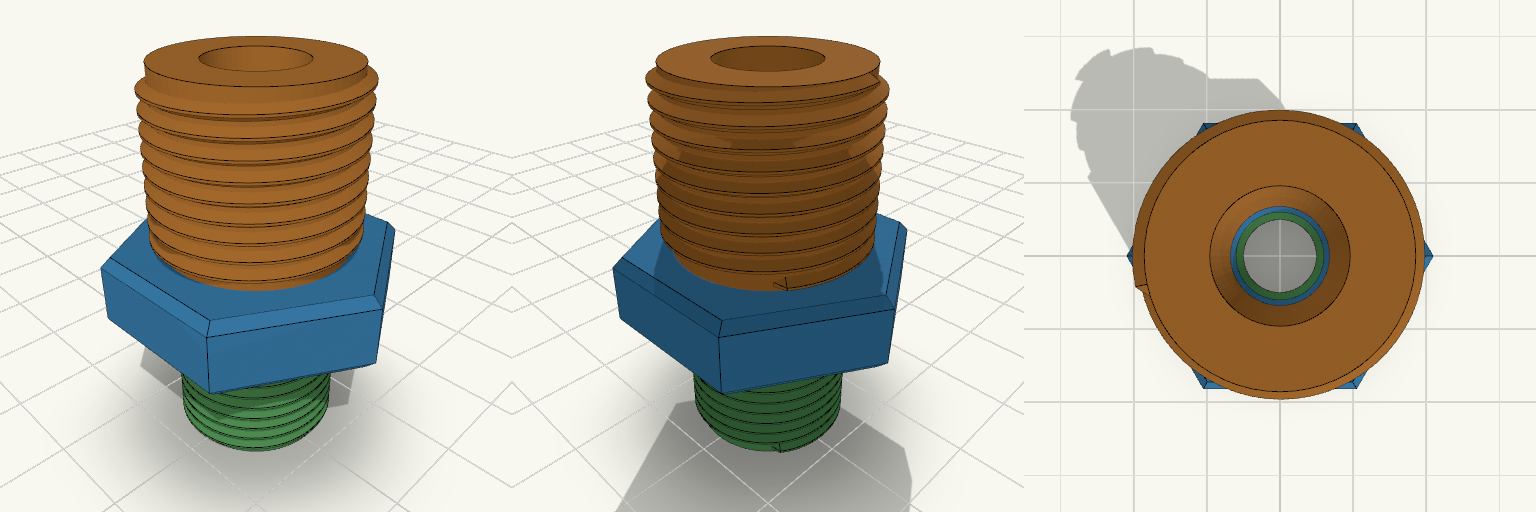
A pocket-sized piece of the plumbing aisle: a low, wide hex body gripped in the middle, a slim 3/8-inch male thread dropping from the bottom and a 1/2-inch male thread rising from the top. A 10 mm bore runs clear through all three sections, so it steps one thread size up to the other while staying hollow end to end. Total height is 40 mm, and the hex is pared down to an 8 mm slab — still a real wrench flat between the two threaded ends, but a much stubbier profile than a stock fitting. Design notes Bottom end: 3/8-inch male thread, 17.1 mm across at 18 TPI and 14 mm long. Top end: 1/2-inch male thread, 18 mm long at 14 TPI. Hex body: 8 mm tall, 27 mm across the flats. Both threads are modelled straight rather than tapered, so wrap them with thread tape — the seal comes from the tape, not the thread form. Printed polymer won't hold rigid PVC working pressure; keep this to low-pressure lines or display use. Prints as a single piece with no assembly. Pairs with Low-pressure runs that need to step a 3/8-inch port up to a 1/2-inch fitting Tight spots where the shorter hex body clears a surrounding boss or housing Jigs, test rigs and spigot adapters where a hollow through-bore matters Props and display builds that want a believable threaded joint
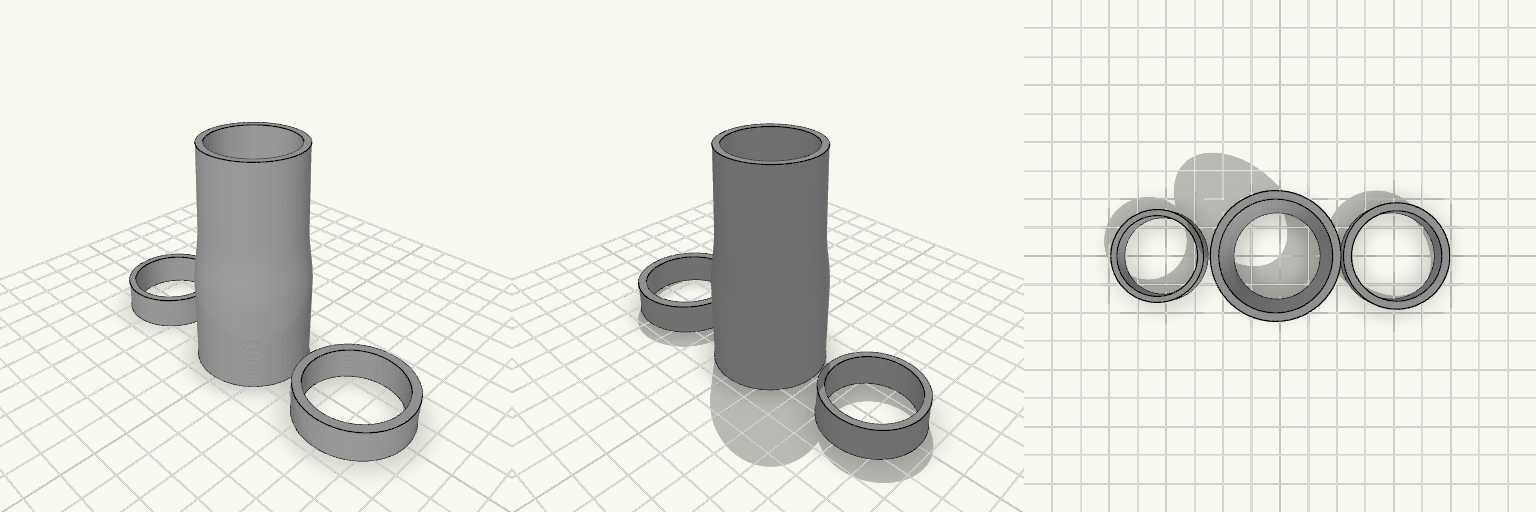
Smooth Vacmaster to Shop Hose Adapter
A smooth two-section adapter that joins a Vacmaster 2.5 gal shop vacuum port to a shop hose. One end is a tapered male spigot that locks into the vacuum port; the other is a tapered female socket that wedges the hose in place. The inner bore and outer surface blend through smooth transitions, so there are no hard ridges in the airflow path and the outside has a continuous profile. The adapter stands 70 mm tall and 35.5 mm across the base, so it prints upright with the wide socket end down on the plate — no supports needed. Two 10 mm test rings sit flat on the plate beside it so both fits can be checked before printing the full adapter. With the rings included, the set spans about 113.5 mm across the plate. Hose socket (bottom, 35 mm): bore tapers from 30.5 mm at the mouth to 29.5 mm, wedging a 30.16 mm hose partway down. Vacmaster spigot (top, 35 mm): outside diameter tapers from 32.5 mm at the base to 31 mm at the tip, with a 27 mm bore. Smooth transitions: the inner bore narrows from the 29.5 mm socket to the 27 mm spigot bore along a smooth curve over about 20 mm; the outer body flows into the spigot over about 22 mm. The old ledge and shoulder are gone. Internal stop: the junction is a gentle cone rather than a hard shelf; a 30.16 mm hose still wedges in the socket taper before reaching it. Test rings: the socket ring has a 35.5 mm OD and a bore from 30.5 mm to about 30.2 mm; the spigot ring tapers from about 31.4 mm to 31 mm OD with a 27 mm bore. Both are 10 mm tall and print flat. Print settings: PETG or ABS, at least 5 perimeters for an airtight seal, 100% infill or walls only, no supports. Because shop-vac ports vary between units, print the two included test rings first, then commit to the full 70 mm adapter.
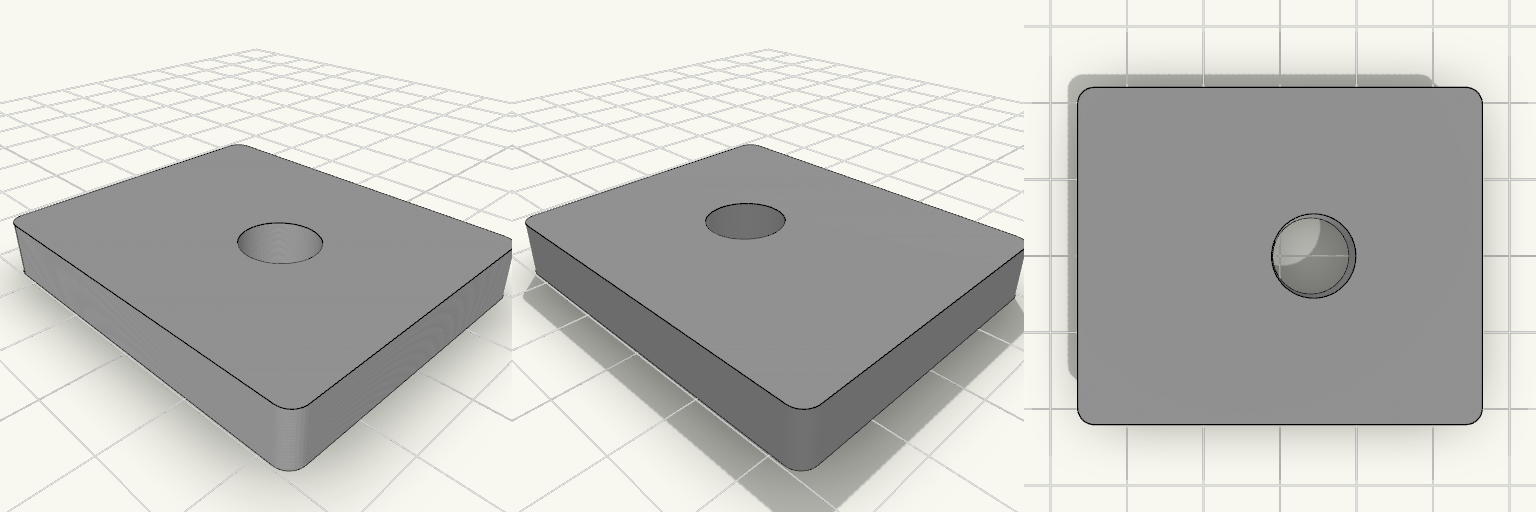
Elliptical Pedal Insert 48x40 Offset Hole
What it's for Central reinforcement insert for an elliptical trainer pedal, bonded into the damaged opening. Flat top, ribbed underside. Dimensions Base: 48 × 40 × 7 mm, rounded corners Through-hole: 10 mm, centered at 24 mm along the length and 4 mm toward the top edge from the width center 18 mm boss around the hole, 5 ribs to a 3 mm frame Remix ideas Change the hole offset for a different pedal Add or remove ribs Thicken the frame for heavier loads