4-Hotend 8-Nozzle Holder for Elegoo Centauri 2
Created 4 days ago
Description
A storage holder for Elegoo Centauri 2 hotends and nozzles. The main block has four front-opening hotend pockets on a 32 mm pitch, each with snap-in retention ridges at the opening so a hotend snaps past and stays put. Four rounded-end magnet slots in the back face take press-fit magnets. Nozzles sit in two holders fused to the ends of the block, four 7.2 mm wells each in a 2 x 2 grid, labelled 0.2/0.4 on one side and 0.6/0.8 on the other. Each holder overlaps its block end by 3 mm, so the whole holder is one solid piece rather than separate clip-on parts, and the wells are shifted outward to sit clear of the block face. The front face is marked HOTEND above the pockets. Lightening slots through the dividers cut material use and print time.
Specifications
- Overall footprint: approximately 170 x 22.8 x 90 mm including the fused side nozzle holders; the hotend block alone is 128 x 22.8 x 90 mm
- Hotends: 4 front-opening pockets, each 22 x 13 mm and 50 mm tall; check the pocket size against your actual hotend dimensions
- Retention: two rounded ridges at each pocket opening narrow it to roughly 18.6 mm, so a hotend around 20 mm wide snaps past and stays put
- Nozzles: 8 wells total, four per side holder in a 2 x 2 grid, 7.2 mm diameter x 14 mm deep
- Side nozzle holders: each about 24 x 22.8 x 30 mm, protruding roughly 21 mm past each end of the block with a 3 mm overlap; wells sit about 1.5 mm clear of the block face
- Labelling: 0.2 and 0.4 on one holder, 0.6 and 0.8 on the other, each label covering the two wells behind it; holder lettering is 3.5 mm tall
- Magnet slots: 4 stadium-shaped slots in the back face, 5.2 x 37 mm and 4 mm deep, for 5 x 37 x 4 mm rounded-end magnets, one centred in each column
- Text: HOTEND embossed 8 mm tall above the pockets, 0.8 mm proud; size numbers on the main block are 7 mm tall
- Lightening: 5 mm wide x 46 mm tall slots through the three dividers between columns, front to back
- Column pitch: 32 mm
Images
More like this
Explore more in Storage & Organization →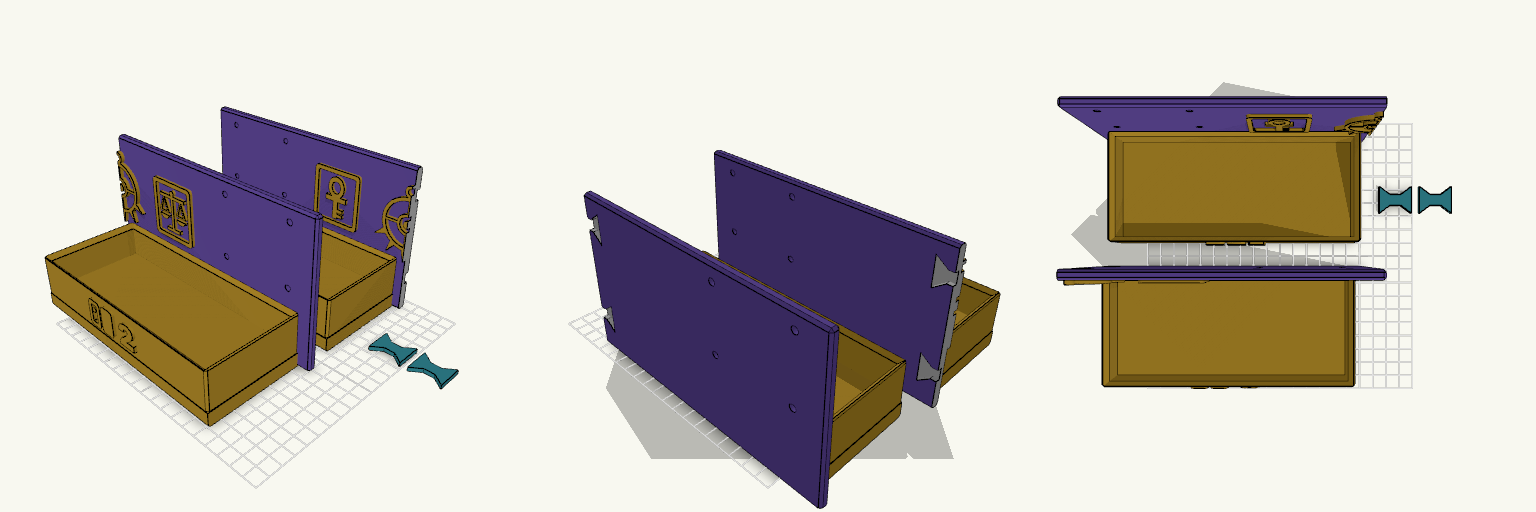
Two-Piece Pro Controller Wall Holder
A 380 mm wall holder for a PS5 and a Switch Pro controller is too wide for most print beds, and a single plate can crack along its length. This version prints as two 190 mm halves that lock together with two butterfly keys. Fit and print Split line: centre of the plate, through the Yu-Gi-Oh! ring emblem Keys: two butterfly-shaped keys, 24 mm wide and 20 mm tall, 2.9 mm thick, printed flat Key pockets: cut 3.3 mm deep into the back face, 0.3 mm clearance all round Assembly: press the keys into the back pockets across the seam, then screw the halves to the wall. The wall holds the keys in Mounting: eight countersunk screw holes in total, four per half Printing: halves lie on their backs or stand on the shelf base. No supports are needed for the hollow blocks Pocket sizes are 166 mm wide and 70 mm deep, from typical controller sizes and not from measurements of a specific controller.
Two-Piece Rack for 14 Game Tiles
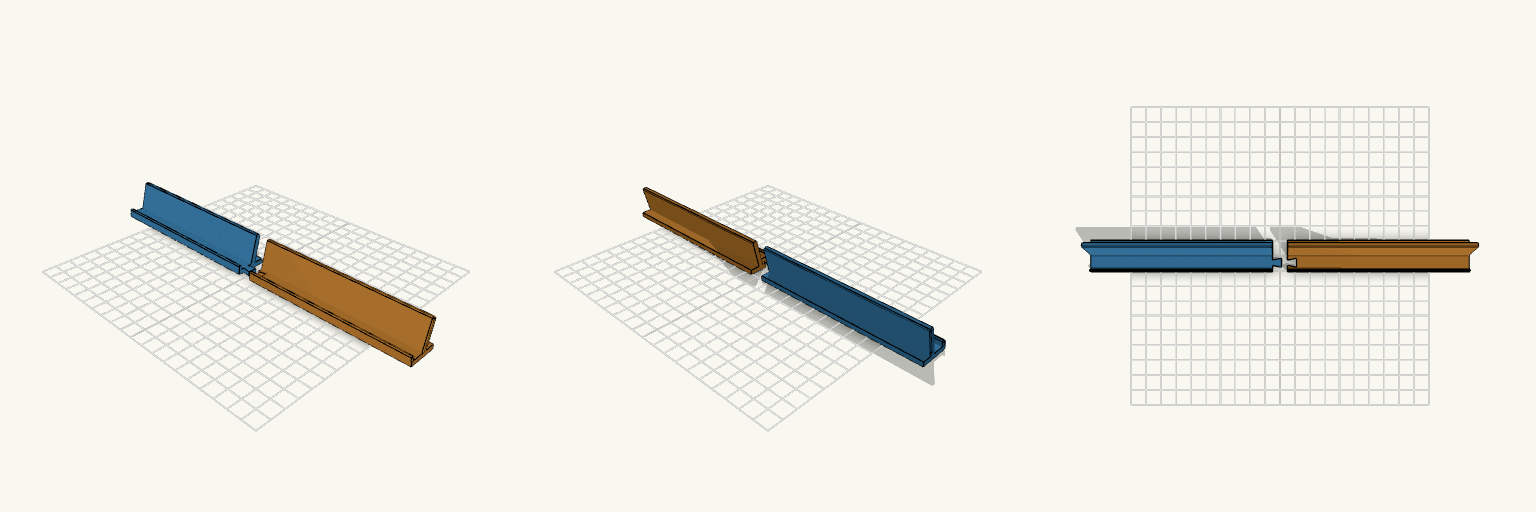
This stand holds fourteen game tiles upright and ready at the table. It is split into two halves that join at the middle with a dovetail, so it breaks down for storage. A low front lip runs along the front of the base, and the fixed back panel leans back 15° so tiles rest in a steady lean against it. The rack is sized for tiles about 17 mm wide, 7 mm deep and 24 mm high, and it has no dividers between tiles. To assemble, drop the tab on the left half down into the socket on the right half from above. The joint sits flush with the tray floor, so the tile slot stays clear. The tab is 3 mm tall, which keeps the halves aligned but is not a strong joint; a dab of glue makes it permanent. Both halves print flat on the plate and need no supports. The dovetail socket is cut to 0.04 mm clearance per side — about the limit for a typical printer, so the halves may not seat by hand. If they bind, sand the tab lightly. Holds 14 tiles sized for 17 × 7 × 24 mm Two halves, about 127 mm and 121 mm long as printed, joined by a drop-in dovetail with 0.04 mm clearance per side Overall length about 242 mm when assembled, leaving roughly 4 mm of slack across 14 tiles 8 mm deep tile slot in front of the back panel, giving about 1 mm of clearance over a 7 mm tile 2 mm front lip, 6 mm high, keeps tiles from sliding forward Fixed back panel about 23 mm tall, leaning back 15° No tile slots or dividers; tiles sit side by side in the tray Both halves print flat without supports
Drawer Organizer Grid for Mini Toolbox Top Drawer
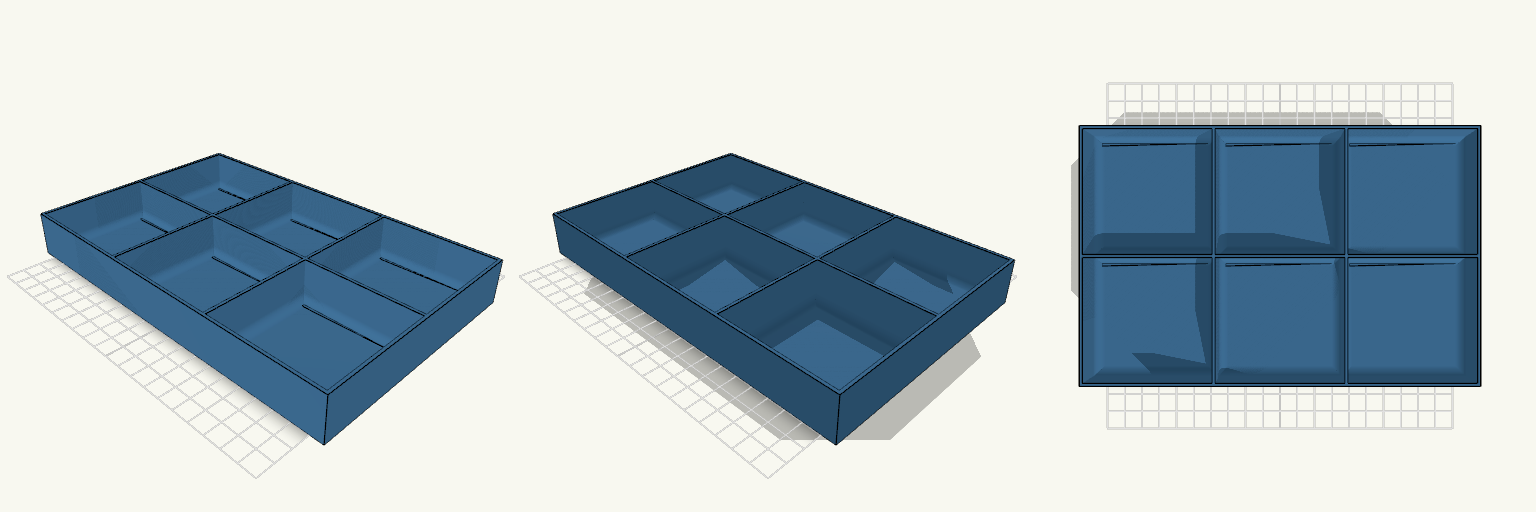
Small screws, bits, and sockets slide into one pile in the shallow top drawer of a U.S. General Mini Toolbox. This 3×2 organizer grid drops into that drawer and gives each group its own bin, so you can grab one without dragging the rest along. Footprint: 215.5 × 140 × 26 mm, sized for the top drawer with clearance. Compartments: six bins, each about 69.7 × 67.6 mm. Walls and floor: 1.6 mm walls, 1.2 mm floor. Bin floors: 5 mm rounded bottom edges so small parts can be scooped out instead of trapped in square corners. Printing: one piece, no separate inserts or assembly. The grid works as a single tray: print it, drop it in, and lift the whole thing out when you need the drawer back. The rounded floors are part of the print, not loose scoops.
4 Bölmeli Vidalı Kapaklı Saklama Kabı
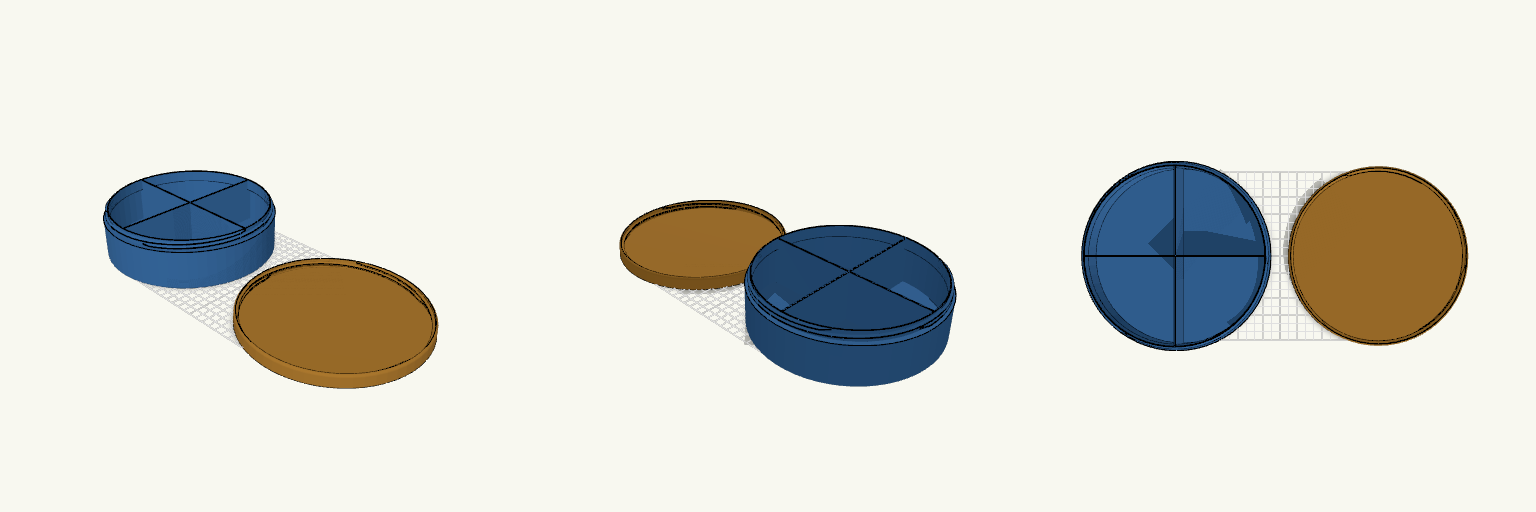
210 mm çapında ve 60 mm yüksekliğinde yuvarlak bir saklama kabı. İçi çapraz iki bölmeyle dört eşit gözeye ayrılmış; kapak kapalıyken gözeler birbirine karışmaz. Kapak, gövdenin üstündeki dış dişe vidalanarak kapanır, böylece taşırken kendiliğinden açılmaz. Gövde duvarları, taban, bölmeler ve kapak üstü ince tutulmuş, böylece baskı kısa sürer ve malzeme az gider. Gövde: 210 mm çap, 60 mm yükseklik, dört eşit bölme Kapak: 210 mm çap, 14,3 mm yükseklik, gövdeye vidalanır Diş: 12 mm boy, 5 mm adım, 3 ağızlı (hatve 15 mm), 0,5 mm boşluk; kapatmak için yaklaşık 0,8 tur (yaklaşık 290°) çevirmek yeterlidir Et kalınlıkları: yan duvar ve taban 1,6 mm, iç bölmeler 1,2 mm, kapak üstü 2,4 mm Baskı: gövde ve kapak ayrı ayrı basılır; kapak ters çevrilmeden, düz yüzü tablaya gelecek şekilde basılır Diş çapı 204 mm'ye çıkarıldığı için gövdenin üst kısmındaki basamak her yanda yaklaşık 3 mm'ye iner; boyun iç çapı 197 mm'dir. Dişin dibindeki duvar ince kaldığından o bölgeyi basarken katman ayarlarına dikkat etmek gerekir. Bölmeler dişli boyun bölgesinde de gövdenin içinde kaldığı için kapak takılıyken de ayrım korunur. Geniş çapı sayesinde dökme parçaları, vida ve küçük donanımı ya da atölye malzemesini tek kapta ayrı gözelerde tutmak için uygundur.
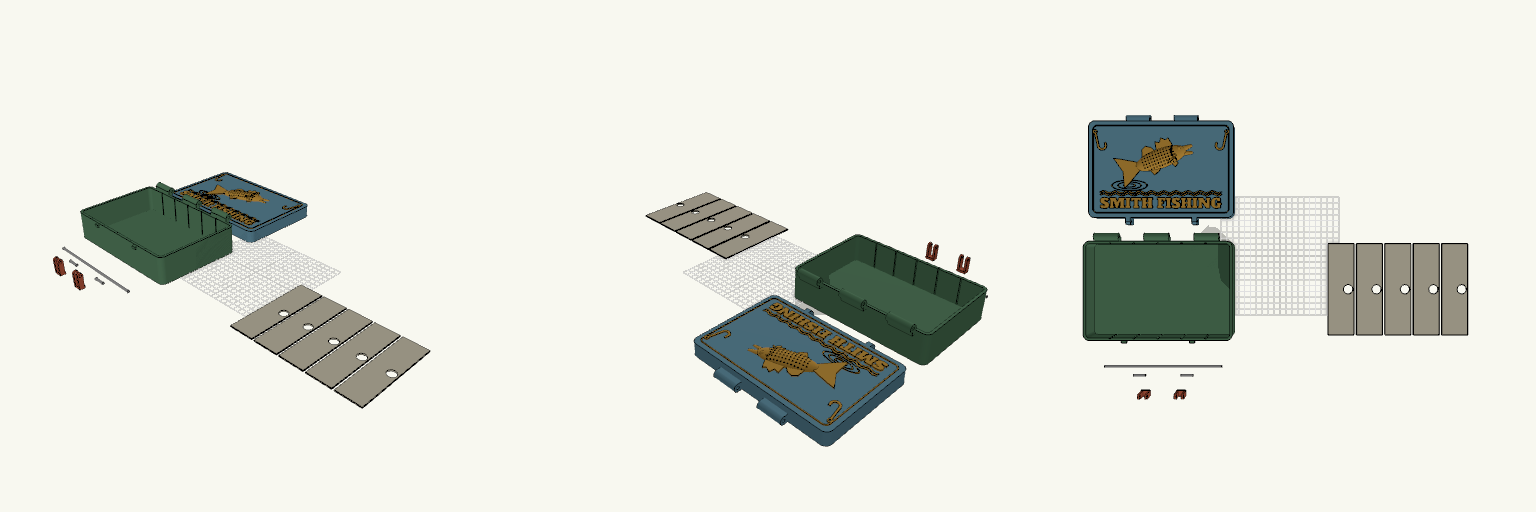
Bass Tackle Box With Hinged Lid
Tackle boxes that pop open in the boat, rattle hooks into the soft plastics, or lose a lid hinge get replaced. This one is a hinged bass tackle box with a locking front latch, adjustable dividers and a leaping largemouth bass on the lid, with SMITH FISHING raised underneath. Load-bearing numbers Base: 240 × 160 × 50 mm, 4 mm walls, 3 mm floor, rounded vertical corners. Lid: 240 × 160 × 22 mm, with a raised bass, ripples, waves, hooks and a border on top. Dividers: 5 removable cross dividers, 1.8 mm thick, sliding in 2.4 mm grooves at 38.5 mm spacing. Hinge: 5 interleaved knuckles across the back, joined by a 4.2 mm pin (197 mm long, printed separately). Latches: 2 front latches with 4.2 mm pivot pins. Each hooks under a ledge on the base. Printing Print every piece in the layout shown: base, lid, dividers, latches and pins are all separate. Lid: print upright. The underside of the top plate bridges across the cavity, so use supports or good bridging settings. Layer height 0.2 mm, PETG or ASA, 3+ perimeters. Hinge and latch pins can be glued or capped at the ends to keep them in.
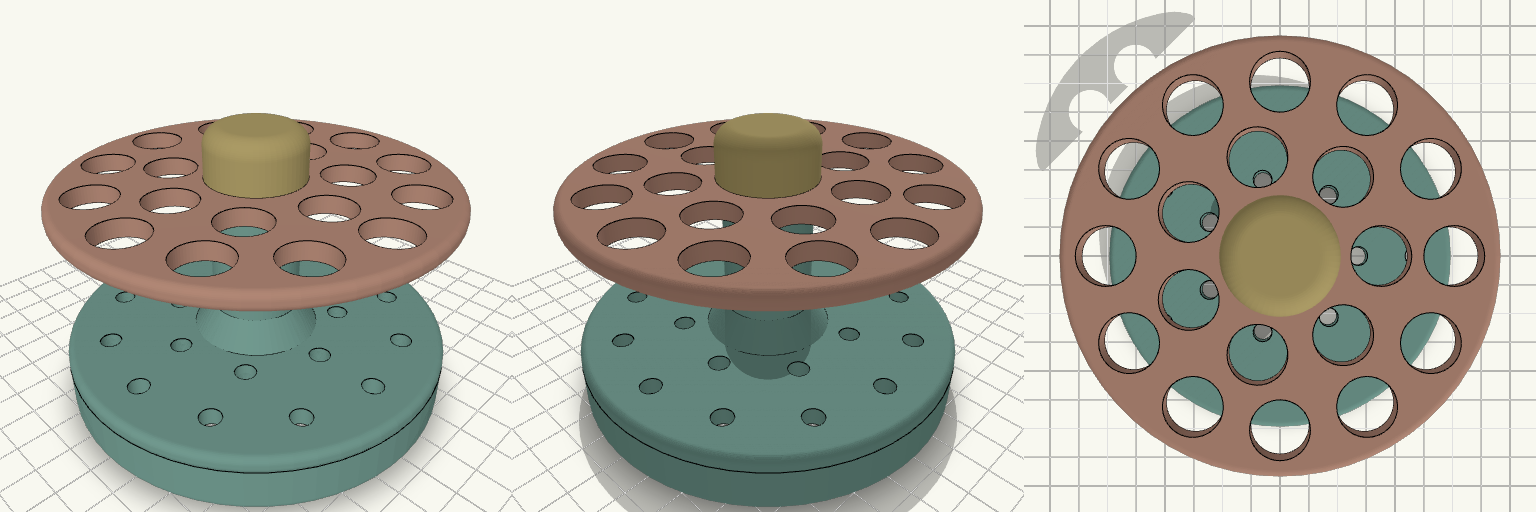
Mini 19-Cone Henna Carousel Stand
A compact two-tier henna cone stand: 110 mm trays, 60 mm apart, holding 19 cones tip-down, joined by a 25 mm central column and a screw cap. The top tray's 15 mm holes sit directly over 6 mm tip holes in the lower tray. A foot ring under the lower tray keeps cone tips off the table. Remix hooks Tray spacing: 60 mm now. Raise it for longer cones. Ring layout: 12 holes at 43 mm radius plus 7 at 25 mm radius. Wall between rings is about 3 mm, so adding holes means growing the tray. Tray diameter: 110 mm. Scale it up and add a third ring for more capacity. Hole size: 15 mm top, 6 mm bottom. Adjust to your cone brand. Pairs with: a turntable disc or non-slip mat under the foot ring.