Two-Piece Rack for 14 Game Tiles
Created today
Description
This stand holds fourteen game tiles upright and ready at the table. It is split into two halves that join at the middle with a dovetail, so it breaks down for storage. A low front lip runs along the front of the base, and the fixed back panel leans back 15° so tiles rest in a steady lean against it. The rack is sized for tiles about 17 mm wide, 7 mm deep and 24 mm high, and it has no dividers between tiles.
To assemble, drop the tab on the left half down into the socket on the right half from above. The joint sits flush with the tray floor, so the tile slot stays clear. The tab is 3 mm tall, which keeps the halves aligned but is not a strong joint; a dab of glue makes it permanent. Both halves print flat on the plate and need no supports. The dovetail socket is cut to 0.04 mm clearance per side — about the limit for a typical printer, so the halves may not seat by hand. If they bind, sand the tab lightly.
- Holds 14 tiles sized for 17 × 7 × 24 mm
- Two halves, about 127 mm and 121 mm long as printed, joined by a drop-in dovetail with 0.04 mm clearance per side
- Overall length about 242 mm when assembled, leaving roughly 4 mm of slack across 14 tiles
- 8 mm deep tile slot in front of the back panel, giving about 1 mm of clearance over a 7 mm tile
- 2 mm front lip, 6 mm high, keeps tiles from sliding forward
- Fixed back panel about 23 mm tall, leaning back 15°
- No tile slots or dividers; tiles sit side by side in the tray
- Both halves print flat without supports
Images
More like this
Explore more in Storage & Organization →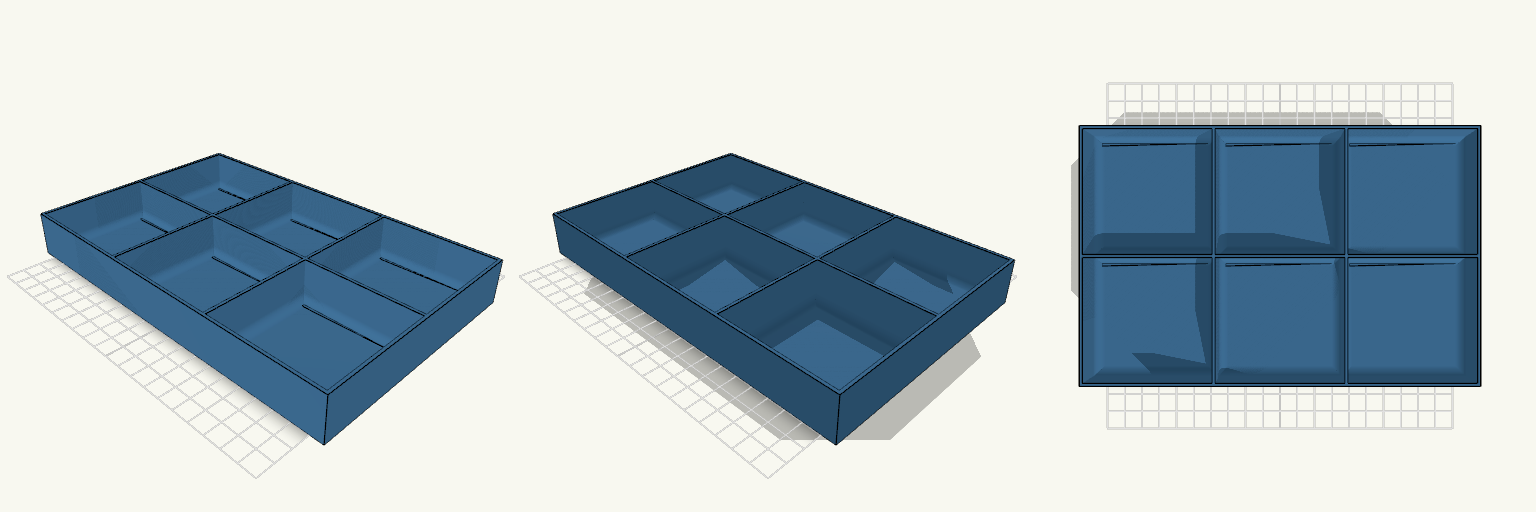
Drawer Organizer Grid for Mini Toolbox Top Drawer
Small screws, bits, and sockets slide into one pile in the shallow top drawer of a U.S. General Mini Toolbox. This 3×2 organizer grid drops into that drawer and gives each group its own bin, so you can grab one without dragging the rest along. Footprint: 215.5 × 140 × 26 mm, sized for the top drawer with clearance. Compartments: six bins, each about 69.7 × 67.6 mm. Walls and floor: 1.6 mm walls, 1.2 mm floor. Bin floors: 5 mm rounded bottom edges so small parts can be scooped out instead of trapped in square corners. Printing: one piece, no separate inserts or assembly. The grid works as a single tray: print it, drop it in, and lift the whole thing out when you need the drawer back. The rounded floors are part of the print, not loose scoops.
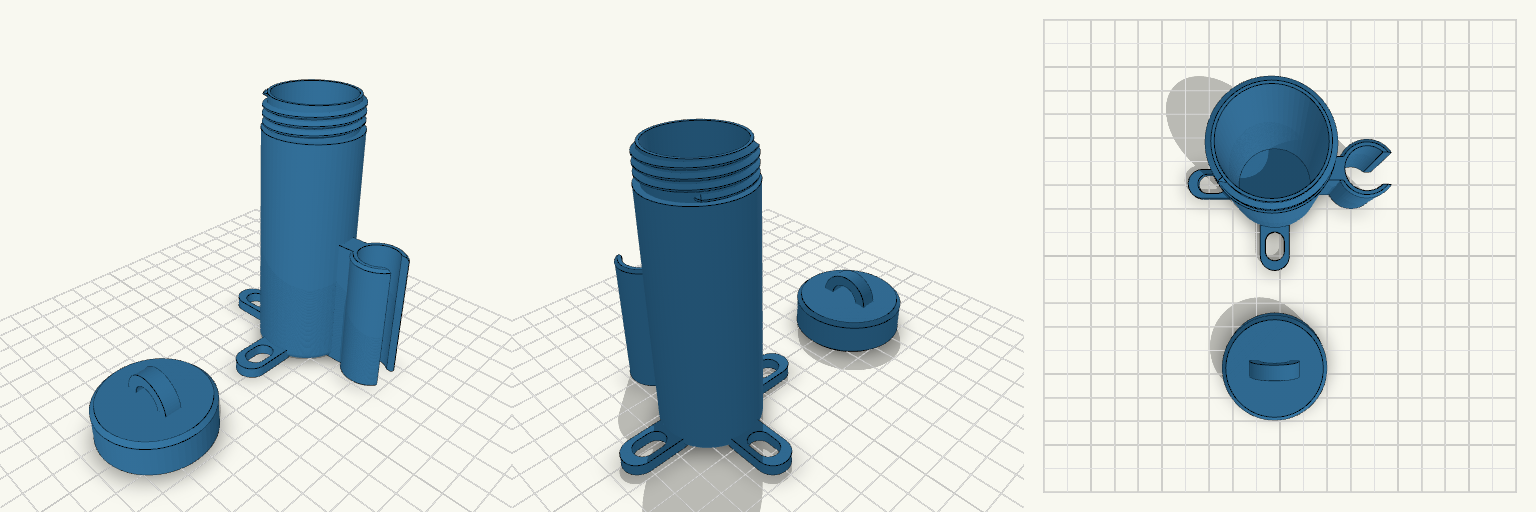
Stickpot
A screw-top tackle jar in the spirit of a carp angler's bankstick kit: tall bore, flat slotted tabs at the base, and a half-circle arch standing on the lid for hanging rigs. Design notes 30 mm bore, 100 mm tall Bankstick clip now runs from the base of the jar upward, 50 mm long, with a snap-in slot Three flat slotted loops at the base, printing flat with no overhang Lid with a 6 mm wide half-circle arch, printed upside-down beside the jar
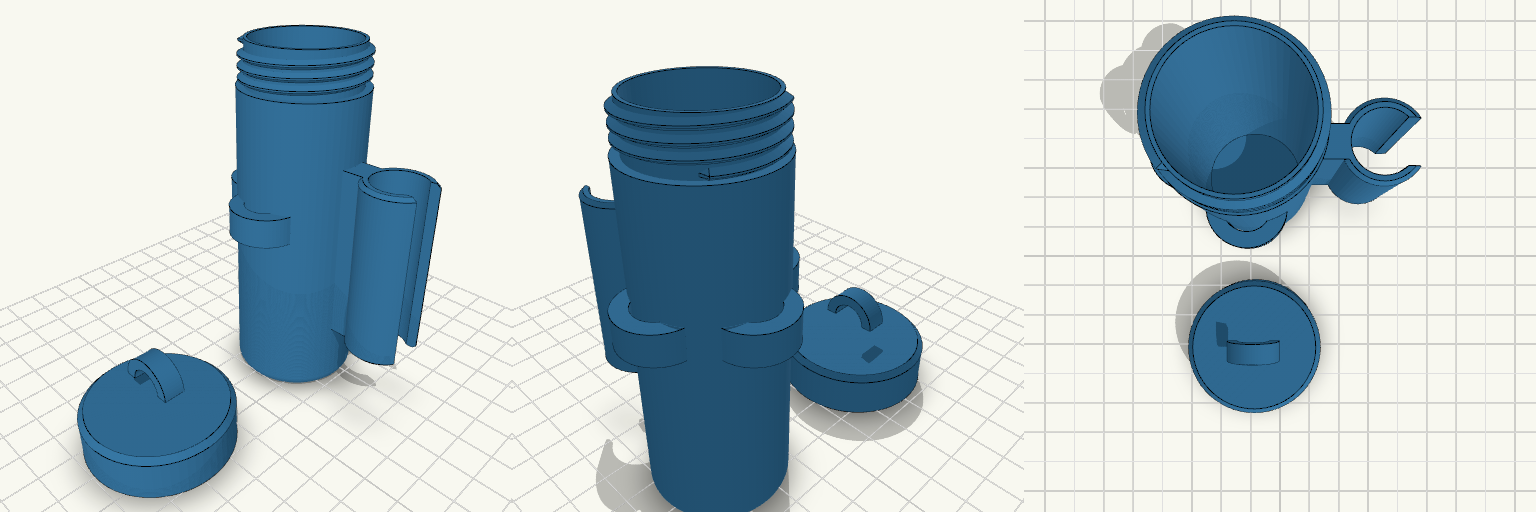
RigPot — Bankstick Jar with Rig Loops
RigPot is a 30 mm bore, 100 mm tall screw-top jar built for carp tackle. It has a 50 mm side clip for a 15 mm bankstick, and three half-round loops for hanging rigs. Features 30 mm inside diameter, 100 mm tall Screw lid printed separately beside the jar Bankstick clip, 50 mm long, 15.4 mm bore with a snap-in slot Three flat half-ring rig loops at 90°, 180° and 270°, both ends fused into the jar wall Print notes The jar, clip and loops print as one body The lid is a separate piece and prints beside the jar
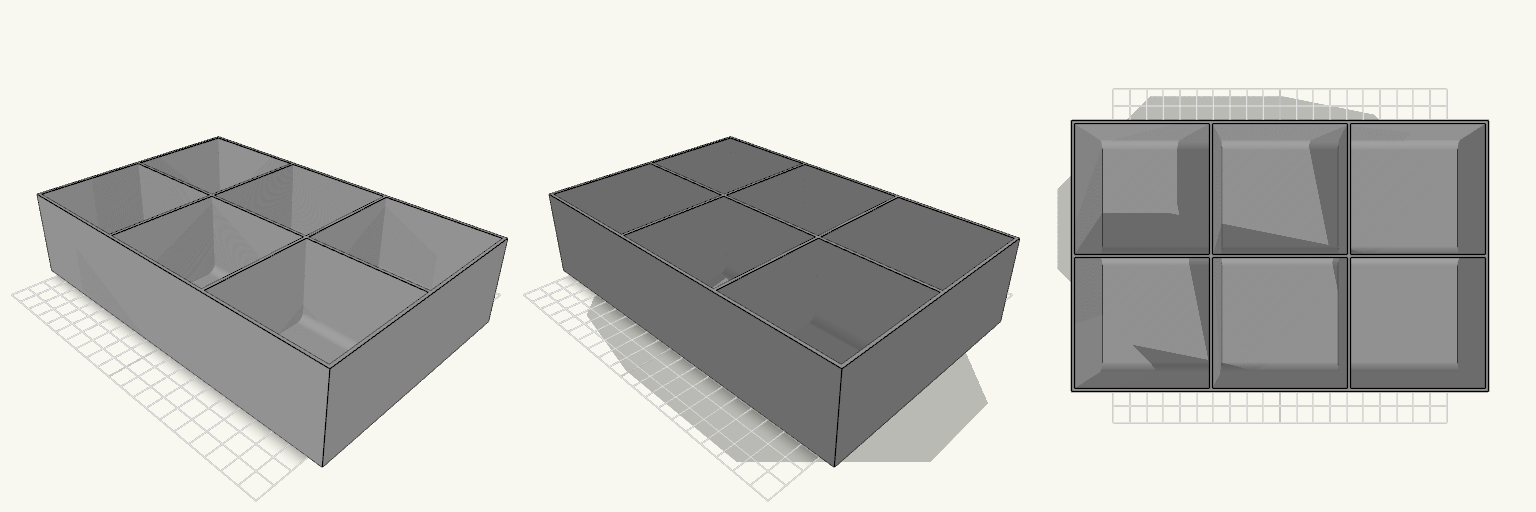
3×2 Drawer Organizer Grid for Mini Toolbox
A six-compartment drawer organizer sized to sit in the bottom drawer of a U.S. General mini toolbox. The 3×2 grid keeps small parts separated, with 1.6 mm outer and internal walls and a 1.2 mm floor. Each bin has a 5 mm concave scoop along the front and back wall, so fingers and small parts slide up the curve instead of catching on a square edge. The overall footprint is 215.5 × 140 × 51 mm. 3×2 grid, six bins 1.6 mm walls and 1.2 mm floor 5 mm finger-scoop fillets front and back in every bin Sized for the bottom drawer of a U.S. General mini toolbox

Seagate 1TB Hinged Drive Case
A hinged case for a 117 x 80 x 14.8 mm external drive, printed flat as one piece with a base, a cover and a flexible hinge between them. A snap latch on the opposite end holds the cover closed. Remix hooks Drive size: the inner cavity is the drive plus 1.5 mm in length and width and 1 mm in height. Change those numbers to fit another drive. Hinge strip: 0.6 mm thick and about 7 mm wide. Thicker is stiffer and longer-lived, thinner folds more easily. PETG is recommended. Latch: the cover tab is 30 mm wide and the base catch is 20 mm wide. Adjust either to change the closing force. Cable storage: the cable tray has been removed. A separate tray or a cable pocket could be added back on the cover's outer face. Both halves print without supports, with the cover opening facing up.
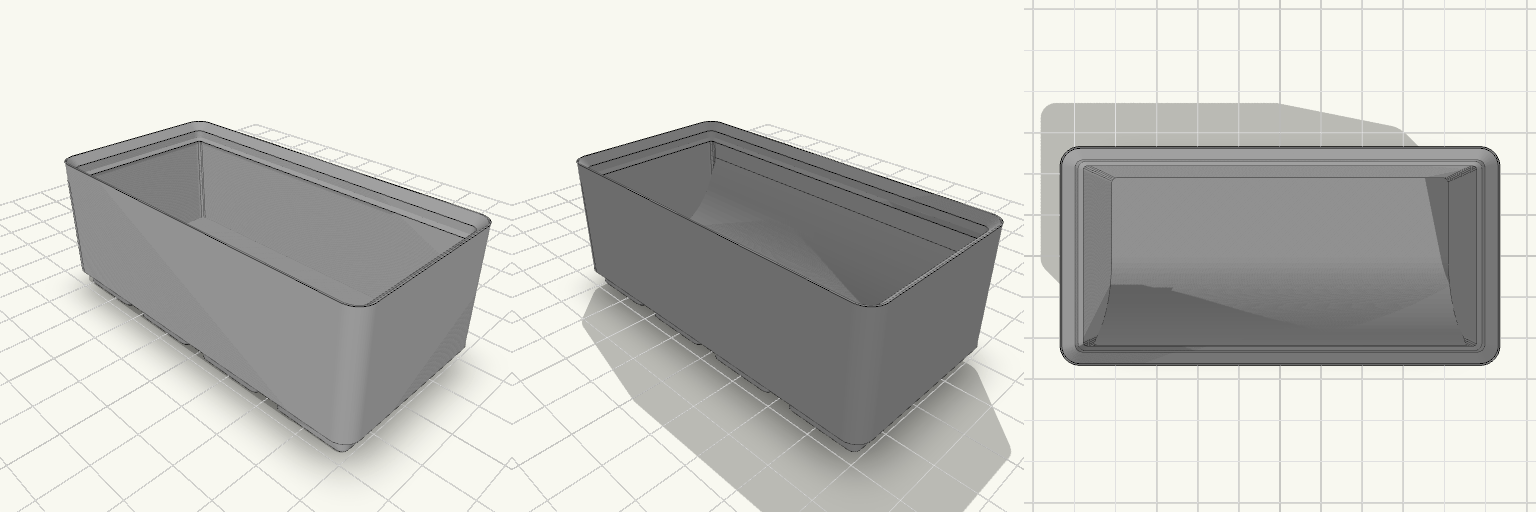
Gridfinity-Schraubenbox 2x1 ohne Label
Gridfinity-Behälter im Format 2x1 Units, 4 Units hoch (28 mm plus 4,4 mm Stapelrand), stapelbar, mit Halfgrid-Boden (4 × 2 Füße im 21-mm-Raster). Vorne läuft eine Rundung mit 18 mm Radius in den Boden aus, damit sich Schrauben und Kleinteile leicht herausschaufeln lassen. Die Vorderseite ist glatt, ohne Label-Mulde. Remix-Ansätze Rundung vorne: Radius 18 mm. Kleiner ergibt eine steilere Rampe, größer eine flachere Schräge mit weniger Restvolumen. Wandstärke und Boden: Wand 2,4 mm, Boden 5,5 mm. Beides lässt sich für leichtere oder robustere Boxen ändern. Label: Die Variante mit Label ergänzt eine 70 × 13 mm große Mulde, 0,8 mm tief, auf der Vorderseite. Alternativ lässt sich ein Schild aufkleben. Höhe: Die Höhe von 28 mm in Vielfachen von 7 mm anpassen, um andere Gridfinity-Höhen zu erhalten. Kombination: Passt auf Gridfinity-Baseplates mit 42-mm-Raster und stapelt mit gleichartigen Boxen. Vor dem Serienausdruck eine einzelne Zelle zur Passprobe drucken.