Game controller stand
Made by GentleHammer
Created 1 months ago
Description
A two-part sliding stand designed to adapt to any device thickness. The front lip captures the bottom edge of the device, while the heavy backrest slides forward along a precision dovetail track to lock it in place.
- Built-in dovetail slide adjusts from bare devices to thick rugged cases
- Generates zero overhangs on the track mechanism for reliable printing
- Two-part flat-bottom layout prints cleanly without supports
- 70-degree backrest angle provides a stable viewing geometry
Photos
Technical views
More like this
Explore more in Desk & Tech →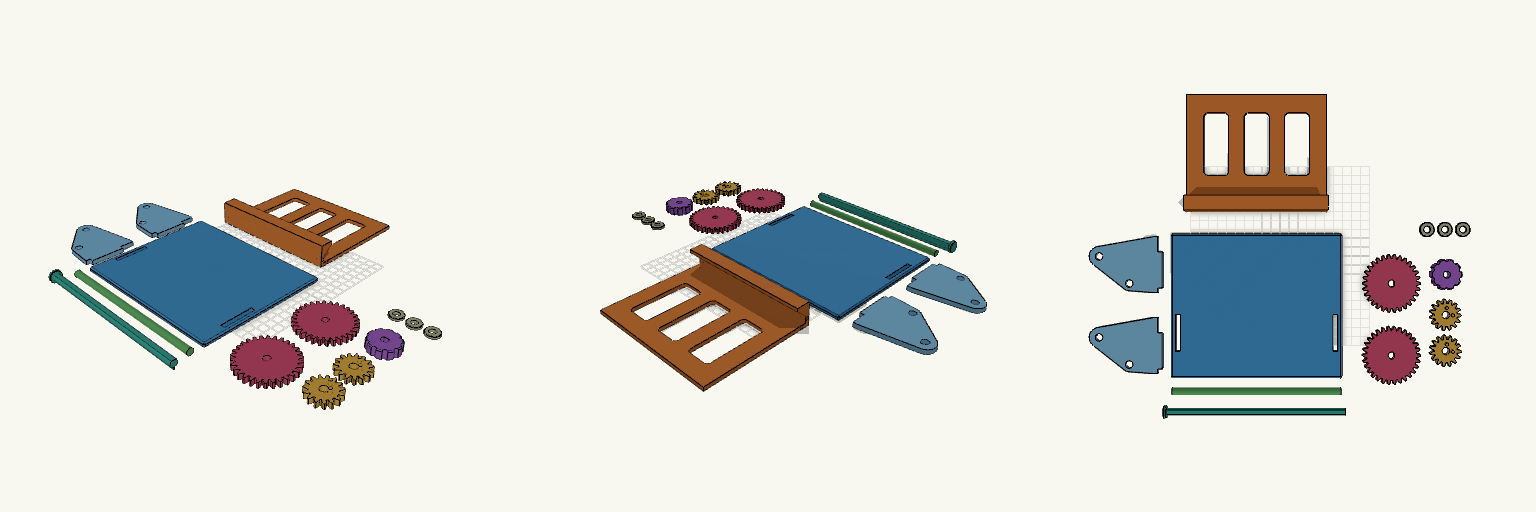
Slot-Together Geared Tablet Stand, Doogee U11
Geared tilting tablet stand for the Doogee U11, laid out as 14 separate flat pieces for printing and assembled by hand after printing. A knob on a drive shaft turns two 30-tooth gears that mesh with 15-tooth gears on the cradle, so a small knob twist tilts the cradle forward or back. Pieces Base plate: 1 Side plates: 2, with tabs that drop into slots in the base Tablet cradle: 1 15-tooth cradle gears: 2, peg into the cradle ends 30-tooth drive gears: 2, keyed to the drive shaft Knob: 1 Axle: 1, 8 mm round Drive shaft: 1, D-profile Friction-fit caps: 3 Print notes Every piece is laid flat on the build plate with no overlap. Gear pegs face up and the shaft flat faces down, so no supports are needed for the main bodies. Clearances are about 0.2-0.4 mm; adjust for your printer. Gear mesh and fit are untested; friction alone holds the tilt angle.
Tromba Perch — Due Staffe Laterali
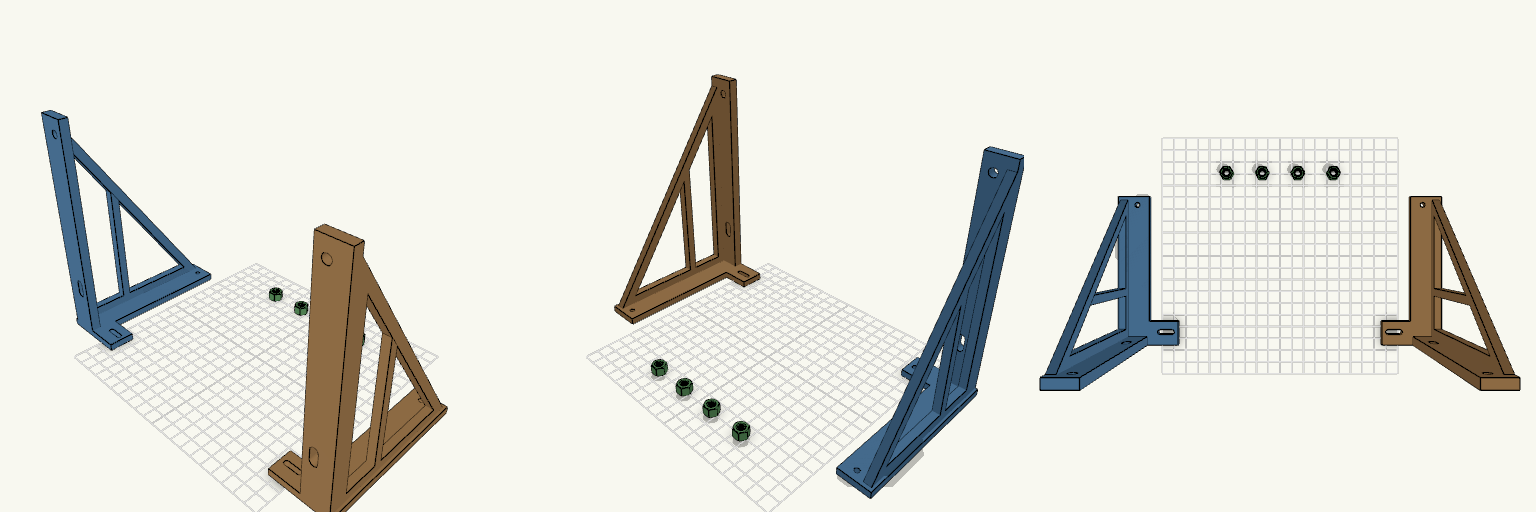
Tromba Perch è una coppia di staffe laterali indipendenti per una tromba 220x160 mm con interasse fori di 240 mm. Senza traversa centrale, ogni staffa si avvita sul monitor con la propria base e regge un lato della tromba. Si risparmia materiale e ogni pezzo entra facilmente nel piatto di stampa. Features Interasse fori tromba invariato: 240 mm in orizzontale, 126 mm in verticale Pilastro allargato verso l'esterno fino a filo del triangolo Triangolo a telaio con montante di irrigidimento Base da 125 mm con fori di fissaggio anteriori (asole regolabili) e posteriori Fori tromba da 6,4 mm per perni M6, foro basso asolato per regolare l'inclinazione In the box Staffa sinistra Staffa destra 4 dadi M6 da 7 mm, stampati a parte Print notes Le due staffe sono pezzi separati, senza giunto Filettatura stampata in PLA fragile: per carichi veri meglio dadi metallici
手机支架
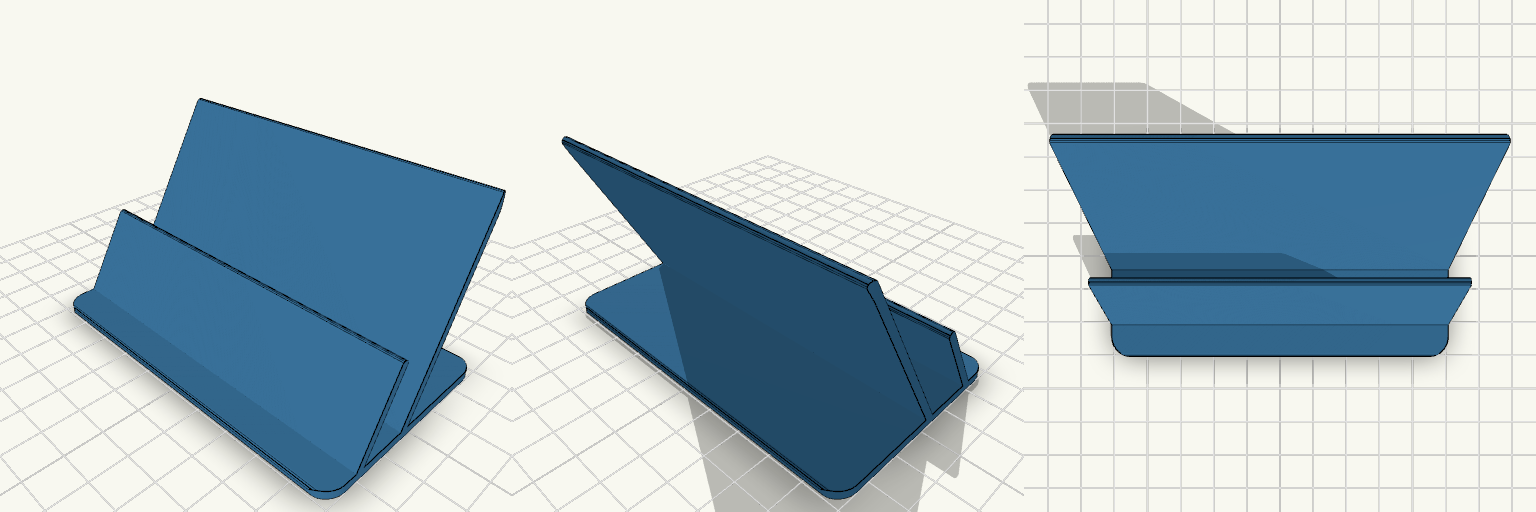
A phone stand for a phone that keeps sliding flat or tipping over: a 60° backrest holds it upright, and a front lip stops it sliding out. Key numbers Base: 100 × 60 mm, 2.2 mm thick Backrest tilt: 60° from the table Slot: 12 mm wide, measured between backrest and front lip Walls: 2.2 mm throughout Corners: rounded in plan and along the profile edges Printing Print with the base flat on the bed. No supports needed: the backrest leans back at 60°, which stays within a typical overhang limit. Phones with thick cases may need a wider slot.
Joystick Controller Enclosure With Bottom Cover
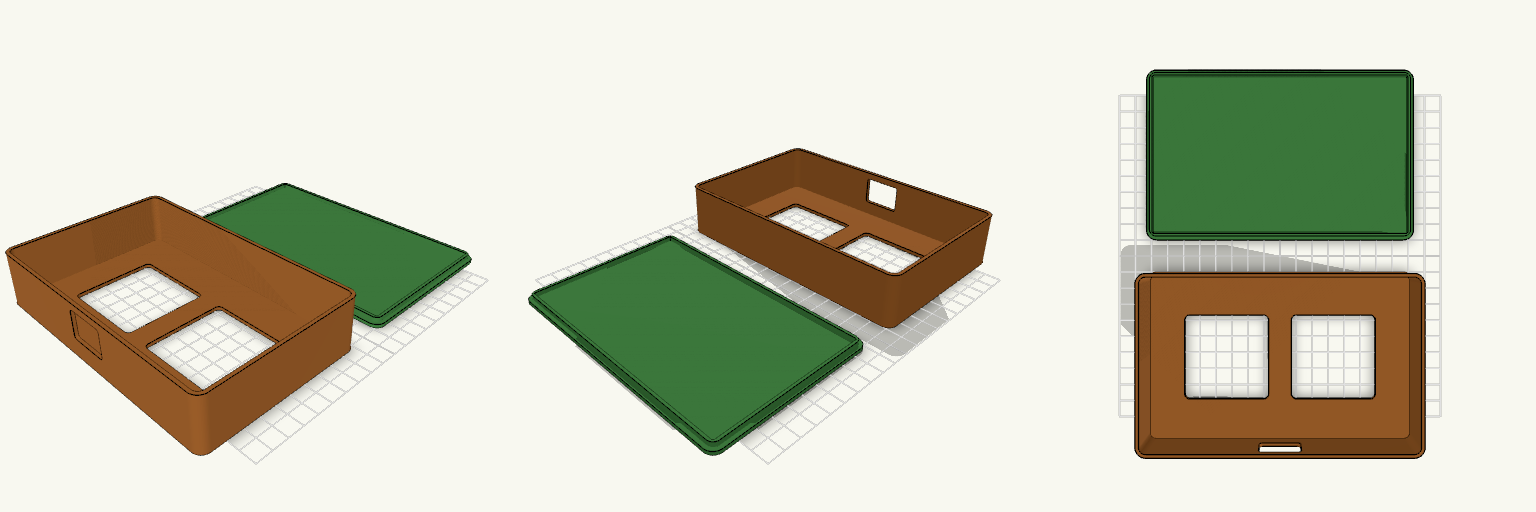
A dual-joystick controller enclosure that can't be wired or soldered through the top, because the two 52 × 52 mm joystick openings are too small for the board. This version splits the floor off as a removable bottom cover, so the board and joysticks go in from below. Key numbers Outer size when assembled: 165 × 105 × 35 mm (shell 33 mm + cover 2 mm) Walls and top panel: 2 mm; corner radius R6 Joystick openings: two at 52 × 52 mm, R3 corners, 14 mm apart RJ45 window: 25 × 18 mm, centred on the rear wall, 6 mm up from the open edge (provisional) Cover lip: 0.3 mm clearance inside the walls, 3 mm tall Printing Shell: print top panel down, open side up, no supports. Cover: print flat with the lip pointing up. Check the 25 mm bridge over the RJ45 window in the slicer preview. The cover is held by friction or a dab of adhesive; there are no screws.
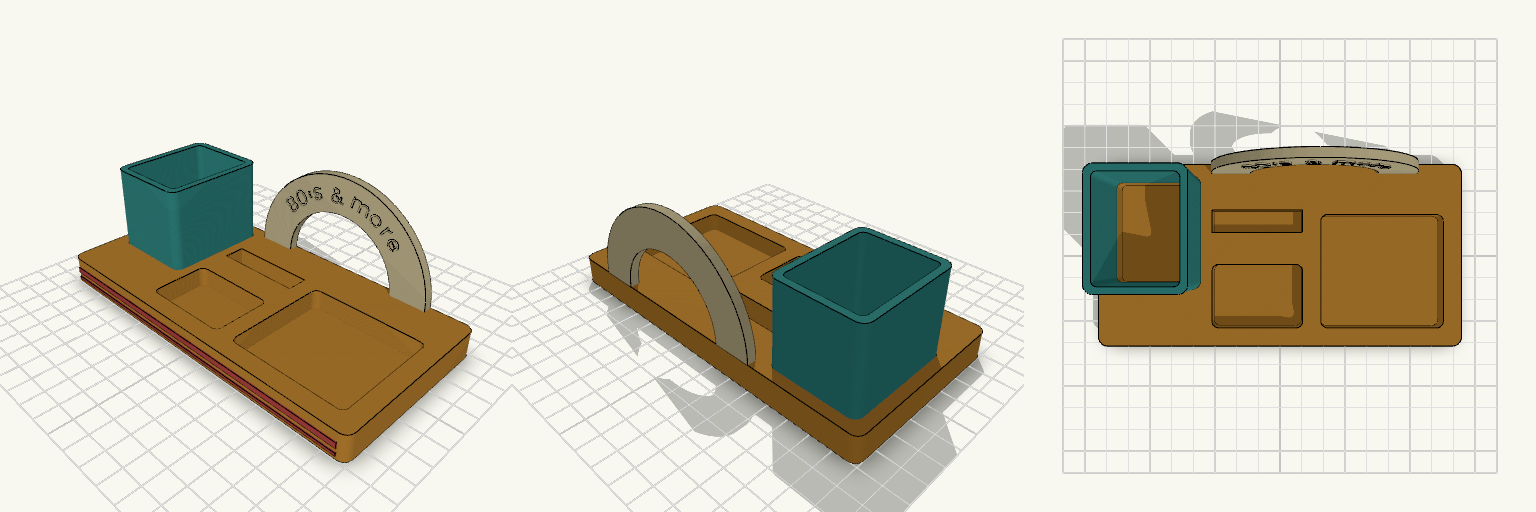
Retro Desk Organizer with Pen Tower
What it's for A retro-styled desk organizer that keeps pens, cards and small items in one place. A teal pen tower, a card or phone slot and two open trays sit on an amber base. A red racing stripe runs along the front. A cream arched backrest has a round window and embossed "80's & more" lettering following the curve. Dimensions Base tray: 160 × 80 × 12 mm Pen tower: 40 × 50 mm footprint, rising to 50 mm overall height Card / phone slot: 40 × 10 mm opening Front tray: 40 × 28 mm Large right tray: 54 × 50 mm Arched backrest: about 90 mm wide, top at 57 mm Lettering: embossed 1 mm, 7 mm tall Remix ideas Change the lettering to a name or a different slogan. Resize the trays for coins, clips or sticky notes. Recolour the stripe and backrest to match a different retro palette. Widen the card slot for a tablet.
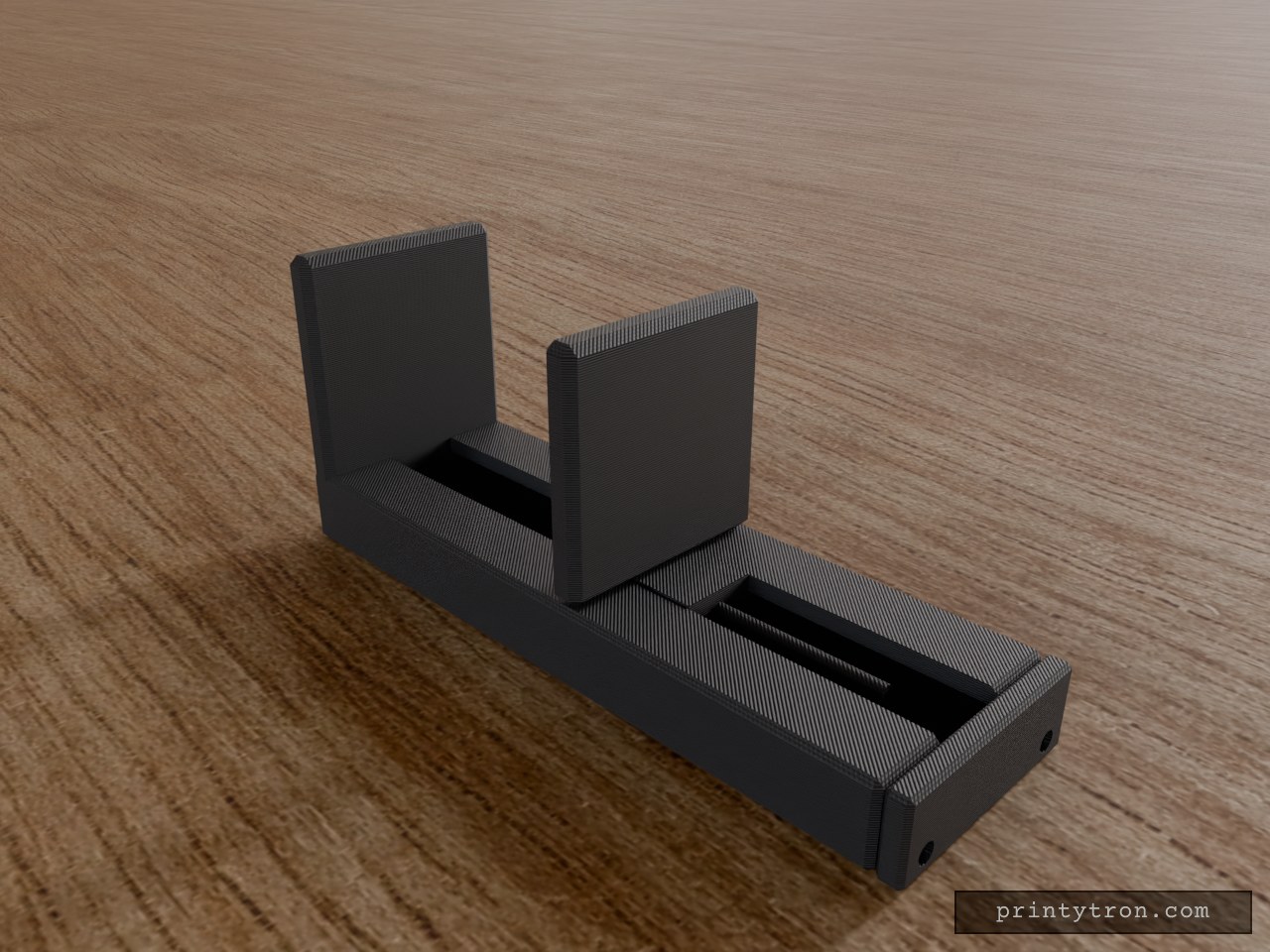
1/4-20 Tripod Spring Phone Clamp, 60–85mm
This is a spring-loaded phone clamp for a standard 1/4-20 tripod mount. It has a fixed jaw, a sliding jaw and a screw-on end cap. The base has a hex pocket that holds a 7/16 in across-flats 1/4-20 nut, with a 6.8 mm bore above it for the tripod screw. What it fits Phones 60–85 mm wide, measured across the body including any case, in portrait orientation. Tripod heads with a 1/4-20 UNC male stud. This is the common camera and phone tripod standard. Jaw faces are chamfered on the inner edges so they don't mar the phone. Check before printing Measure your nut across the flats. The pocket is sized for a 7/16 in (11.1 mm) hex 1/4-20 nut. A nut with a different flat size will rattle or won't seat. Hardware you supply 1 × 1/4-20 hex nut, 7/16 in across flats. 1 × compression spring, about 6 mm OD and 45 mm free length, over the slider's 3 mm guide rod. 2 × M3 screws for the end cap. The pilot holes are 2.6 mm. Does not fit Phones narrower than 60 mm or wider than 85 mm. Metric tripod studs such as 3/8 in or M6. The bore is sized only for 1/4-20. Landscape use on very heavy phones. Spring force is untested, and it is lowest near the 85 mm end. A heavy phone in a thick case may be loose there. Parts Base and fixed jaw Sliding jaw End cap