Broom-Handle Sword End with Threaded Socket
Made by CheeryKoi
Created today
Description
A screw-on sword end that turns a broom handle into a toy sword. The grip has a socket in its base sized for a standard 3/4" broom thread — 22 mm diameter, 4.5 mm pitch, 26 mm deep — so the blade threads onto the handle and unscrews again for carrying or storage. Above the grip sit an 80 mm crossguard and a 110 mm blade with a pointed tip. The finished piece measures about 80 × 34 × 175 mm as it sits on the plate.
Broom threads are not identical across brands, so check your handle's diameter and pitch before committing to a full print; a short thread test piece is cheaper than a wasted blade.
Remix hooks
- Socket diameter and pitch (22 mm / 4.5 mm) — the first thing to change. Match your own handle and the sword fits anything from a broom to a mop or a dowel.
- Socket depth (26 mm) — deepen it for a handle with a long exposed thread, or shorten it if the blade sits too high off the grip.
- Blade length (110 mm) — trim it for a dagger or stretch it for a two-hander; the crossguard scales along with it.
- Crossguard width (80 mm) — widen it for a more toy-like silhouette, narrow it for something closer to a real arming sword.
- Tip profile — the point can be rounded off further for younger wielders without touching anything else.
Pairs naturally with a printed pommel or a wrapped grip sleeve, and the same socket can be reused on an axe, spear or halberd head for a matching set.
Images
More like this
Explore more in Decor & Display →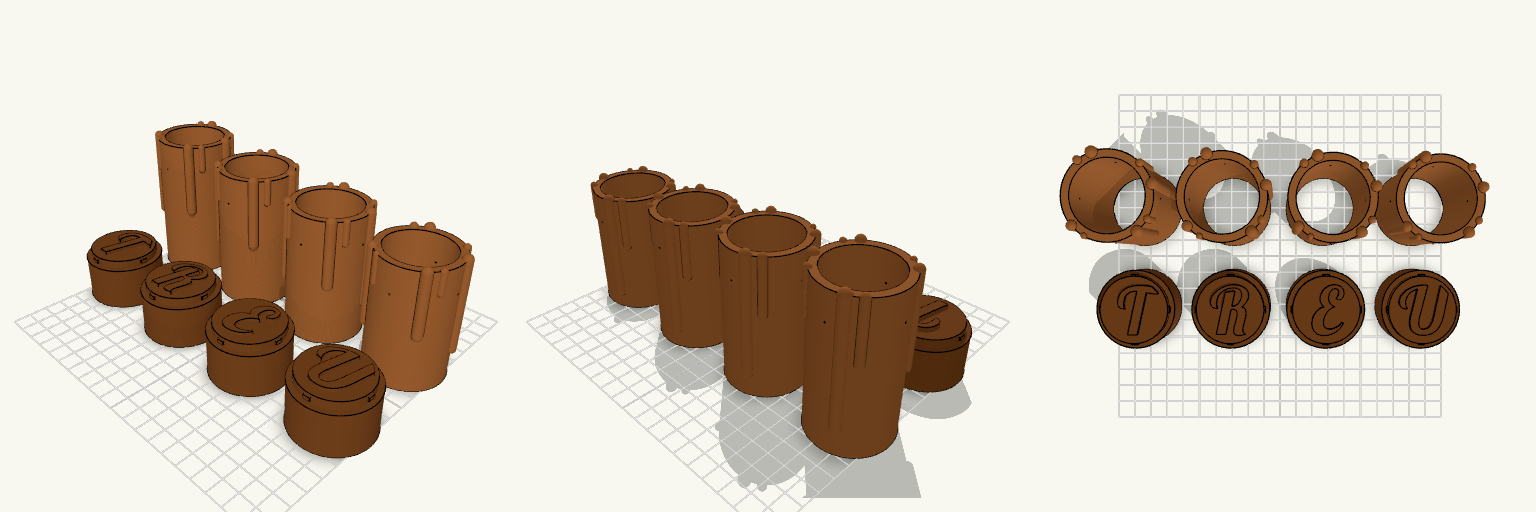
Sonderkerzen 2.0
What it's for Vier Kerzenkörper in abgestuften Höhen, die eine brennende Kerze simulieren. An der Außenseite laufen unregelmäßige Wachstropfen unterschiedlich weit herunter; einige Bereiche des oberen Randes bleiben frei. Jede Kerze ist in ein Oberteil und ein Unterteil geteilt. Der Bajonettverschluss mit Rastnase hält die Teile zusammen und soll sich nicht unbeabsichtigt lösen. Die Unterteile sind bis zur Lippenfläche massiv gefüllt und tragen je einen erhabenen Buchstaben: T, R, E und U in einer verspielten Schreibschrift. Der Buchstabe steht 2 mm über der Lippenfläche und ist dadurch als Stempel nutzbar. Die Schrift ist nicht gespiegelt; Abdrücke wären seitenverkehrt, zum Stempeln müsste sie gespiegelt werden. Der Innenraum der Oberteile bleibt frei; der Innendurchmesser von 37 mm und die vier 1-mm-Löcher bleiben unverändert. Dimensions Gesamthöhen: 110, 105, 100 und 95 mm Außendurchmesser: 45 mm; Innendurchmesser: 37 mm Teilung: 25 mm über dem Boden Vier durchgehende Löcher von 1 mm, 16 mm unter der jeweiligen Oberkante, bei 12, 3, 6 und 9 Uhr Buchstaben: ca. 27 mm groß, auf einen 34-mm-Kreis begrenzt, 2 mm über der Lippenfläche erhaben Print notes Das Set besteht aus acht Einzelteilen: vier Oberteile und vier Unterteile. Die Teile lassen sich im Slicer trennen und auf einer 180-mm-Platte verteilen. Der Bajonettverschluss ist für den Druck ohne Supportmaterial ausgelegt. Die Rastnase ist 0,6 mm hoch und sitzt vor der Endposition; sie ist bewusst dezent, sodass die Haltekraft von Material und Drucker abhängt. Für den ersten Testdruck sind PETG oder PLA sinnvoll. Die Buchstaben vor dem Druck in der Vorschau prüfen, da feine Verbindungsstriche bei sehr feinen Düsen an Schärfe verlieren können. Remix ideas Rastnase höher oder niedriger auslegen, um die Haltekraft anzupassen Andere Höhenstufen oder mehr bzw. weniger Wachstropfen Buchstaben austauschen, eine andere verspielte Schrift verwenden oder die Schrift für Stempelabdrücke spiegeln

Dual xvideos plate print 180 mm
A two-up XVIDEOS nameplate set intended as a gift sign for a friend, for desk or shelf display. The model contains two identical horizontal plates, each with a solid black base, a red uppercase “X” at the left, and white “VIDEOS” lettering across the rest of the width. Each plate has a flat back and three underside pockets for 4×2 mm disc magnets. The plates are laid out with a gap and print as two separate pieces. Layout: two identical plates, each 180 × 44.3 mm at about 4.06:1; overall footprint 180 × 99.3 mm with roughly a 10 mm gap; prints as two separate plates. Base: black, 6.5 mm thick, flat back, no supports required. Lettering: single word XVIDEOS, all uppercase; cap height 29.7 mm, about 67% of plate height; text spans about 164 mm with even side margins; heavy geometric sans; letters set tight. Colors: red “X” (#E02A00), white “VIDEOS”, black base; aligned color regions for clean multi-color boundaries. Relief: letters stand about 1.8 mm above the base; raised faces are left square. Magnets: three round pockets per plate, 4.2 mm across × 2.1 mm deep, for 4×2 mm disc magnets; on the long centerline at X = -60, 0 and +60 mm; 120 mm end to end, with the outer pockets 30 mm in from the short ends. Magnet fit: 0.2 mm of play in diameter and depth for a snug fit; about 4.4 mm of base remains above each pocket. Printing: FDM-friendly, flat backside, no supports required.
Flat Picket Fence Panel, 100 mm
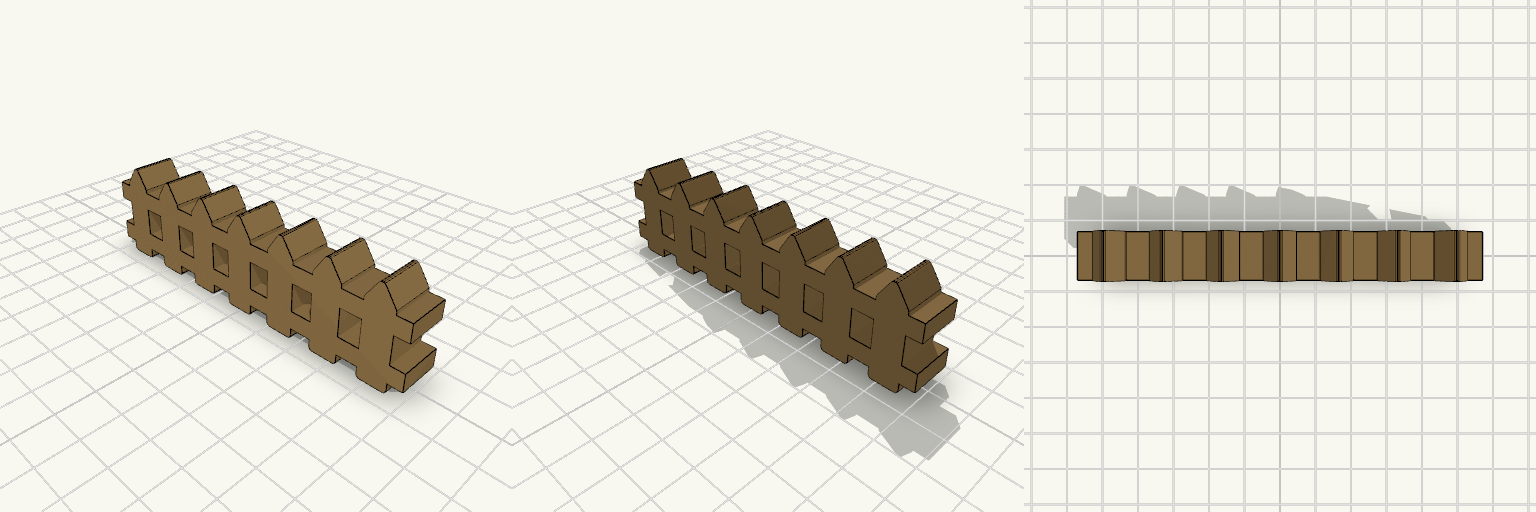
A single flat picket fence panel, 100 mm long and 12 mm thick, with seven vertical pickets set 8 mm wide with 6 mm gaps between them. Two horizontal rails run the full length near the top and bottom, and the picket tips are rounded points that top out at about 27.2 mm. The pickets sit 4 mm in from each end, with the rails running through to the edges. The model is stored standing upright but is meant to print on its back face: laid flat, the 12 mm thickness becomes the print height and no supports are needed. Walls are 3 mm and the rails are 5 mm tall, so the part is sturdy at a small scale. Seven pickets, 8 mm wide with 6 mm gaps Two full-length rails, 5 mm tall Rounded pointed tips, roughly 27.2 mm overall height Print flat on the back face, no supports 3 mm walls, suited to PLA Use it as a miniature garden border, a diorama or model-railway accessory, or a small decorative edging piece.
Square-Foot Tabletop Post Stand
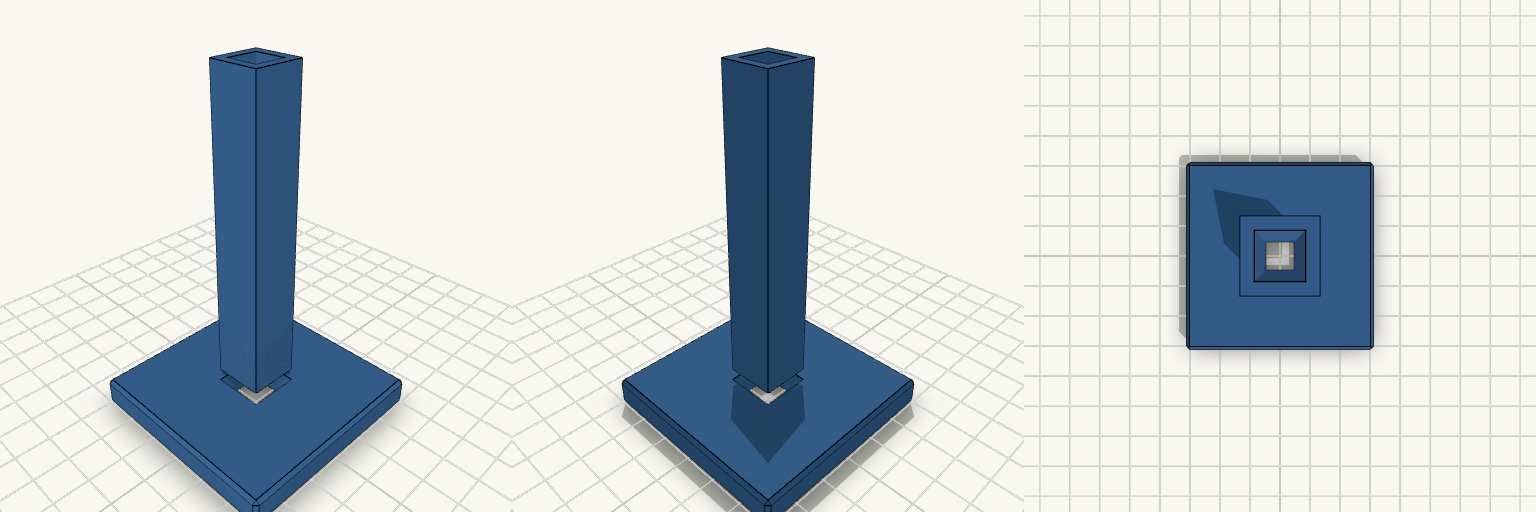
What it's for A one-piece tabletop stand: a flat square foot with a single 14 mm square post rising from its centre. The broad 60 mm foot keeps the post stable on a desk or shelf, and the post gives you a square, straight upright to build onto, hang something from, or slot a part over. The underside carries a square sleeve socket with a wire hole through its floor, so a cable can be fed up through the post and out of the open top instead of running loose down the outside. It prints as one piece — nothing to glue or assemble. Dimensions Footprint: 60 × 60 mm, 8 mm thick, with a 1 mm chamfer around its edges. Post: 14 × 14 mm square, rising 90 mm from the centre of the foot. Overall height: 98 mm as it sits on the print plate. Underside socket: 14.5 × 14.5 mm square, 12 mm deep, centred in the foot and running 4 mm up into the post. Wire bore: 9 × 9 mm, running the full length of the post from the socket floor out through the open top, leaving about 2.5 mm of wall around it. Print notes Material: PLA on an FDM printer. Orientation: stands upright on its foot, so it prints with no supports. Walls: the post is bored out, so its walls are about 2.5 mm — a 3 mm perimeter setting will not fit them evenly; two or three perimeters gives a cleaner result. Slicing: set 20% infill in your slicer; the model itself does not carry an infill value. Remix ideas Change the post cross-section to match whatever has to slide over it, keeping roughly 0.5 mm clearance per side. Resize the socket to take a different sleeve, or cap the top of the bore to make a closed internal channel. Scale the foot wider or thinner for a heavier load or a tighter shelf space.
Emberlink — Articulated Dragon Fidget
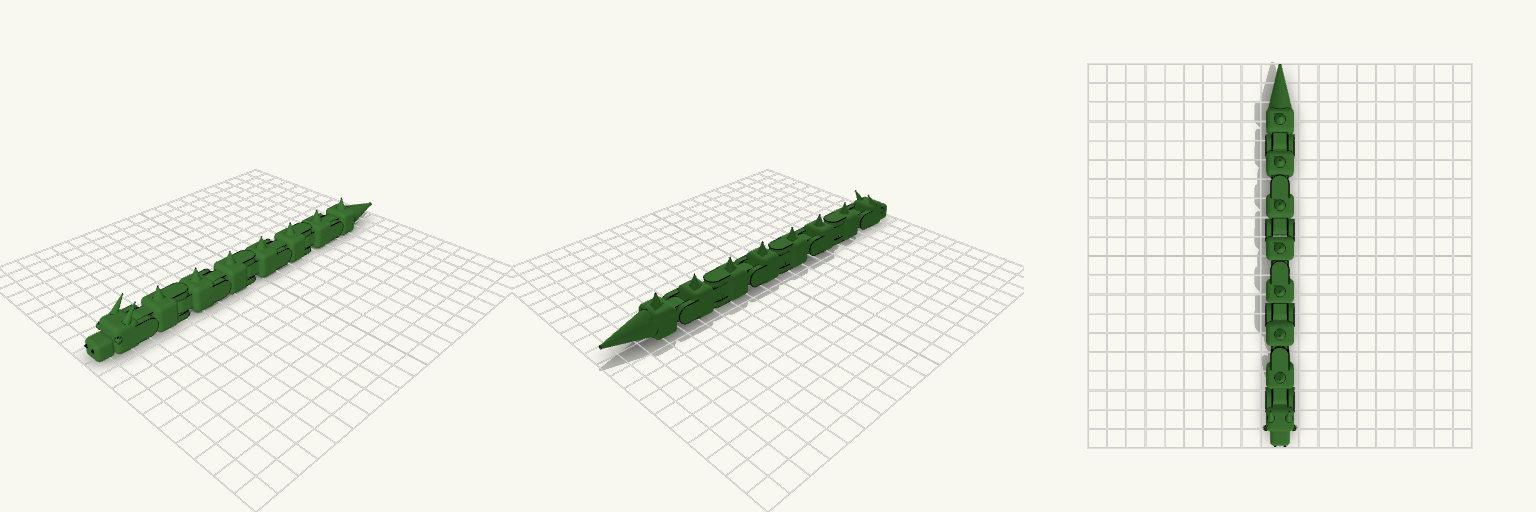
Emberlink is a segmented dragon built to be bent, curled and twisted in the hand. Eight blocky body links are joined by hinges that alternate between bending sideways and bending up and down, so the whole body can wiggle in any direction. It prints flat as a single piece, with the hinges already working. Features Eight linked body segments with a horned head and a tapered tail Spines along the back Alternating hinge directions for full-body flex Pin hinges with 0.4 mm clearance, designed to print in place Dimensions Roughly 170 mm long and 14 mm wide and tall Print notes Print lying flat, with no supports for the body. Move every joint after printing to break it free. Horns and tail may need light cleanup.
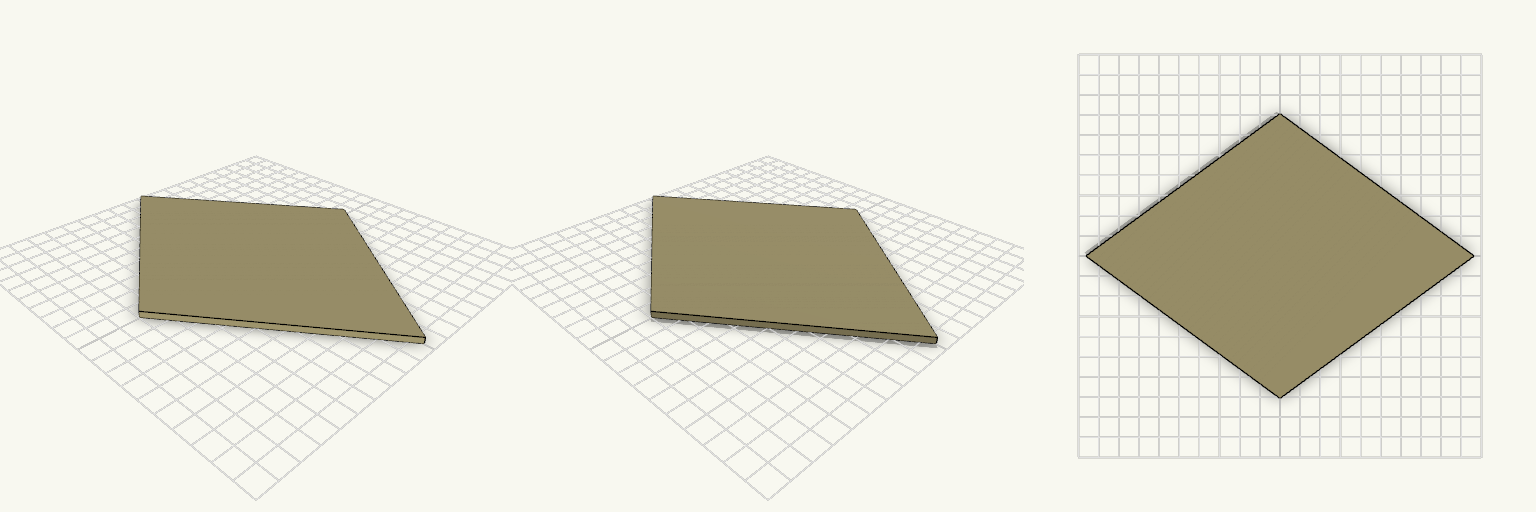
Goldenrow — Flat Diamond Panel
Goldenrow is a plain, flat diamond panel: a clean blank with a 7.5 in diagonal along X and a 5.5 in diagonal along Y. With no raised artwork, it is a single flat slab that prints quickly with no supports. Dimensions Diagonals: 190.5 mm (7.5 in) along X, 139.7 mm (5.5 in) along Y Thickness: 3 mm Print notes Flat on the bed, no supports needed For speed: 0.6 mm nozzle, 0.3–0.4 mm layers, 2 walls, low infill (10–15%) and a fast top-surface setting Fits a bed of roughly 200 x 150 mm or larger