Cursive Sally Sign for 5 mm LED Strip
Made by Zonetech3d
Created today
Description
Cursive "Sally" name sign with a continuous recessed groove sized for 5 mm wide flexible LED neon strip. The groove follows the full lettering and is bordered by retaining walls, with wire exits through the floor at both ends of the word.
Specs
- Pacifico script lettering, mixed case
- Groove width about 5.2 mm (5 mm strip plus clearance)
- 1.6 mm retaining walls
- 2 mm floor, 10 mm overall height
- Wire exit holes through the floor at both ends
- Prints flat, no supports
- Brush-style stroke width varies slightly, so test-fit the strip before committing to a full print
Images
More like this
Explore more in Decor & Display →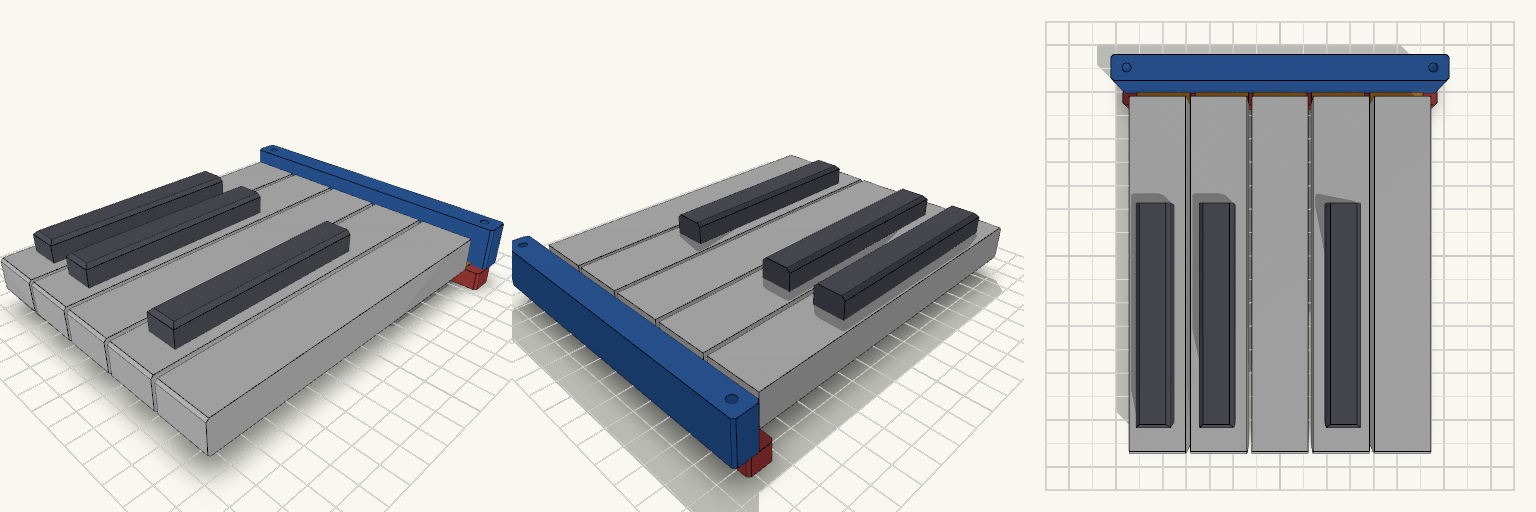
Five-Key Flexure Piano Keyboard Strip
Piano key mockups that stick, stay down or feel dead usually have no return force. This five-key strip gives every key its own 0.8 mm flexure hinge and its own leaf spring, all on one shared back rail. Key numbers Keys: 5 white keys, 22 × 140 mm, 14 mm thick, 24 mm pitch (2 mm gap between keys) Hinge: 0.8 mm flexure on the underside of each key Return spring: 12 mm wide, 1.2 mm thick leaf under each key Black keys: on keys 1, 2 and 4 Rail: shared, 118 mm wide, two 3.5 mm mounting holes at the ends Printing Use PETG or a ductile PLA so the thin hinges do not crack. Print on the flat plate with the base down. Print a spare, since 0.8 mm hinges are the first thing to wear out.
Print-in-Place Hinged Infinity Cube Fidget
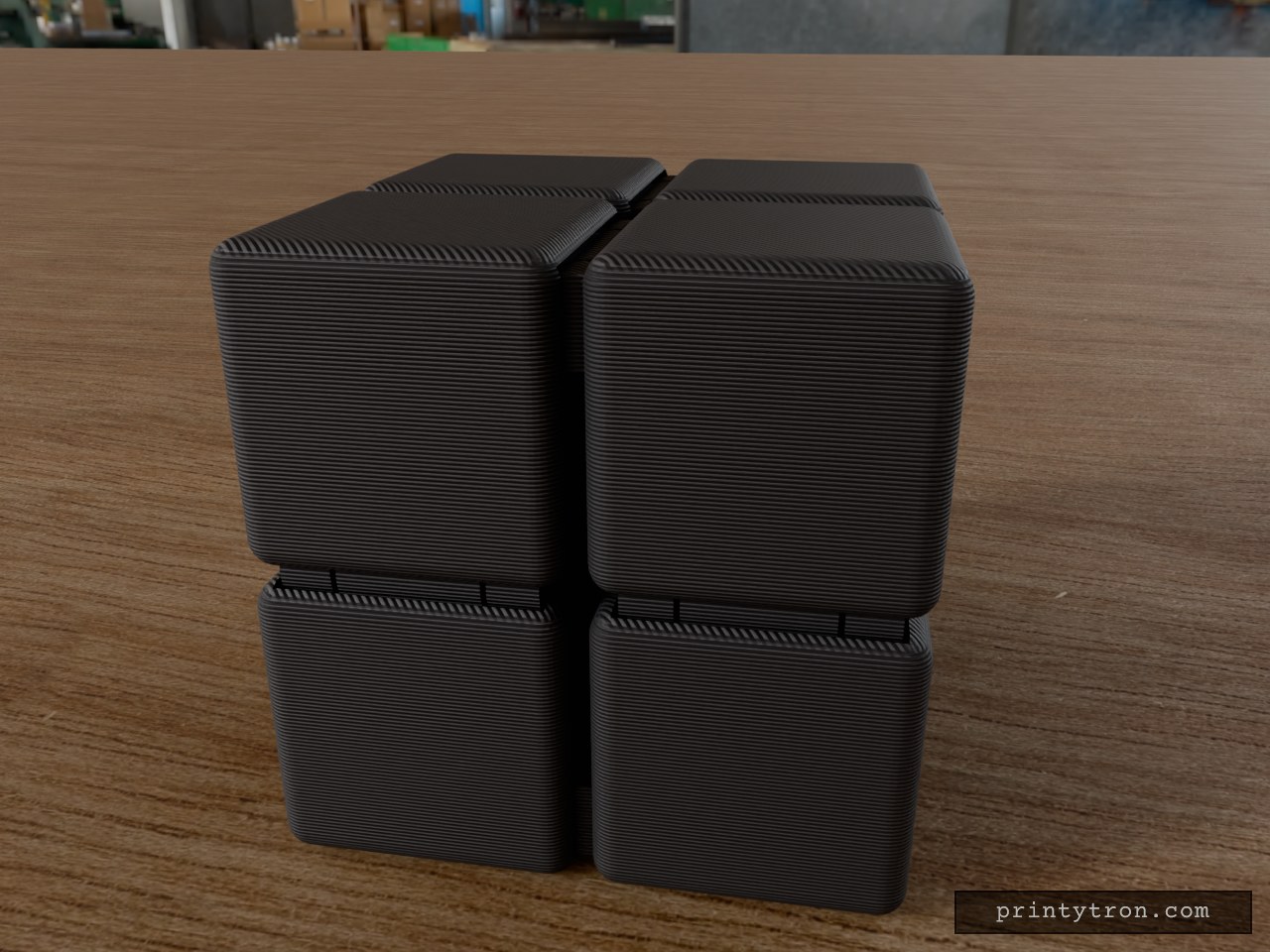
Eight rounded 22 mm blocks in a 2×2×2 grid, each a different colour, joined by twelve print-in-place pin hinges instead of solid bridges — so the cube actually folds in the hand. The hinge assemblies measure 42.2 × 42.2 × 42.2 mm laid out on the plate, and each hinge runs about 0.4 mm clearance around its pin and 0.4 mm between knuckle and lugs. Print it with no supports at a 0.2 mm layer height, and expect to snap each hinge free by hand once before the first fold. It is a fidget piece first and a desk object second; it has not been test-flexed, so treat the 0.4 mm clearances as a starting value rather than a proven one. Remix hooks Hinge clearance (about 0.4 mm): the one number worth tuning first. Loosen it if your printer runs tight or you print in a stringy filament; tighten it toward 0.3 mm if the joints feel sloppy after breaking them in. Block size (22 mm): the whole cube scales with it — the 42.2 mm hinge envelope follows the block edge, so resize the blocks and let the joints follow. Corner radius (2 mm): the easiest restyle that doesn't touch the mechanism. A larger radius sits softer in the hand and reads cleaner at the seams. Gap between blocks: widen it for visible, colour-separated seams; close it up if you want the folded cube to read as one mass. Pin and knuckle section: thicker knuckles hold tighter but need more break-in force; thinner ones free up faster and wear looser. Pairs well with two-tone or colour-swapped filament by block, and with other small desk fidgets. The eight-block grid is the constraint; everything hung on it is a choice.
Letra L luminosa de 15 cm con tapa difusora
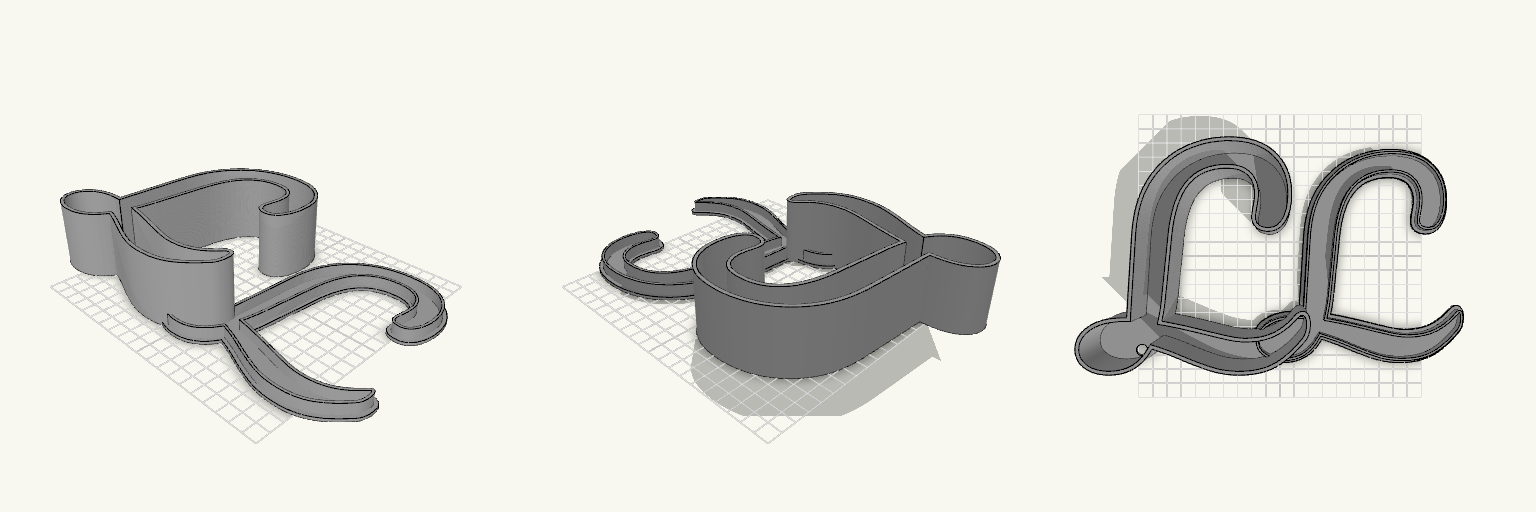
Letra L en fuente Pacifico, pensada como letrero luminoso: una base trasera hueca donde se pega una tira de LEDs y una tapa delantera que difumina la luz. Las dos piezas encajan entre sí y el cable sale por un orificio en la parte trasera, de modo que el conjunto queda cerrado y la luz solo se ve a través del difusor. Especificaciones Altura: 15 cm. Anchura aproximada: 25 cm, según la cola del trazo de la Pacifico. Fondo de la pieza trasera: 5 cm, con paredes de 2,4 mm para poder pegar la tira de LEDs por dentro, en los laterales. Orificio para el cable: 8 mm, situado en el fondo de la trasera, cerca de la base del trazo vertical. Tapa difusora: lámina de 2 mm con reborde de 8 mm que entra en la trasera con 0,3 mm de holgura. Impresión: dos piezas separadas, sin soportes. La trasera se imprime con el hueco hacia arriba y la tapa con la lámina plana sobre la cama. Huella en la cama: aproximadamente 258 × 150 mm con las dos piezas colocadas una al lado de la otra. Consejos de montaje Imprime la tapa en blanco natural o translúcido para que la luz se difumine de forma uniforme. Pega la tira de LEDs en las paredes interiores de la trasera, no en la cara del difusor, para evitar puntos de luz concentrados. Pasa el cable por el orificio antes de cerrar la tapa; el encaje de 0,3 mm permite abrir y cerrar la pieza sin pegamento.
Broom-Handle Sword End with Threaded Socket
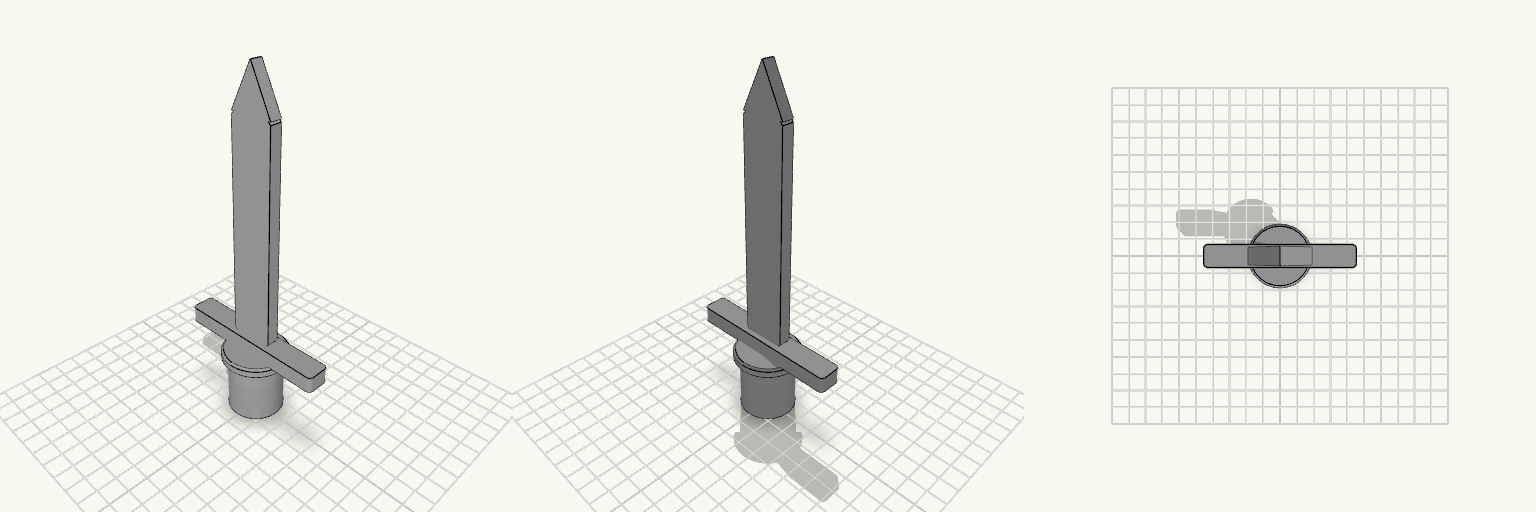
A screw-on sword end that turns a broom handle into a toy sword. The grip has a socket in its base sized for a standard 3/4" broom thread — 22 mm diameter, 4.5 mm pitch, 26 mm deep — so the blade threads onto the handle and unscrews again for carrying or storage. Above the grip sit an 80 mm crossguard and a 110 mm blade with a pointed tip. The finished piece measures about 80 × 34 × 175 mm as it sits on the plate. Broom threads are not identical across brands, so check your handle's diameter and pitch before committing to a full print; a short thread test piece is cheaper than a wasted blade. Remix hooks Socket diameter and pitch (22 mm / 4.5 mm) — the first thing to change. Match your own handle and the sword fits anything from a broom to a mop or a dowel. Socket depth (26 mm) — deepen it for a handle with a long exposed thread, or shorten it if the blade sits too high off the grip. Blade length (110 mm) — trim it for a dagger or stretch it for a two-hander; the crossguard scales along with it. Crossguard width (80 mm) — widen it for a more toy-like silhouette, narrow it for something closer to a real arming sword. Tip profile — the point can be rounded off further for younger wielders without touching anything else. Pairs naturally with a printed pommel or a wrapped grip sleeve, and the same socket can be reused on an axe, spear or halberd head for a matching set.
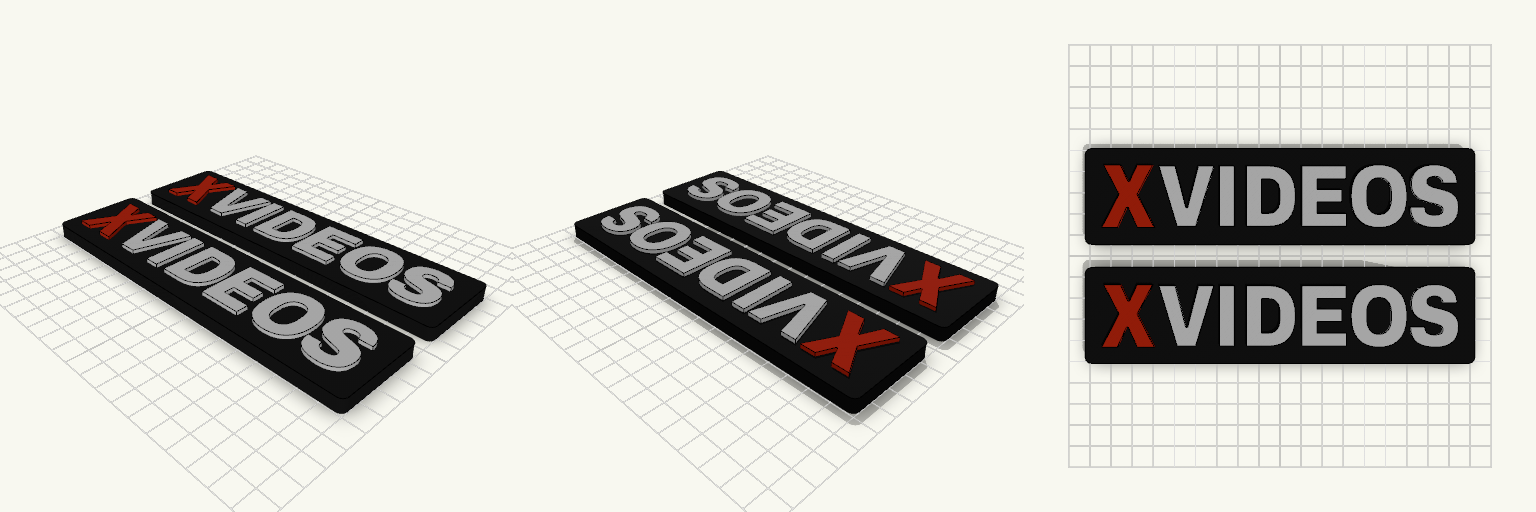
Dual xvideos plate print 180 mm
A two-up XVIDEOS nameplate set intended as a gift sign for a friend, for desk or shelf display. The model contains two identical horizontal plates, each with a solid black base, a red uppercase “X” at the left, and white “VIDEOS” lettering across the rest of the width. Each plate has a flat back and three underside pockets for 4×2 mm disc magnets. The plates are laid out with a gap and print as two separate pieces. Layout: two identical plates, each 180 × 44.3 mm at about 4.06:1; overall footprint 180 × 99.3 mm with roughly a 10 mm gap; prints as two separate plates. Base: black, 6.5 mm thick, flat back, no supports required. Lettering: single word XVIDEOS, all uppercase; cap height 29.7 mm, about 67% of plate height; text spans about 164 mm with even side margins; heavy geometric sans; letters set tight. Colors: red “X” (#E02A00), white “VIDEOS”, black base; aligned color regions for clean multi-color boundaries. Relief: letters stand about 1.8 mm above the base; raised faces are left square. Magnets: three round pockets per plate, 4.2 mm across × 2.1 mm deep, for 4×2 mm disc magnets; on the long centerline at X = -60, 0 and +60 mm; 120 mm end to end, with the outer pockets 30 mm in from the short ends. Magnet fit: 0.2 mm of play in diameter and depth for a snug fit; about 4.4 mm of base remains above each pocket. Printing: FDM-friendly, flat backside, no supports required.
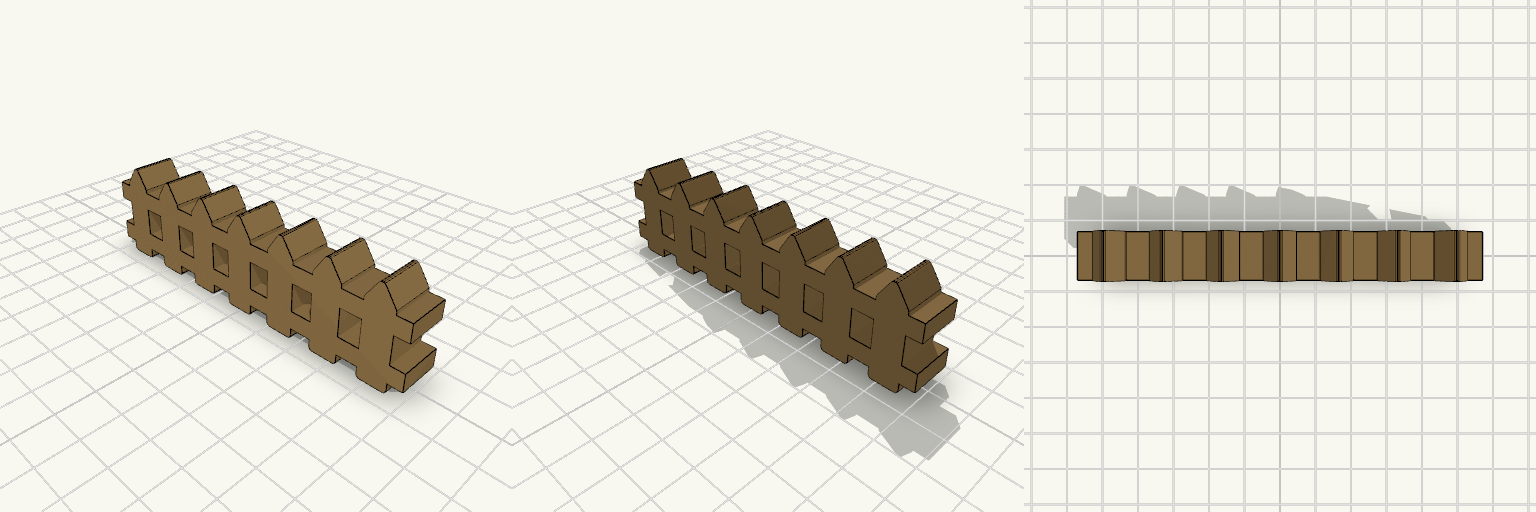
Flat Picket Fence Panel, 100 mm
A single flat picket fence panel, 100 mm long and 12 mm thick, with seven vertical pickets set 8 mm wide with 6 mm gaps between them. Two horizontal rails run the full length near the top and bottom, and the picket tips are rounded points that top out at about 27.2 mm. The pickets sit 4 mm in from each end, with the rails running through to the edges. The model is stored standing upright but is meant to print on its back face: laid flat, the 12 mm thickness becomes the print height and no supports are needed. Walls are 3 mm and the rails are 5 mm tall, so the part is sturdy at a small scale. Seven pickets, 8 mm wide with 6 mm gaps Two full-length rails, 5 mm tall Rounded pointed tips, roughly 27.2 mm overall height Print flat on the back face, no supports 3 mm walls, suited to PLA Use it as a miniature garden border, a diorama or model-railway accessory, or a small decorative edging piece.