Description
Enclosure for an ESP32 + OLED gaming device that hides every fastener behind the cover, so the front stays clean and the display stays put. The OLED sits in a guided pocket with a separate retaining frame, and the USB-C slot is placed to match the ESP32 board's connector.
Key numbers
- External size: 60 mm wide × 44 mm high × 40 mm deep, including the 2.5 mm rear cover.
- Display window: 27.5 × 27.5 mm (assumed active area of a 34 × 34 mm OLED PCB). Check this against your module.
- Internal cavity: 56 × 40 mm, 2 mm walls.
- USB-C slot: 10.2 × 4.2 mm on the right wall, at 18 mm height. Button hole: 3.4 mm, 36 mm up, with a holder for a 6 mm tact switch.
- Battery tray: fits a 703048 cell (about 48 × 30 × 7 mm), held by front ledges and side stops.
- Four M2 screws, 6 mm long, enter from the rear only. The tips stop in the bosses, short of the battery.
- Print: body front-face down, cover flat, frame flat. No supports are needed apart from the USB slot bridge. 0.2 mm layers, PETG or PLA.
Assumptions to verify
- The ESP32 board is taken as about 51 × 25.5 mm, with its long axis along the width and the USB-C on the right end. Many boards have no mounting holes, so the standoffs are side ribs with small locating pins. Trim or remove the pins if your board has no holes there.
- The retaining frame is a friction fit in its guides. Add a dab of glue if you want it permanent.
- Lettering is inlaid in black and runs vertically either side of the screen.
Images
More like this
Explore more in Desk & Tech →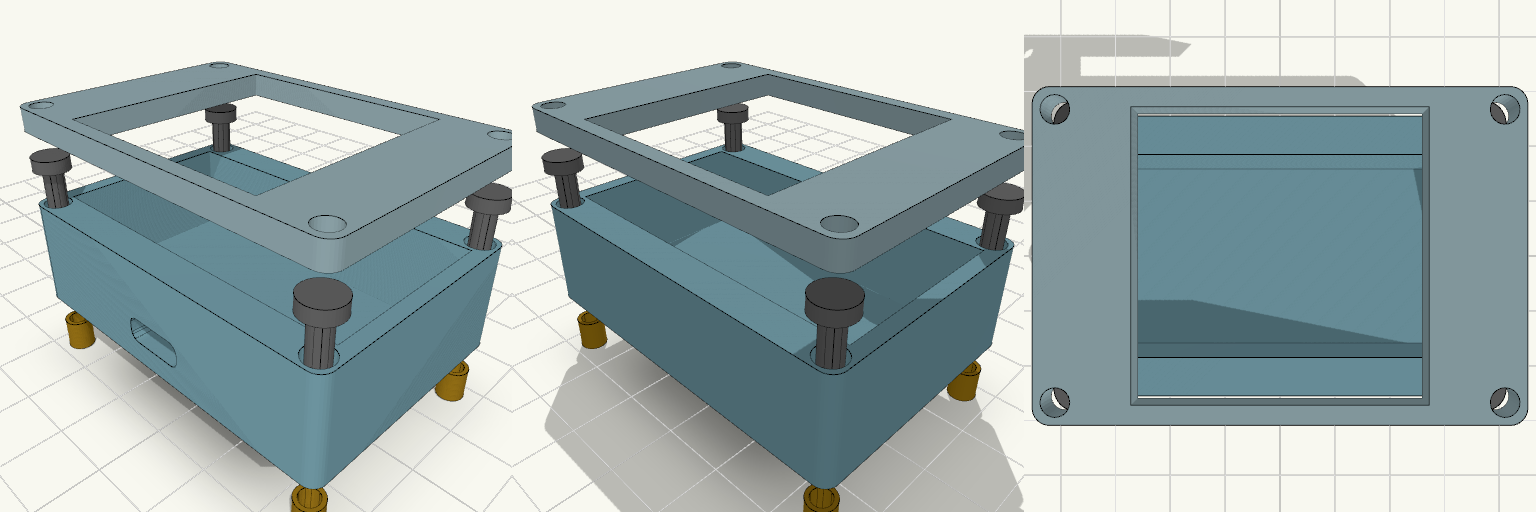
Endgame
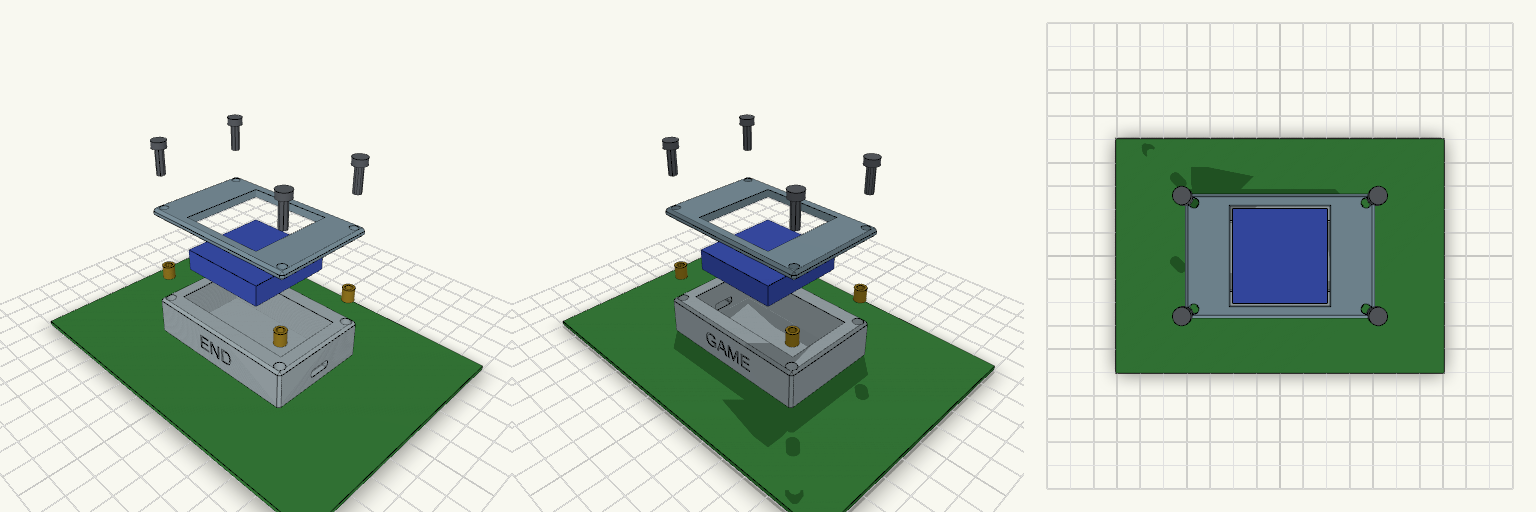
What it's for A two-piece enclosure for an ESP32-WROOM-32 dev board with a 1.3 inch square OLED display in the lid. Shown exploded with brass heat inserts and M3 screws aligned to the corner holes. Dimensions Board pocket: 52 x 28 mm, 14 mm deep (0.2 mm total clearance added so it actually fits) OLED window: 34 x 34 mm Outer size: about 56.8 x 40.4 mm, 2.4 mm walls Front USB-C slot, 10 x 4 mm Remix ideas Add vent slots for cooling. Make the lid thicker to recess the 8 mm display module. Add a cable pass-through at the rear. Print notes A true zero-clearance fit is impractical on FDM, so a small clearance is included. Dimension lines and the cutting mat from the reference image are not modelled.
Endgame1
Exploded assembly of a two-piece enclosure for an ESP32-WROOM-32 board (52 x 28 x 14 mm) and a 1.3-inch square OLED module (34 x 34 x 8 mm). The lower chassis has a 52.4 x 28.4 mm pocket, a USB-C cutout on the +X end, and debossed text: "END" on the front wall and "GAME" on the back wall. The lid has a 34.2 mm square window for the OLED. Brass inserts, M3 screws and the OLED module float above the chassis on a flat mat base. Outer size: 64 x 42 mm; chassis height 16 mm, lid thickness 3 mm Board pocket: 52.4 x 28.4 mm, 14 mm deep, 2 mm floor OLED window: 34.2 x 34.2 mm Corner holes: 4 positions at ±29.1 x ±17.9 mm; 4.2 mm for heat-set inserts in the chassis, 3.5 mm clearance in the lid USB-C cutout: 9.2 x 3.4 mm with rounded ends, on the +X end Text: 1 mm deep debossed lettering, 6 mm tall Exploded layout shows inserts, OLED module and M3 screws in assembly order; the mat is a reference surface, not part of the enclosure Material: PETG or clear/natural filament suits the frosted look; print the chassis and lid separately
Arc Reactor Docking Console
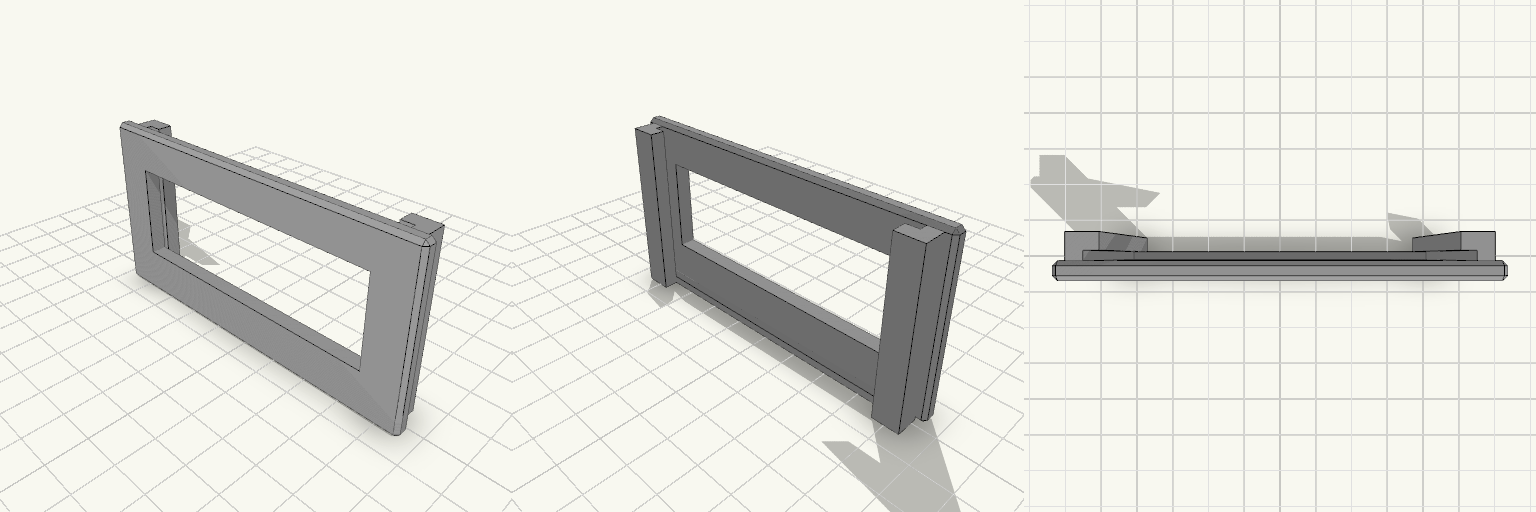
A modular desktop console base designed to securely dock and display a prop Arc Reactor. The underlying architecture prioritizes easy electronic integration without resorting to threaded inserts or messy glue. The chassis walls run at a lean 2 mm, shedding unnecessary material while preserving the rigid industrial aesthetic. Integration Points OLED Mount: A friction-fit slide track drops down directly behind the front JARVIS bezel, sized for a standard 0.96-inch (128x64) I2C OLED PCB (roughly 27.5 mm width). Control Board Cradle: The bottom service panel incorporates a built-in snap-fit cradle engineered for a standard ESP32 development board, positioned exactly in line with the rear USB-C access port. Reactor Mount: Features a 93 mm forward-pitched docking collar. Clearances: The top dock, bottom panel, and front bezel are modelled as separate bodies in the source for multi-part printing if needed, built with 0.4 mm clearances where they meet.
Handheld-Gehäuse mit herausnehmbarer Anschlussblende
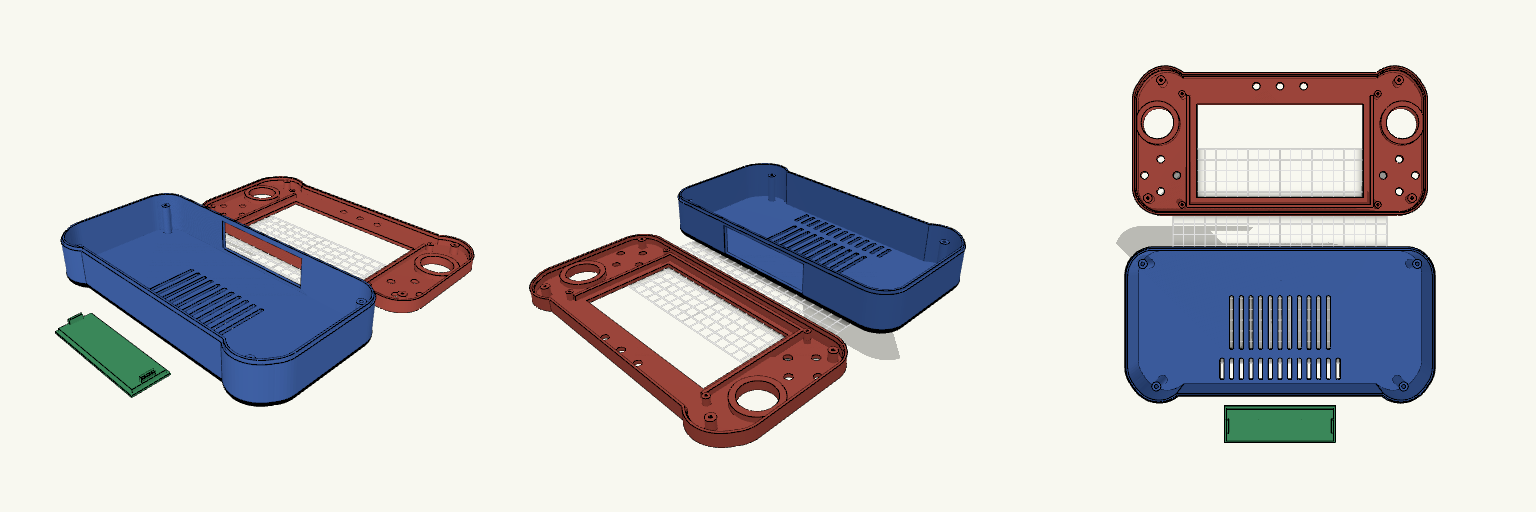
Handheld-Gehäuse für eine selbstgebaute Konsole, bei dem die Kabel- und USB-Öffnung hinten nicht dauerhaft offen bleibt: Eine Klipp-Platte schließt sie und lässt sich bei Bedarf herausnehmen. Aussparung in der Rückwand: 100 × 30 mm, mittig Klipp-Platte: Außenrand 104 × 34 mm, Einsatz 99,6 × 29,6 mm, zwei Federarme mit Rastnasen, Fingermulde Innentiefe: 48 mm, Wandstärke 3 mm Display-Fenster 155 × 87 mm, Tastenlöcher 7,2 mm Druck: Schalen offen nach oben, Platte flach, ohne Stützen möglich
Pi 3 case
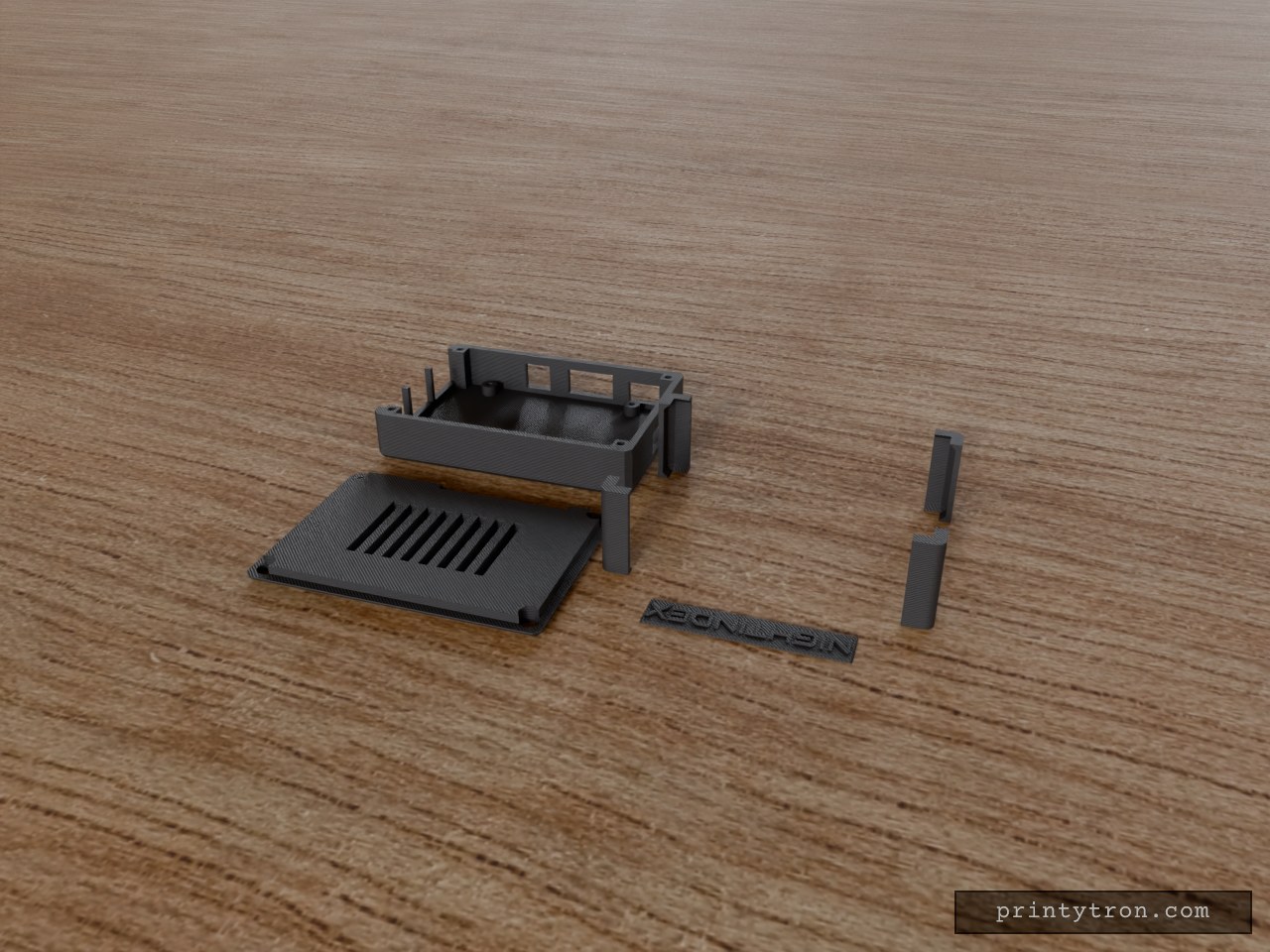
A bare Raspberry Pi 3 is so light that hooking up a standard HDMI cable instantly tips it off the desk. This case locks the board into a heavy enclosure and uses snap-on outer corner bumpers to give it some actual grip, so the board stays exactly where you put it. The port cutouts are oversized enough to accept real molded cables without them binding against the shell. Bed Fit: Everything is packed tightly to fit in a single run on a 180×180 mm print bed. Printing: All pieces sit flat on the plate. No supports required anywhere. Clearances: Built with a 0.4 mm gap around the board and lid joint so it slots together cleanly.
XIAO ESP32-S3 Chatbot Shell
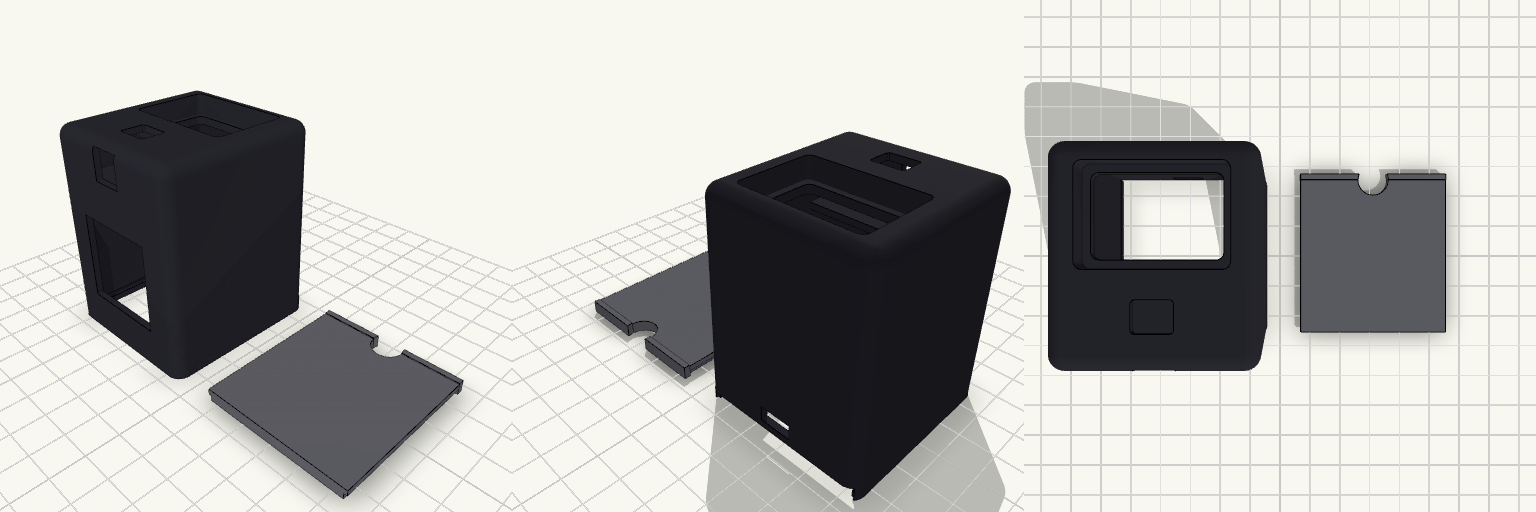
Boîtier compact conçu pour intégrer une carte Seeed Studio XIAO ESP32-S3 Sense avec caméra, un écran TFT de 1,54" en façade et un haut-parleur plat (3525). L'ensemble se ferme via un tiroir coulissant en sous-face. Vérifications de montage : L'écran s'insère par l'intérieur (espace pour PCB de 32x43,7 mm). La carte XIAO repose sur une butée interne située à 43,7 mm du fond, avec une profondeur d'appui de 15 mm. La caméra pointe par le trou carré de 10 mm en façade. L'accès USB-C sort par le haut. Le haut-parleur 3525 s'encastre à fleur par l'extérieur du toit.