Flowing Kitchen Organizer Tray
Created 1 months ago
Description
A premium, single-piece kitchen and desk organizer engineered specifically for support-free FDM printing. The design integrates distinct vertical storage and a sweeping transition into a shallow tray, tied together by a heavy, stable base.
Features
- Rear Compartments: Two independent 128mm tall pockets with 2mm structural walls for heavy utensils.
- Front Storage: A 65mm tall tool cup and a swooping front-right spoon rest with an organic basin curve.
- Phone Interface: Twin central resting rails angled at 20 degrees with a dedicated front base cable notch.
- Printability: 100% support-free geometry with rounded external corners and thick 12-16mm solid base floors to prevent tipping.
Images
More like this
Explore more in Kitchen & Bathroom →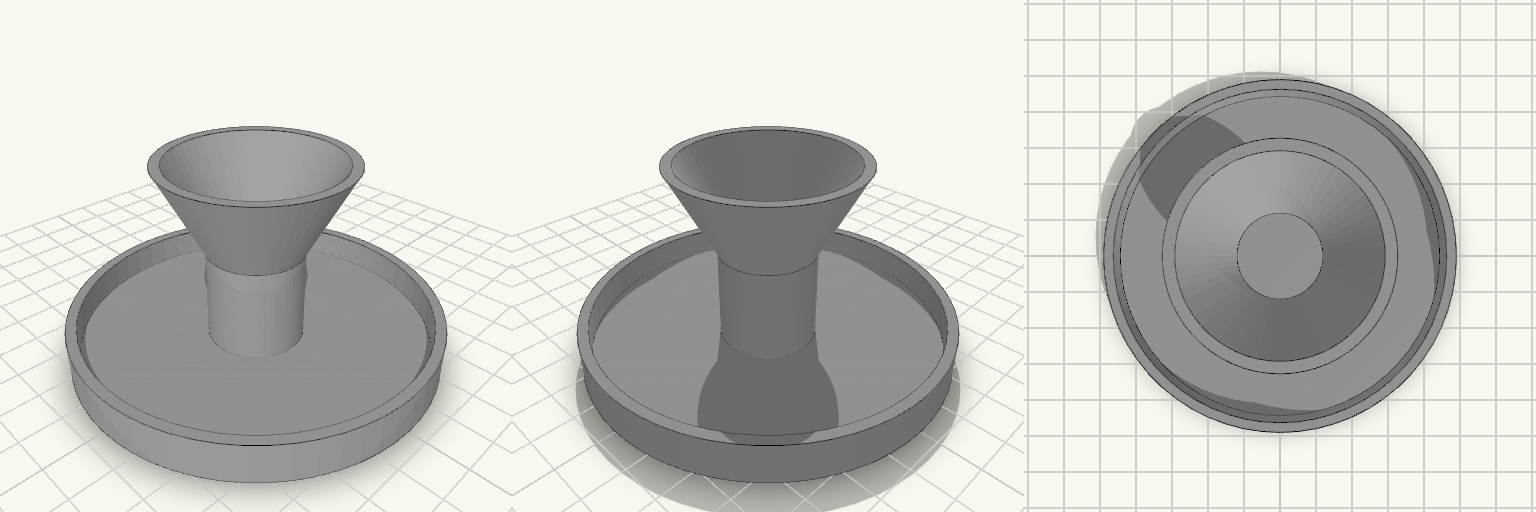
Modern Egg Cup With Shell Dish
A one-piece egg cup for soft-boiled eggs. The cup has a 42 mm opening that tapers inward, so a standard chicken egg (about 45 mm at its widest) sits snugly at the rim. It stands on a short stem inside a wide 92 mm dish with a 10 mm lip, which catches the shell top when you crack it off. Remix hooks Opening diameter (42 mm): Make it 40 mm for small or bantam eggs, or 44 mm for a looser fit with large eggs. Keep it a few mm under the egg's widest point so the egg sits on the rim instead of dropping in. Cup height and taper: The cup is 48 mm tall overall, narrowing to a 20 mm seat. A shorter cup shows more of the egg. A steeper taper holds it more upright. Dish size (92 mm wide, 10 mm lip): Widen it or raise the lip to catch more shell. Shrink it for a tighter footprint. Stem (about 12 mm radius): Thicken it for more stability, or lengthen it to lift the cup higher above the dish. Pairs with A matching spoon rest, or a second cup in a different colour for a set. A flat lid or cap over the opening to turn the dish into a small storage cup. A set of four on a shared tray. Dimensions have not been test-printed. The dish floor is 3 mm thick, which is a good first value to check before changing anything else.
Brim — Flat-Bottom Rounded Bowl
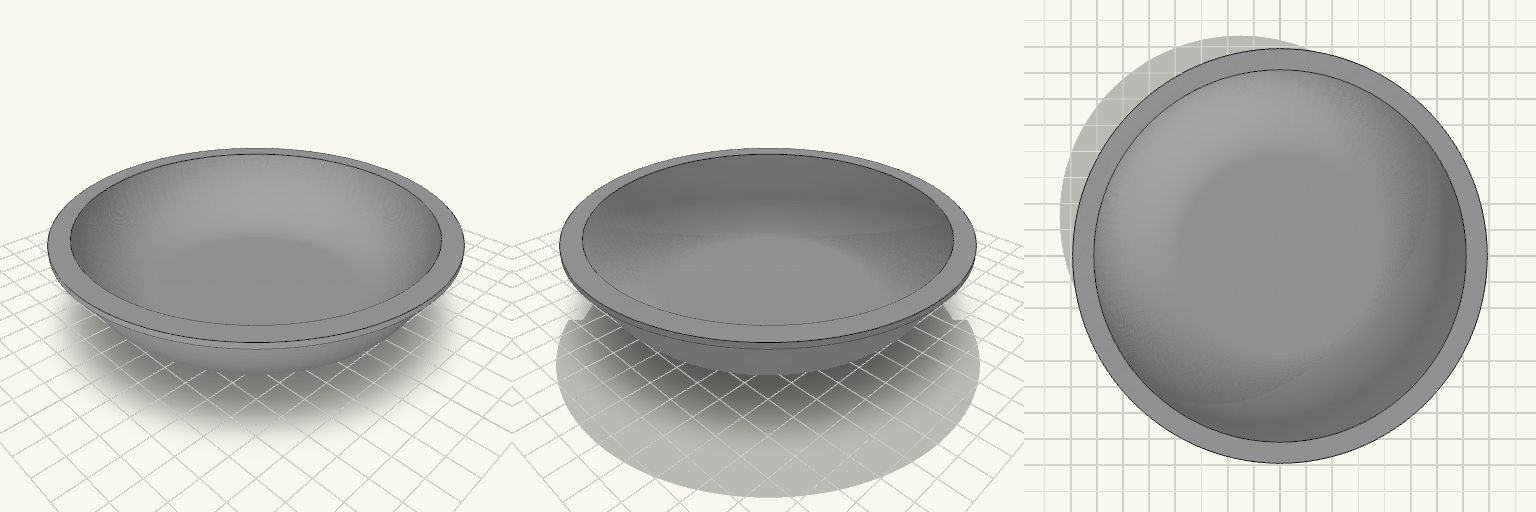
Brim is a shallow serving bowl with a flat 75 mm base that sweeps up in a smooth curve to a wide, flat rim. The flat base keeps it stable on a table and easy to print without supports on the bottom face. Dimensions Outer rim diameter: 138 mm Rim width: 5 mm, flat and horizontal Opening inside the rim: 128 mm Depth: 30 mm Flat bottom diameter: 75 mm Wall thickness: 2 mm throughout Print notes Print rim-up or base-down; base-down is the natural orientation. The steepening curve near the rim may need supports or slow cooling.
Brutalist T-Post Cap with Square Platform
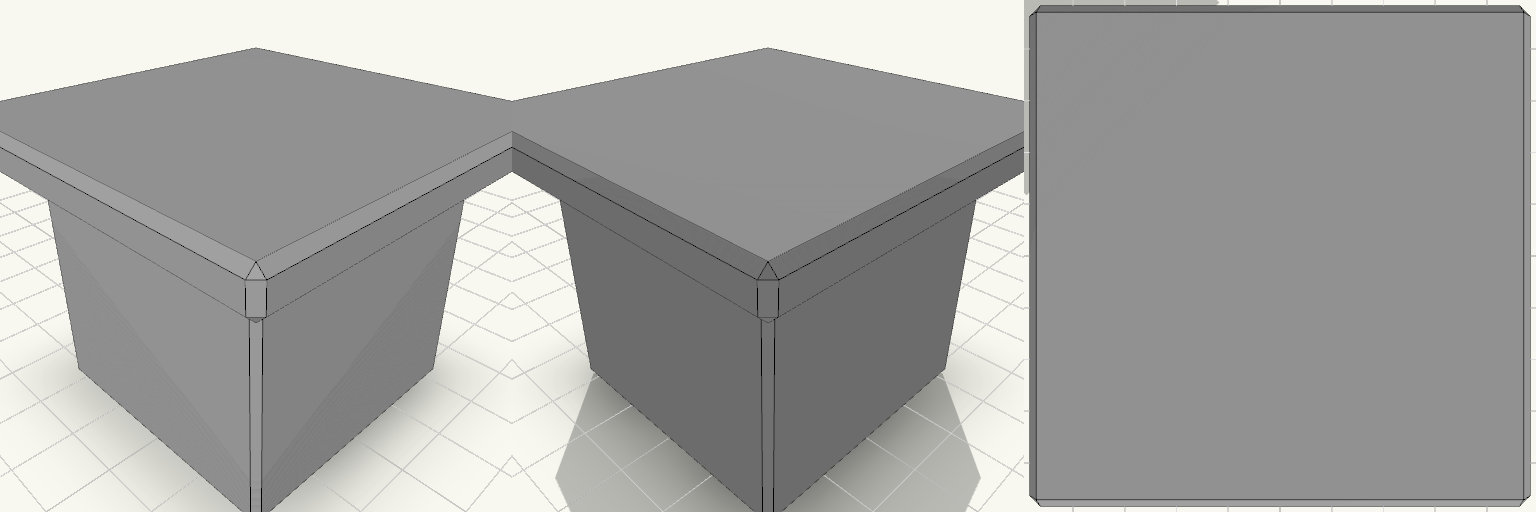
A blocky sleeve that drops over a T-post and carries a flat square platform on top — a brutalist plinth silhouette in cap form, all hard edges and stacked planes. The pocket inside is T-shaped, cut generously around a typical steel fence T-post: a 38 × 7 mm flange opening and a 7 × 38 mm stem slot, leaving roughly a millimetre of play per side so it drops on without a fight. The sleeve is 40 mm deep with 3 mm walls and a 4 mm roof, and the whole cap stands 46 mm tall over a 60 × 60 × 6 mm platform. Design notes T-shaped pocket for a T-post — flange opening 38 × 7 mm, stem slot 7 × 38 mm. Pocket sized with a little slack per side; the 7 mm slot width is the fit-critical dimension on real posts. 40 mm deep sleeve, 3 mm walls, 4 mm roof. 60 × 60 × 6 mm square platform sits on top as one solid piece with the sleeve. Overall footprint on the print plate: 60 × 60 mm, 46 mm tall. Prints as a single part; no assembly and no fasteners. Good to know The pocket is shaped from a typical steel fence T-post rather than a measured one — check your post's flange width, stem length and metal thickness before committing to a long print. Platform size is independent of the pocket, so it can grow or thicken without touching the post fit. Tightening or loosening the pocket is a small change if the cap ends up sloppy or stubborn on the post. The sleeve's outside was widened to 44 mm to keep the walls at a full 3 mm around the bigger pocket, so the cap stays chunky rather than thin-shouldered.
Deep J Fridge Hook with Magnet Recess
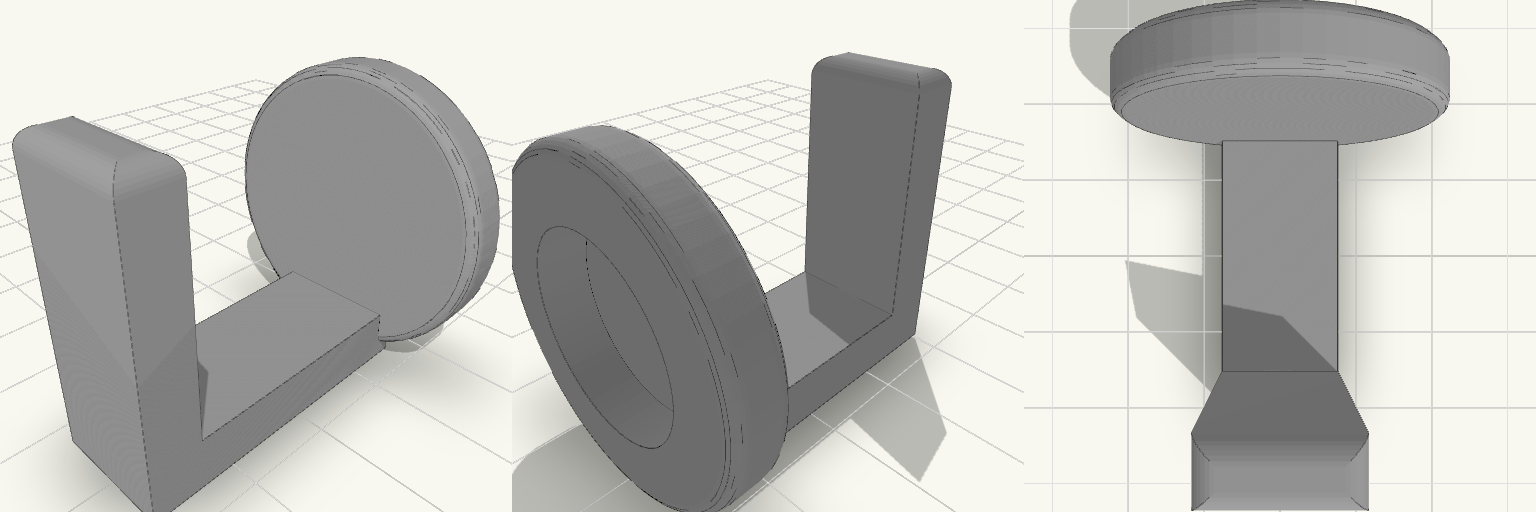
A deep J-shaped hook for hanging a tea towel on a fridge door. A round back plate holds a standard 20x5 mm neodymium disc magnet, and a tall lip at the end of the arm stops the towel sliding off when the door swings open. What it's for Hanging a tea towel on the side or front of a steel fridge door. Keeping the towel in place when the door is opened or closed, thanks to the tall lip. The magnet sits flush against the fridge door, with a 1 mm wall of plastic on the hook side. Dimensions Back plate: 34 mm diameter, 6 mm thick, with rounded edges. Magnet recess: 20.2 mm diameter, 5 mm deep, opening on the fridge side. The extra 0.2 mm gives a press fit without the magnet binding. Wall behind the magnet: 1 mm. Arm: 14 mm wide, 6 mm thick, 36 mm long. Lip: 14 mm wide, 6 mm thick, 34 mm tall. Overall footprint: 34 mm wide, 40 mm projection, 34 mm tall. Print notes Print with the arm's underside flat on the bed. No supports are needed for the arm and lip. The recess faces the back, so the plate's back face needs a clean first layer or a short bridge, depending on orientation. Secure the magnet with a drop of glue if the fit is loose. Check the magnet polarity before gluing, so it grips the fridge. Remix ideas Lengthen the arm for thicker towels or oven gloves. Shorten the lip for a lighter hook. Resize the recess for 15 mm or 25 mm magnets. Add a second hook arm for a double hook.
Steep-Shouldered Funnel for Clean, Targeted Pouring
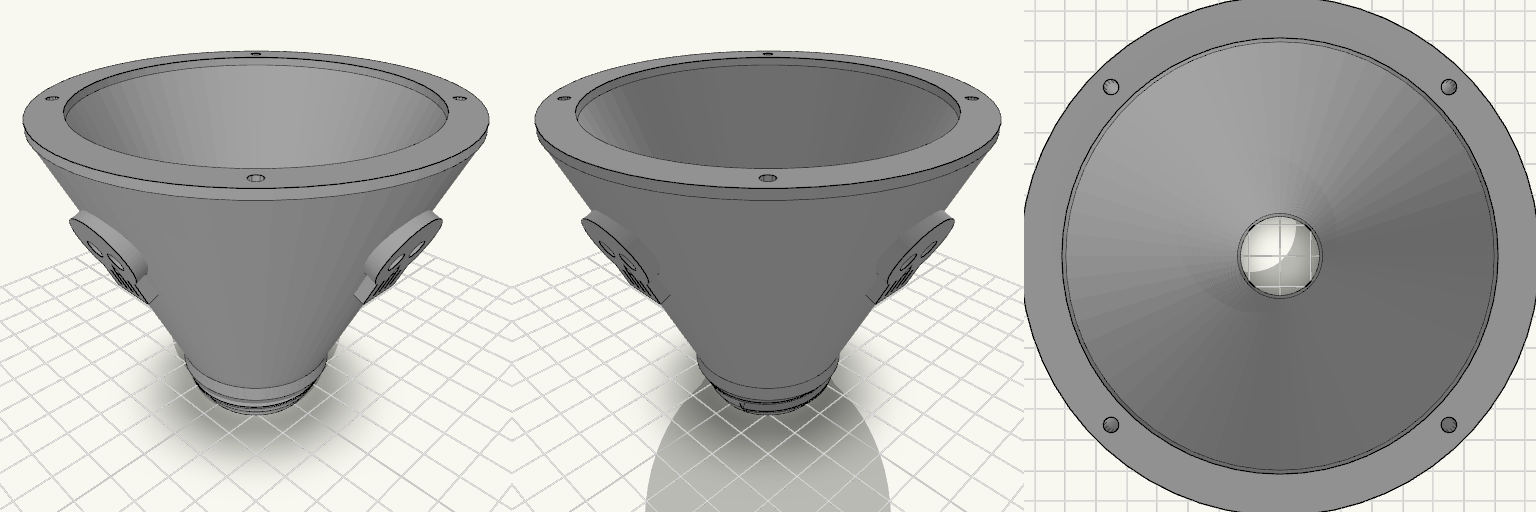
A broad-shouldered funnel with a gothic streak: a 100 mm outside rim (84 mm inside) gathers a jug or bottle mouth, the cone narrows into a 26 mm bore, and the stream drops toward the filler. At 82 mm tall it stays compact enough for a tight engine bay, and the inner cone has no side holes, so the pour runs down the middle. The spout is built around a 36.5 mm major-diameter, 3 mm pitch right-hand screw thread that runs the full 10 mm from the tip up to a 40 mm sealing shoulder. The 26 mm bore keeps the pour path open; the thread is the fit feature, so check the filler neck and gasket stack before printing, since the thread has to match the mating part. Four sealed air tunnels, 3 mm across and spaced 90° apart, run inside the wall from the top rim down through the cone. At the lower end each turns inward and opens through the bore wall about 3 mm above the spout tip, so the bottom face stays solid and air can climb while oil runs down the middle. No holes pierce the side of the cone, so it vents without weeping out. The threaded spout wall carries these passages; at the bore openings the material is thin, so inspect the slicer preview before printing. Four raised skulls ring the cone between the tunnels, one every 90°, angled to follow the slope. Each is about 19 mm wide and stands roughly 2.5 mm proud of the surface, with eye sockets, nose and teeth lines cut into the face; the fine teeth lines may print faintly on a 0.4 mm nozzle. They give the funnel a gothic edge without interrupting the flow path. Fit notes 36.5 mm major-diameter, 3 mm pitch right-hand screw thread on the spout Threaded section runs the full 10 mm from the spout tip to the sealing shoulder 40 mm sealing shoulder for a gasket 26 mm bore through the spout Verify thread fit and gasket compression on the filler neck before printing Check the thin tunnel openings near the bore in the slicer preview Design notes 100 mm outside opening, 84 mm inside — a wide catch area 82 mm overall height Four internal 3 mm air tunnels, evenly spaced, opening into the bore about 3 mm above the tip and exiting at the rim Four raised skulls about 19 mm wide and 2.5 mm proud, set between the tunnels Prints as one piece
5-Point Star Cookie Cutter
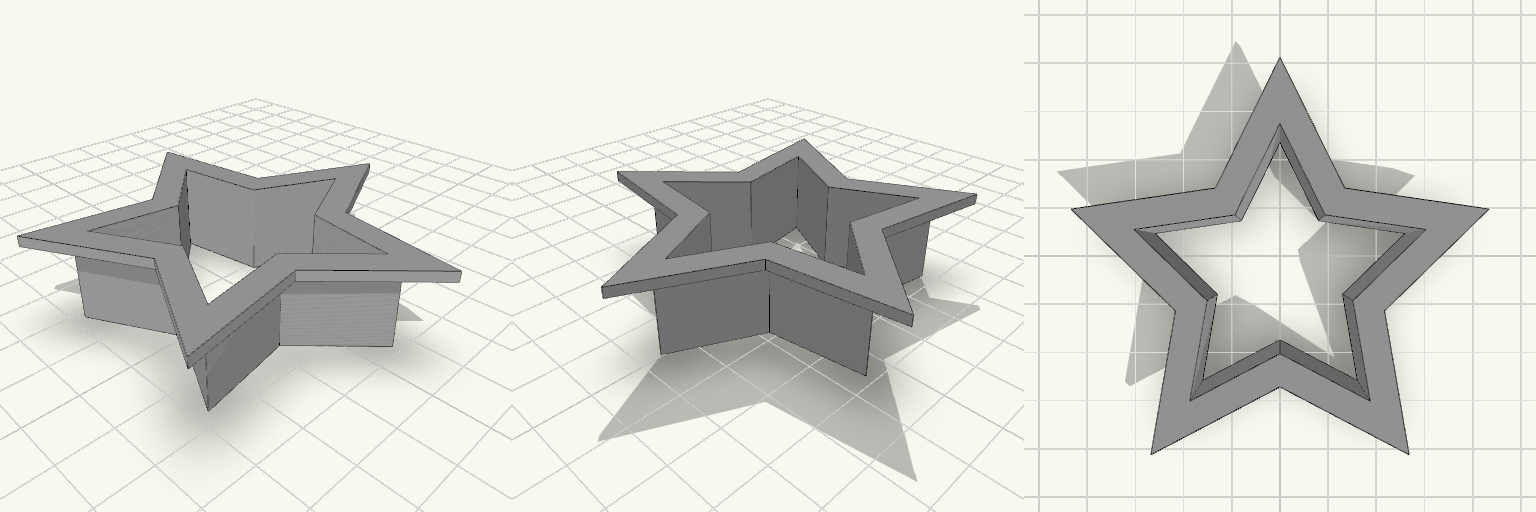
A five-point star cookie cutter, 60 mm tip to tip, with 18 mm tall walls and a wide flat flange around the top edge. The flange gives a thumb a broad surface to press on, so pushing the cutter through dough doesn't put a thin edge against your skin. Remix hooks The values below are the ones worth changing. Everything else follows from them. Star size (R, 30 mm): This is the tip radius, so 60 mm across. Change it to scale the star. At about 40 mm across or less, check that the flange doesn't crowd the inner corners. Point sharpness (ratio, 0.5): This is the inner radius divided by the outer radius. Lower values like 0.4 give spikier points. Higher values like 0.6 give a chubbier, more rounded star. Very spiky points are harder to press out of dough. Flange (flangew 4 mm, flanget 2 mm): Widen it for a more comfortable press, or thicken it for more stiffness. Rounding the flange's outer corners is an easy variant if you want it softer on the thumb. Wall (wall, 1.2 mm): This is about three nozzle widths on a 0.4 mm nozzle. Thinner cuts more cleanly but is more fragile. Thicker is sturdier but pushes dough aside more. Height (H, 18 mm): Lower it for thin cookies, or raise it for thick dough or a deeper grip. Pairs well with A set of different sizes, made by changing R and nothing else. Other shapes that reuse the same wall and flange values, such as a heart or circle, so the whole set feels the same in the hand. A matching stamp or embossing plate that fits inside the cutter opening. Printing Print it flange-up or flange-down on the bed. Flange-down needs no supports, and the thin walls grow straight up from the flange. Use food-safe filament if you want to use it on dough.