Retro Soda Can Cover with Swivel Shutter
Created today
Description
A snap-on cover that turns an open drink can into something with a bit of mid-century diner about it: a round cap that seats over the rim, and an orange shutter pivoting on a centre pin, flicked aside by a fingertip notch to uncover the drinking slot and swung back to close it. Swivel it shut and the can looks sealed; flick it open and it reads like the lid of an old soda can.
The shutter turns on a printed pin with a 0.4 mm working gap, so the cover comes off the plate already assembled — no loose parts, no fitting, no supports to pick out of the pivot. The cap is 71 mm across and shaped to snap over a standard 12 oz can rim (assumed at roughly 66 mm), so measure your can before committing to a long print.
Good to know
- Cap and Swivel Shutter print as one working piece; the shutter stays captured on its pin.
- Finger notch on the shutter tip for one-handed opening.
- Sized for a standard 12 oz can; slim cans and other rim diameters need the fit adjusted first.
- The shutter is the natural place for a second colour — a filament change at its layer gives the cap a contrasting tab.
- Print the cap flat on its face; the pivot needs a clean, squish-free first layer to swing freely.
Images
More like this
Explore more in Kitchen & Bathroom →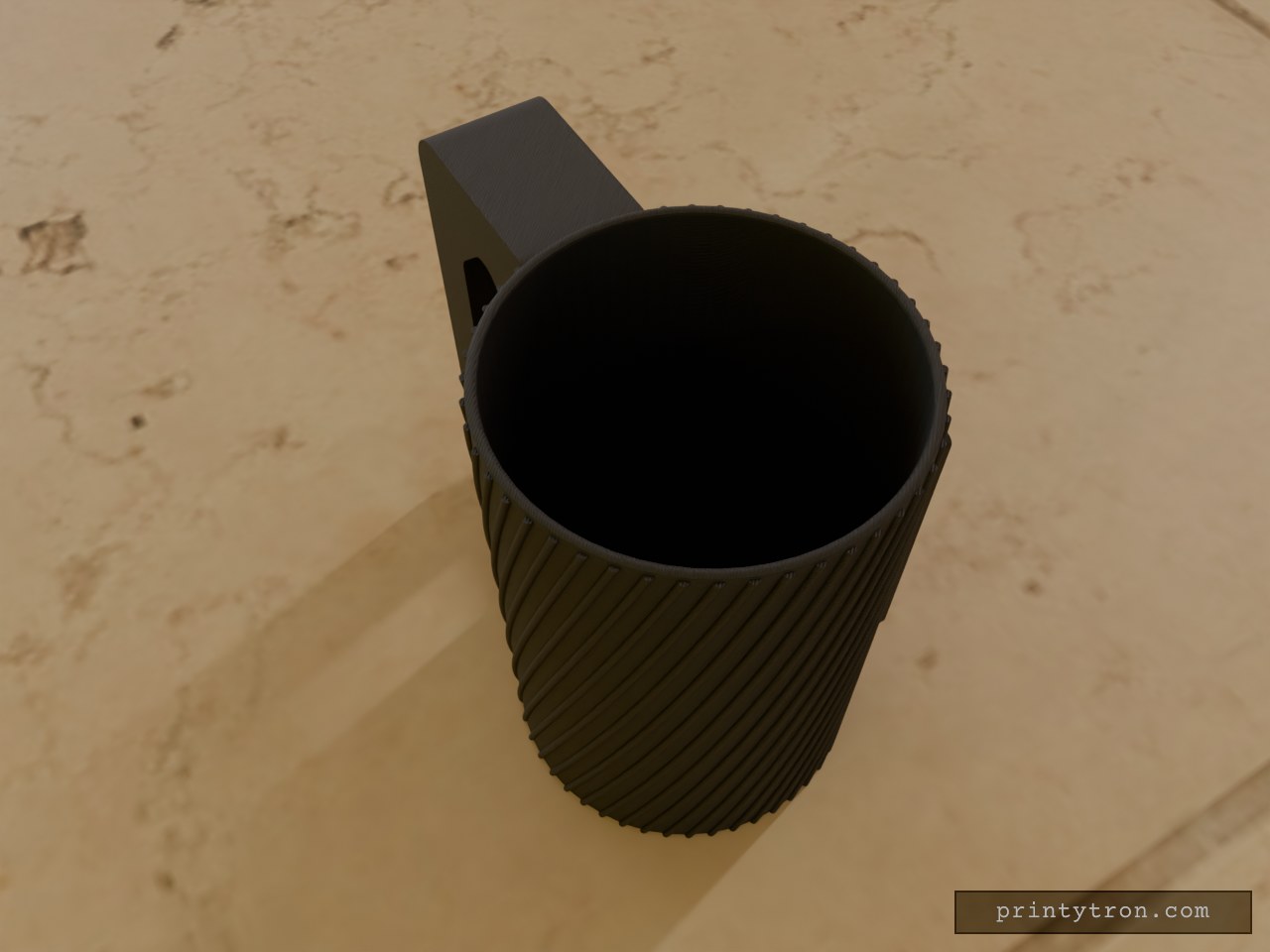
Obsidian — Ribbed Can Cooler with Handle
Obsidian is a matte-black-ready can cooler for standard 330 ml cans, with a reinforced side handle, diagonal grip ribs and a flat front panel reserved for names or logos. The handle opening has a peaked top so it prints upright without supports. Dimensions Inside diameter: 68 mm Inside height: 105 mm (above a 3 mm base) Wall: 2 mm, base: 3 mm Overall height: 108 mm; footprint about 115 × 74 mm including handle and panel Features Diagonal ribs outside, perfectly smooth bore inside Rounded top rim Broad, rounded handle, 24 mm wide Flat front panel, 40 × 66 mm Print notes Print upright, base on the plate, PETG, 0.4 mm nozzle, 0.2 mm layers No supports expected; fits a 180 mm build volume
Cucharilla de dos piezas con conector
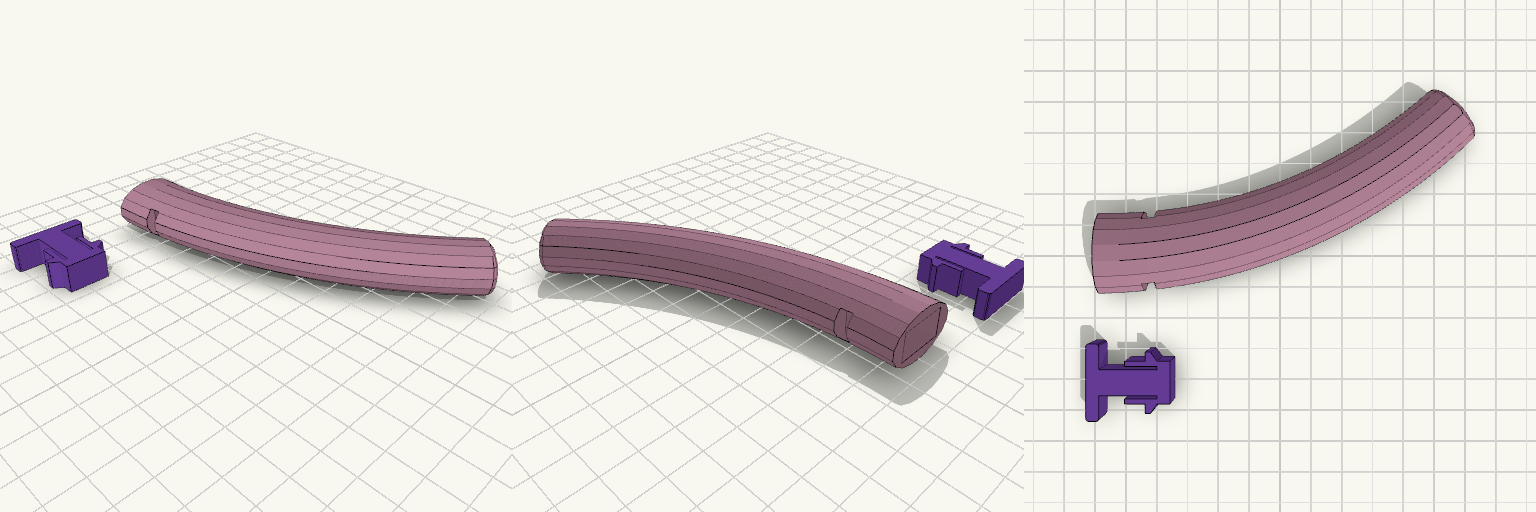
What it's for Mango curvo tipo banana y conector independiente con dos pestañas flexibles. El conector encaja con un clic en el alojamiento del mango y se retira pellizcando las pestañas a través de las ventanas laterales, sin herramientas. Dimensions Mango: 120 mm de largo, 25 mm de ancho en la base y 20 mm en la punta, 16 mm de grosor. Alojamiento: 16 × 6 mm, 23 mm de profundidad. Conector: núcleo de 22 mm, 5,6 mm de grosor, brazos de 1,6 mm con resalte de clic. Ventanas laterales de 4 mm donde se aloja el resalte. Remix ideas Añadir una cabeza de cuchara en la pestaña tope del conector. Ajustar el grosor de los brazos (1,6 mm) para un clic más suave o más firme. Cambiar el radio de curvatura del mango.
5-Point Star Cookie Cutter
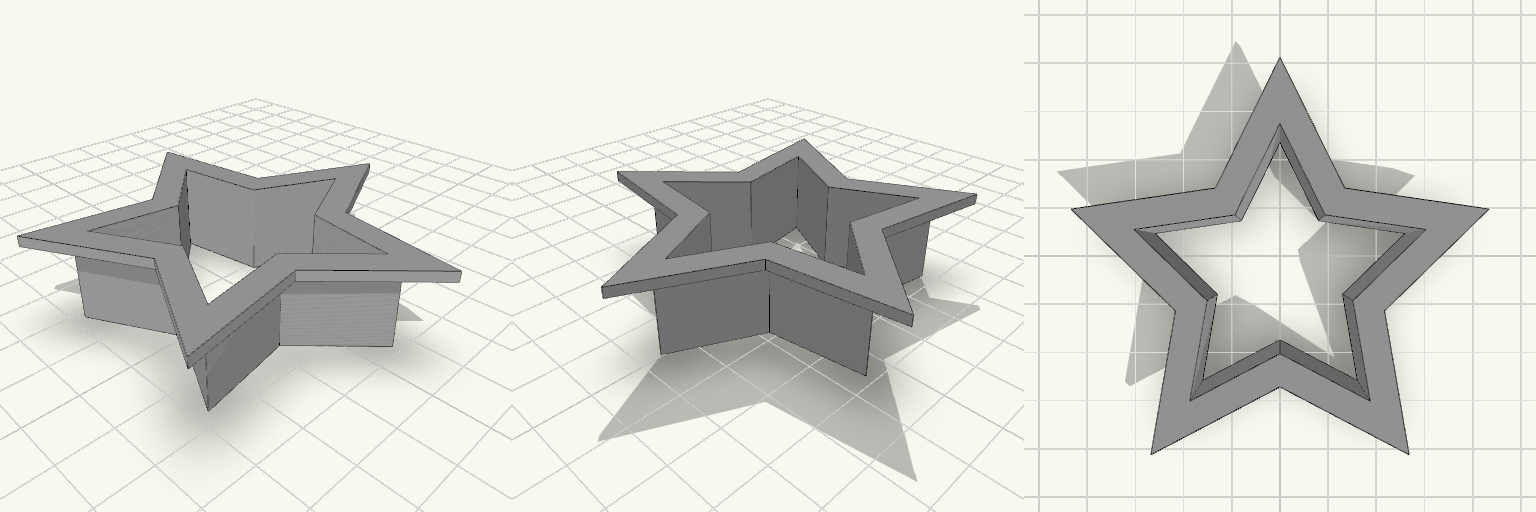
A five-point star cookie cutter, 60 mm tip to tip, with 18 mm tall walls and a wide flat flange around the top edge. The flange gives a thumb a broad surface to press on, so pushing the cutter through dough doesn't put a thin edge against your skin. Remix hooks The values below are the ones worth changing. Everything else follows from them. Star size (R, 30 mm): This is the tip radius, so 60 mm across. Change it to scale the star. At about 40 mm across or less, check that the flange doesn't crowd the inner corners. Point sharpness (ratio, 0.5): This is the inner radius divided by the outer radius. Lower values like 0.4 give spikier points. Higher values like 0.6 give a chubbier, more rounded star. Very spiky points are harder to press out of dough. Flange (flangew 4 mm, flanget 2 mm): Widen it for a more comfortable press, or thicken it for more stiffness. Rounding the flange's outer corners is an easy variant if you want it softer on the thumb. Wall (wall, 1.2 mm): This is about three nozzle widths on a 0.4 mm nozzle. Thinner cuts more cleanly but is more fragile. Thicker is sturdier but pushes dough aside more. Height (H, 18 mm): Lower it for thin cookies, or raise it for thick dough or a deeper grip. Pairs well with A set of different sizes, made by changing R and nothing else. Other shapes that reuse the same wall and flange values, such as a heart or circle, so the whole set feels the same in the hand. A matching stamp or embossing plate that fits inside the cutter opening. Printing Print it flange-up or flange-down on the bed. Flange-down needs no supports, and the thin walls grow straight up from the flange. Use food-safe filament if you want to use it on dough.
90mm Can Ring Pull Lever Tool
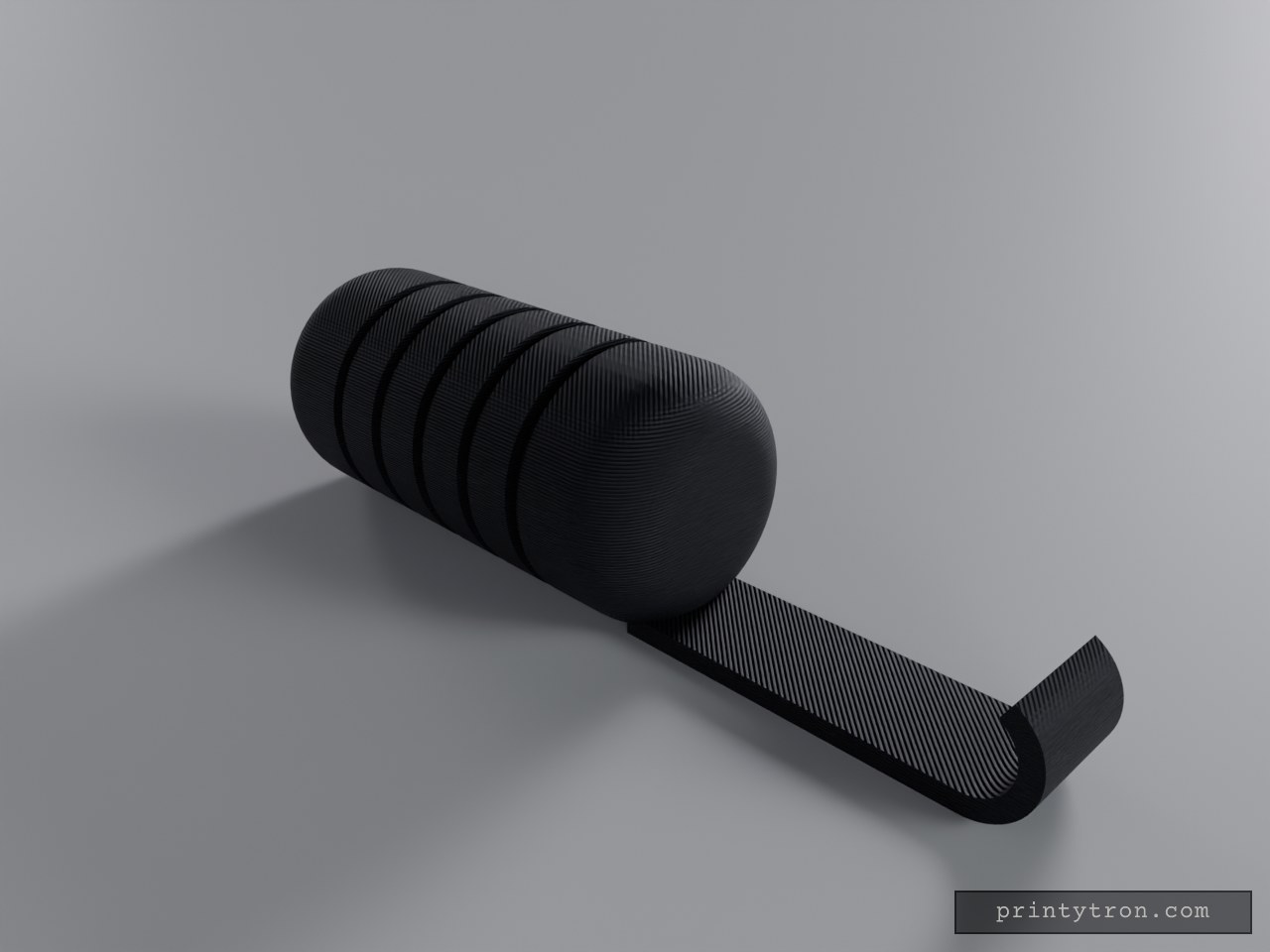
A hand-held lever for lifting can ring pulls without using fingernails. A thin curved hook slides under the ring, and a thick barrel handle gives the leverage to lift it. Suited to anyone with limited grip strength or short nails. Specifications Overall length: 90 mm Handle: 25 mm diameter barrel, about 55 mm long, with ring grooves for grip Hook blade: 2 mm thick, 12 mm wide, curved upward at the tip to slide under the ring Construction: single welded body, printed as one piece Orientation: print with the handle and blade lying flat on the bed. Supports may be needed under the barrel's curved underside. Material: PETG or PLA. PETG is preferred for the 2 mm blade because it flexes before it breaks. Use: ring-pull cans such as beans, soups and drinks Notes The 2 mm blade is the thinnest part. Print it with at least 3 perimeters for strength. The grip grooves are shallow, so the handle stays easy to wash.
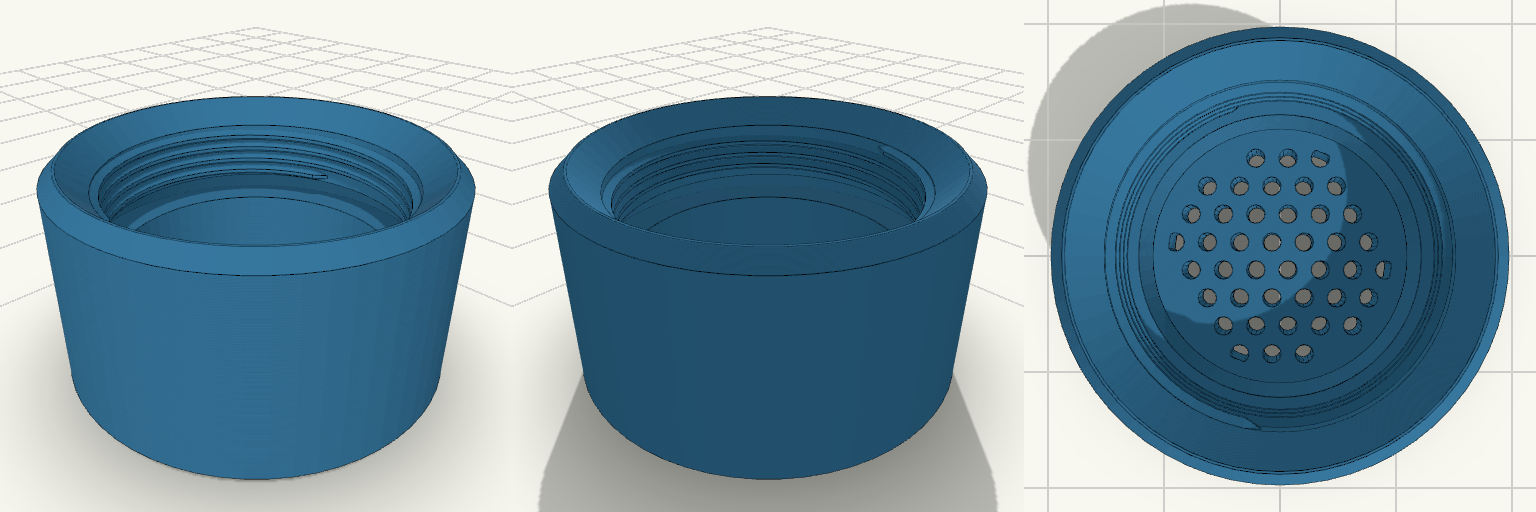
Softflow — M22 Faucet Splash Diffuser
Softflow is a screw-on splash diffuser for faucets with an M22x1 male outlet thread. The base is perforated with a staggered hex grid of small holes, breaking the flow into many fine streams for a softer, wider spray. A short open chamber between the thread and the perforated floor lets water spread across the whole hole pattern before it exits. Features M22x1 female thread, 8 mm deep, with a beveled lead-in at the opening Staggered hex grid of 1.5 mm holes at 2.6 mm spacing, inside an 18 mm circle 3 mm perforated floor with a relief chamber above it Chamfered top and bottom edges on a round body Dimensions Outer diameter: 28 mm Overall height: 16 mm Thread: M22 x 1 mm pitch, 8 mm engagement depth Floor thickness: 3 mm Print notes Print with the perforated face down on the bed, opening facing up; no supports are needed. Thread fit has not been tested against a real faucet. If it binds, increase the thread clearance slightly. A fine layer height (0.12–0.16 mm) keeps the small holes and thread crisp. PETG or ASA suits wet, warm-water use better than PLA.
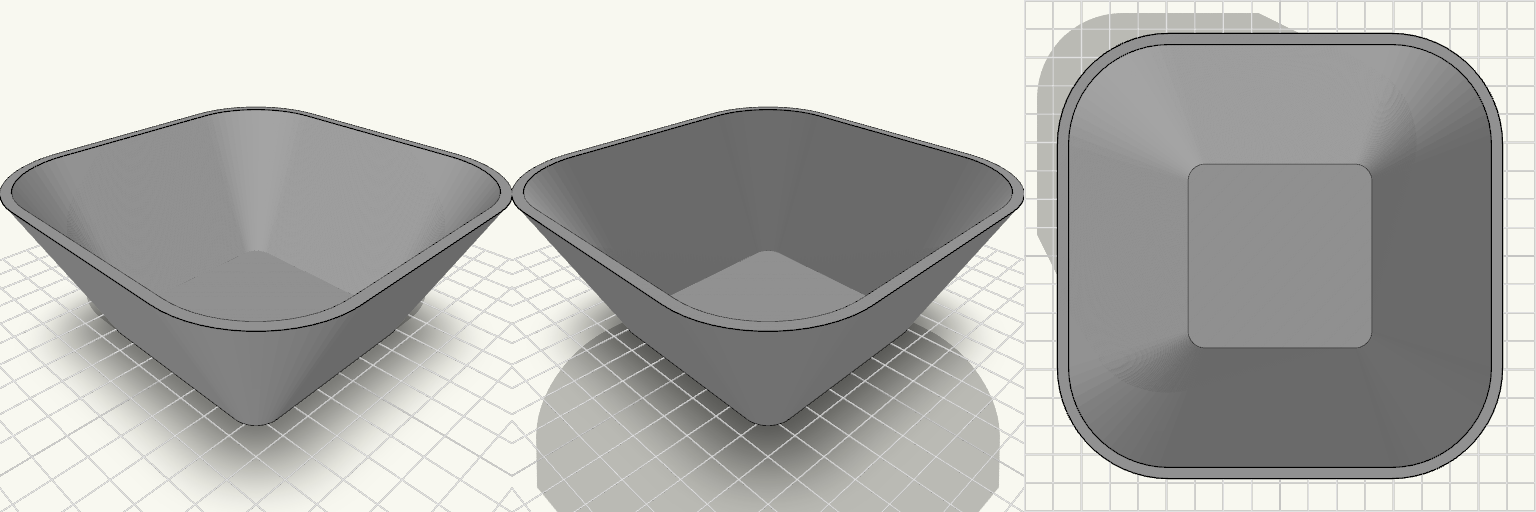
Square-Base Bowl That Stays Put
A bowl that skids across the counter or tips the moment you stir it is the annoyance; this one has an almost square base that keeps it planted. The base is a 70 mm square with rounded corners, so it sits flat instead of rocking, and the walls flare out to a 120 mm rim that is rounder and easier to eat from. What decides the fit Base footprint: 70 mm rounded square — the number to check against your shelf, tray or cupboard. Rim: 120 mm across at the widest point. Height: 50.8 mm (2 in). Walls and floor: 3 mm thick, so it holds its shape without being heavy. It prints as one piece, standing on its flat base, so no supports are needed and the inside comes out clean.