Honeycomb Cake Topper
Made by DraftBear
Created 4 months ago
Description
A sturdy, two-color capable cake topper featuring "Happy Birthday Bumblebee" combined with a honeycomb cluster. The backing plate securely binds the distinct elements into a single robust piece.
- Format: 2mm thick structural backer with two 90mm tapered stakes
- Graphic Details: 1.5mm raised lettering and honeycomb web
- Color Handling: Optimized for a midline filament swap (color change at Z=2.0mm)
- Font: Berkshire Swash
Photos
Technical views
More like this
Explore more in Gifts, Seasonal & Personalized →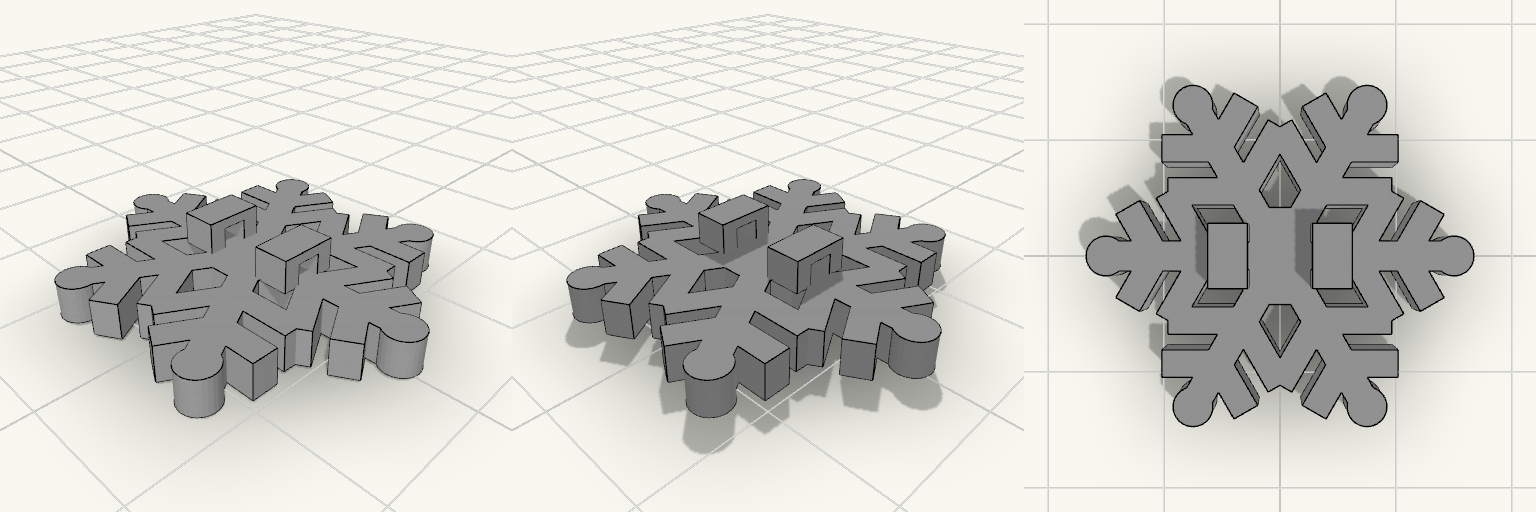
Snowflake Shirt Pin with Safety Pin Loops
A small snowflake pin with six branched arms, made to be worn on a shirt. Two loops on the back take a standard safety pin, so the snowflake sits on the fabric like a brooch. Six-arm snowflake with side branches and rounded tips Two back loops, 8 mm apart, for threading a safety pin Flat front face prints directly on the plate No supports needed Roughly 31 mm across and under 6 mm thick
Bold Block-Letter FLOYD Name Sign
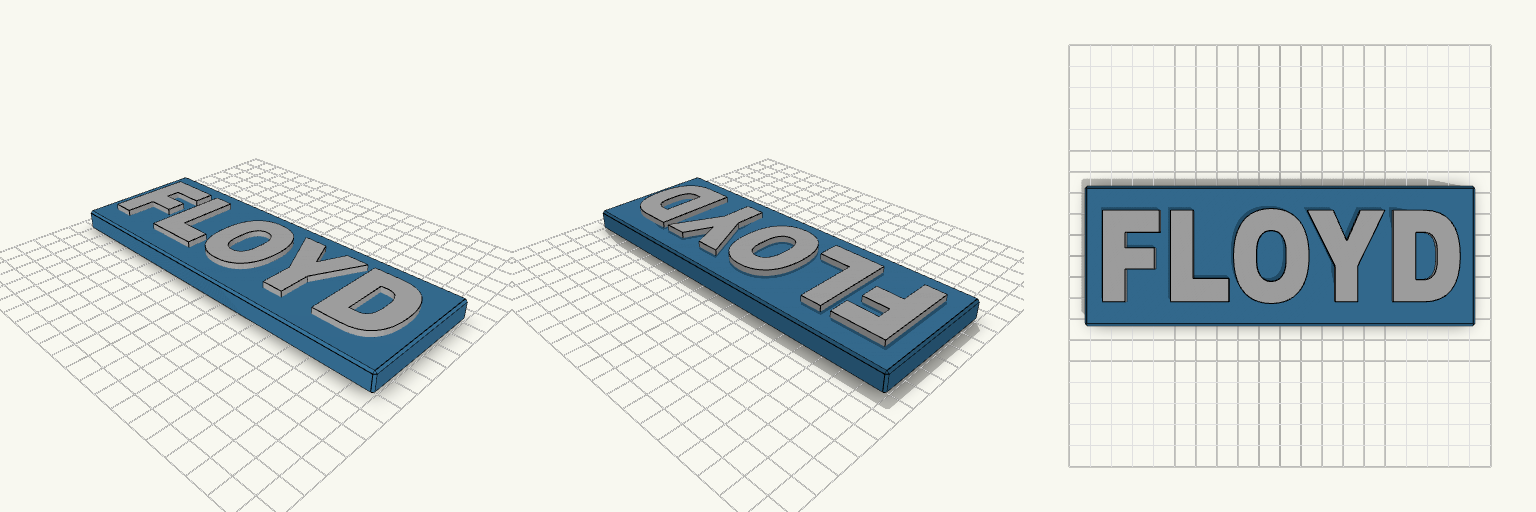
A confident single-word nameplate: a 179 × 64 mm slab, 10 mm thick, with FLOYD rising 3 mm off the face in heavy block capitals for a total height of 13 mm. The letters stretch to roughly 162 × 43 mm, running almost the full length of the top face and leaving only a slim border around them. It reads as signage first and decoration second — the kind of bold lettering that belongs over a door, on a wall, or fixed to a workshop board, and with 10 mm of depth behind it, it also stands on its own as a chunky desk or shelf piece. Sized for a Bambu Lab A1 mini, the sign uses the bed's full width in one direction only, so it prints as one piece with no scaling needed. That width fit is tight: only about 0.5 mm of margin remains on the long side, so a skirt, brim, or calibration offset could push it past the bed edge — a slightly smaller scale is safer if the slicer complains. The 10 mm body uses noticeably more filament than a thin plate, so keep that in mind if material use or weight matters. Design notes Raised lettering sits proud of the plate, catching light and shadow and allowing a contrasting colour with a filament swap at the right layer. The top face, the lettering and the sides are all square-edged; the plate has a flat back and prints from a single flat base without supports. Wide, thick strokes keep the text legible from across a room and sturdy enough to handle. The lettering is proportioned to the plate, so shrinking it uniformly in the slicer keeps the composition intact. Pairs well with a wall bracket, a small stand, or adhesive pads on the back — or just set it down as it is. A plain blue plate with white letters is only one finish — a dark plate with bright lettering, a painted recess, or a single-colour print all work with the same geometry.
Christbaumkugel mit Namen Mari
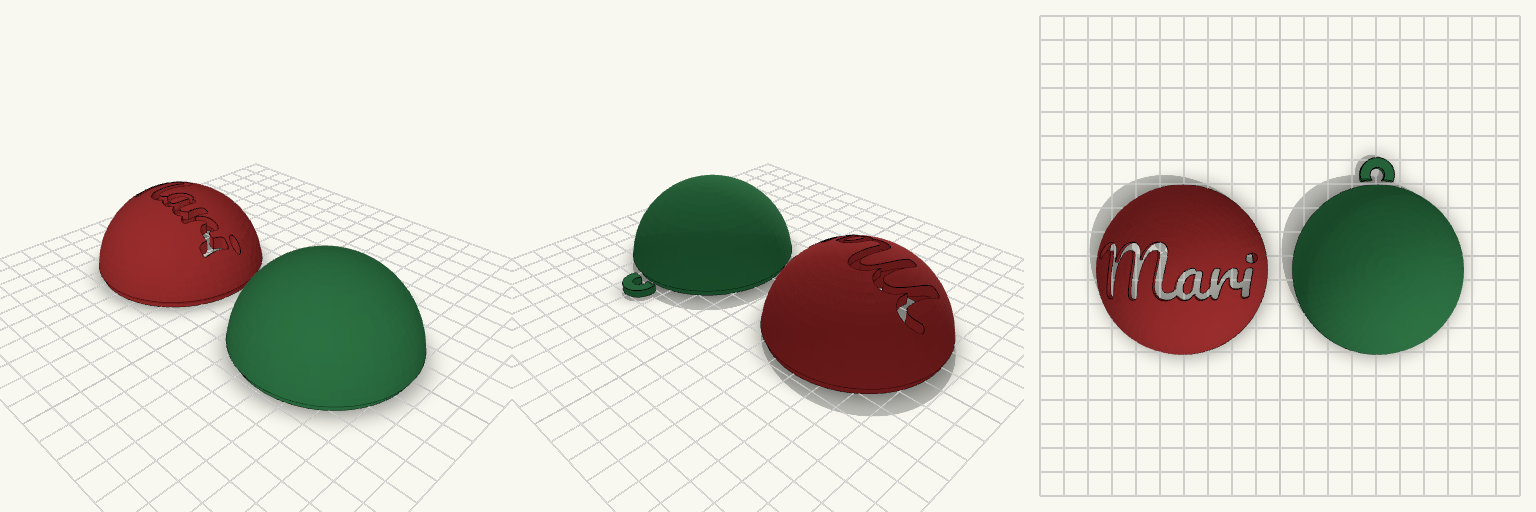
Zweiteilige Christbaumkugel, 70 mm Durchmesser, mit durchgeschnittenem Schriftzug "Mari" in der Vorderhälfte. Beide Hälften liegen mit der flachen Seite auf dem Druckbett und passen locker auf das A1 mini. Durchmesser 70 mm, Wandstärke 3 mm Beide Hälften drucken ohne Stützen Stufenfalz zum Zusammenstecken, Kleber oder Klebeband zur Fixierung Aufhängeöse an der Rückhälfte Schrift durchbrochen: Ein Teelicht oder LED scheint durch Die Schrift ist in Pacifico gesetzt. Innere Flächen der Buchstaben (z. B. das a) und der i-Punkt werden als freie Inseln ausgeschnitten.
Pot à bonbons tasse 110 mm Père Noël assis
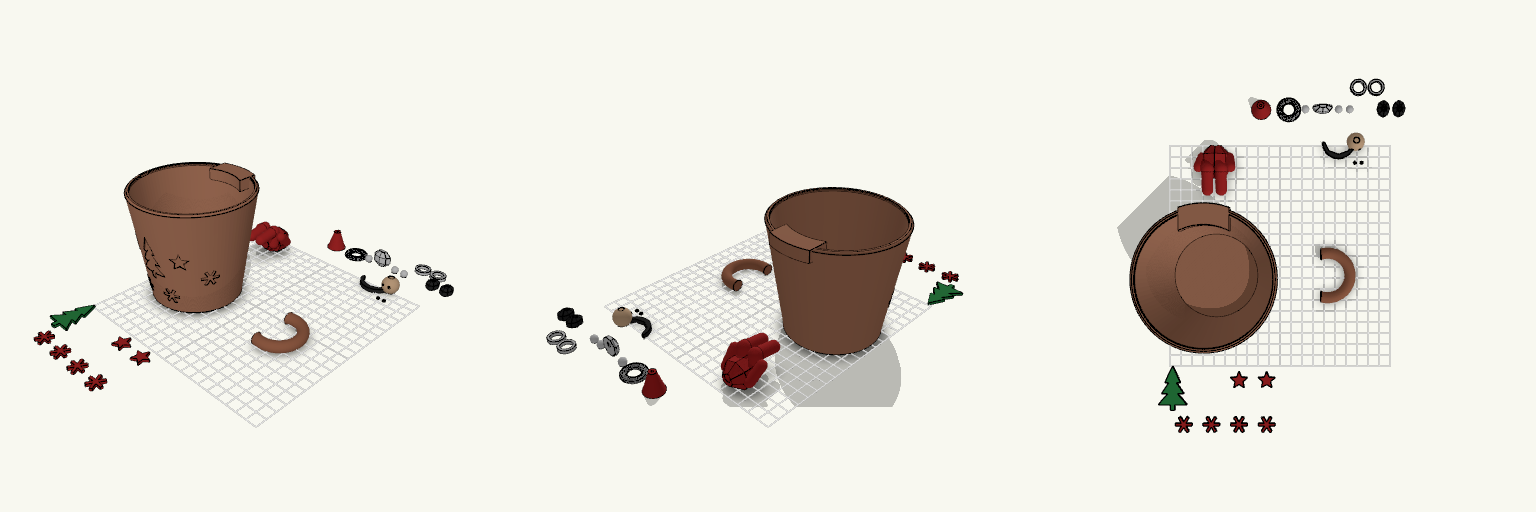
Pot à bonbons en forme de tasse de chocolat chaud, avec un bonhomme en pain d'épice couché sur le rebord arrière. Il n'y a pas de couvercle : le dessus reste ouvert et les bonbons se prennent par le haut. Le modèle se présente en volumes séparés, posés à plat sur le plateau, à réunir à la colle après impression — l'anse comprise, qui n'est plus attachée à la tasse. La cote qui commande tout, c'est le diamètre au sommet de la tasse : 110 mm. C'est lui qui définit l'ouverture et l'encombrement du pot une fois monté. La tasse mesure 100 mm de haut, son diamètre passe de 80 mm au pied à 110 mm au sommet, avec des parois de 3 mm, un fond de 5 mm et une base parfaitement plate. Sans son anse, elle occupe environ 110 × 110 mm au sol. Une fois l'anse collée sur le côté, l'emprise passe à environ 130 mm de large, avec une saillie d'environ 25 mm ; ses extrémités s'arrêtent dans l'épaisseur de la paroi, donc l'intérieur reste entièrement dégagé pour les bonbons. Les pièces du plateau Tasse : 110 × 110 × 100 mm environ, paroi lisse côté anse, avec les creux des motifs sur la face avant et l'emplacement du bonhomme creusé dans le rebord arrière. Anse : demi-anneau posé à plat, 31 × 50 × 10 mm, les deux bouts coupés droit pour le collage. Elle s'imprime sur son tube rond, donc la première couche est étroite. Bonhomme pain d'épice : debout sur ses pieds, 68 × 44 × 51 mm ; le corps ne touche pas le plateau. Sapin de Noël : à plat, 26 × 40 × 2 mm — trois étages, un petit tronc et une étoile au sommet. Décors rouges : à plat, 2 mm d'épaisseur — deux étoiles et quatre flocons ; les perles ont été retirées. Visage (yeux et sourire), Nœud et joues, Chapeau haut de forme (22 mm de large, 17,5 mm de haut, ruban rouge à part) : chacun traité comme une pièce distincte. Une fois collé, le bonhomme repose sur le rebord par le torse, les bras et les jambes, la tête relevée vers l'avant, coiffé du haut de forme noir incliné vers l'arrière. Le sapin vert occupe le centre de la face avant, entouré des décors rouges en relief de 2 mm, sur une paroi de 3 mm qui s'évase. À vérifier avant de lancer Ouverture : 110 mm de diamètre au sommet, la référence pour la tasse. Plateau : la tasse seule occupe environ 110 × 110 mm ; l'anse, le sapin, les décors et le bonhomme se répartissent à côté, sans se toucher. Bonhomme : il est modélisé debout et son corps ne porte pas sur le plateau — il faut le coucher sur le dos dans le logiciel d'impression, sinon il s'imprime dans le vide. Anse : première couche étroite ; si l'adhérence est mauvaise, faites-la reposer sur une face plate dans le slicer. Chapeau : le bord large reste en porte-à-faux ; prévoyez un support dessous. Rebord arrière : l'emplacement du bonhomme laisse de petites encoches dans le rebord, il n'est pas parfaitement lisse à cet endroit. Couleurs : chaque pièce séparée reçoit son filament dans le logiciel d'impression (tasse chocolat, sapin vert, décors rouges, chapeau noir). Un export monochrome ne contient aucune couleur. Ce à quoi ce modèle ne convient pas Aucun couvercle n'est prévu, ni à visser ni à poser : ce n'est pas un pot fermé. Aucune pièce n'a d'ergots d'emboîtement, l'anse pas plus que les autres. Tout se pose bord à bord et demande de la colle ; sans collage, l'ensemble ne tient pas. L'anse est coupée pour cette tasse : ses deux faces de collage suivent la paroi de ce pot, pas celle d'un autre récipient. Le bonhomme n'est pas une figurine libre : sa découpe suit le rebord arrière de cette tasse précise. Le chapeau et le visage sont des pièces rapportées, pas des éléments venus de matière avec la tête. L'anse ne convient pas à une prise en main de grande tasse à boire : le passage pour les doigts fait environ 30 mm de haut.
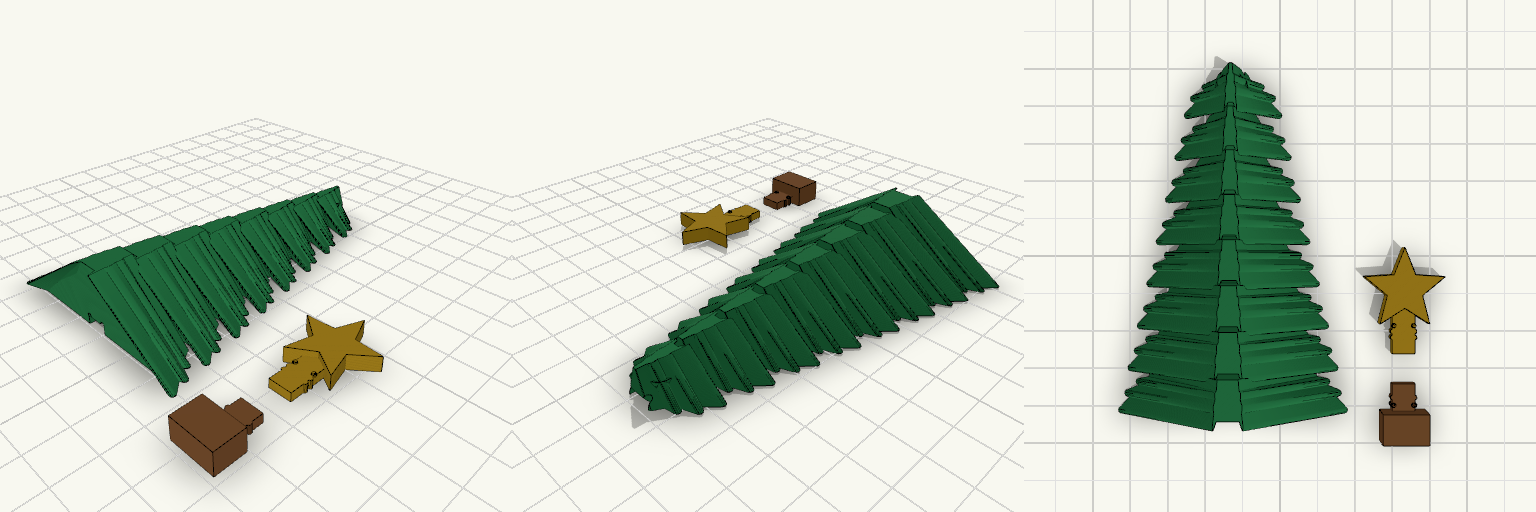
Christmas tree fidget
A print-in-place flexi Christmas tree with a separate snap-fit stump and a separate snap-fit star. There is no host device, thread standard or model number to match here: the fit that decides whether it works is the hidden hinge clearance, then the plug-and-slot snap joints that hold the stump and the star. The tree is eight stacked tiers, each a tent shape rising to a centre ridge, cut with jagged, uneven fir-style boughs that swing out past the body, droop at the tips and step back in toward the top. The bottom tier rises 17 mm and each tier above is 1.2 mm lower. The topmost tier carries a slot with two snap dimples for the star; the slot is 8 mm deep, and the star’s plug is 14 mm long. The stump and the star both sit beside the tree on the plate as their own pieces. What it fits and replaces Tilt the tree and the tiers should wiggle on hidden pin hinges; it is a fidget as much as a decoration. The tier-to-tier tabs now reach 1.2 mm further into the solid and each carries an anchor lug, so the tree is meant to stay together when lifted. Each hinge pocket now has a thin floor under it: a 9.8 mm disc, 0.6 mm thick, on seven of the eight tiers. The pin heads sit above the floor instead of resting at bed level, so they cannot drop out the bottom. To make room, the hinge parts were raised 0.9 mm and the pockets deepened to match. The stump plug slides into the slot under the bottom tier; print it, swap it, or leave it off. The tree has no trunk of its own, so the bottom tier’s hinge pocket stays open until the stump is fitted. The star’s 14 mm plug slides into the 8 mm deep slot cut in the top of the highest tier. Its outline is a solid five-point shape with no hanging hole. Both plugs snap in. Each carries two small domed bumps on its top face, and each slot ceiling has two matching dimples: push the stump or star up from below, the bumps ride over the ceiling, and they drop into the dimples. Crush ribs stay in place, two on each side, and the plugs are 0.1 mm thicker, so the fit has friction as well as the click; no glue should be needed. The fits are untested, so shave the ribs or bumps if a plug is too tight, or enlarge them if it is still loose. Print the tree, stump and star in the same filament for one colour; the preview colours only mark the separate parts. Check before printing On the plate the Flexi Tree measures 60.9 × 90.6 mm and rises 17 mm at the bottom tier; the Stump measures 12 × 15.2 × 6 mm; the Star measures 20.9 × 27.9 × 4 mm. Check the hidden hinges first: 4.4 mm pins in 5.6 mm holes leave 0.6 mm per side. The 8.2 mm knuckles, 6 mm tabs, 1.2 mm gaps between tiers and 0.6 mm pocket skins are the rest of that fit. The new hinge floor leaves about 0.3 mm under each tab, so check that the tiers still swing freely and the floor has not fused to the tab; if they stick, open that gap. If the tiers fuse or feel stiff, open the pin clearance rather than forcing them; if a pocket skin looks weak or sags, thicken it. The reinforced tab joints and anchor lugs are untested and not pull-tested; a hard tug could still separate the tiers, in which case thicker pin heads are the next fix. Check the star’s hold in particular: the slot is 8 mm deep and the plug is 14 mm long, so the rest of the plug bridges the gap to the star’s base. The longer hold should cut wobble, but check it on the first print. Check the snap joints: the bumps are 1.2 mm domes and the dimples are 1.8 mm. Snap strength is a guess. If a joint clicks too hard or the slot walls flex too much, shrink the bumps; if it does not hold, enlarge them. The drooping tips on the wide bottom tiers are the thin, spiky parts and come within a couple of millimetres of the tier below; check those gaps on the first print. The topmost tier is the narrowest part and now carries a deep slot, so its walls are thin; check that it does not flex and that its tip prints cleanly. The sloped tier faces overhang heavily near the ridge, so expect rough overhangs without supports, or add them. The model is untested: treat the first print as a fit check, not a finished batch. What it is not It is not a centre-post spinner; nothing rotates around an axle. It carries no name, year or message, so it is not a personalised piece. There is no hanging loop or hole anywhere — the star’s outline is solid — so it is a display fidget, not something to hang. The hinges are hidden from the front, not from the back: the pin heads sit in blind pockets that are open at the rear. It is not a single-piece print. The tree prints in place as one piece; the stump and the star are separate parts. The bough faces are smooth tents with jagged tips; this version has no dimpled texture and no raised rim. Specs as it sits on the plate Flexi Tree: 60.9 × 90.6 mm, 17 mm rise at the bottom tier, eight hinged fir-style tiers Stump: 12 × 15.2 × 6 mm, with snap-fit plug and crush ribs Star: 20.9 × 27.9 × 4 mm, with 14 mm snap-fit plug, solid outline, no hanging hole 8.2 mm knuckles, 4.4 mm pins with domed heads, 5.6 mm pin holes, 0.6 mm per side clearance Hidden hinges: blind pockets with 0.6 mm skins, open at the back; hinge parts raised 0.9 mm; 9.8 mm × 0.6 mm floors under seven pockets; reinforced tab joints with anchor lugs Print-in-place tree; separate stump and star on snap-fit plugs; overhangs near the ridge may need supports
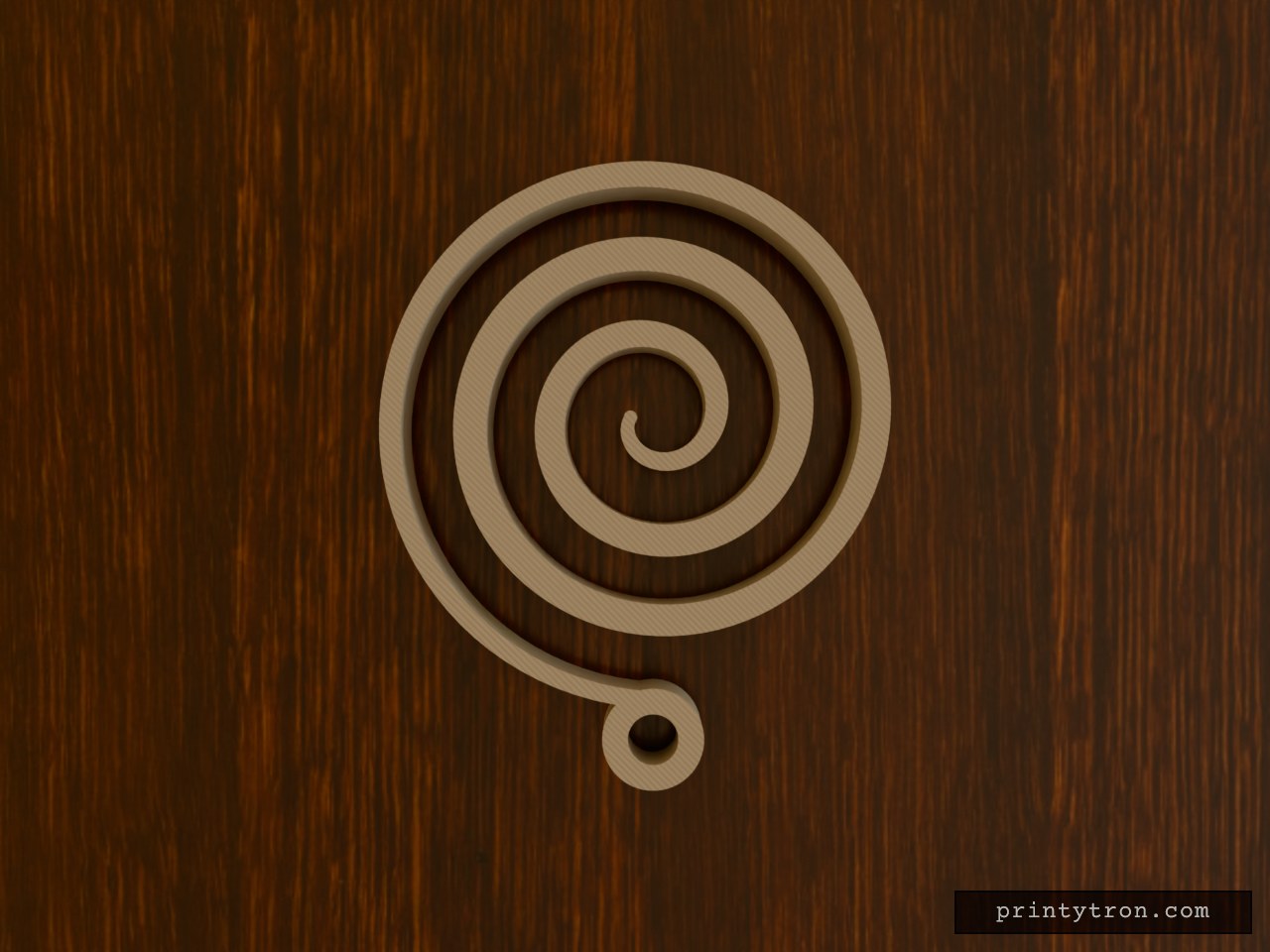
Flat Round Spiral Curl Ornament Medallion, 50 mm
A flat, round hanging ornament shaped as a smooth spiral curl. The spiral is one continuous band that swells through the middle and thins to fine points at both ends, like a calligraphy stroke, with even spacing between turns. It lies flat, so the ornament sits close against a tree branch or a wall instead of projecting outward. A round hanging loop sits at the top at the 12 o'clock position, and the whole ornament prints as one piece in a single color. Specs Overall size: about 45 × 56 mm, 5 mm thick Spiral: one continuous band, tapered to fine points at both ends, heaviest at the middle Turns: about 3.5, evenly spaced Hanging loop at the top, sized for thread, ribbon or a wire hook Single color, one-piece print Flat face: hangs flush against the tree or a wall Prints without supports on its flat face Loop joint: the tapered outer end meets the ring over a small area, so this is the weak point — hang it gently or reinforce that joint if it sees rough use