Klipper Telemetry Console
Created 27 days ago
Description
A compact enclosure for Klipper printer telemetry, mounting to standard 2040 extrusion. This version features revised back cover mounts that embed securely into the enclosure walls, ensuring robust assembly.
- Revised Mounts: Structural corner blocks anchor the back plate safely to the frame.
- Component Fits: Room for a 1602A LCD and 32x32mm MAX7219 matrix.
- Mounting: Flush side flange with M4 t-nut clearance.
Images
More like this
Explore more in Workshop & Tools →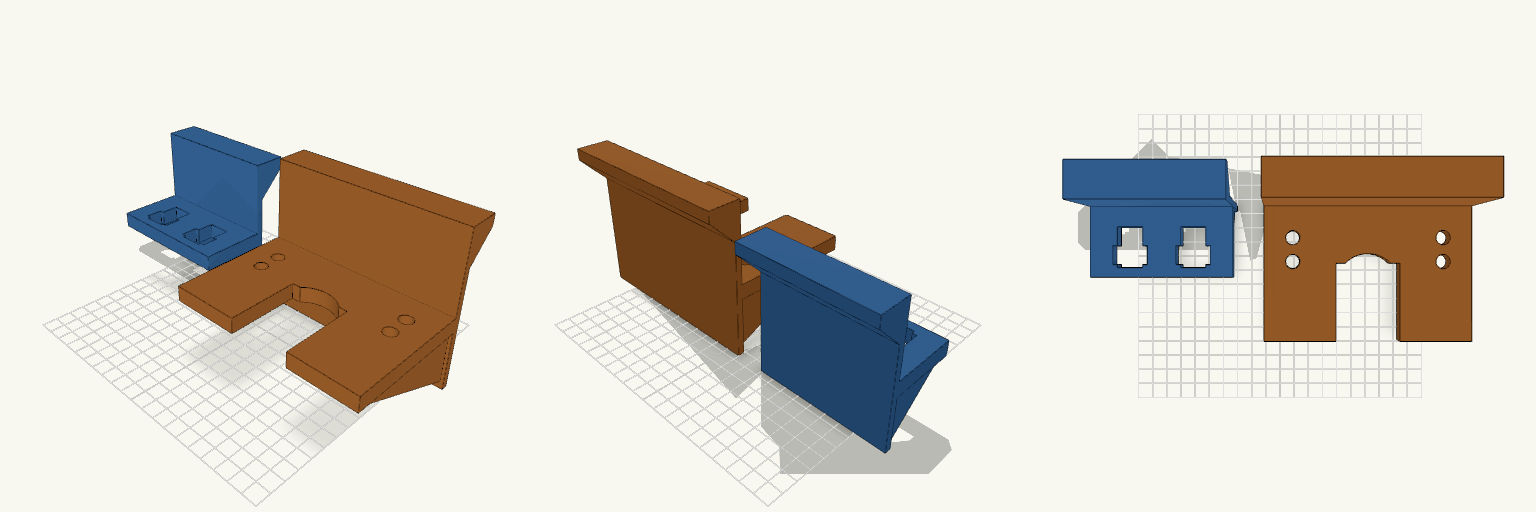
French Cleat Pliers and Drill Holders
A pair of tool holders that hang on a 45° french cleat wall: a pliers rack and a cordless drill holder. Each has a matching 45° lip on the back, sized for an 18 mm ply cleat with 0.5 mm of clearance, so it drops on and stays put under its own weight. Built for a bare garage wall where the tools currently live in a bucket. Pliers holder: 90 mm wide, 95 mm tall, with a 10 mm shelf that projects 45 mm. Two handle slots sit at 25 mm and 65 mm across and taper slightly open toward the back. Drill holder: 130 mm wide, 105 mm tall, with a 10 mm shelf that projects 85 mm. A 40 mm round chuck opening is open to the front, and four 9 mm bit holes sit near the side edges. Remix hooks Cleat size: the cleat thickness (18 mm) and clearance (0.5 mm) drive the lip. Change them to match 12 mm or 19 mm stock. Tighten the clearance only after a test print. Slot count and spacing: add more pliers slots by widening the holder and repeating the slot positions. Narrow or widen each slot to suit your handle thickness. Chuck opening: the 40 mm diameter suits a typical cordless drill chuck. Adjust it for larger drivers or impact guns. Drill extras: the bit holes are 9 mm. Resize them for hex bits or drill bits, or replace them with a battery cradle. Shelf strength: the shelf is 10 mm thick with 4 mm gussets. Thicken it for heavier tools. Pairs well with More cleat-mounted holders cut to the same lip profile. A length of 45° ply cleat screwed into studs, with the holders spaced about 20 mm apart (the pliers holder is 90 mm wide and the drill holder is 130 mm wide). Print each holder on its back, and test the cleat fit on a short piece before committing to a full print.
Tapa cuadrada con agujeros mixtos
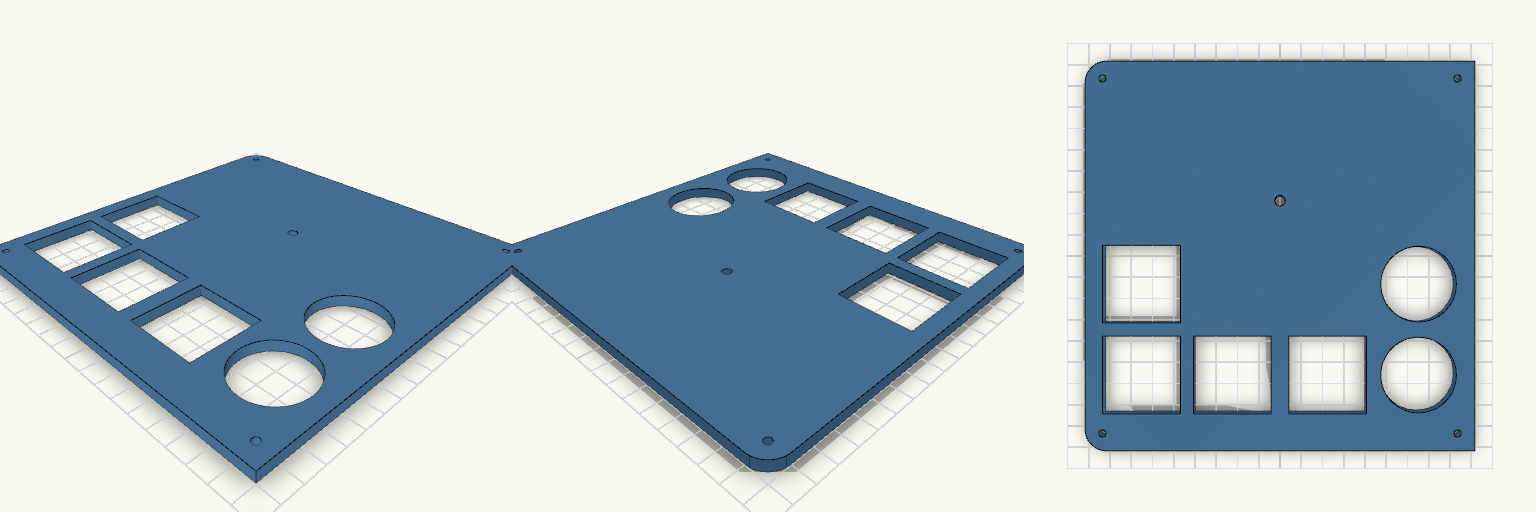
Tapa de 180×180×5 mm con dos lados redondeados a la izquierda (radio 10 mm), cuatro agujeros M3 en las esquinas y un agujero de 5 mm. Dos agujeros redondos de 35 mm a la derecha y cuatro cuadrados de 36 mm a la izquierda, en la zona inferior. Ideas para remezclar Diámetro de los redondos (35 mm): súbelo o bájalo según la pieza que deba pasar; la pared entre ellos es de 7 mm. Lado cuadrado (36 mm): ajústalo por separado; los centros están a 42 mm. Radio de las esquinas (10 mm): 5 mm para una curva más suave. Agujero de 5 mm: está a 25,5 mm sobre el centro; muévelo para un pasacables o un pulsador. Combina con: una base o caja de 180 mm usando los M3 de las esquinas (3,4 mm, a 8 mm del borde).
28BYJ-48 Auger Housing, Large-Kibble Auger
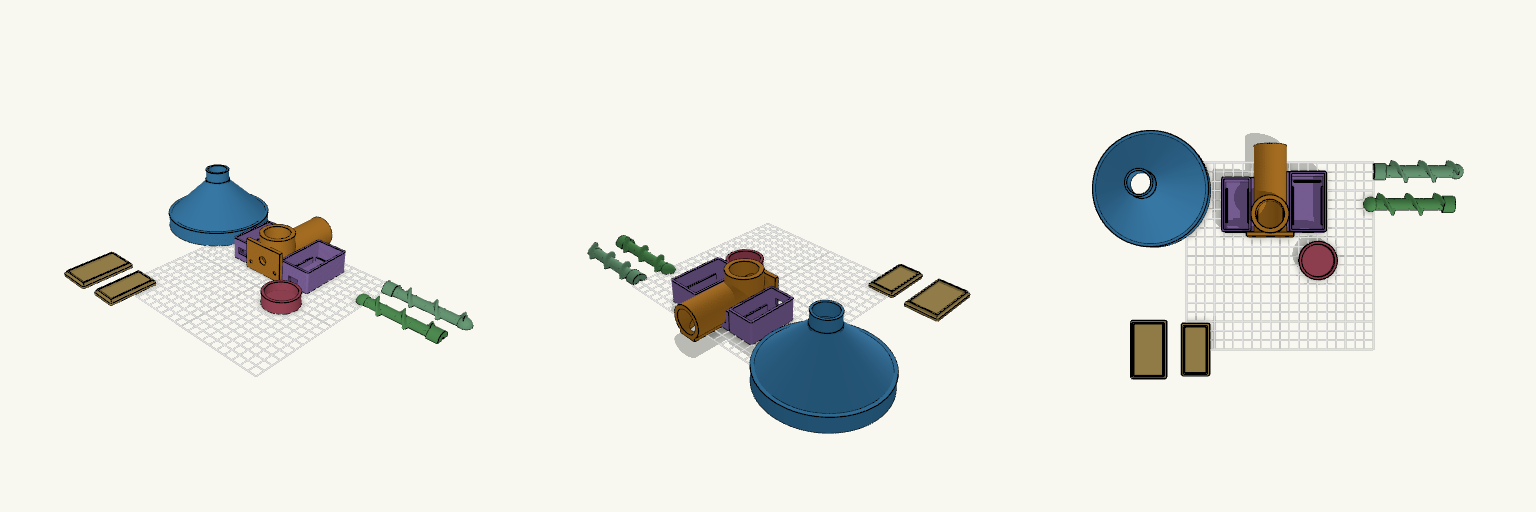
Large-kibble auger for a 28BYJ-48 auger housing with a 26 mm bore, plus the 109 mm female-thread funnel adapter and two side electronics cases. What changed Flight pitch goes from 20 mm to 30 mm, so each pocket between flights is wider. Core goes from 15 mm to 12 mm, which deepens the channel. Flight thickness goes from 7 mm to 6 mm. Tip diameter stays 23.2 mm. Check before printing Housing bore is 26 mm and unchanged, so the auger tip clearance is about 1.4 mm per side. Funnel spigot inner diameter is about 23 mm and limits the largest kibble that can enter. It was not changed. The 6 mm funnel thread pitch is unverified. Measure the host opening. Does not fit The D-bore hub is for the 28BYJ-48 5 mm shaft with flats. Other motor shafts will not fit.
SpoolScope — Filament Remaining Gauge
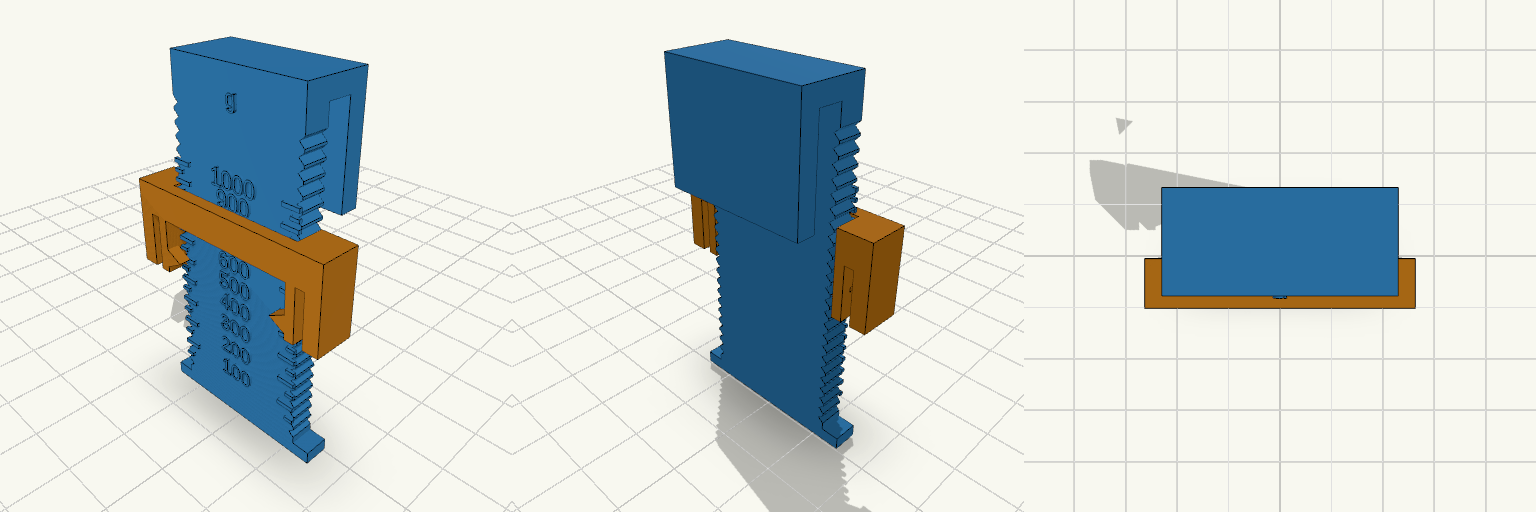
SpoolScope is a two-part gauge for estimating how much filament remains on a standard spool, made for spools that sit out of easy view in an AMS or on a shelf. The rail hooks over the flange rim; the sliding block rides on it with light detents, so you can push it down until it touches the filament, lift the gauge away and read the result. Raised ticks and numbers plus an unambiguous arrow on the block make the measurement clear without needing line-of-sight while the gauge is in place. Features Two printed parts: a rail with a rim hook, and a detented sliding block. Gram scale from 0 to 1000 g, with ticks every 50 g and numbers every 100 g. Ticks follow filament geometry rather than an even spacing: closer together near full, wider apart near empty. Arrows on the block tip directly toward the scale, and the detents hold the reading after the gauge is lifted off. Hook gap of 4 mm, sized to clear flanges from 2.8 mm to 3.6 mm thick. Dimensions Flange diameter: 200 mm. Hub outer diameter: 95 mm (from a measured Polymaker spool). Full-roll diameter: 170 mm (estimated from a 1 kg PLA roll on a 95 mm hub and a 65.6 mm spool width). Hook gap: 4 mm. Fitting and calibration Sized around Polymaker and Inland 1 kg spools; other brands are worth checking against the hub and flange figures above. The scale can be shifted by a single fixed offset if a first print reads consistently high or low, so a weight check against a known spool is worth doing before trusting the numbers. If the error differs between a full and an empty spool, the hub and full-roll values are the ones to correct. Print notes Both parts are laid out flat on the print plate. The block contacts the filament at its outer edges rather than at the centre, so a reading can sit slightly high; a weight check against a known spool is the best way to confirm the scale.
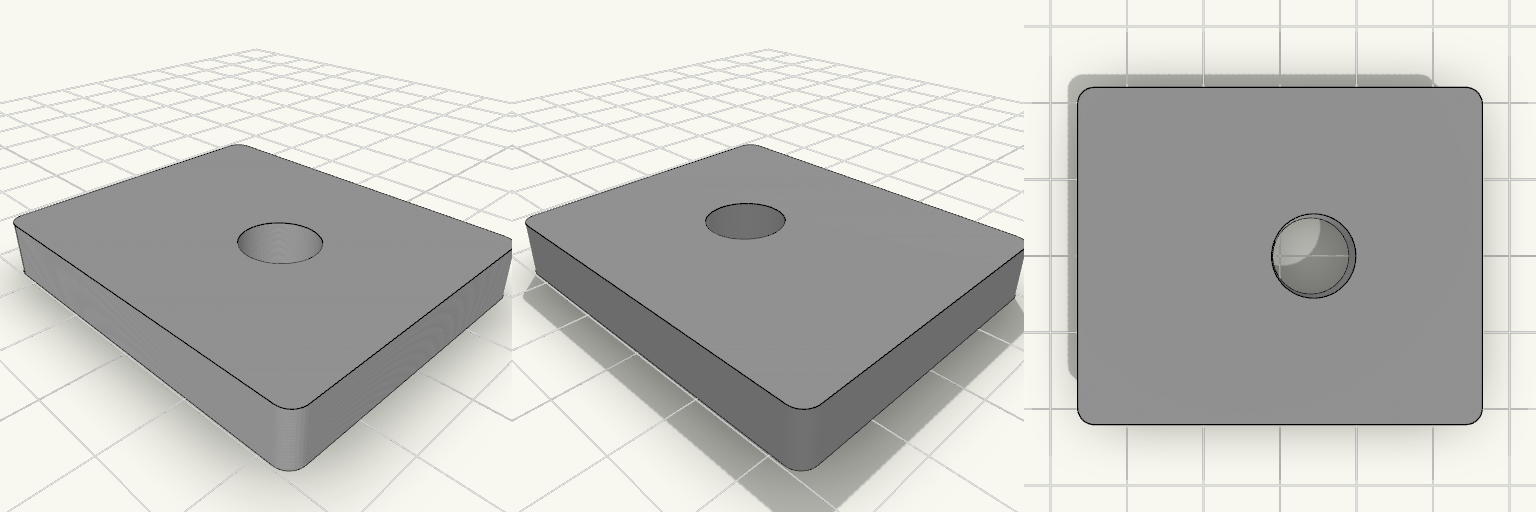
Elliptical Pedal Insert 48x40 Offset Hole
What it's for Central reinforcement insert for an elliptical trainer pedal, bonded into the damaged opening. Flat top, ribbed underside. Dimensions Base: 48 × 40 × 7 mm, rounded corners Through-hole: 10 mm, centered at 24 mm along the length and 4 mm toward the top edge from the width center 18 mm boss around the hole, 5 ribs to a 3 mm frame Remix ideas Change the hole offset for a different pedal Add or remove ribs Thicken the frame for heavier loads
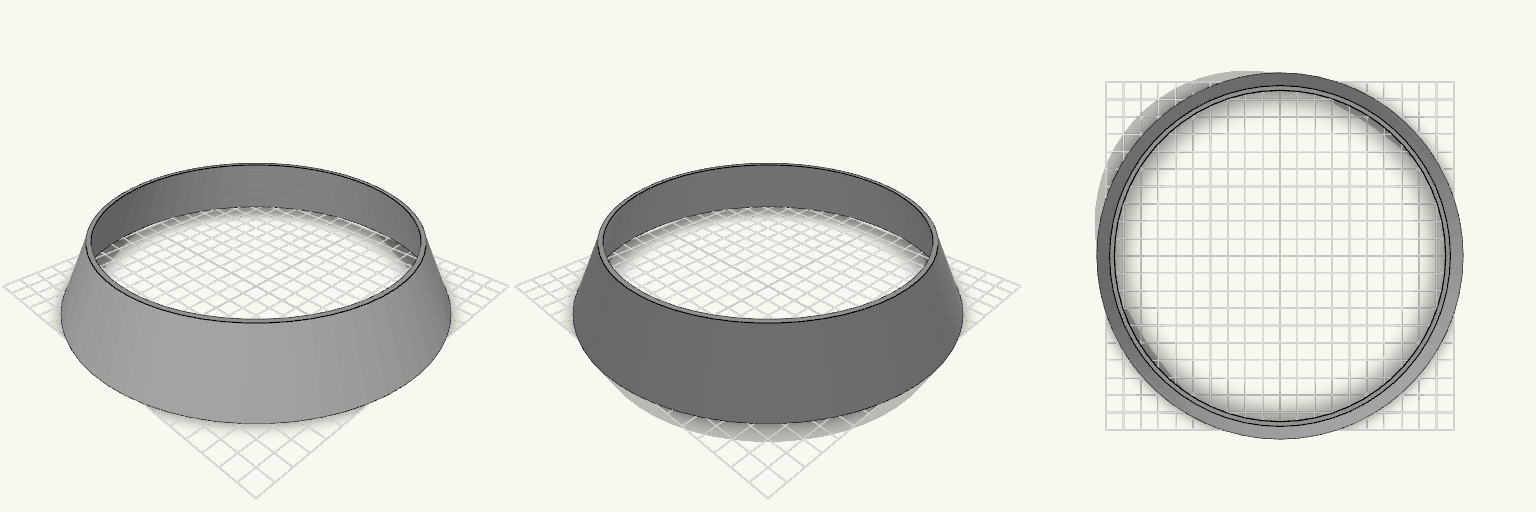
Rough Cone light diffuser
Two round openings that don't share a diameter is the small annoyance that stops everything downstream — the hose won't seat, the liner won't sit, the funnel wobbles instead of funnelling. This is the plain fix: a hollow truncated cone, wide at the bottom and narrow at the top, open at both ends so anything poured or pushed through it passes straight through instead of bottoming out. Fit dimensions Bottom outer diameter: 210 mm Top inner diameter: 170 mm Overall height: 38 mm Wall thickness: 2.4 mm Both ends open — it is a sleeve, not a capped cone Printing It prints as one piece sitting on its 210 mm base, so no assembly and no separate parts to line up afterwards. The wall is thin enough to stay flexible in the hand but still hold its shape, and the shallow flare means the outer surface is not a long unsupported overhang. Check the 170 mm top against whatever has to pass through it before printing — that is the number that decides whether the part works; the 210 mm bottom decides whether it sits down properly.