Modular Hexagonal Phone Stand
Made by MilledGimlet
Created 1 months ago
Description
What it's for
A single-piece modular phone stand designed around a regular hexagonal footprint. It features an angled 70-degree backrest for optimal viewing and a sturdy front retaining lip. A central U-groove is carved through the front lip and into the base, allowing a charging cable to pass cleanly underneath the phone while docked.
The stand is designed to tile: dovetail tabs on the right side match with identical slots on the left side, allowing multiple hexagonal units to be linked together into a continuous charging array or desk organizer without any extra hardware.
Dimensions
- Base size: 80 mm across opposite vertices, sitting 6 mm thick.
- Back panel: 65 mm tall, leaning back at a 20-degree angle from vertical.
- Front lip: 10 mm high above the resting surface, leaving a generous 23 mm gap for the device.
- Cable groove: 12 mm wide, recessing down to a 2 mm floor height.
Print notes
- Designed to print entirely support-free in its default upright orientation.
- The 0.2 mm clearance on the dovetail joints should slide together firmly on a well-calibrated machine.
- Standard PLA or PETG will provide plenty of strength for the upright panels.
Images
More like this
Explore more in Desk & Tech →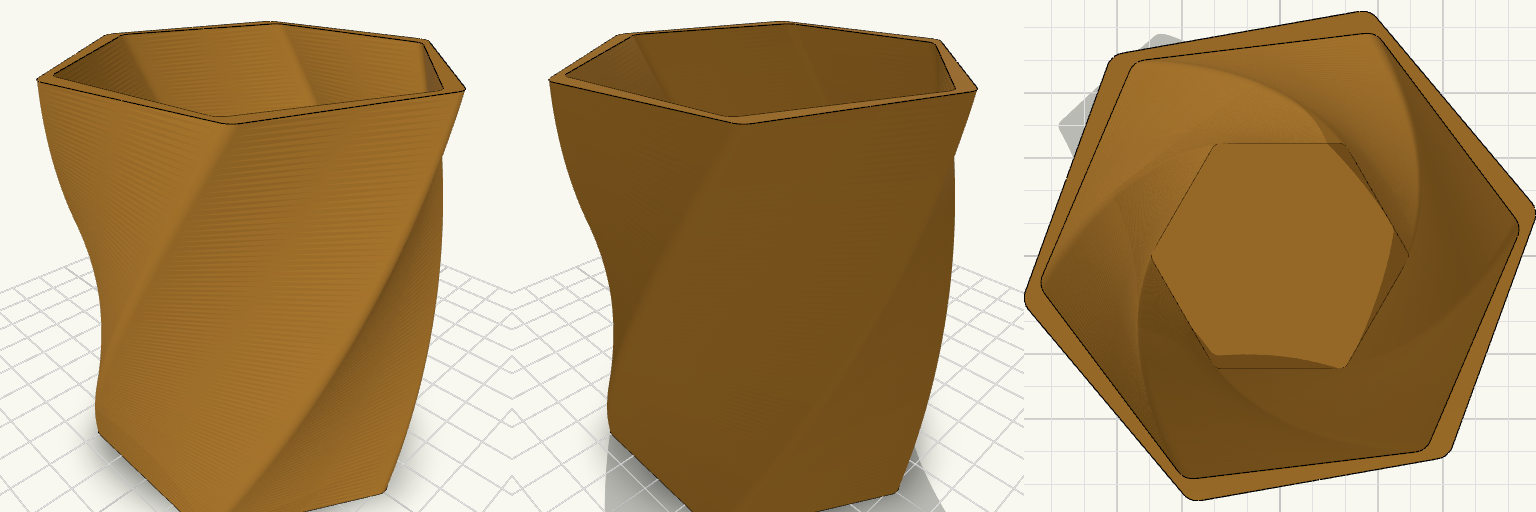
Helix — Twisted Hexagonal Pen Cup
A hexagonal desk cup with the twist built into its silhouette: the six-sided body rotates 70° from bottom to top, so the facets read as a slow spiral rather than a straight column. It stands 90 mm tall and measures about 83 mm across the corners — enough for pens and pencils, with room to spare for scissors or a ruler. The hexagon sits flat on the desk, giving it the weight of a solid block rather than a floating one. Walls are 3 mm and the floor is 4 mm, so it holds its shape under a full load without feeling heavy. Dimensions Overall height: 90 mm — takes pens, pencils, scissors and a ruler Width across corners: about 83 mm Wall thickness: 3 mm Floor thickness: 4 mm Features Six-sided body with a 70° twist from base to rim Flat hex base sits directly on the desk for a stable, blocky stance One named area, Twisted Cup Body, printed as a single piece Flat facets catch the light along the spiral Print notes Print upright as oriented on the plate. The twist is gentle enough that the walls lean without needing supports, and the flat hex base gives a broad, secure contact patch. A matte dark filament shows the spiral facets best; 0.2 mm layers with two or three perimeters make a sturdy cup, and a finer layer height sharpens the edges of the twist.
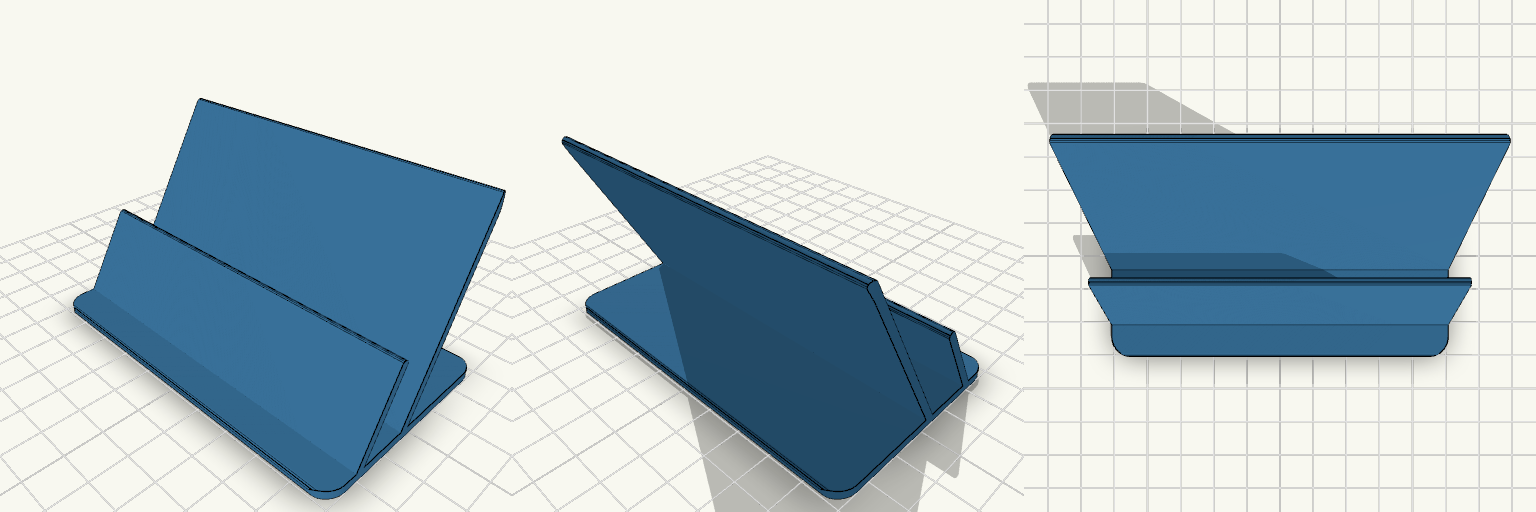
手机支架
A phone stand for a phone that keeps sliding flat or tipping over: a 60° backrest holds it upright, and a front lip stops it sliding out. Key numbers Base: 100 × 60 mm, 2.2 mm thick Backrest tilt: 60° from the table Slot: 12 mm wide, measured between backrest and front lip Walls: 2.2 mm throughout Corners: rounded in plan and along the profile edges Printing Print with the base flat on the bed. No supports needed: the backrest leans back at 60°, which stays within a typical overhang limit. Phones with thick cases may need a wider slot.
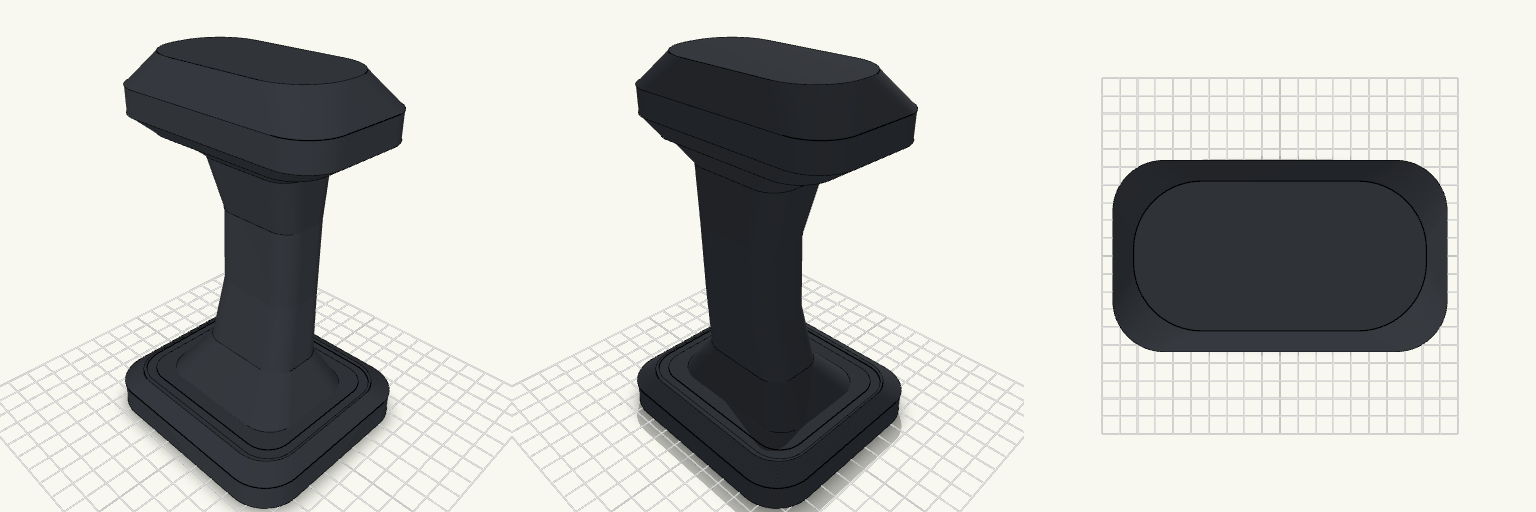
One-Piece Over-Ear Headphone Stand
A single-piece stand for large over-ear gaming headphones, built as a bold futuristic object rather than a plain pole. The base is an asymmetric hexagonal platform, the chamfered column leans back with a sloping front face and a narrow channel running down it, and the wide head grows out of the column through stepped transitions, so there is no thin neck. The whole stand prints as one continuous solid, with nothing to glue or assemble. Size as printed: 160 × 140 × 140 mm (width × depth × height) Base: 160 × 140 mm asymmetric hexagon with a chamfered edge, flat underside and five round recesses for rubber anti-slip pads; the top steps up toward the column and a recessed groove runs around it Column: flares out of the base, measures about 50 mm wide and 30 mm deep at its narrowest, and carries a shallow decorative channel on the front Head: 110 × 65 mm with 14 mm rounded corners, full width through a straight band before narrowing into a domed top — wide enough to spread the load of a large headband Printing: the base sits flat on the bed; the head overhangs the column on both sides, so expect some support or a slow bridge there — check it in your slicer The low, wide footprint keeps the centre of gravity down so the stand stays put with heavy headphones hung on it, while the modest height keeps the whole thing printable in one piece. Large smooth bevels, angular faces and the recessed groove give it a premium architectural look that suits matte black, graphite, dark grey or metallic-looking filament.
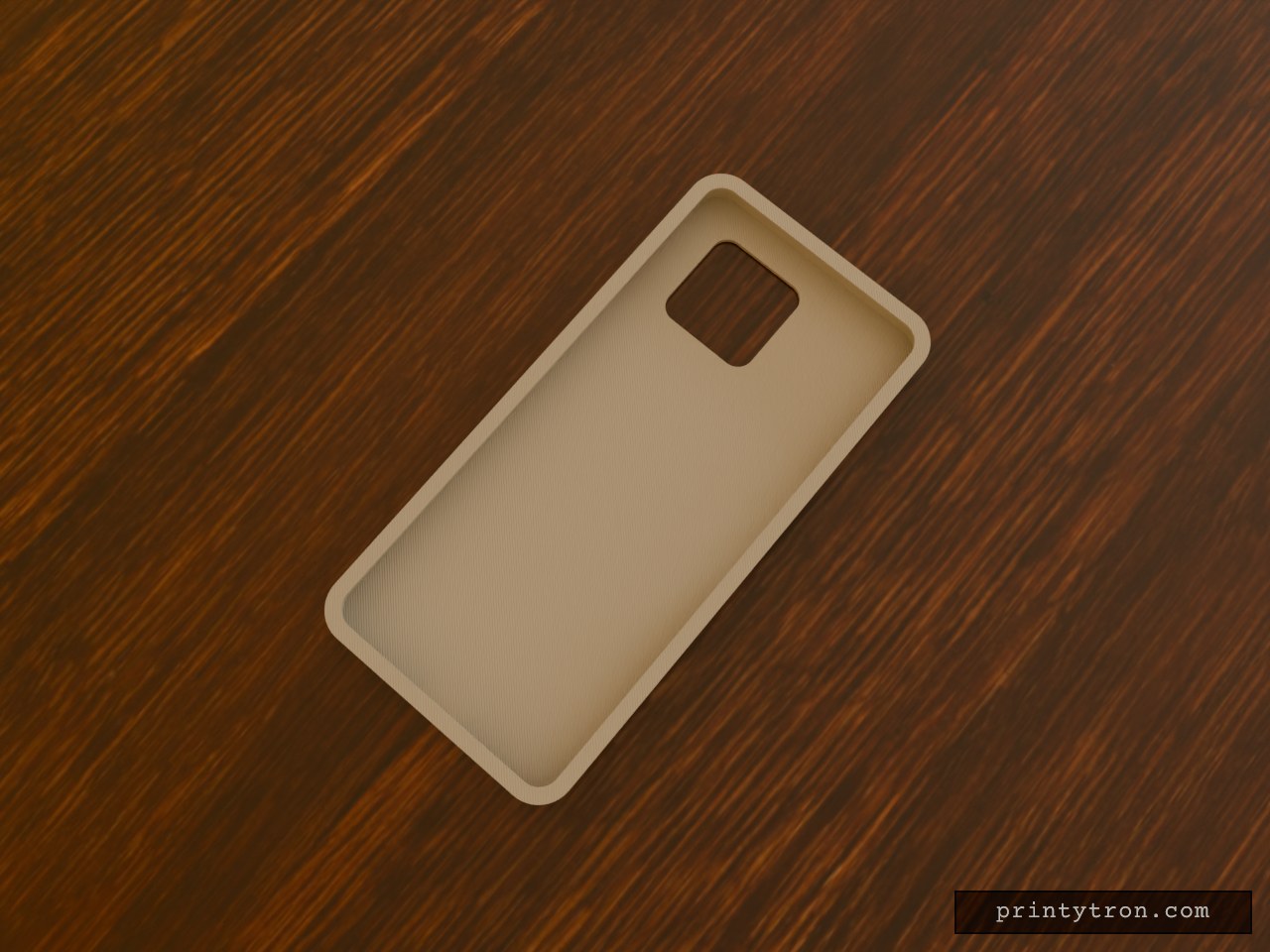
Snug Shell Fairphone 5 Case
A close-fitting, rounded-corner shell with the clean look of a classic bumper case. The back sits flat on the bed, and a slim lip wraps the screen edge to hold the phone in. Fits a phone of about 161.6 × 75.8 × 9.6 mm, with 0.3 mm clearance per side 2 mm walls and a 1.6 mm back Cutouts: camera and flash, USB-C, bottom speaker and mic slots, and a long slot for the side buttons Print in TPU or a flexible filament so the lip can flex over the phone. Rigid plastics may need a larger lip gap.
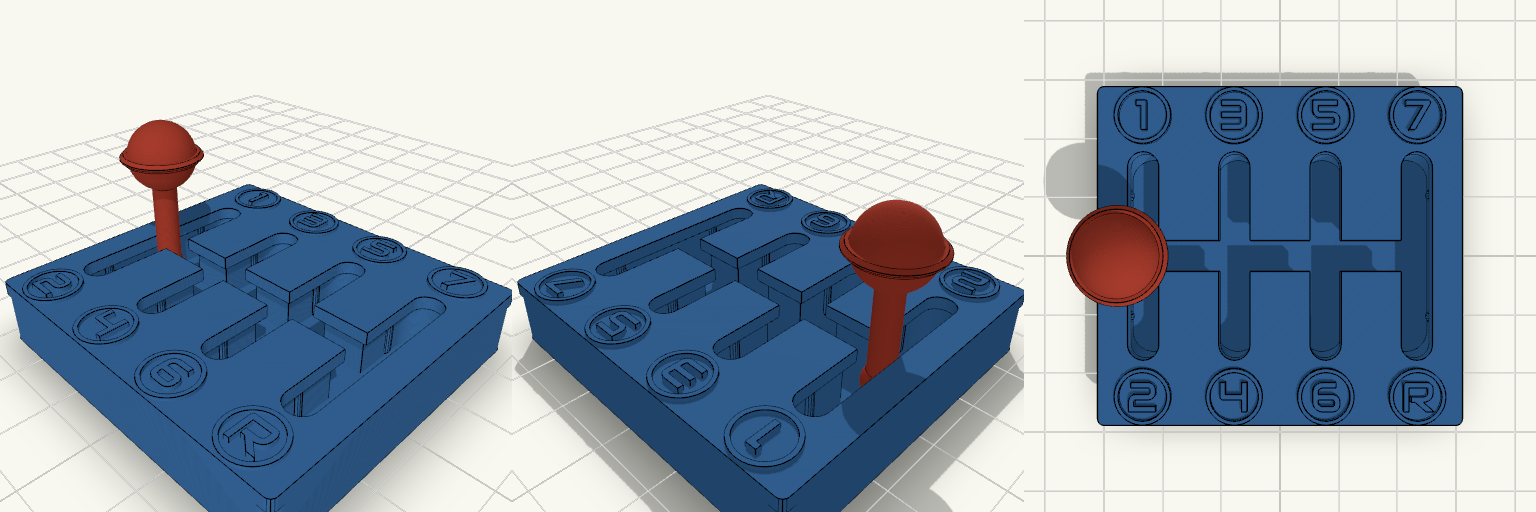
Table Shifter 6000
A print-in-place gate shifter fidget with seven forward gears plus reverse. There is no host device, thread or bore to match here, so the fit that decides whether it prints is the captive ball working under the 4.4 mm lid slots. The ball is wider than the slots, so the lever stays trapped under the slotted lid and the model comes off the plate in one piece — no assembly. The base measures 56 × 52 × 10.8 mm. Four 32 mm columns are joined by a crossbar, putting gears 1 to 6 on the first three columns, gear 7 at the far end of the fourth, neutral on the crossbar and reverse at the near end of that fourth column. The lever starts parked in the left column. Raised ringed badges label the lid: 1, 3 and 5 at the far ends of the first three columns; 2, 4 and 6 at their near ends; 7 at the far end of the fourth; and R at its near end. Each badge is an 8.6 mm ring around a 0.8 mm-tall digit in a squared technical style. This version is set up for smooth travel rather than a hard click. The ball is 5.4 mm with about 0.5 mm of play above and below in the socket, and the detent bumps at the ends of each column are 2.4 mm across — small enough that the ball passes them with roughly 1 mm to spare. The lever glides through the gate with almost no detent feel; if you want the click back, tighten the bumps in 0.05 mm steps. The shift lever measures 13 × 13 × 28.4 mm. The stick is 4 mm thick and 20.2 mm long, and the top knob is an 11 mm ball with a 13 mm chamfered disc around it. Fit and print checks Fits: prints in place as one piece — no assembly, no hardware. Not for: a vehicle, gearbox or real shifter; this is a desk fidget only. Check before printing: the model has not been test-printed. Captive fit: 5.4 mm ball in 4.4 mm lid slots; the lever cannot pull out. Detent bumps: 2.4 mm across, leaving about 1 mm of clearance past the ball — smooth travel, negligible click. Tighten by 0.05 mm at a time if too loose. Ball clearance: about 0.5 mm above and below the ball, so it should not fuse on a slightly over-extruded printer. Check the lid labels: the 1–7 and R badges are 8.6 mm rings and have not been confirmed clear of the slots or the lid edge. Inspect the top layer before committing to a full print. Key dimensions: 56 × 52 mm base, 32 mm columns, 20.2 × 4 mm stick, 5.4 mm ball.
Dual Vertical Laptop Stand, 20mm Slots
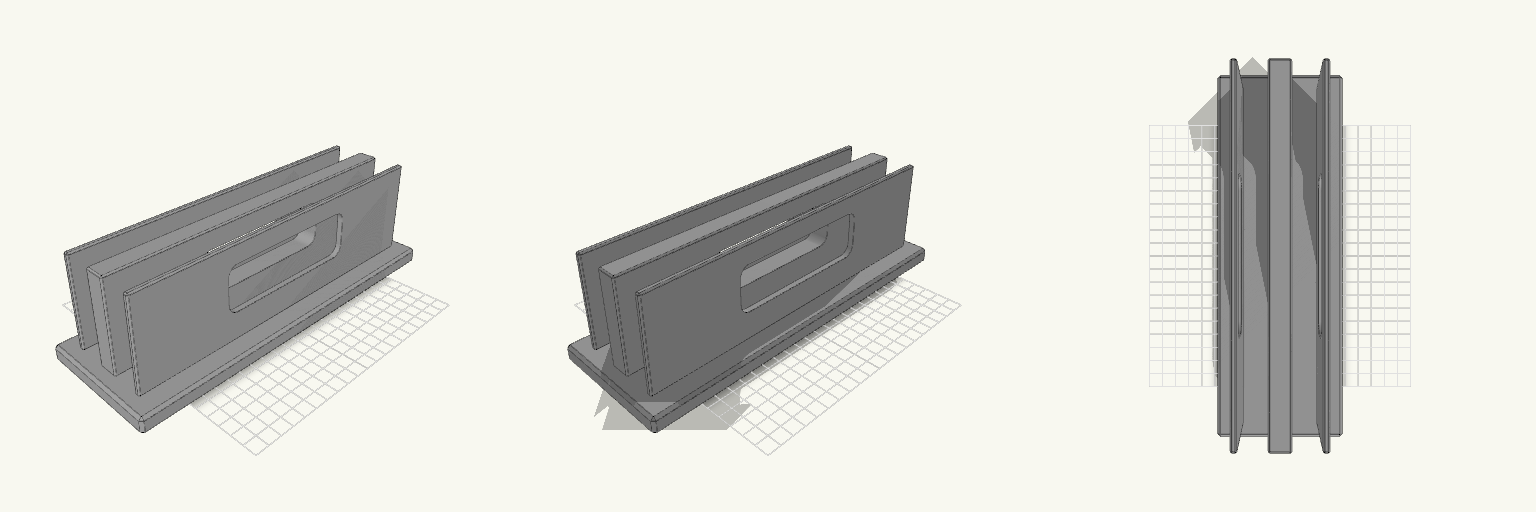
A vertical stand that docks two closed laptops side by side on their edges, freeing up desk space. Built for a setup with a work laptop and a personal laptop sharing one desk. Each slot has a window cut through its walls, so a hand can rest on a lid to check for heat without removing the laptop. What it's for Holding two closed laptops upright, one per slot, with a solid 15 mm divider between them. Checking temperature by touch through the window in each slot wall. Staying put thanks to a wide, weighted base that resists tipping. Dimensions Slot width: 20 mm each Divider between slots: 15 mm Outer and divider wall thickness: 4 mm (the divider is the 15 mm gap) Overall width: about 93 mm Overall depth: 270 mm base, 250 mm walls Overall height: about 82 mm (12 mm base plus 70 mm walls) Windows: 110 mm long by 35 mm tall, with rounded ends, through each wall Weight pockets: four underneath, each 14 × 80 × 7 mm Print notes Print with the base flat on the bed. No supports are needed for the main body. The underside pockets open downward. Fill them with steel washers, shot or similar, then seal them with felt, a sticker or a thin plate. Use PETG or PLA with 3 or more perimeters for stiff walls. Remix ideas Change the slot width to fit thicker laptops or ones in sleeves. Add a third slot for a tablet. Add rubber feet or a felt pad under the base. Add a cable cutout in the base for charging leads.