Table Shifter 6000
Made by Georgios14
Created today
Description
A print-in-place gate shifter fidget with seven forward gears plus reverse. There is no host device, thread or bore to match here, so the fit that decides whether it prints is the captive ball working under the 4.4 mm lid slots. The ball is wider than the slots, so the lever stays trapped under the slotted lid and the model comes off the plate in one piece — no assembly.
The base measures 56 × 52 × 10.8 mm. Four 32 mm columns are joined by a crossbar, putting gears 1 to 6 on the first three columns, gear 7 at the far end of the fourth, neutral on the crossbar and reverse at the near end of that fourth column. The lever starts parked in the left column. Raised ringed badges label the lid: 1, 3 and 5 at the far ends of the first three columns; 2, 4 and 6 at their near ends; 7 at the far end of the fourth; and R at its near end. Each badge is an 8.6 mm ring around a 0.8 mm-tall digit in a squared technical style.
This version is set up for smooth travel rather than a hard click. The ball is 5.4 mm with about 0.5 mm of play above and below in the socket, and the detent bumps at the ends of each column are 2.4 mm across — small enough that the ball passes them with roughly 1 mm to spare. The lever glides through the gate with almost no detent feel; if you want the click back, tighten the bumps in 0.05 mm steps.
The shift lever measures 13 × 13 × 28.4 mm. The stick is 4 mm thick and 20.2 mm long, and the top knob is an 11 mm ball with a 13 mm chamfered disc around it.
Fit and print checks
- Fits: prints in place as one piece — no assembly, no hardware.
- Not for: a vehicle, gearbox or real shifter; this is a desk fidget only.
- Check before printing: the model has not been test-printed.
- Captive fit: 5.4 mm ball in 4.4 mm lid slots; the lever cannot pull out.
- Detent bumps: 2.4 mm across, leaving about 1 mm of clearance past the ball — smooth travel, negligible click. Tighten by 0.05 mm at a time if too loose.
- Ball clearance: about 0.5 mm above and below the ball, so it should not fuse on a slightly over-extruded printer.
- Check the lid labels: the 1–7 and R badges are 8.6 mm rings and have not been confirmed clear of the slots or the lid edge. Inspect the top layer before committing to a full print.
- Key dimensions: 56 × 52 mm base, 32 mm columns, 20.2 × 4 mm stick, 5.4 mm ball.
Images
More like this
Explore more in Desk & Tech →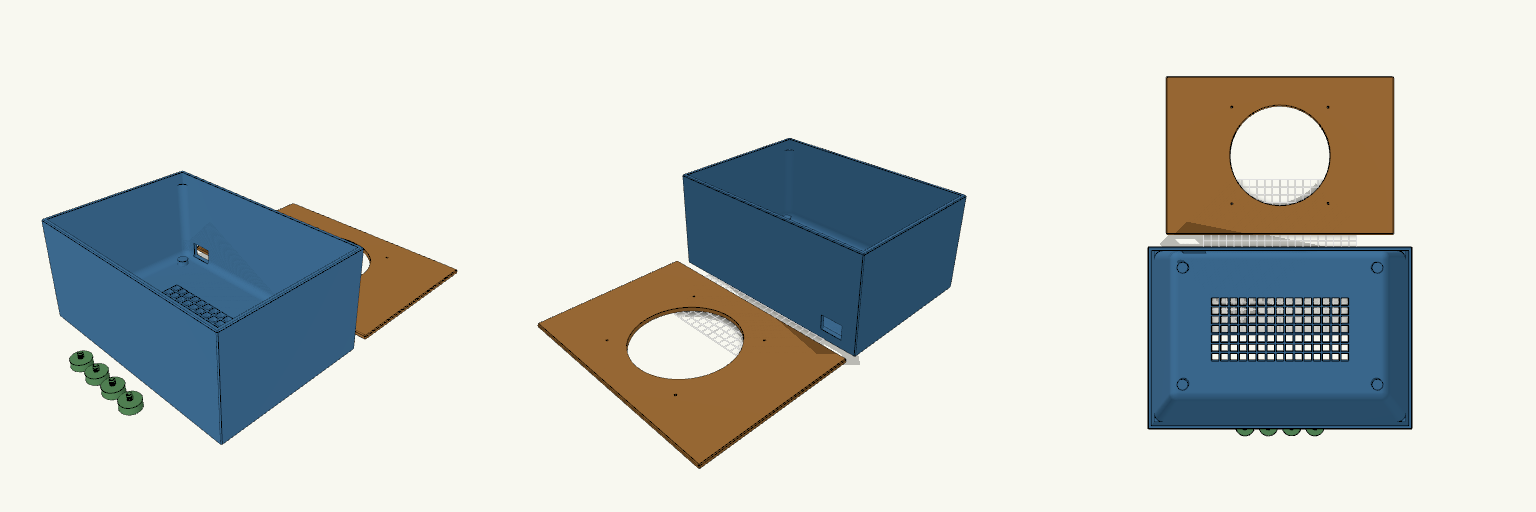
Mini-Server-Box with Feet, Lid and Fan
What it's for A solid-walled enclosure for hiding and cooling equipment. Every side wall is closed, and the only airflow path is a sturdy grid cut into the floor, so the box stays dark and quiet from the sides. A 30 × 20 mm cable hole in the lower rear corner lets wiring in and out, and the flat lid lifts off for access. The model prints as separate pieces: the box, the lid and four feet. The lid is a flat plate with a locating lip underneath, slightly larger than the box on every side so it overhangs and can never drop inside. Each foot carries its own coarse threaded stud, so the feet screw directly into matching threaded holes in the floor bosses with no separate fasteners. Dimensions Box: 290 × 200 × 130 mm, with 4 mm walls, solid on all four sides, an 8 mm floor, and a 50 mm solid border around the floor grid. The floor grid is centred on the narrower floor. The thicker floor makes the mesh bars deeper, so airflow per opening drops slightly. Inside fillets: 10 mm radius on the vertical corners and the floor-to-wall edges, stopping 15 mm below the rim. The top 15 mm stays square so the lid and its lip fit without changes. Lid: 294 × 204 mm, 9 mm overall with a 5 mm plate and underside lip; overhangs the box by 2 mm on all sides; 140 mm fan opening and four 3 mm fan screw holes at 124.5 mm center-to-center. Cable hole: 30 × 20 mm in the rear wall, set 20 mm from the left edge and 12 mm above the bottom, inside the solid section so it doesn't weaken the corners. Feet: four solid 24 mm discs, 10 mm tall, each with a 6 mm thick, 8 mm long threaded stud on top; 18 mm overall. The studs use a 1.5 mm pitch. Foot sockets: four corner bosses widened to 14 mm, with threaded holes 6.6 mm across and 11 mm deep at the same 1.5 mm pitch, giving about 0.6 mm clearance on diameter. Print notes Print the box, lid and feet separately. Print the lid lip-side up so its flat face sits on the bed and the lip rises clear of the plate. The floor grid benefits from enough perimeters to keep the bars sturdy. The threads have not been test-fitted; if the feet bind, raise the socket diameter slightly, and if they wobble, lower it. Test-fit the fan and check its screw-hole spacing before committing to a full print. Remix ideas Add a removable filter frame behind the fan opening. Add internal standoffs or a shallow tray for mounting equipment inside. Resize or duplicate the rear cable port for thicker cable bundles. Swap the floor grid for a denser or more open pattern to change the airflow.
Four-Board 1U Rack Mount for Orange Pi 5 Pro
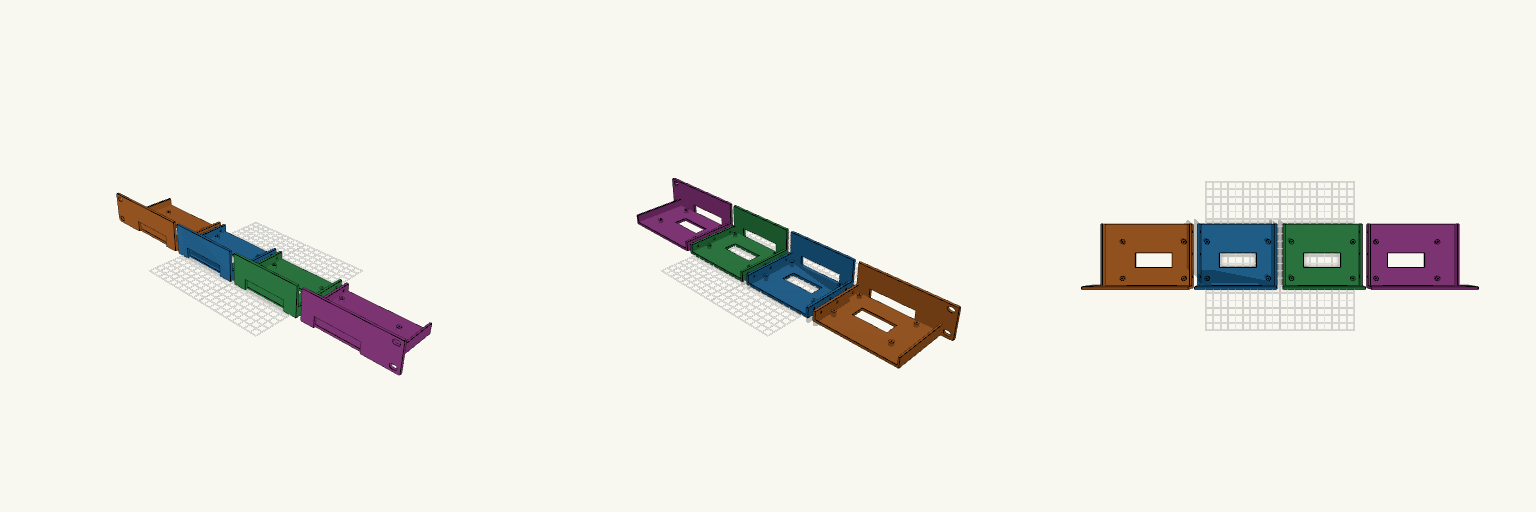
A 1U, 19-inch rack mount that holds four Orange Pi 5 Pro boards side by side. The front panel fills a standard rack opening and the tray behind it carries the boards at 105 mm spacing, so all four sit behind a single 1U slot. Slotted ear holes line up with standard 19-inch rack spacing, and four 66 × 16 mm cutouts in the panel line up with the boards for power and Ethernet cables. The mount is split into four modules that print separately and bolt together, so it fits beds of roughly 150 mm or larger. Print each module flat on its back with the tray side down. Every seam has a rib with three 3.4 mm holes for M3 bolts; cut through the rib and those holes become the clamping points between neighbouring modules. Cutouts and standoff positions are based on an assumed board footprint of about 89 × 56 mm, so check them against your boards before printing. Ear modules: 136.3 × 85 × 44.5 mm each Centre modules: 105 × 85 × 44.5 mm each Seams: centre and ±105 mm, three M3 bolt holes per seam Board spacing: 105 mm between positions Cable cutouts: four at 66 × 16 mm Standoffs: four per board, 2.2 mm pilot holes Panel height: 44.5 mm (1U), ears slotted at standard rack spacing
Touchscreen-Gehäuse mit Klappfuß STL
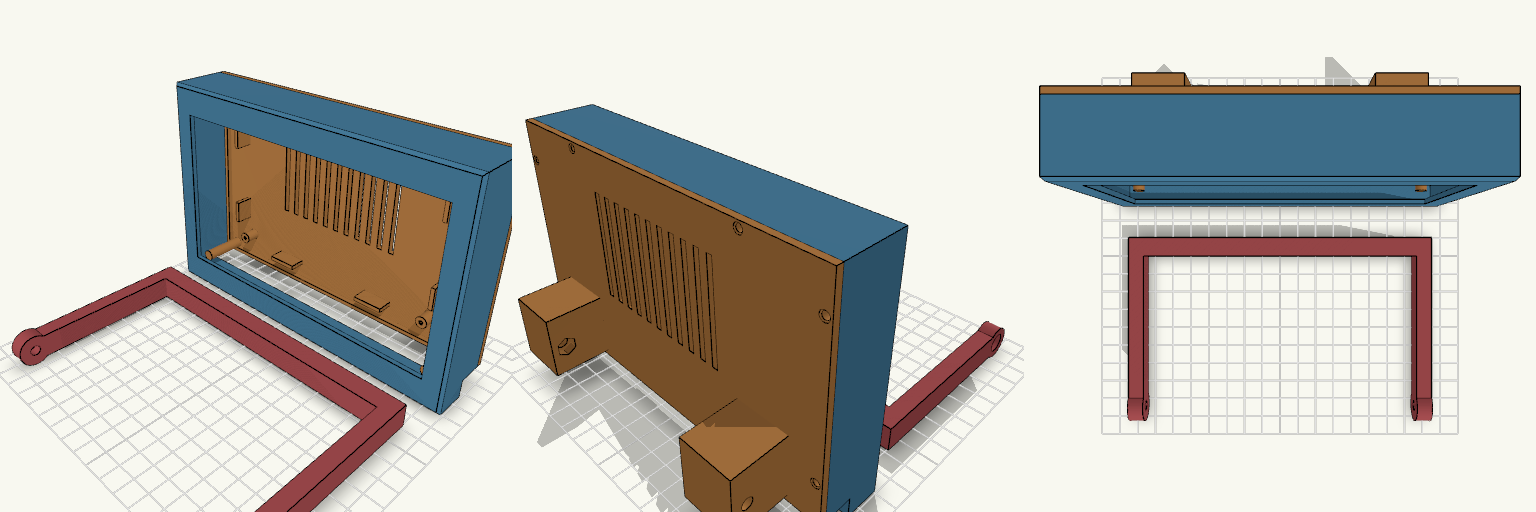
Schlichtes Gehäuse für das 7-Zoll-Display Pollin LS-7T, im Stil eines kleinen Werkstatt-Terminals. Hinten sitzt eine abnehmbare Rückwand mit Lüftungsschlitzen. Der U-förmige Standfuß ist ein eigenes Bauteil und liegt zum Drucken flach neben dem Gehäuse. Hinweise Standfuß separat gedruckt, ohne Stützen druckbar Befestigung am Gelenk mit je einer M5-Schraube samt Mutter Kabelschlitz über die volle Breite, 10 mm hoch Platinen-Abstandshalter im Raster 122 × 79 mm (bitte gegen die Platine prüfen)
Dual Vertical Laptop Stand, 20mm Slots
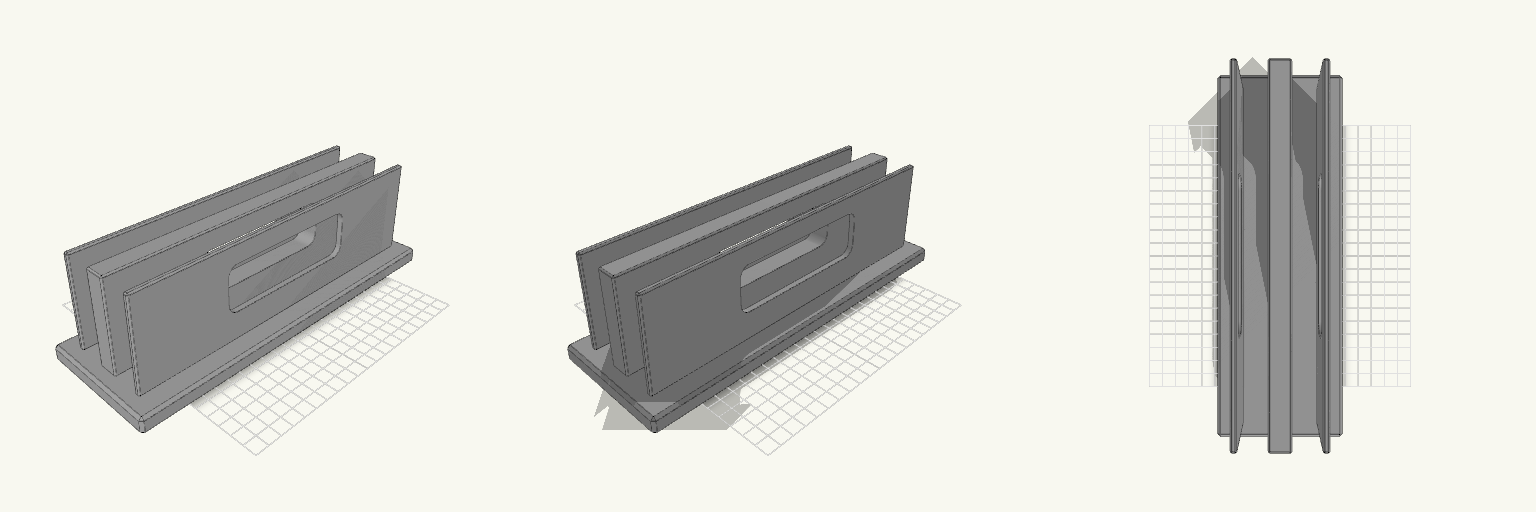
A vertical stand that docks two closed laptops side by side on their edges, freeing up desk space. Built for a setup with a work laptop and a personal laptop sharing one desk. Each slot has a window cut through its walls, so a hand can rest on a lid to check for heat without removing the laptop. What it's for Holding two closed laptops upright, one per slot, with a solid 15 mm divider between them. Checking temperature by touch through the window in each slot wall. Staying put thanks to a wide, weighted base that resists tipping. Dimensions Slot width: 20 mm each Divider between slots: 15 mm Outer and divider wall thickness: 4 mm (the divider is the 15 mm gap) Overall width: about 93 mm Overall depth: 270 mm base, 250 mm walls Overall height: about 82 mm (12 mm base plus 70 mm walls) Windows: 110 mm long by 35 mm tall, with rounded ends, through each wall Weight pockets: four underneath, each 14 × 80 × 7 mm Print notes Print with the base flat on the bed. No supports are needed for the main body. The underside pockets open downward. Fill them with steel washers, shot or similar, then seal them with felt, a sticker or a thin plate. Use PETG or PLA with 3 or more perimeters for stiff walls. Remix ideas Change the slot width to fit thicker laptops or ones in sleeves. Add a third slot for a tablet. Add rubber feet or a felt pad under the base. Add a cable cutout in the base for charging leads.
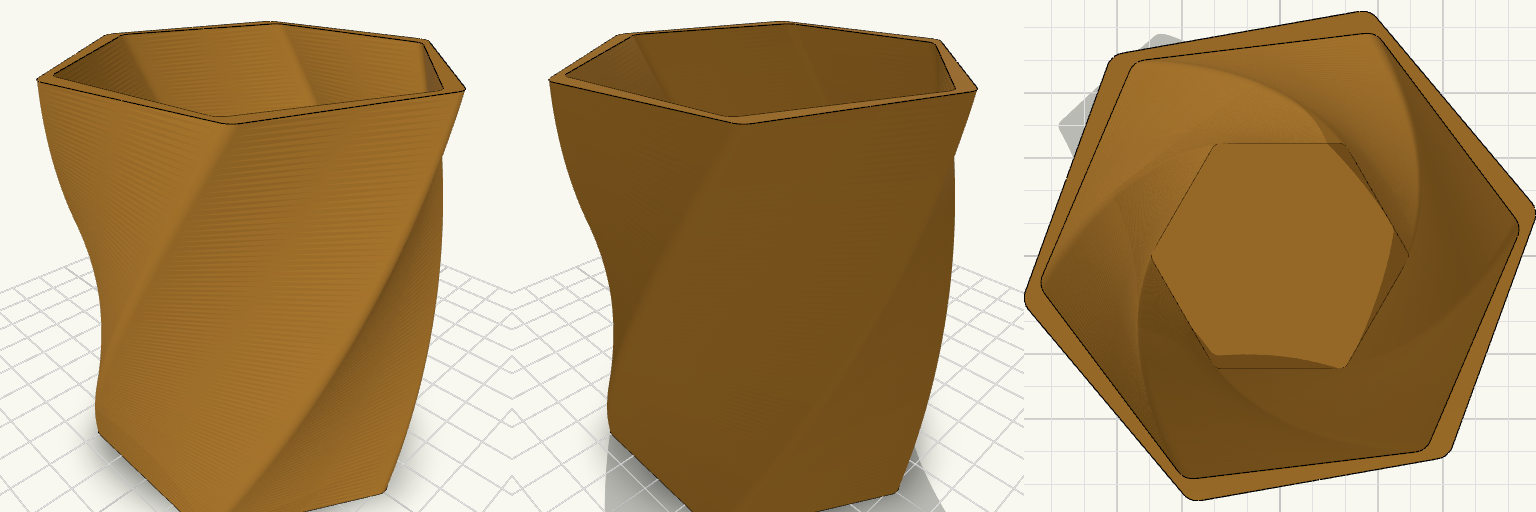
Helix — Twisted Hexagonal Pen Cup
A hexagonal desk cup with the twist built into its silhouette: the six-sided body rotates 70° from bottom to top, so the facets read as a slow spiral rather than a straight column. It stands 90 mm tall and measures about 83 mm across the corners — enough for pens and pencils, with room to spare for scissors or a ruler. The hexagon sits flat on the desk, giving it the weight of a solid block rather than a floating one. Walls are 3 mm and the floor is 4 mm, so it holds its shape under a full load without feeling heavy. Dimensions Overall height: 90 mm — takes pens, pencils, scissors and a ruler Width across corners: about 83 mm Wall thickness: 3 mm Floor thickness: 4 mm Features Six-sided body with a 70° twist from base to rim Flat hex base sits directly on the desk for a stable, blocky stance One named area, Twisted Cup Body, printed as a single piece Flat facets catch the light along the spiral Print notes Print upright as oriented on the plate. The twist is gentle enough that the walls lean without needing supports, and the flat hex base gives a broad, secure contact patch. A matte dark filament shows the spiral facets best; 0.2 mm layers with two or three perimeters make a sturdy cup, and a finer layer height sharpens the edges of the twist.
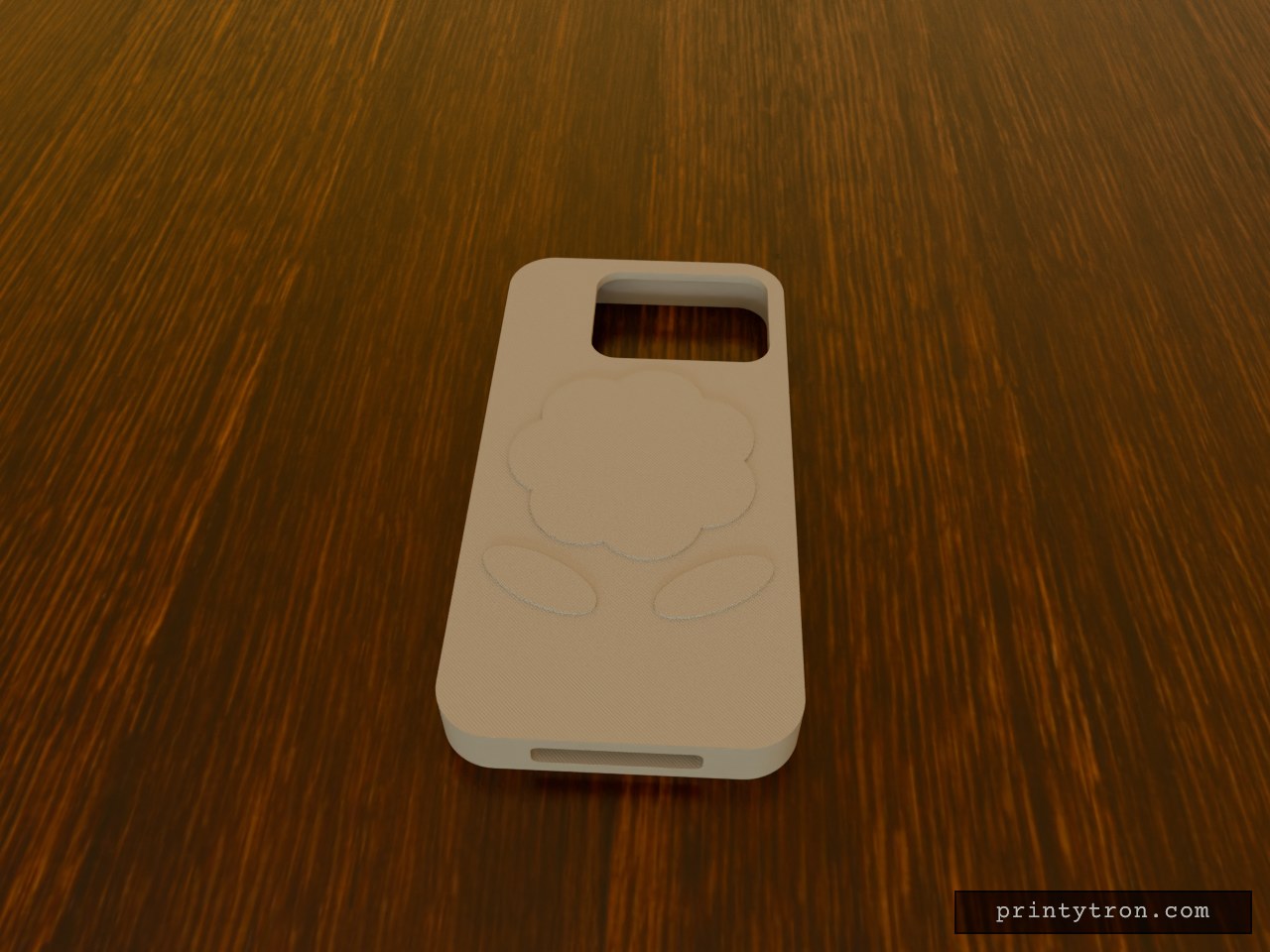
iPhone 17 Pro Max Case, Blue with Rose
What it's for A protective case for the iPhone 17 Pro Max in light blue, with a raised rose on the back below the camera cutout. Dimensions Phone body: 163.4 × 78 × 8.75 mm, with 0.3 mm of play per side Walls 4 mm, back 3 mm Rose relief: 1 mm, flat-topped layers Remix ideas Recolour the rose in blue tones to blend with the case Make the rose taller or soften its edges Swap the rose for another motif