Placa Rectangular 200 x 50 x 10 mm
Created 2 days ago
Description
Placa rectangular maciza de 20 cm x 5 cm x 1 cm, para cuando hace falta una base plana y rígida que no se flexione ni se astille en los bordes.
Datos para imprimir
- Medidas: 200 x 50 x 10 mm
- Bisel de 1,5 mm en todas las aristas, para que la primera capa no se levante en las esquinas
- Se imprime tumbada sobre su cara más grande, sin soportes
- Relleno recomendado: 20 % o más, según la carga
Images
More like this
Explore more in Workshop & Tools →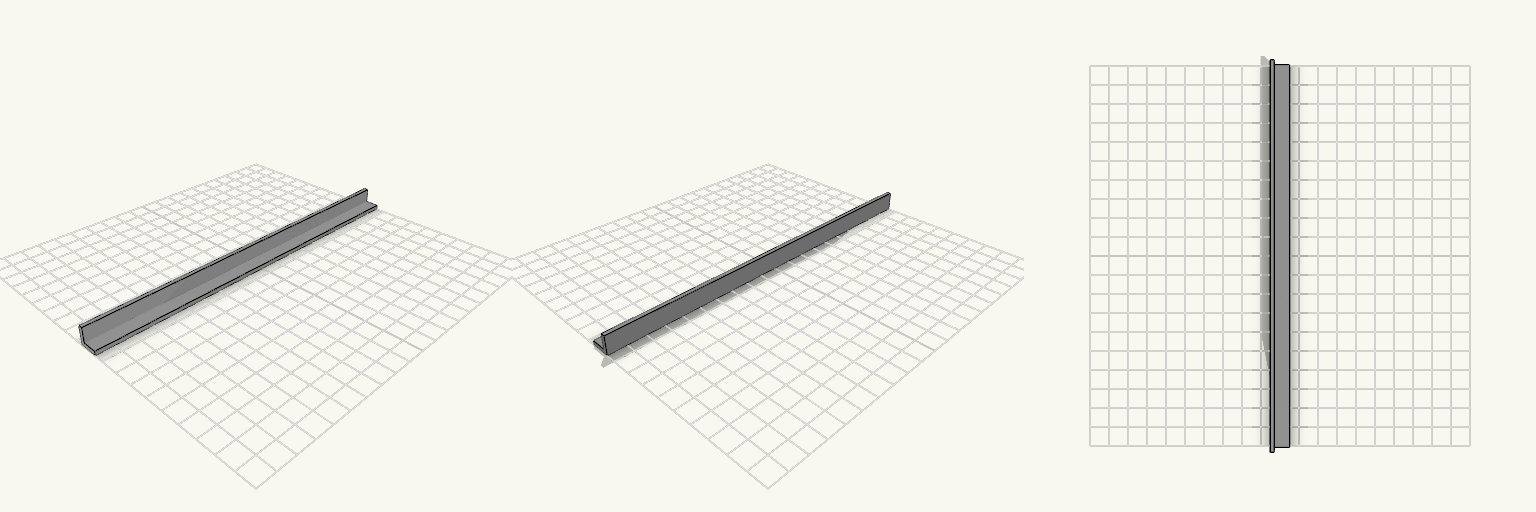
Ángulo — Tira en L de 20 cm
Ángulo — perfil en L de 20 cm de largo, pensado como esquinero, guía o refuerzo de bordes. Dos caras iguales a 90°, de sección sencilla y fácil de imprimir tumbado. Dimensiones Largo: 200 mm Ancho de cada cara: 10 mm Grosor: 2 mm Notas de impresión Imprimir apoyado sobre una cara, sin soportes. Para más rigidez, orientar las capas a lo largo del perfil.
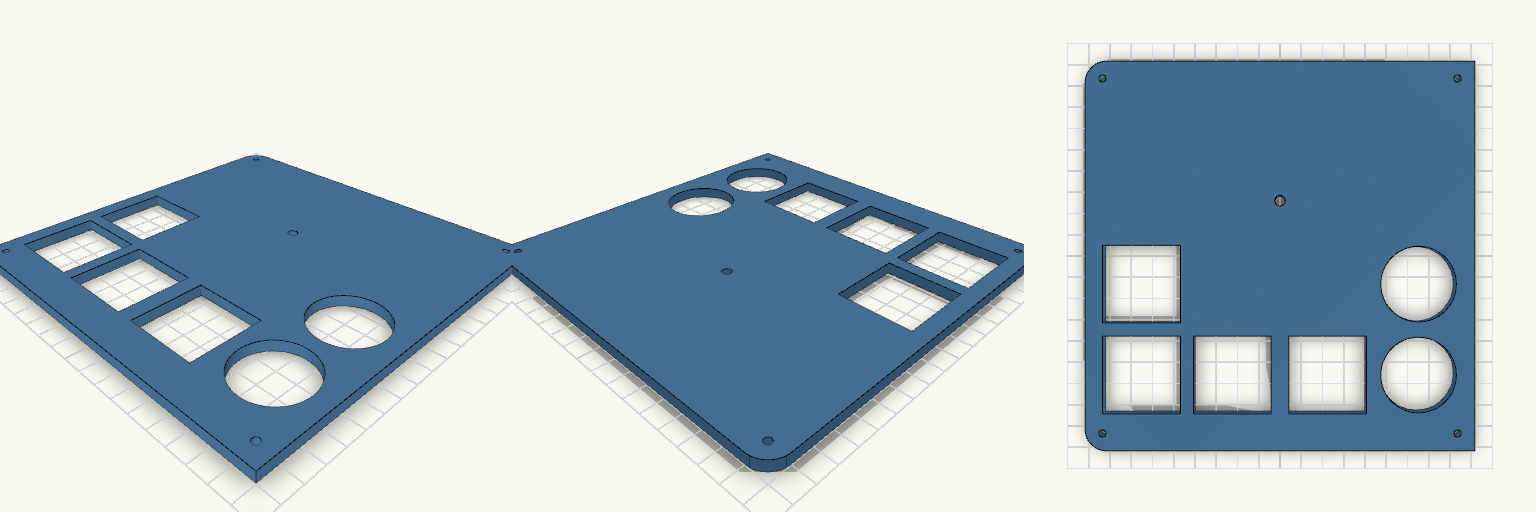
Tapa cuadrada con agujeros mixtos
Tapa de 180×180×5 mm con dos lados redondeados a la izquierda (radio 10 mm), cuatro agujeros M3 en las esquinas y un agujero de 5 mm. Dos agujeros redondos de 35 mm a la derecha y cuatro cuadrados de 36 mm a la izquierda, en la zona inferior. Ideas para remezclar Diámetro de los redondos (35 mm): súbelo o bájalo según la pieza que deba pasar; la pared entre ellos es de 7 mm. Lado cuadrado (36 mm): ajústalo por separado; los centros están a 42 mm. Radio de las esquinas (10 mm): 5 mm para una curva más suave. Agujero de 5 mm: está a 25,5 mm sobre el centro; muévelo para un pasacables o un pulsador. Combina con: una base o caja de 180 mm usando los M3 de las esquinas (3,4 mm, a 8 mm del borde).
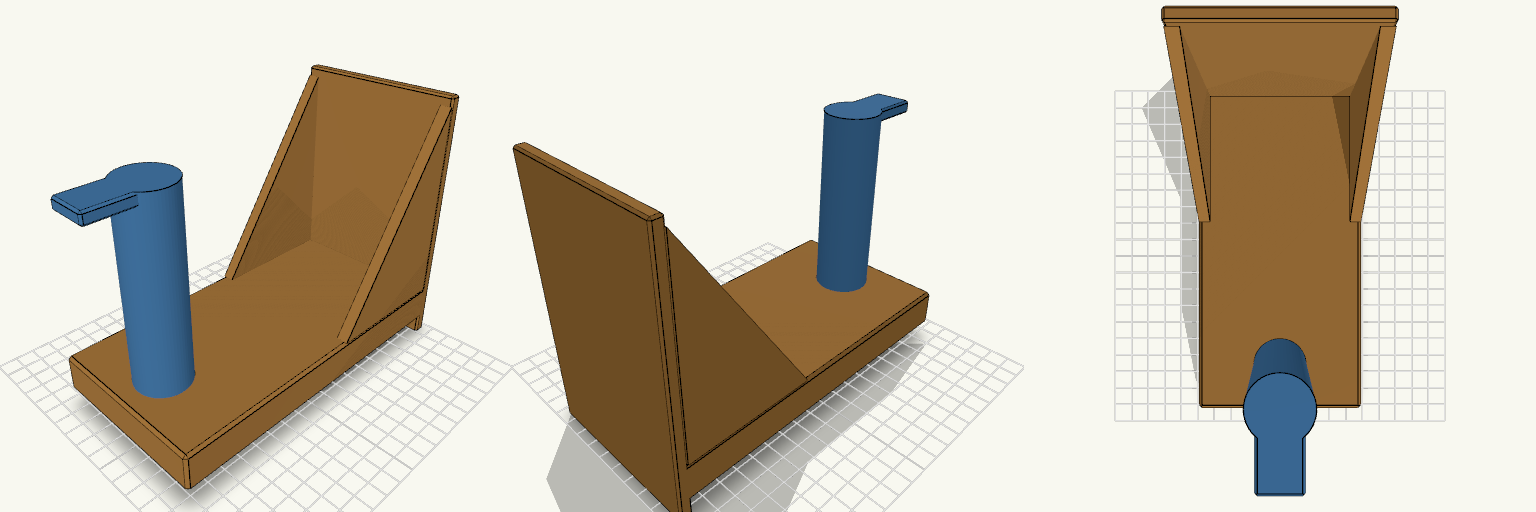
Stovas su vienpuse 10 cm iškyša
Stovas su sulietu 29 mm strypu, kuris kyšo 100 mm į vieną pusę. Strypo gale yra stačiakampis stabdiklis, kad kabinamas daiktas nenuslystų. Ką verta keisti Stabdiklio aukštis: 20 mm virš strypo paviršiaus (iš viso 34,5 mm nuo ašies). Stabdiklio plotis: 20 mm, storis 6 mm. Strypo ilgis ir skersmuo: 100 mm, 29 mm. Pagrindas: 90 mm plotis, 140 mm gylis, dvi trikampės atramos 105 × 70 mm. Tinka poroms su kitu stovu, jei strypą reikia perdaryti į atskirą detalę.
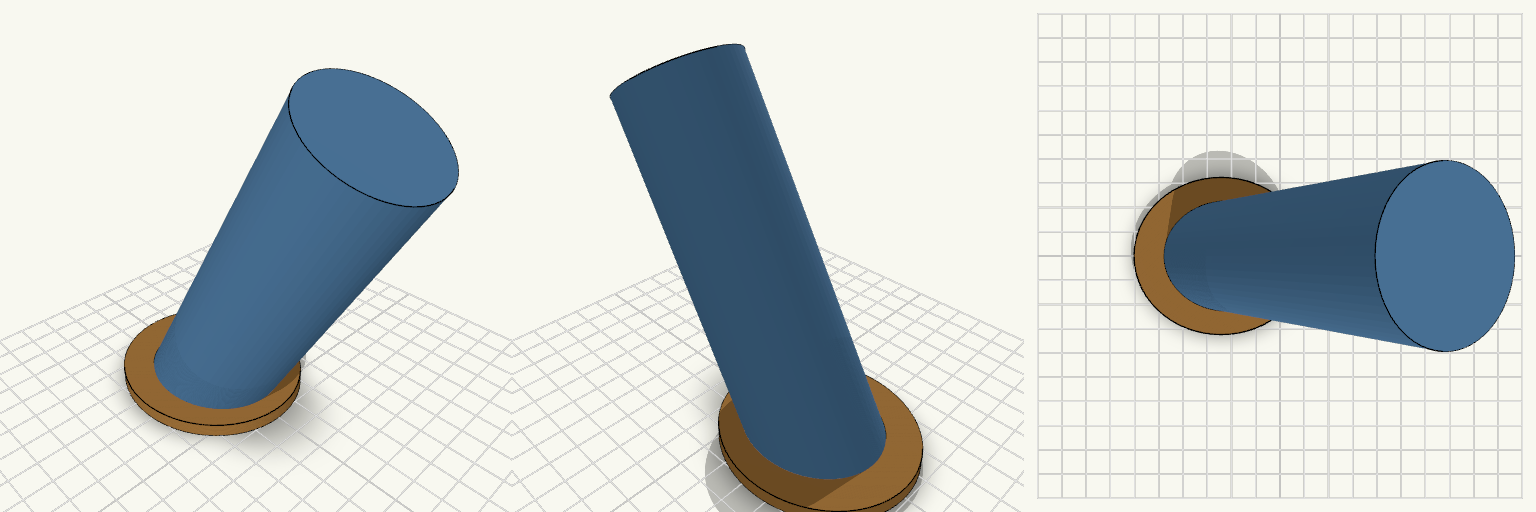
30° Tilted 1.75 in Cylinder With Base
A 1.75 in diameter cylinder leaning 30° from vertical, mounted on a flat base plate. The upper side of the cylinder measures 4.5 in from the base to the top end. Cylinder: 1.75 in (44.45 mm) diameter, 30° from vertical, 4.5 in along the top side Base: 0.18 in (4.57 mm) thick, extends 0.375 in beyond the cylinder footprint on all sides Flat underside, prints without supports on the base; the lean is unsupported on the underside of the cylinder, so a brim or supports may help One continuous solid
cache moteur araignee
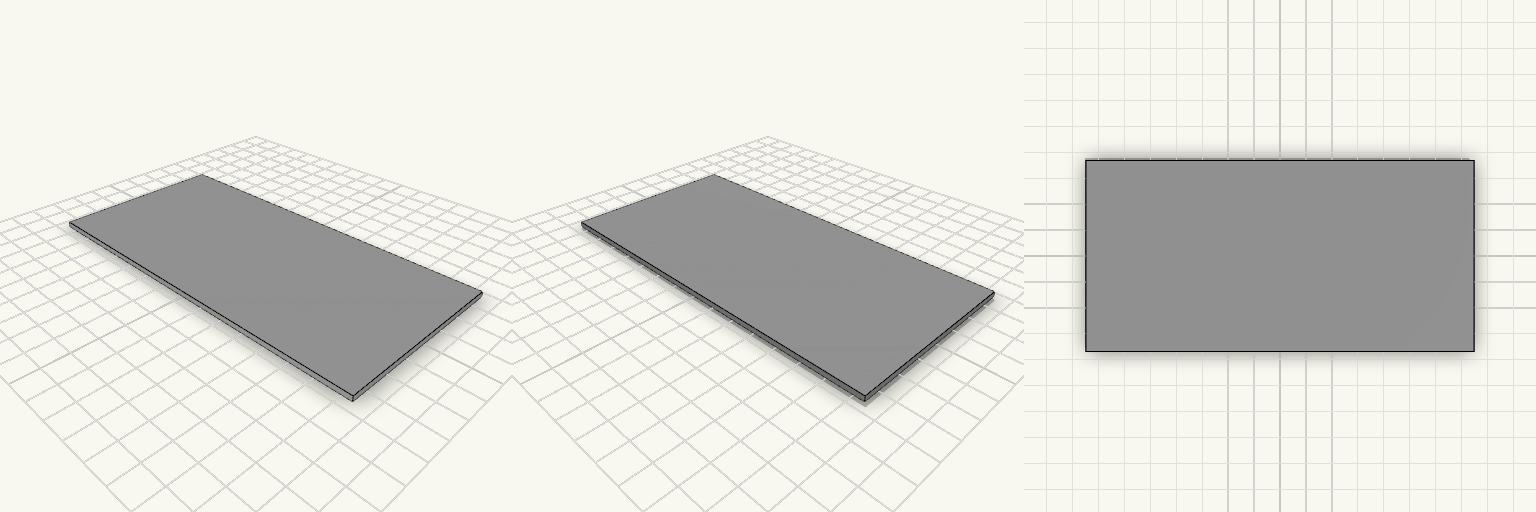
Une plaque plane rectangulaire de 148 × 73 mm pour 2 mm d'épaisseur, posée à plat sur le plateau. Les arêtes sont vives et les faces sont lisses : c'est une base neutre, faite pour être percée, collée, vissée ou redessinée selon le besoin. Elle s'imprime sans support, quelle que soit l'orientation, et sert aussi bien de panneau de fond que de gabarit, de cale ou de renfort. Pistes pour une version à toi Épaisseur (2 mm) : c'est le paramètre le plus utile à faire varier. En dessous, la plaque devient souple et se déforme ; au-dessus de 3 mm, elle devient rigide mais consomme vite de la matière. Garde 2 mm si tu veux une plaque qui se découpe aux ciseaux après impression. Empreinte (148 × 73 mm) : les deux cotes sont libres. La diagonale vaut environ 165 mm, donc la plaque tient dans la plupart des plateaux sans dépasser. Arêtes vives : un congé de 1 à 3 mm sur les quatre coins change complètement le rendu et évite les angles qui s'ébrèchent. Un chanfrein sur le pourtour donne un bord plus doux au toucher. Perçages et découpes : trous de fixation aux quatre coins, rainure centrale, fenêtre traversante — tout se rajoute sans toucher au contour. Ce avec quoi elle s'associe Une plaque comme celle-ci se superpose : deux exemplaires collés font une cale de 4 mm, un exemplaire vissé sur un caisson fait un fond ou une porte, et un exemplaire percé devient un gabarit de perçage. Si tu la destines à un objet précis, indique les cotes de cet objet plutôt que de repartir de zéro : c'est la seule mesure qui compte vraiment.
SpoolScope — Filament Remaining Gauge
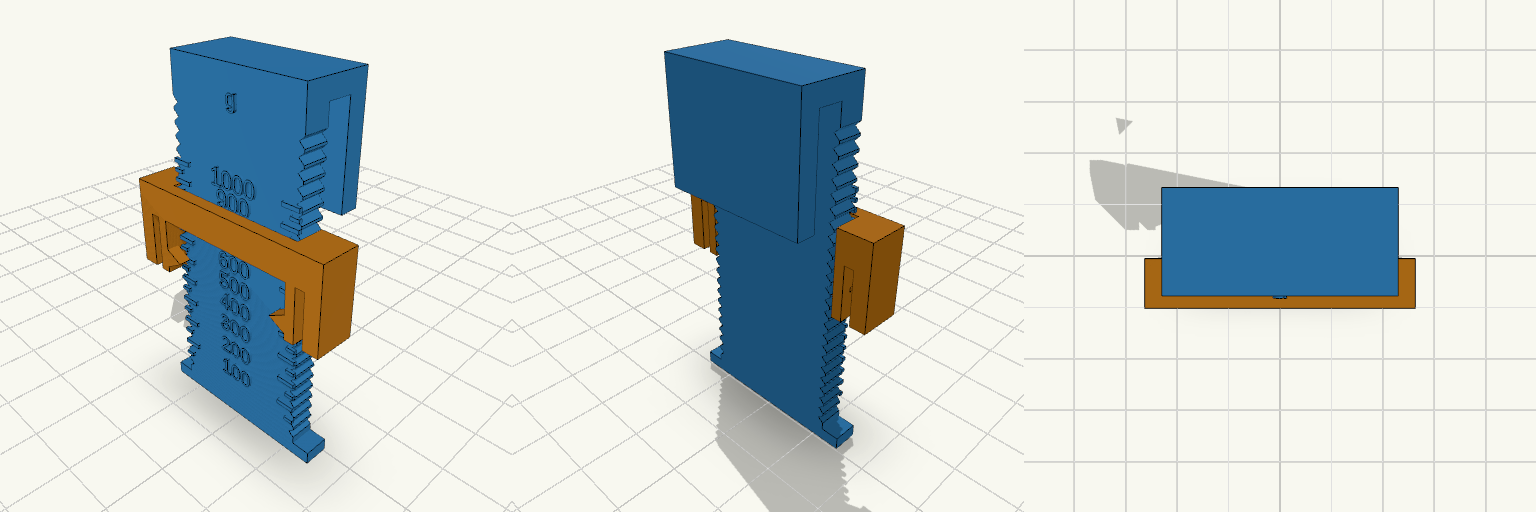
SpoolScope is a two-part gauge for estimating how much filament remains on a standard spool, made for spools that sit out of easy view in an AMS or on a shelf. The rail hooks over the flange rim; the sliding block rides on it with light detents, so you can push it down until it touches the filament, lift the gauge away and read the result. Raised ticks and numbers plus an unambiguous arrow on the block make the measurement clear without needing line-of-sight while the gauge is in place. Features Two printed parts: a rail with a rim hook, and a detented sliding block. Gram scale from 0 to 1000 g, with ticks every 50 g and numbers every 100 g. Ticks follow filament geometry rather than an even spacing: closer together near full, wider apart near empty. Arrows on the block tip directly toward the scale, and the detents hold the reading after the gauge is lifted off. Hook gap of 4 mm, sized to clear flanges from 2.8 mm to 3.6 mm thick. Dimensions Flange diameter: 200 mm. Hub outer diameter: 95 mm (from a measured Polymaker spool). Full-roll diameter: 170 mm (estimated from a 1 kg PLA roll on a 95 mm hub and a 65.6 mm spool width). Hook gap: 4 mm. Fitting and calibration Sized around Polymaker and Inland 1 kg spools; other brands are worth checking against the hub and flange figures above. The scale can be shifted by a single fixed offset if a first print reads consistently high or low, so a weight check against a known spool is worth doing before trusting the numbers. If the error differs between a full and an empty spool, the hub and full-roll values are the ones to correct. Print notes Both parts are laid out flat on the print plate. The block contacts the filament at its outer edges rather than at the centre, so a reading can sit slightly high; a weight check against a known spool is the best way to confirm the scale.