Pojemnik z nasuwanym wieczkiem
Created today
Description
Do czego służy
Pusty w środku pojemnik na zapasową baterię CR2032, także w małym opakowaniu blisterowym. Wnętrze nie ma kratki, więc baterię lub całe opakowanie wkłada się do środka i zamyka wieczkiem nasuwanym z zewnątrz, jak pokrywka pudełka. Pojemnik i wieczko to dwa osobne elementy; wieczko nie ma zawiasu ani magnesu, a po nałożeniu jest równe z korpusem na bokach.
Wymiary
- Pojemnik: podstawa 60 × 75 mm, wysokość 40 mm; ścianki i dno po 2 mm.
- Wnęka: 56 × 71 mm, u góry zwężona do 52 × 67 mm na wysokości 8 mm.
- Wieczko: 60 × 75 × 10 mm; otwór 56,4 × 71,4 mm, luz 0,2 mm z każdej strony.
- Po założeniu wieczka całość ma 42 mm wysokości.
- Opakowanie baterii o grubości niecałe 5 mm mieści się z zapasem.
Druk
- Dwa elementy do wydruku: pojemnik i wieczko — drukują się osobno.
- Wieczko nasuwa się z zewnątrz; przy zbyt luźnym pasowaniu zmniejsz luz lub zwiększ wypełnienie ścianek.
- Bez kratki i bez napisów na wieczku.
Pomysły na modyfikacje
- Zmiana wymiarów wnęki pod inne opakowania baterii lub stos.
- Wersja z kratką na kilka baterii obok siebie.
- Nacięcie lub uchwyt przy krawędzi wieczka, ułatwiający zdejmowanie.
- Miejsce na napis lub oznaczenie na wieczku.
Images
More like this
Explore more in Storage & Organization →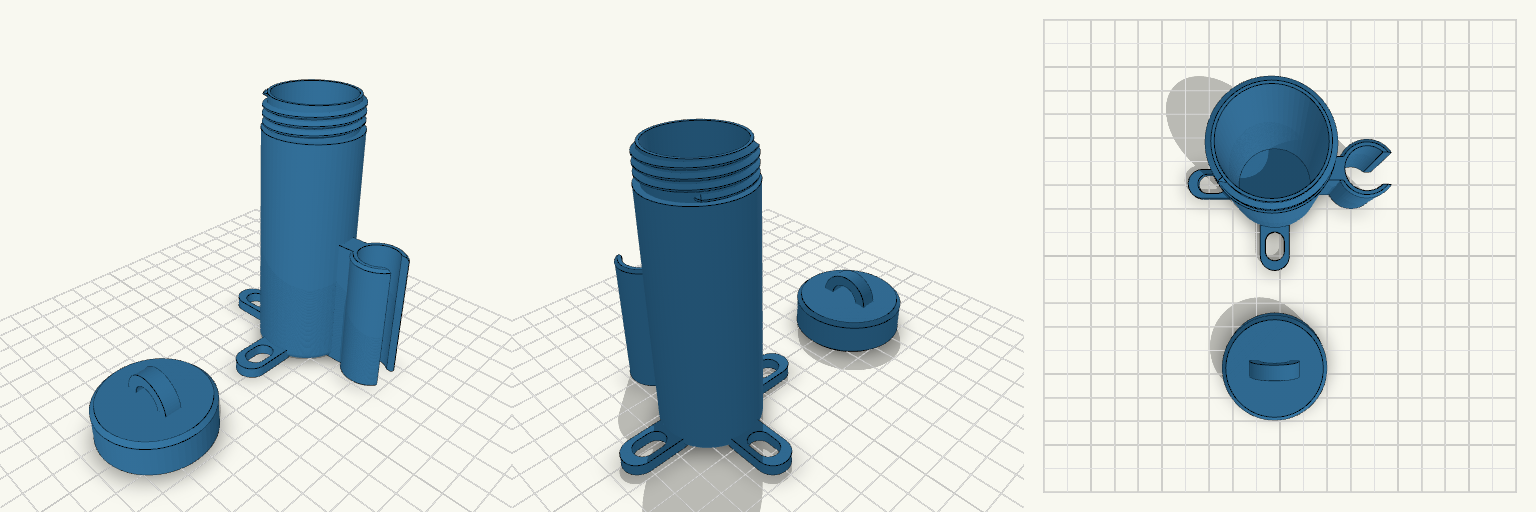
Stickpot
A screw-top tackle jar in the spirit of a carp angler's bankstick kit: tall bore, flat slotted tabs at the base, and a half-circle arch standing on the lid for hanging rigs. Design notes 30 mm bore, 100 mm tall Bankstick clip now runs from the base of the jar upward, 50 mm long, with a snap-in slot Three flat slotted loops at the base, printing flat with no overhang Lid with a 6 mm wide half-circle arch, printed upside-down beside the jar
RigPot — Bankstick Jar with Rig Loops
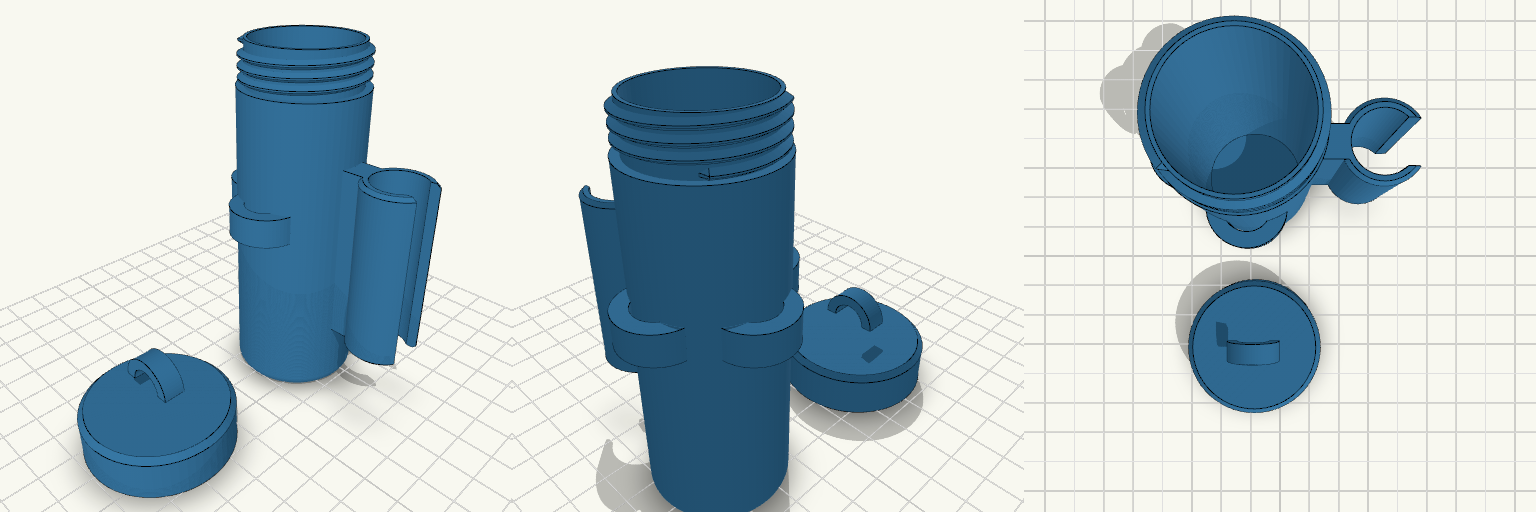
RigPot is a 30 mm bore, 100 mm tall screw-top jar built for carp tackle. It has a 50 mm side clip for a 15 mm bankstick, and three half-round loops for hanging rigs. Features 30 mm inside diameter, 100 mm tall Screw lid printed separately beside the jar Bankstick clip, 50 mm long, 15.4 mm bore with a snap-in slot Three flat half-ring rig loops at 90°, 180° and 270°, both ends fused into the jar wall Print notes The jar, clip and loops print as one body The lid is a separate piece and prints beside the jar
Hot Wheels 1:64 Carrying Case
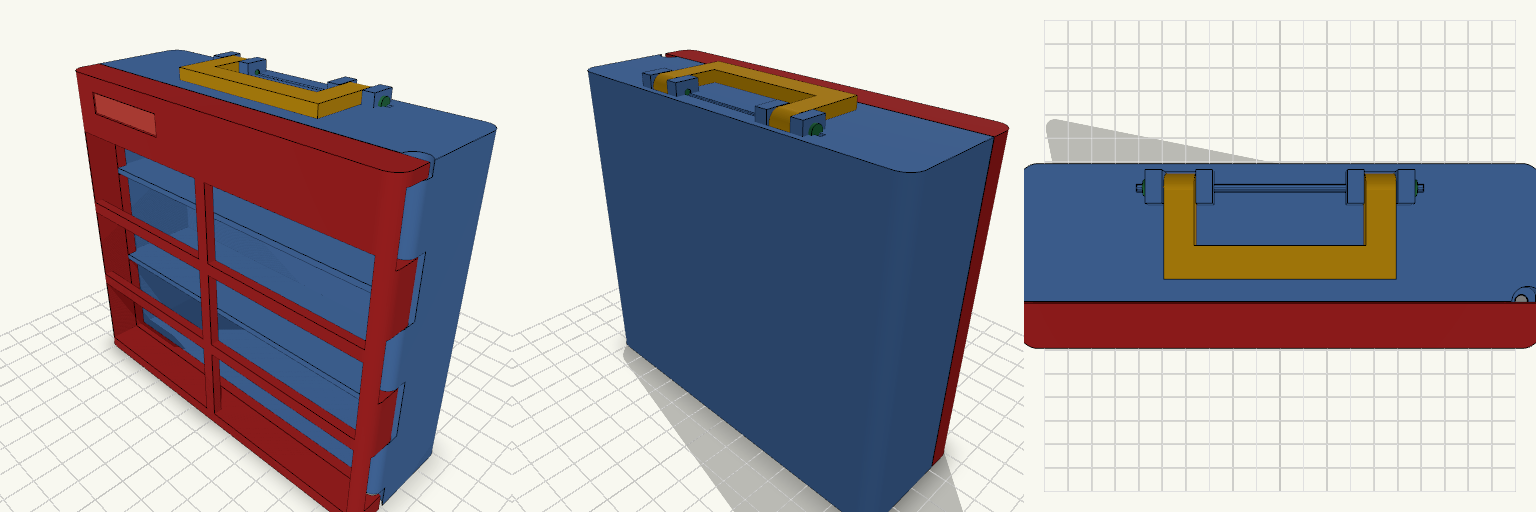
A portable carrying case for 1:64 Hot Wheels cars, measuring 127.7 mm wide, 45 mm deep and 115.5 mm high when closed, with the right-side hinge and folded handle inside those outer dimensions. The hollow rounded body has three equal stacked compartments lined up with the lid rows and an internal depth of about 31.6 mm. A separate red grid lid with two columns and three rows of openings closes over the open front, and a small internal locating lip on the back of the lid enters the body about 3 mm with 0.4 mm clearance along the top, bottom and left side; it is left off the hinge side so it cannot foul the knuckles. The U-shaped handle folds flat on top and lifts by rotating on two 2 mm pivot pins at the back. Each handle end now has a 7 mm round boss around the pin, with about 2.2 mm of material around the pin, and the bosses swing in 8 mm pockets so the handle still folds within the 115.5 mm closed height. One wide red push-button on the front left works with a separate flexible latch tab: the tapered tab clips behind a catch ridge when the lid closes, and two arms on the button reach back to ramps near the hook so pressing the button releases the lid. The hinge uses three knuckles on the body and two on the lid, with a separate 3 mm pin in 3.4 mm holes and 0.4 mm between knuckles; the body is relieved around the hinge axis so the lid opens about 90° or more. The case prints as seven separate parts and is assembled afterwards: Main body: rounded hollow body with three compartments, 2.4 mm side walls, 2 mm dividers, hinge knuckles, handle mounts and latch catch ridge Red grid lid: 4 mm frame, 2 × 3 openings, rounded front corners, locating lip, hinge knuckles and button slot Folding U-handle: pivots on two 2 mm pins, with reinforced 7 mm bosses; folded height keeps the closed case at 115.5 mm Handle pivot pins: two separate pins; a 2 mm steel rod is the stronger choice Red push-button: wide front-left button, recessed about 0.4 mm Flexible latch tab: separate tapered spring-like tab with hooked end Hinge pin: separate pin, about 101 mm long All parts are separate and not merged. Designed for a Bambu Lab P1S with a 0.4 mm nozzle, with every part printed separately and assembled afterwards. The latch and folding handle are moving mechanisms, so test-fit them on the first build; printed handle pins can work, but a 2 mm steel rod is the stronger option.
Revo7 Armbrust Tischständer
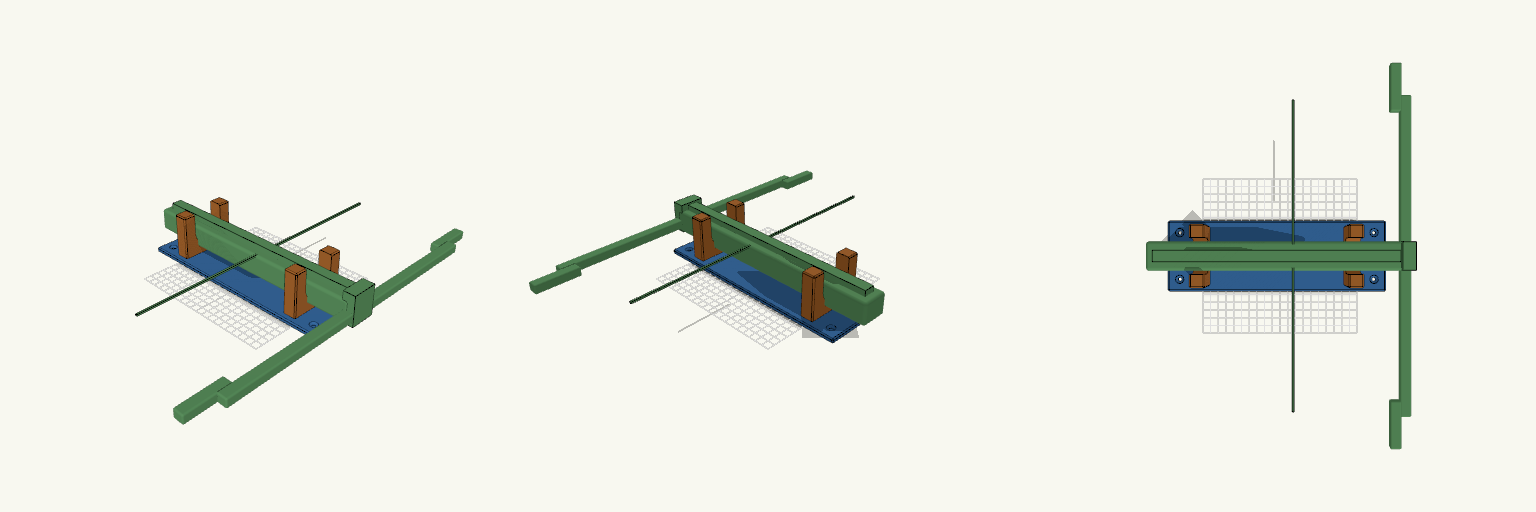
Ein Tischständer im Stil eines Waffenregals: Die Armbrust liegt waagrecht in zwei U-förmigen Auflagen, die auf einer flachen Grundplatte stehen. Die Platte lässt sich mit vier Senkschrauben auf der Tischplatte befestigen. Grundplatte 280 × 90 × 6 mm mit vier Senkbohrungen Zwei Auflagen im Abstand von 190 mm, Aussparung 44 mm breit Grüner Revo7-Platzhalter zeigt die Lage der Armbrust (Maße geschätzt) Auflagen und Abstand lassen sich an die echten Maße anpassen
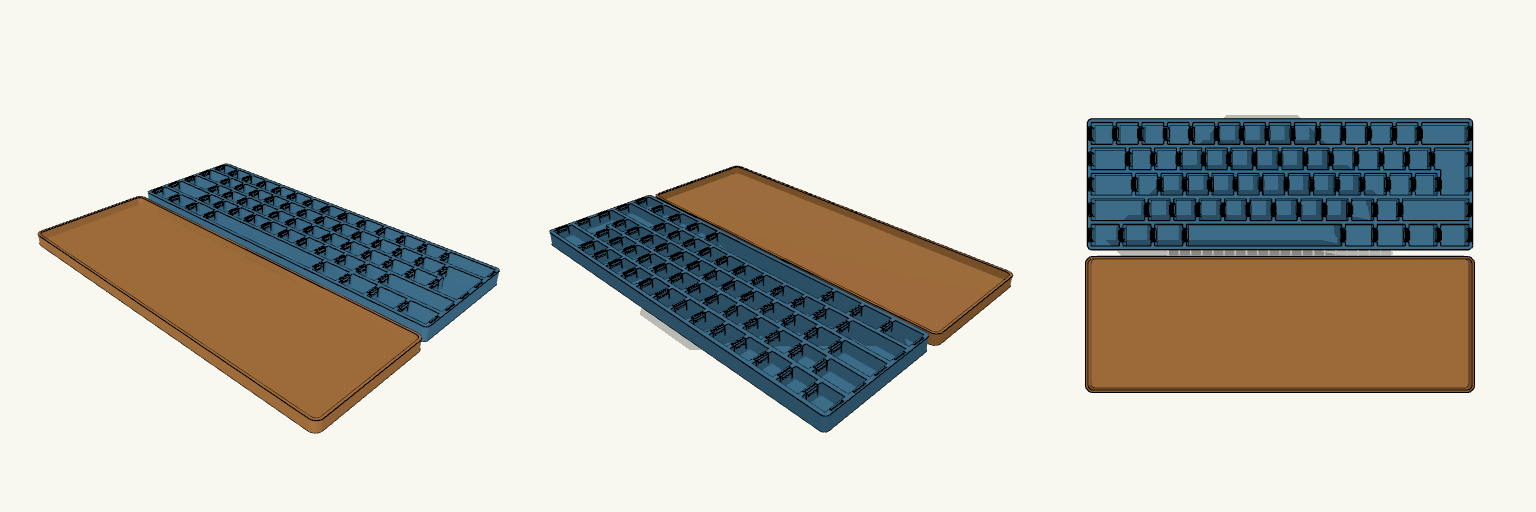
Logitech G PRO X 60 ISO Keycap Organizer
A fully 3D-printable keycap storage organizer for the Logitech G PRO X 60 mechanical keyboard in ISO layout. It keeps the keycap set in keyboard order rather than loose in a bag or tray, with a snap-fit pocket for each keycap and a separate slip-over dust lid. The organizer body and lid print as two pieces; the lid is laid out upside-down beside the body so it prints flat. Fitment Host: Logitech G PRO X 60, ISO version only. The pocket layout follows the 60% ISO rows; it does not fit the ANSI G PRO X 60 layout. Key sizes: 1u, 1.25u, 1.5u, 1.75u, 2u, 2.25u, 2.75u and a 6.25u spacebar pocket. The left Shift pocket is 2.25u. ISO Enter: one L-shaped pocket, 1.5u across the top and 1.25u across the lower step, joined into a single cavity. Retention: each pocket has two thin flexing fingers on the left and right walls, 10 mm wide with a 0.8 mm ramped bump. The fingers are separated by an air gap inside the 3.2 mm wall. Keycaps click past the bumps and pull out by hand. Spares: there is no spare-key row. The organizer holds the keyboard's keycaps in layout order only. Check before printing Pocket pitch is 22.2 mm. A 1u pocket is 19 mm wide, leaving about 0.5 mm per side around an 18 mm keycap base; wider bases will not seat. Pocket depth is 11 mm. Confirm this against your keycaps before printing; the fit has not been checked against physical keycaps. The organizer body measures about 336.2 × 114.2 × 13 mm and the lid 341.2 × 119.2 × 10 mm, with 4 mm rounded corners. Both are over 336 mm long, so a typical 220 mm bed will not fit them; the supplied model is not split into sections.
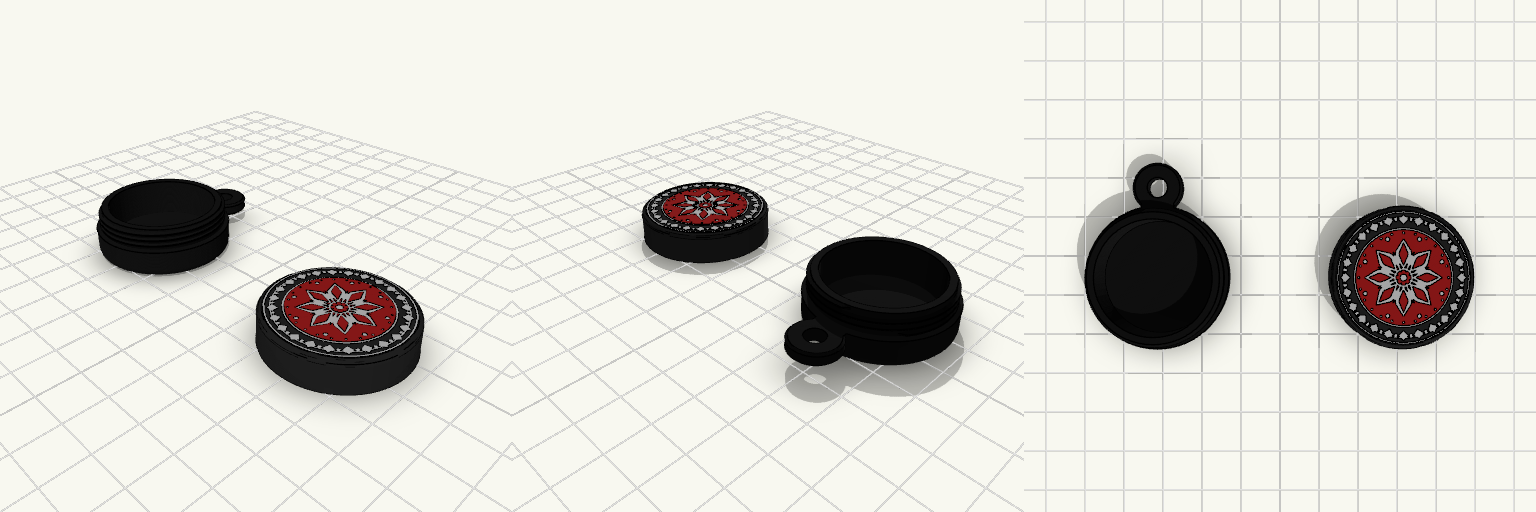
35 mm Turbah Container, Raised Medallion Lid
A 35 mm round screw-top container for a small Turbah, with a black body and lid, a red medallion and white ornament on the lid, and a keychain loop on the base. Fitment Outer diameter: 35 mm, both parts. Thread: 33 mm major diameter, 1.5 mm pitch, with 0.3 mm clearance on the lid. Closed height: 15 mm. Keychain loop: on the base, 5 mm through-hole. Check before printing The cavity is 28 mm across. It will not take a 35 mm Turbah, only a piece of about 25 mm or less. Decoration The red medallion and white ornament stand 0.1 mm above the black lid surface. There is no text. Print with at least 3 perimeters, because the walls around the thread are thin.