Revo7 Armbrust Tischständer
Created today
Description
Ein Tischständer im Stil eines Waffenregals: Die Armbrust liegt waagrecht in zwei U-förmigen Auflagen, die auf einer flachen Grundplatte stehen. Die Platte lässt sich mit vier Senkschrauben auf der Tischplatte befestigen.
- Grundplatte 280 × 90 × 6 mm mit vier Senkbohrungen
- Zwei Auflagen im Abstand von 190 mm, Aussparung 44 mm breit
- Grüner Revo7-Platzhalter zeigt die Lage der Armbrust (Maße geschätzt)
- Auflagen und Abstand lassen sich an die echten Maße anpassen
Images
More like this
Explore more in Storage & Organization →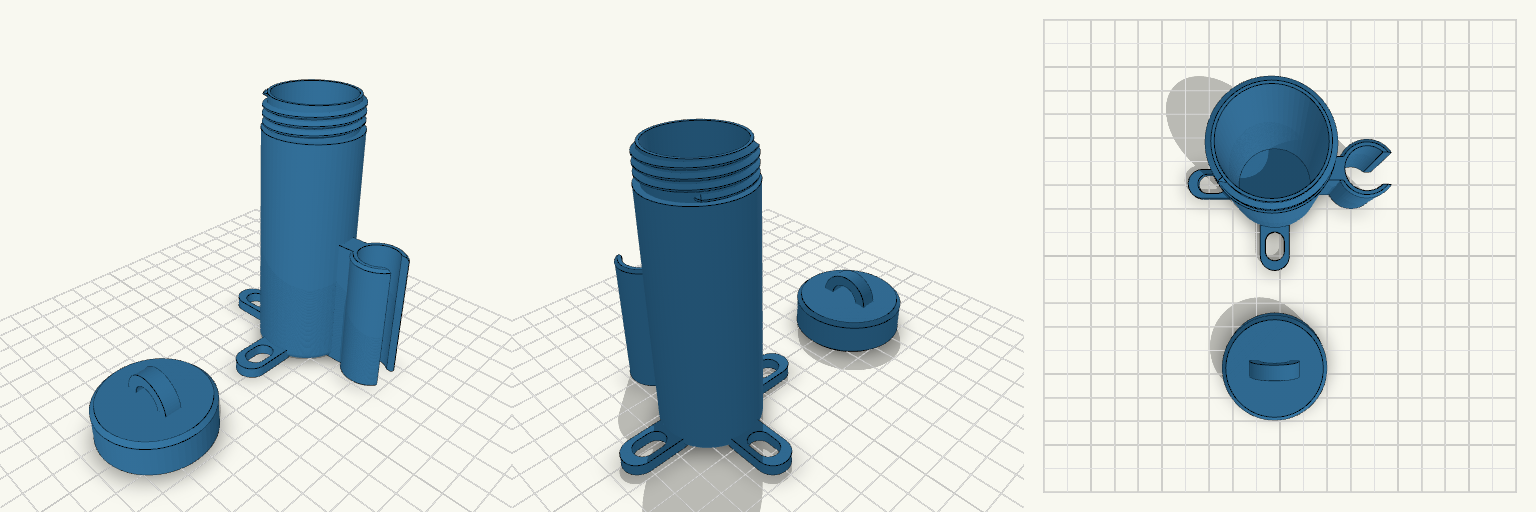
Stickpot
A screw-top tackle jar in the spirit of a carp angler's bankstick kit: tall bore, flat slotted tabs at the base, and a half-circle arch standing on the lid for hanging rigs. Design notes 30 mm bore, 100 mm tall Bankstick clip now runs from the base of the jar upward, 50 mm long, with a snap-in slot Three flat slotted loops at the base, printing flat with no overhang Lid with a 6 mm wide half-circle arch, printed upside-down beside the jar
RigPot — Bankstick Jar with Rig Loops
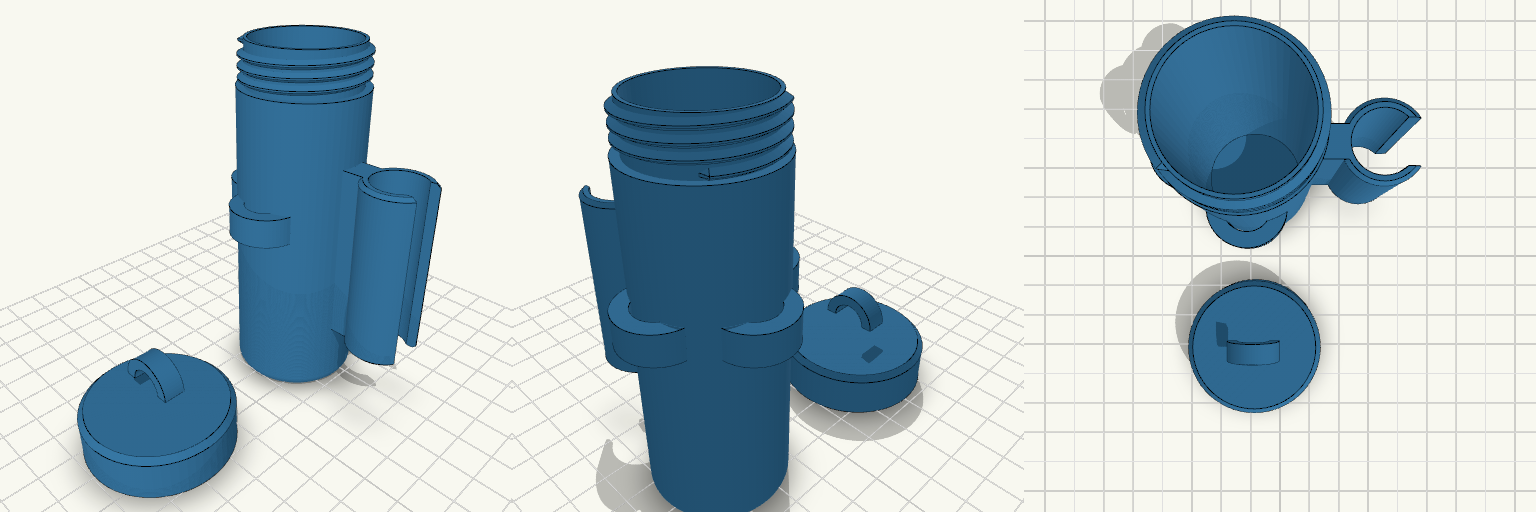
RigPot is a 30 mm bore, 100 mm tall screw-top jar built for carp tackle. It has a 50 mm side clip for a 15 mm bankstick, and three half-round loops for hanging rigs. Features 30 mm inside diameter, 100 mm tall Screw lid printed separately beside the jar Bankstick clip, 50 mm long, 15.4 mm bore with a snap-in slot Three flat half-ring rig loops at 90°, 180° and 270°, both ends fused into the jar wall Print notes The jar, clip and loops print as one body The lid is a separate piece and prints beside the jar
Logitech G PRO X 60 ISO Keycap Organizer
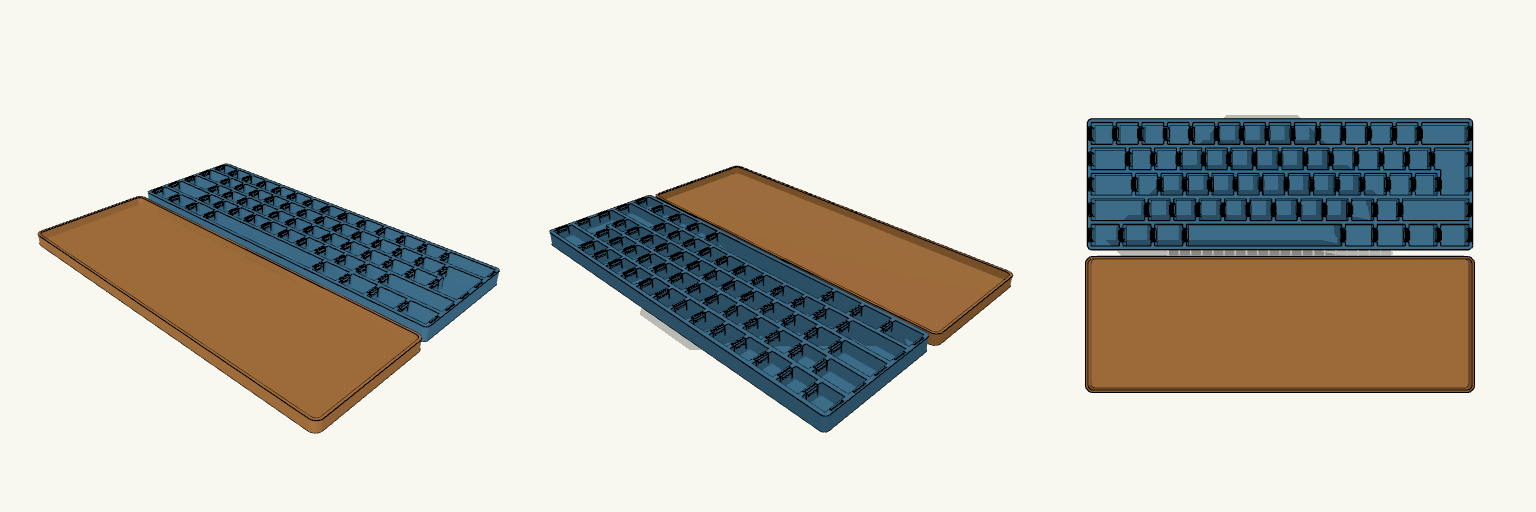
A fully 3D-printable keycap storage organizer for the Logitech G PRO X 60 mechanical keyboard in ISO layout. It keeps the keycap set in keyboard order rather than loose in a bag or tray, with a snap-fit pocket for each keycap and a separate slip-over dust lid. The organizer body and lid print as two pieces; the lid is laid out upside-down beside the body so it prints flat. Fitment Host: Logitech G PRO X 60, ISO version only. The pocket layout follows the 60% ISO rows; it does not fit the ANSI G PRO X 60 layout. Key sizes: 1u, 1.25u, 1.5u, 1.75u, 2u, 2.25u, 2.75u and a 6.25u spacebar pocket. The left Shift pocket is 2.25u. ISO Enter: one L-shaped pocket, 1.5u across the top and 1.25u across the lower step, joined into a single cavity. Retention: each pocket has two thin flexing fingers on the left and right walls, 10 mm wide with a 0.8 mm ramped bump. The fingers are separated by an air gap inside the 3.2 mm wall. Keycaps click past the bumps and pull out by hand. Spares: there is no spare-key row. The organizer holds the keyboard's keycaps in layout order only. Check before printing Pocket pitch is 22.2 mm. A 1u pocket is 19 mm wide, leaving about 0.5 mm per side around an 18 mm keycap base; wider bases will not seat. Pocket depth is 11 mm. Confirm this against your keycaps before printing; the fit has not been checked against physical keycaps. The organizer body measures about 336.2 × 114.2 × 13 mm and the lid 341.2 × 119.2 × 10 mm, with 4 mm rounded corners. Both are over 336 mm long, so a typical 220 mm bed will not fit them; the supplied model is not split into sections.
35 mm Turbah Container, Raised Medallion Lid
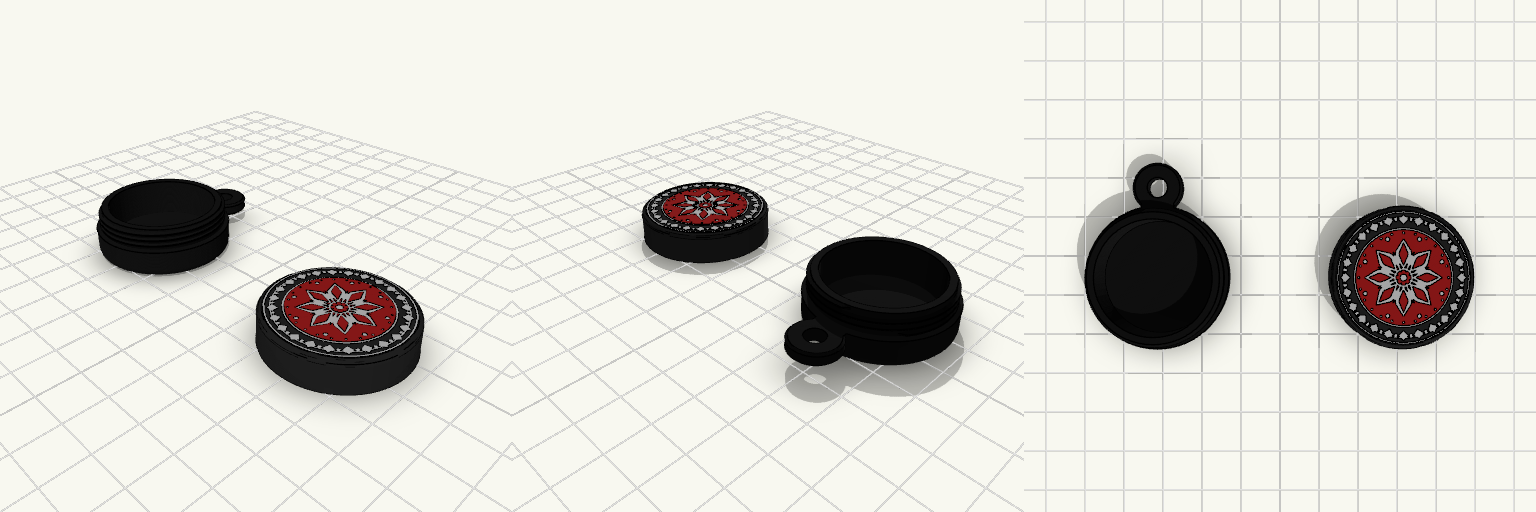
A 35 mm round screw-top container for a small Turbah, with a black body and lid, a red medallion and white ornament on the lid, and a keychain loop on the base. Fitment Outer diameter: 35 mm, both parts. Thread: 33 mm major diameter, 1.5 mm pitch, with 0.3 mm clearance on the lid. Closed height: 15 mm. Keychain loop: on the base, 5 mm through-hole. Check before printing The cavity is 28 mm across. It will not take a 35 mm Turbah, only a piece of about 25 mm or less. Decoration The red medallion and white ornament stand 0.1 mm above the black lid surface. There is no text. Print with at least 3 perimeters, because the walls around the thread are thin.
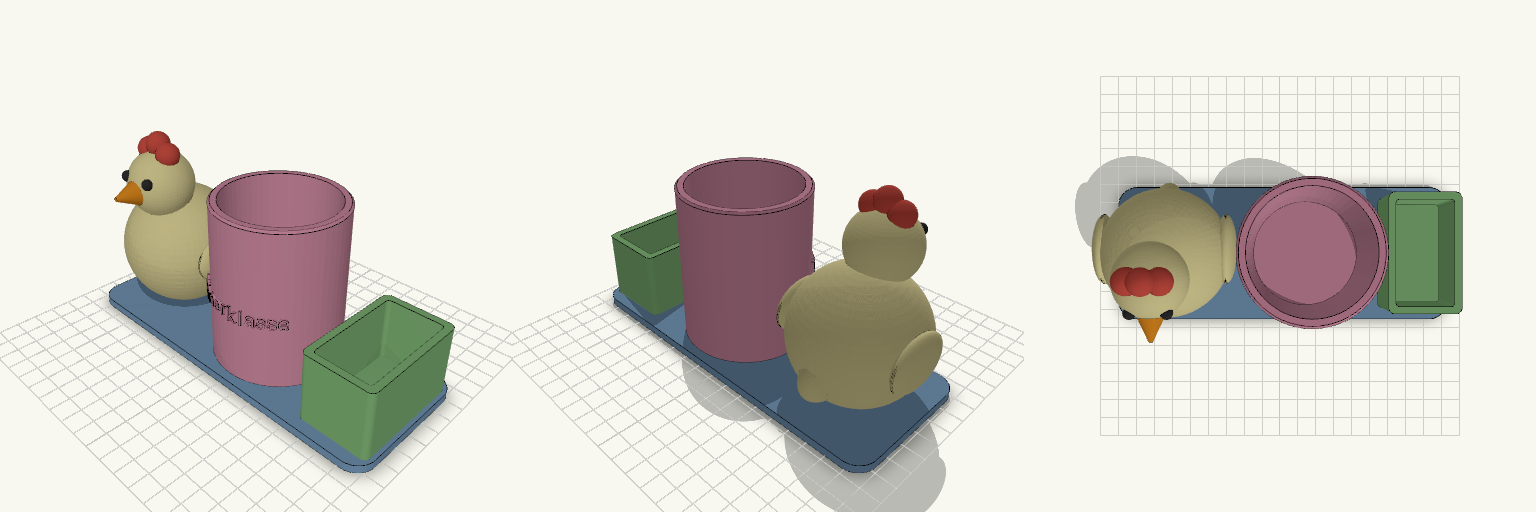
Hühnerklasse: Schreibtisch-Organizer mit Hühnchen
Ein kleiner Hühnerhof für den Schreibtisch einer Grundschullehrerin: Links sitzt ein rundliches Hühnchen mit dreiteiligem Kamm, Kegelschnabel, Augen, Flügeln und Schwänzchen. In der Mitte steht der Stiftehalter als runder Zylinder mit 64 mm Außendurchmesser; die erhabene Aufschrift „Hühnerklasse“ läuft Buchstabe für Buchstabe um seine Vorderseite, sodass sie auf der Rundung liegt und nicht davor schwebt. Rechts daneben bleibt ein niedrigeres, eckiges Fach für Büroklammern und Radiergummis. Alles steht auf einer schmalen, abgerundeten Bodenplatte von 180 × 72 mm und bildet zusammen ein einziges, zusammenhängendes Stück. Das Hühnchen ist vollplastisch gehalten – Kugelkörper, Kopf, Flügel und Schwanz statt flacher Reliefs. Der Organizer ist als ein Teil ausgelegt, das ohne Stützen auskommen soll; an der Unterseite der kugeligen Körperformen sind leichte Überhänge möglich. Die erhabene Beschriftung auf der runden Vorderseite des Stiftehalters bleibt auch nach dem Druck gut lesbar. Maße, die beim Aufstellen zählen Bodenplatte: 180 × 72 mm, abgerundete Ecken, 4 mm stark Stiftehalter: runder Zylinder, 64 mm Außendurchmesser, 80 mm hoch, oben offen, 4 mm Boden, Innenraum ca. 76 mm tief Ablagefach: eckig, 35 mm hoch, geschlossener Boden Hühnchen: rund 86 mm hoch, mit Kamm und Schnabel als klar abgesetzte Formen Passt zu Stiften, Büroklammern und Radiergummis.
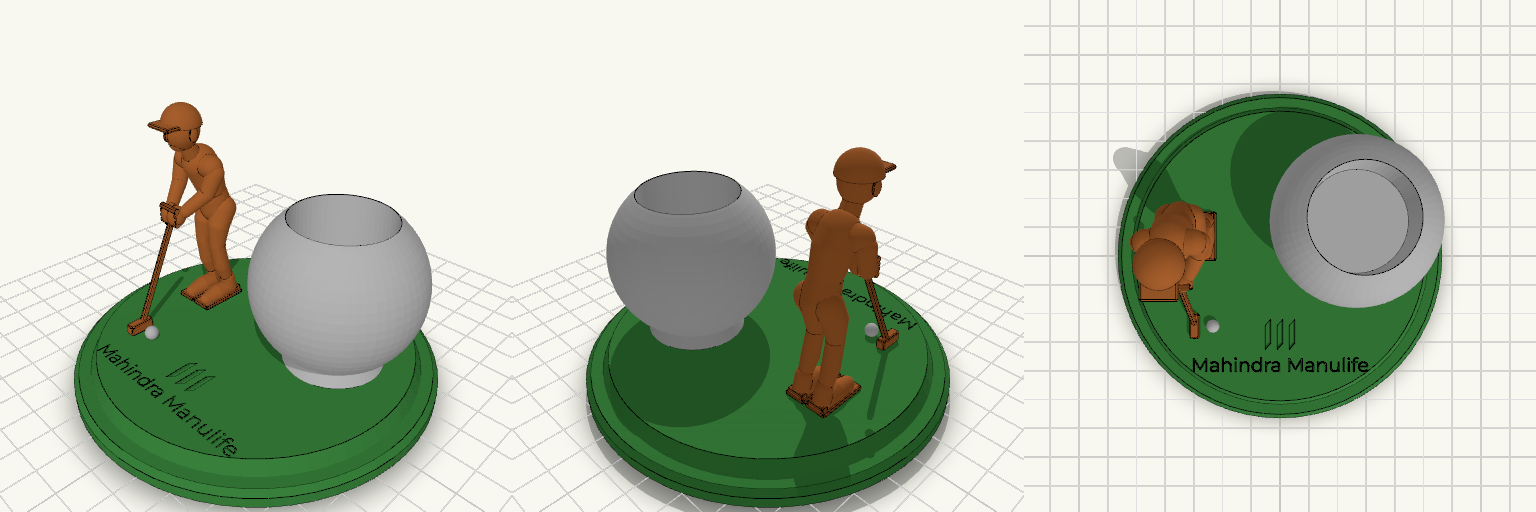
Golf Ball Pen Cup with Golfer Figurine
A desk pen stand built around a small golf scene: a 110 mm round base carries a slim golfer figure toward the back and a smooth golf-ball pen cup at the front-right, with the pen dropping into a 30 mm hole in the top of the ball. The club head sits at ground level on the base. A separate small golf ball, 4.2 mm across, sits on the base about 9 mm in front of the club head. "Mahindra Manulife" is cut into the front edge of the base, 4.5 mm tall and 1 mm deep, reading from the front, with the golfer set back so the club head clears the lettering. Above the text sit three upright parallel marks, each end cut at a slant — top tip pointing up on the right, bottom tip pointing down on the left — 10 mm long, 1.8 mm wide at the middle, 4 mm apart and cut 2 mm deep. The pen cup is a plain smooth sphere about 50 mm across; its golf-ball read comes from the cup shape and context rather than surface texture. The golfer has a slimmer, less muscular build: thinned thighs, calves, upper arms and forearms, a narrower torso and shoulders, and smoother blended limbs. It has a calf bulge, thighs that widen into the hips, a continuous torso from pelvis to chest, shoulders that blend into the upper arms, a slight jaw, a separate neck, ears, a nose, and a cap, with both hands on the grip. The legs and shoes sit inward under the pelvis rather than out at the sides of the waist; the feet are about 7 mm from the centreline and the hips about 6 mm apart. The hands are rounded palms with four fingers wrapped across the grip and a thumb, with no wrist cuffs. Each shoe has a thin flat sole, an upper that tapers from a heel block to a rounded toe, and a short ankle collar. The base, golf-ball cup and golfer are the three named areas of the design. Starting dimensions Base: 110 mm round, 10 mm tall Golf-ball cup: 50 mm across, 45 mm tall, with a 30 mm pen hole Golfer: about 21 mm wide, 42 mm deep and 68 mm tall, set back to clear the front lettering, with the legs under the pelvis and the feet about 7 mm from the centreline Small front golf ball: 4.2 mm across, about 9 mm ahead of the club head Front text: 4.5 mm tall, 1 mm deep Three marks above the text: 10 mm long, 1.8 mm wide at the middle, 4 mm apart, 2 mm deep Remix hooks Base outline is the freest choice. The 110 mm round plate can be trimmed, squared off or stretched into an oval without touching the figure or the cup — just leave a clear arc at the front for the lettering and the marks, and enough surface behind the golfer for the stance. The front text is the easiest thing to make your own: the wording, the 4.5 mm height and the 1 mm depth are all movable, and the three marks above it can be swapped for any shape — a monogram, a club crest, a simple icon. A deeper cut reads more boldly, a shallower one stays crisp on a resin print, and taller letters need a wider clear arc along the front edge. Golfer setback is a real parameter, not a fixed value: moving the figure forward or back trades text clearance against the balance of the composition, and the club head has to stay clear of the lettering. Leg stance is set with feet about 7 mm from the centreline and hips about 6 mm apart; moving them outward changes the silhouette and can make the thighs touch near the top. Golf ball size is the next knob: the 50 mm ball and its 30 mm bore scale together, and the 30 mm bore is already wide for a 50 mm ball — widen it further only if the ball grows with it. Ball surface is an open canvas: the smooth sphere is the neutral starting point, so add your own dimples, a seam ring, a fine pattern, or a painted finish. Keep whatever you add clear of the pen opening. Small front ball is a separate detail: the 4.2 mm sphere and its 9 mm gap can be scaled, moved closer to the club, or swapped for a tee, marker or small flag without touching the cup. Pen hole depth is not tied to any particular pen — set the bore to your own pen length before printing, deep enough to stop it toppling and shallow enough to grab. Golfer details are the obvious swap: change the club for a putter, a flag or a raised arm, re-dress the figure, or thicken the fingers if your printer turns them into a ridged lump — they finish around 1.7 mm across as drawn, and the shoes are about 16 mm long. Pairs with other desk organisers and small pieces: a ball marker dish or a tee tray works alongside it on the same desk. These numbers are a starting point rather than a fixed spec: only the pen bore and the ball wall behind it carry a real constraint; everything else is a dimension you can move.