Reinforced 8mm Irrigation Y-Splitter
Created today
Description
A heavily reinforced Y-shaped hose connector built specifically to merge two fluid lines into one. Designed for 8mm inner-diameter flexible tubing, it uses a solid central hub rather than thin overlapping walls, ensuring the part handles pressure without snapping at the junction.
The internal geometry is sculpted to maintain flow: a 6mm channel through the main body prevents a bottleneck at the merge, smoothly necking down to 5mm inside the barbs to guarantee thick, watertight perimeters where the plastic gets thinnest. A precision flat cut on the underside allows the entire assembly to drop straight onto the build plate, completely eliminating the need for support material.
Remix Hooks & Constraints
- Hose Fit: The double barbs peak at 8.5mm OD and drop to a 7.2mm valley, grabbing 8mm ID silicone or vinyl hose tightly.
- Print Settings: Built for PETG or ABS. Use 4 to 5 perimeters to ensure watertightness and maximum mechanical strength against bending forces.
- Scaling: Scaling up works cleanly for larger hose (e.g., 125% for 10mm ID), but scaling down is not recommended as the internal channel will restrict flow and the walls may drop below the required thickness for a watertight seal.
Images
More like this
Explore more in Home & Fixtures →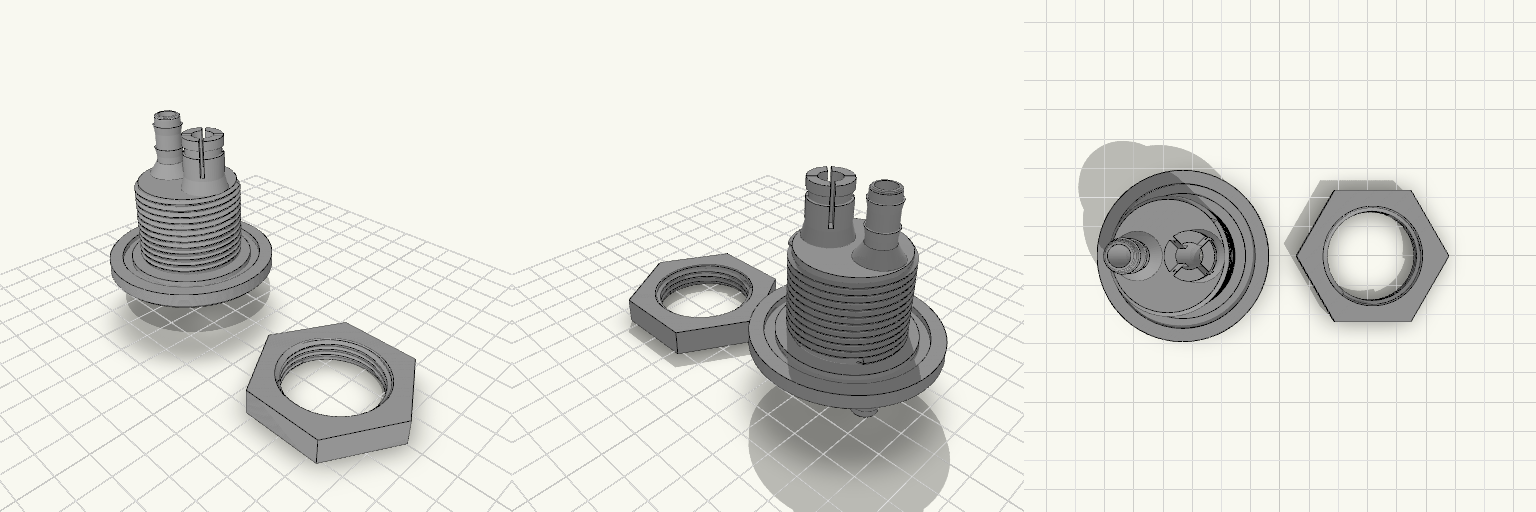
8mm Tank Bulkhead Fitting
M18 threaded bulkhead fitting engineered to pass an 8mm inner-diameter irrigation hose securely through a plastic tank lid. Interface: M18x2 thread with an independent hex locking nut. Sealing: Recessed O-ring groove on the interior flange face (2.5mm wide) to provide a watertight seal against the tank wall. Hose Barb: Double retaining barbs with a reinforced transition cone to handle clamping forces. Clearance: The hex nut is designed to slide freely over the 10.2mm barbs and internal threads are sized for clean printing in PETG. Both components are oriented to print flat on the bed without supports.
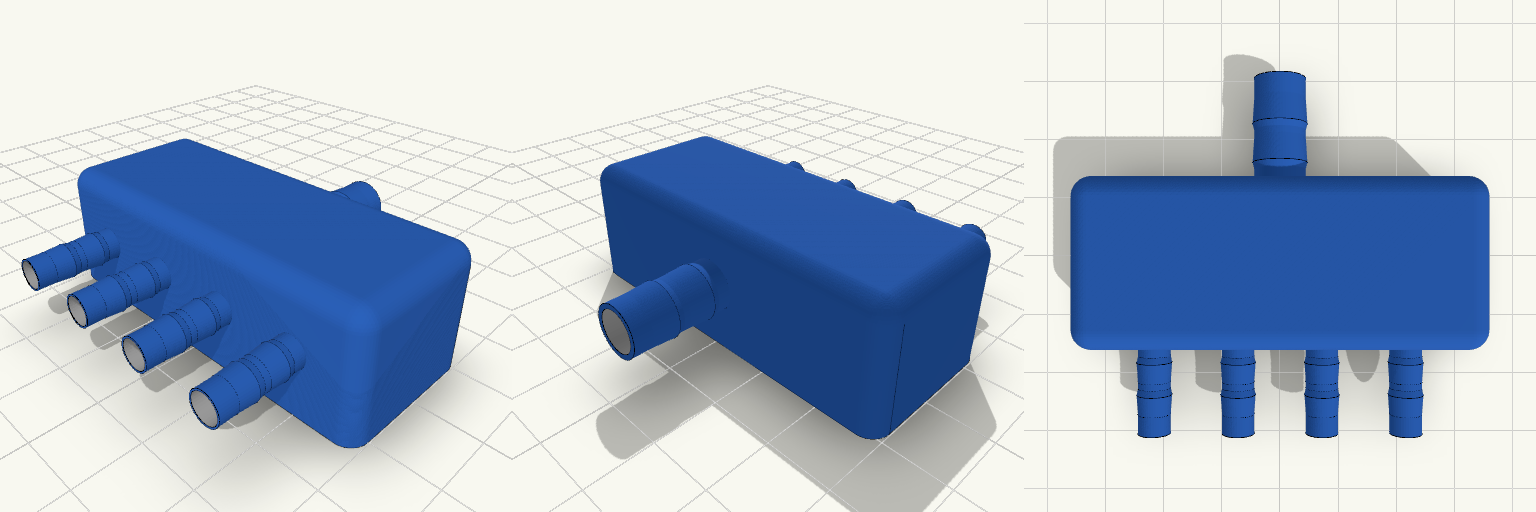
4-Way Water Manifold
A compact, print-in-place water manifold built for automated plant irrigation systems. It splits a single main feed into four independent channels with smooth internal transitions to minimize flow restriction. Inlet: Single center-mounted fitting sized for 8mm ID hose. Outlets: Four equally-spaced fittings sized for 5mm ID hose. Barbs: Dual retaining ridges on all connections to prevent slip-offs under pressure. Internal Channels: Fully hollowed 7mm common chamber with spherical transitions to eliminate dead zones and sharp fluid corners.
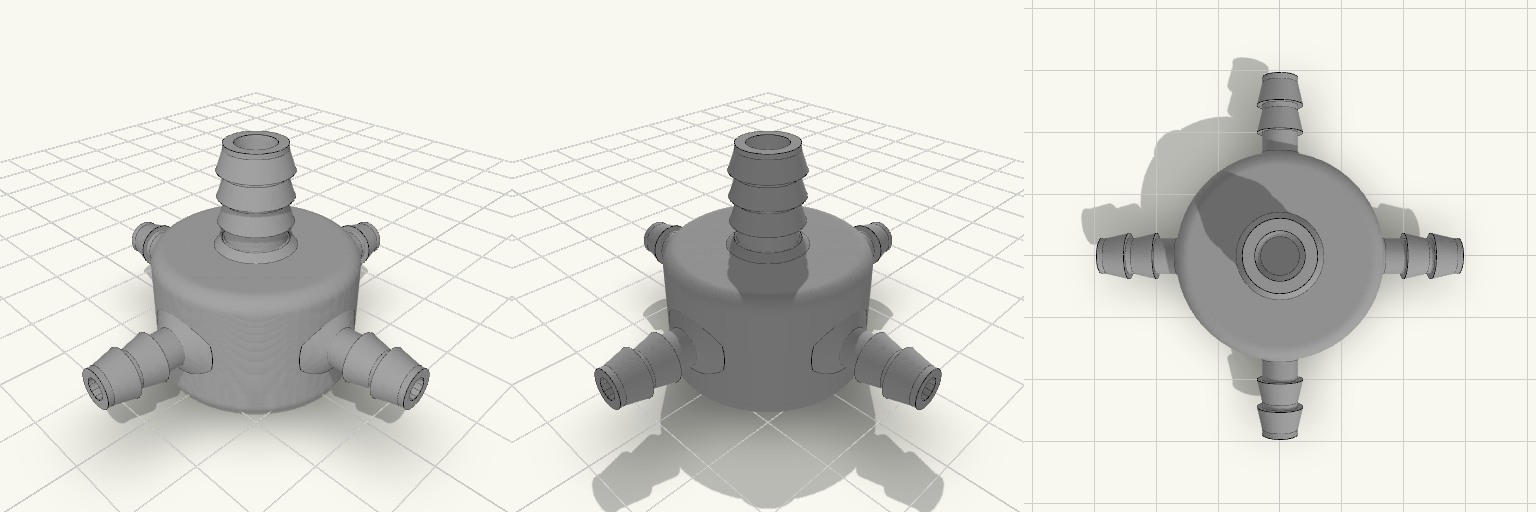
4-Way Barb Manifold
Hoses slipping off a plain tube is a guaranteed flood. This 4-way manifold uses aggressive, precisely sized barbs to bite into soft tubing, routing one 8mm inlet into four 5mm outlets. Critical Fit Inlet: 8.2mm main shaft, 10mm max OD on three barbs. Outlets: 5.2mm main shaft, 6.7mm max OD on two barbs each. Flow: Internal bores are necked down to 3mm on the branches to preserve wall strength, expanding to a 16mm central chamber. Print it base-down. The horizontal barbs are short enough to bridge without supports if your part cooling is dialled in.
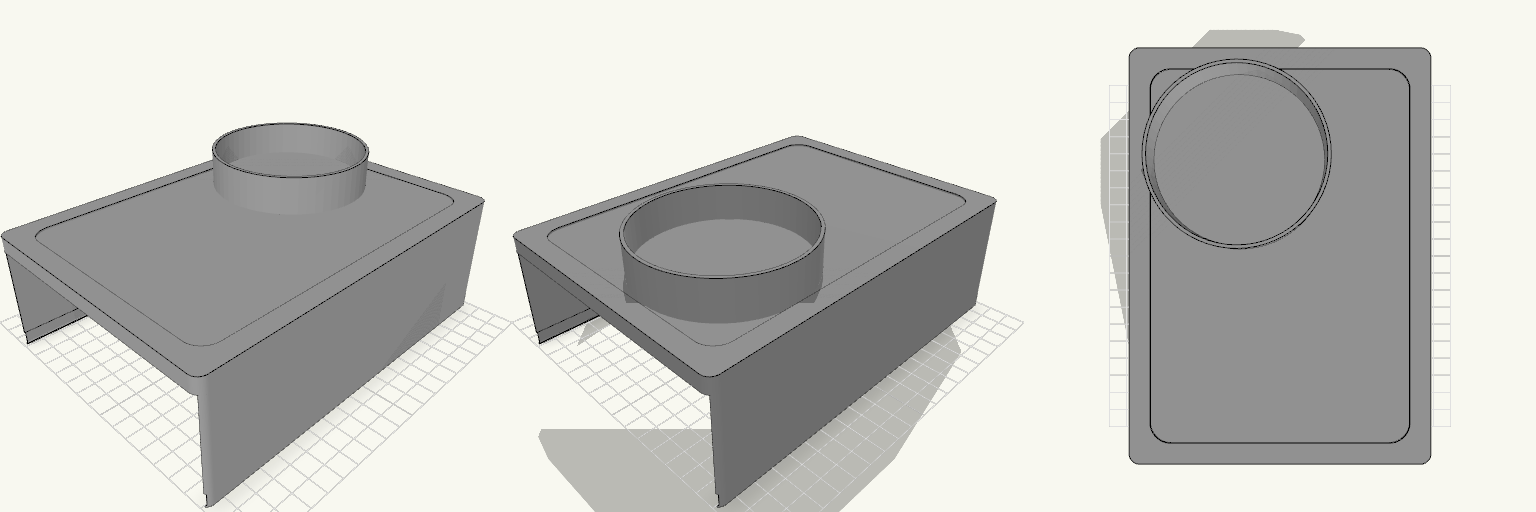
Narrow Armrest Caddy
Sofa arms exist mostly to launch drinks onto the rug the second you shift your weight. This saddles a rigid channel over a narrow armrest to bridge the gap, locking down a recessed staging plate on one side and a cup holder on the other. I deepened the plate recess to catch condensation and minor spills before they track down the side of the couch. Specifications Inner Channel Width: 141.8 mm (check your sofa arm before printing) Plate Recess Depth: 5 mm Cup Holder: 80 mm diameter, 20 mm deep Print Specs: Prints upright, no supports needed. Use PETG if your coffee runs hot.
Halo Drip Irrigation Ring
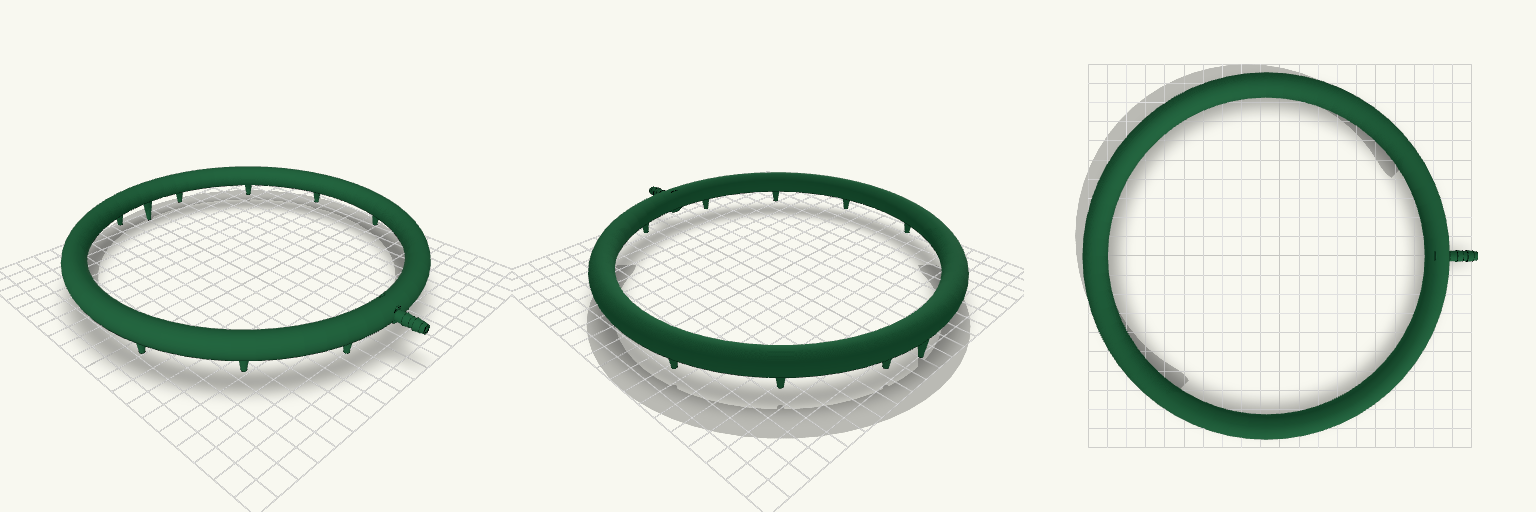
This is a low-profile, continuous-loop irrigation ring designed for automated watering systems. It distributes water evenly around the base of a plant without interfering with the stem. The structure is engineered specifically for FDM printing without supports. The internal hollow channel features a teardrop cross-section so the printer can bridge the ceiling cleanly, and the external hose barb includes a small, built-in support block connecting it to the build plate. Design Notes Dimensions: 197 mm outer diameter, 173 mm inner diameter, leaving a 12 mm wide profile. Inlet: Dual-barb fitting sized for 5 mm internal diameter tubing, pointing outward to keep the hose clear of the foliage. Distribution: 12 downward-facing 1 mm drip holes spaced every 30 degrees, beginning 15 degrees offset from the inlet to ensure the first drops don't pool at the connection. Mounting: Three low-profile tabs sit on the outer perimeter, drilled for standard wire pegs to anchor the ring into the soil.
Compact Offset Duct Adapter
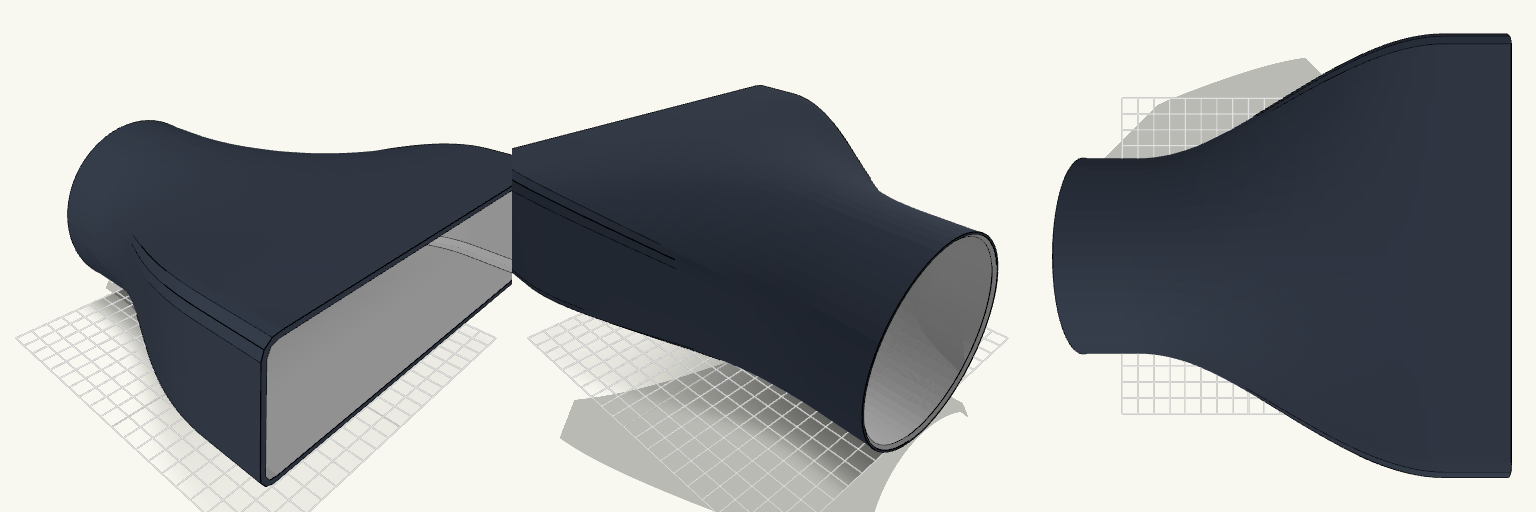
A parametric, FDM-printable ventilation duct adapter connecting a nominal Ø100 mm round duct to a 200 × 60 mm rectangular duct. Round Inlet: Ø101 mm internal diameter, 30 mm deep Rectangular Outlet: 201 × 61 mm internal, 30 mm deep Offset: 25 mm vertical centerline shift Wall Thickness: 2.4 mm (constant, pushed outward) Total Length: 210 mm (150 mm transition) Both ends are female sockets designed for a slip fit over existing plastic ducting. The loft provides a smooth internal airflow path with no steps or constrictions.